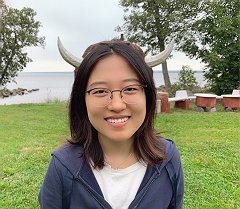
Min Xian is an Associate Professor in the Department of Computer Science at the University of Idaho's College of Engineering. Their research focuses on Trustworthy Artificial Intelligence , Machine Learning , Deep Learning , and Adversarial Learning , with applications in Biomedical Image Analysis and AI-Aided Materials Characterization . They actively contribute to nuclear safety research through AI applications in nuclear fuel analysis and power plant risk assessment. Ph.D. in Computer Science (2017), Utah State University M.S. in Computer Science (2011), Harbin Institute of Technology B.S. in Information Security (2008), Harbin Institute of Technology (Weihai) Their research integrates AI into critical domains like medical imaging (skin cancer diagnosis, breast ultrasound analysis) and nuclear materials characterization (fission gas bubble segmentation in metallic fuels). They also explore uncertainty quantification , adversarial defense mechanisms , and knowledge-informed AI for nuclear safety. Recent publications demonstrate expertise in vision-language models , sharpness-aware optimization , and multi-task learning for biomedical and nuclear applications. Their work balances algorithm development (e.g., Bend-Net, GCSAM) with domain-specific applications. Dean's Distinguished Faculty Fellow, University of Idaho (2024) Min Xian leads the MIDA Lab (Machine Intelligence and Data Analytics) , developing AI solutions for nuclear material analysis and medical imaging. Their collaborations span biomedical engineering, materials science, and nuclear safety domains.
Thomas P. Jensen is a Researcher at INRIA Rennes , France, specializing in program analysis , software security , and abstract interpretation . With a Cand. scient. in Computing and Mathematics from the University of Copenhagen (1990) and a PhD from Imperial College, University of London (1992), he has led research teams at INRIA, including the Celtique project-team (2010-2022) and currently the Epicure project-team (since 2022). He holds a Habilitation à diriger des recherches from Université Rennes 1 (1999). Research Focus Program analysis with type-based and big-step semantics approaches Certification of static analysis tools for embedded systems Software fault isolation and language-based security Information flow control through hybrid static-dynamic analysis His work spans Java security (including Java Card and mobile telephony) and formal verification of compilers and sandboxes. Notable projects include JavaSec , AJACS , and the CominLabs cybersecurity network. He received a Best Paper Award at GPCE 2018. Publications & Editorial Recent publications focus on algebraic data types , automata-based verification , and control-flow analysis with applications in cybersecurity . He has contributed to the Strategic research and innovation roadmap for SPARTA (2022) as editor. His work appears in top venues like POPL , PLDI , ICFP , and ESOP . Leadership Director of Laboratoire d'Excellence CominLabs (since 2022) Co-chair of VMCAI 2026 and member of PriSC 2024 Program Committee
Xiaoning Du is a Senior Lecturer (equivalent to U.S. Associate Professor) at the Department of Software Systems and Cybersecurity within the Faculty of Information Technology at Monash University, Australia. She was promoted to this position effective July 1, 2025, having previously served as a Lecturer (Assistant Professor) since joining Monash in February 2021. Her research bridges the gap between theory and practical applications of program analysis and formal methods in evaluating traditional and AI-assisted software systems. Dr. Du's educational background includes: PhD from Nanyang Technological University (2020) Bachelor's degree from Fudan University (2014) Dr. Du specializes in software engineering, artificial intelligence, and cybersecurity , with particular focus on SE4AI (Software Engineering for AI), software analysis and testing . Her research has made significant contributions to the security and quality assurance of intelligent software systems, especially intelligent software engineering tools. She is best known for her work on Devign , BigCodeBench , DeepStellar , and SimPy , which have advanced the fields of code generation, program analysis, and AI security. Her approach consistently bridges theoretical foundations with practical applications to improve software quality and security. Dr. Du's recent publications demonstrate a strong focus on the intersection of software engineering and AI, particularly examining how large language models interact with source code. Her work addresses critical challenges in code generation efficiency, security vulnerabilities in AI-assisted development, and fairness in AI systems. She has made significant contributions to benchmarking frameworks like BigCodeBench and has pioneered research on watermarking techniques to protect code datasets from misuse by neural code completion models. Dr. Du has received numerous prestigious awards and recognitions: 2024 Google Research Scholar Award in Software Engineering ACM SIGSOFT Distinguished Paper Award (ISSTA'24) ICLR Oral presentation (2025) 2024 FIT Dean's Early Career Researcher of the Year Award Multiple FIT ECR Seed Grants (2021-2023) Dr. Du actively mentors PhD students, with notable successes including Terry (2024-2025 IBM PhD Fellowship Award recipient) and Zhensu (2024 Bytedance Scholarship Award recipient). She is currently seeking self-motivated PhD students with strong programming skills and relevant research experience, offering full scholarship support. Her research has been supported by multiple grants including the Google Research Scholar Program award and several FIT ECR Seed Grants that have enabled her team to pursue innovative research in software security and AI-assisted development. Dr. Du leads a research group focused on intelligent software systems security and quality assurance. Her team has developed several influential tools and benchmarks including Devign, BigCodeBench, DeepStellar, and SimPy. These resources have become important assets for researchers and practitioners working at the intersection of software engineering and artificial intelligence, particularly in the areas of code generation, program analysis, and security testing of AI systems.