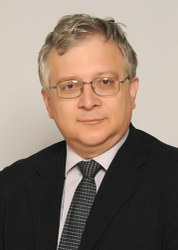
Besa Kadriu is an Associate Professor at the Contemporary Social Sciences Faculty of South East European University in Tetovo, North Macedonia. With a Doctor of Sciences in Public Governance and Administration (2015-2019), her work focuses on policymaking in multiethnic states, public administration reforms, and governance challenges. Native Albanian, C2 Macedonian, C1 English, and A2 German speaker Her research interests span public governance frameworks, integration challenges in Western Balkans, pension system sustainability, and youth migration dynamics. She has published extensively on policy implementation in post-conflict societies and institutional development. Recent publications demonstrate expertise in multiethnic governance (2016-2021), educational reforms (2015), and social inclusion policies (2019). Her work combines theoretical analysis with practical case studies from North Macedonia's political and administrative landscape.
Assoc. Prof. Iliev Atanas is affiliated with the Faculty of Electrical Engineering and Information Technologies (FEIT) at the Ss. Cyril and Methodius University of Skopje. He holds the position of Associate Professor at the Institute for Power Plants and Switchgear. His academic journey includes a PhD (2003), MSc (1993), and BSc (1987) in Electrical Engineering from FEIT. His work experience spans over three decades, starting as a Junior Assistant (1987–1994), progressing to Assistant Professor (1994–2008), and attaining his current rank in 2008. His research focuses on optimizing power systems through advanced algorithms, particularly genetic algorithms applied to unit commitment, hydrothermal scheduling, and microgrid management. Key areas include renewable energy integration, grid reliability, and security-constrained optimization. He has contributed to over 50 publications addressing topics like dynamic programming for hybrid power systems, fuzzy logic for hydroelectric project evaluation, and reliability modeling of substations under distributed generation uncertainty. Notable contributions include developing novel self-adaptive genetic algorithms for short-term scheduling and energy management in hybrid systems. His work bridges theoretical optimization with practical grid challenges, emphasizing sustainability and resilience in power infrastructure.
Prof. Dimitar Nikoloski is a Full Professor at the Faculty of Economics-Prilep, Ss. Cyril and Methodius University of Skopje. He specializes in econometrics, labor economics, and statistical inference. His research focuses on transition economies, labor market dynamics, and policy evaluation. Nikoloski holds a PhD from Staffordshire University (UK) and has held academic positions since 2000. He has been actively involved in international projects such as TEMPUS initiatives and has authored/co-authored multiple books and over 50 peer-reviewed articles. Education: Bachelor's in Economic-Statistical-Cybernetics (1996), Faculty of Economics-Prilep Master's in Economics (2000), University of Neuchâtel (Switzerland) PhD in Economics (2007), Staffordshire University (UK) Research Interests: Labor market transitions in post-communist economies Unemployment dynamics and policy interventions Green skills gap analysis Impact of FDI and wage subsidies Informal economy dynamics Key Achievements: Second Prize in Macroeconomics Research Competition (2007) Editorial roles in journals like Equilibrium Lead researcher on EU-funded projects (e.g., CEDEFOP, WIIW) His work bridges academic rigor with policy relevance, addressing critical issues such as skills mismatches, migration impacts, and sustainable employment strategies in Southeastern Europe.
Renata Deskoska is a Full-Time Professor at the Faculty of Law ‘Justinian First’ in Skopje , part of the Ss. Cyril and Methodius University in Skopje . She holds a position in the Department of Constitutional Law and Political System and teaches courses such as Constitutional Law, Human Rights, and Rights of National Minorities across undergraduate, master’s, and doctoral programs. Her research focuses on constitutionalism, human rights, and the interplay between political systems and legal frameworks in North Macedonia and beyond. Her work examines themes like populist transformations of constitutional law, sustainability in governance, and legal responses to crises such as the pandemic. She has contributed to debates on judicial independence, parliamentary dynamics, and the role of constitutional courts. Her recent publications emphasize contemporary legal challenges, including the balance between executive power and democratic legitimacy. Deskoska has been actively involved in academic and policy initiatives related to European integration, language policies, and minority rights. Her research often bridges theoretical constitutional concepts with practical legal reforms, reflecting her commitment to fostering democratic institutions and human rights protection in transitional contexts. She is based at Office 64, reachable via email at renata@pf.ukim.edu.mk , and holds office hours Tuesdays/Thursdays 12-14.
Dr. Irena Avirovic Bundalevska is an Associate Professor at the Institute of Family Studies, Faculty of Philosophy, Ss. Cyril and Methodius University in Skopje. She holds a PhD in Historical Sciences (2013) from the same university, specializing in Balkan migration histories. Her academic career includes roles at the Institute of National History as an assistant researcher and teaching positions at the American College in Skopje. Key qualifications include a Master's in International Relations from the University of Bologna (2009) and a Philology degree from the Faculty of Philology (2006). She serves as National Coordinator for the European Family Network (COST Action 18123) and speaks English, Italian, Spanish, with proficiency in German and Russian. Research Focus Cultural shifts in Balkan societies during the 20th century Ethnic minorities' migration patterns Family dynamics influenced by religious institutions Impact of multicultural policies on family structures Her work explores historical migration (e.g., Macedonian emigration to the U.S.), contemporary cohabitation trends, and institutional frameworks affecting family welfare. Recent publications analyze disability-inclusive family policies and UN family initiatives, reflecting her interdisciplinary approach bridging history, sociology, and policy studies. Awards & Grants No specific awards or grants mentioned in current records. Professional Networks Active participant in international conferences on social change and family studies. Collaborations include University Goce Delcev (Stip) and Macedonian Association of Marketing.
Sami Mehmeti is an Associate Professor at the Faculty of Law , South East European University , with a focus on Legal History , Roman Law , and Comparative Law . His work spans Private International Law , Space Law , Labor Law , and Constitutional Law , often addressing interdisciplinary intersections. PhD in Legal History (University of Skopje, 2015) MA in Civil Law (University of Prishtina, 2010) BA in Law (South East European University, 2005) His research examines historical legal systems , cross-jurisdictional harmonization , and emerging legal challenges in space exploration . Recent publications analyze Brussels I Regulation , orbital pollution , and labor standards in Kosovo . Scientific Awards : None listed. Grants & Advising : No specific grants mentioned. Collaborates with scholars like Blerton Sinani , Granit Elezaj , and Stefani Stojčevska . Experience in education and research since 2005.
Prof. Dr. Antoanela Petkovska is a Full Professor at the Institute of Sociology, Faculty of Philosophy, Ss. Cyril and Methodius University (UKIM). Born in 1958, she holds a PhD in Sociology from the University of Belgrade. Her career spans over four decades, including roles as assistant professor (1994) and associate professor (1999). She specializes in sociology of culture, art, youth, and intercultural communication. She has conducted study stays in the USA (civic education) and France (brain drain). Educations: BA (1980) and MA (1985) from UKIM, PhD (1993) from University of Belgrade. Her research focuses on cultural policy, art sociology, gender studies, and European integration. She has published over 20 books and chapters, including Есеи од социологијата на културата (2009) and Иновацијата низ хуманистички и општествени науки (2020). She has coordinated major projects like EVS European Values Study (2008/2018) and studies on creative industries (2008). Teaching spans undergraduate, graduate, and doctoral programs with courses like Sociology of Visual Culture , Intercultural Communication , and European Civilization . She led professional associations including the Macedonian Center for Culture and Arts (President) and served as President of the Association of Sociologists of Macedonia (2008–2011). Her work addresses societal security through cultural exclusion analysis, youth values, and transnational identity dynamics. Research collaborations include Bulgarian universities and international organizations like DCAF Geneva.
Prof. Violeta Petroska-Beška is a Full Professor of Psychology at the Institute of Psychology, Faculty of Philosophy, Ss. Cyril and Methodius University of Skopje (UKIM). She has been employed since 1980 and holds academic positions in Methodology/Psychometrics and Peace Psychology. She holds a PhD from Belgrade University (1989) and advanced conflict resolution training from Columbia University. Prof. Petroska-Beška is licensed psychologist and member of Macedonia's Psychological Testing Board. Her research focuses on psychological test development, ethnic identity dynamics, multicultural education, and program evaluation. She has authored/co-authored influential works on interethnic relations, including analyses of Macedonian textbook biases (2018), refugee prejudice reduction (2018), and policy transfer in social cohesion (2018). She led Macedonia's 2010 Millennium Development Goal report on universal education and co-created the bilingual "Mosaic" kindergarten initiative. Prof. Petroska-Beška serves as Editor-in-Chief of Psychology - Science and Practice (since 2019) and leads the Citizens' Association Center for Human Rights and Conflict Resolution. She has collaborated with UNDP, UNICEF, and international institutions on education reforms, conflict resolution programs, and refugee integration projects. Her work includes over 200 academic publications and 30 authored/co-authored books. Key Awards: Distinguished Alumni Award (Columbia Teachers College, 2011) Professional Roles: Senior Fellow at USIP (2000-2001), UNESCO consultant, international lecturer at 10+ universities
Dr. Makedonka Radulovic is an Associate Professor at the Institute of Family Studies, Faculty of Philosophy, Ss. Cyril and Methodius University in Skopje. She holds a PhD in European Integration Studies (2011) and has extensive experience in teaching and research related to family dynamics, health policy, and human rights. Her research explores intersections between European Union policies and Macedonian societal structures, with a focus on family education, health equity, and cultural values. Education: Bachelor's in Journalism (2004), Faculty of Law, Ss. Cyril and Methodius University Master's in European Studies (2009), Institute of Sociology PhD in European Integration Studies (2011), Institute of Sociology Research Interests: European social policy, family structures, healthcare rights, marital education, globalization impacts, and human rights compliance. She actively participates in international conferences and serves as National Coordinator for COST Action 18123 (European Family Network) and Vice President of the European Movement of Macedonia. Teaching Roles: "Contemporary Challenges of Families in Europe" "The Family in EU Strategies" "Family Health and Healthcare" "Tradition in European and Macedonian Families" "Family, Marital Education, and Communication" Labs/Teams: Leads research initiatives at the Institute of Family Studies, collaborating with EU networks and local policymakers to advance family policy frameworks.
Meral Shehabi serves as an Associate Professor at the Faculty of Languages, Cultures and Communication, South East European University (SEEU) in Tetovo, Macedonia. Appointed full-time in September 2003, she teaches Albanian language courses for multiple academic levels, Academic Writing, Romanticism in Albanian poetry, Modern Literature, Literary text analysis, and Balkan dimensions of Albanian folklore. Education: Doctor of Philological Sciences (2009-2017) from Ss. Cyril and Methodius University, Skopje, specializing in Albanian Literature with dissertation "Aspekte te intertekstualitetit në pitarasin e Rilindes naksionale" Magister i šešinave filologije (2004-2009) from Ss. Cyril and Methodius University, Skopje, thesis "Dialogu letrar i Naim Frashërit me letersína ojentale" Profesor i gjuhes dhe letersise shqipe (1999-2003) from Ss. Cyril and Methodius University, Skopje Research Focus: Her scholarship centers on intertextual relationships within Albanian literature, particularly examining biblical narratives, mythological frameworks, and folk traditions in National Renaissance works. She investigates textual dialogues between canonical authors like Naim Frashëri, Jeronim de Rada, and Ismail Kadare, while analyzing cultural transmission across Balkan literary traditions. Her recent publications demonstrate increasing engagement with Arbëresh diaspora literature and linguistic analysis of Albanian written usage. Publication Trends: Analysis of her 15 publications (2017-2025) reveals three dominant research trajectories: biblical intertextuality in Albanian drama (33%), National Renaissance literary analysis (40%), and linguistic studies of Albanian language (27%). Her work consistently applies intertextual theory to explore cultural identity formation, with growing emphasis on transnational literary connections since 2020. Professional Activities: Dr. Shehabi's teaching portfolio spans foundational language instruction to advanced literary analysis. While no formal advisees or research grants are documented in available records, her course development in Balkan folklore studies indicates program-building contributions. Her multilingual capabilities (Albanian native, Macedonian/Turkish C2, Serbian C1, English B2) facilitate cross-cultural academic work across the region.
Besa Arifi is a Full Professor at the Faculty of Law, South East European University (SEEU), with over 15 years of academic experience in criminal law, criminology, and victims' rights. Her career spans roles as Coordinator for International Cooperation and Mobility (2015–present), former Head of SEEU's Human Rights Centre, and leadership in academic reform projects. PhD in Criminal Law Sciences (2007–2010), St. Cyril and Methodius University Master of Arts in Criminal Law and Criminology (2003–2006), St. Cyril and Methodius University Bachelor of Arts in Law (2000–2003), St. Cyril and Methodius University Her research bridges criminal law , cybercrime , and gender-based legal analysis , with a focus on restorative justice and counter-violent extremism strategies . Recent publications address blockchain-enabled corruption , hate crime drivers , and children's procedural rights . Arifi's scholarly output spans 15 years, covering hate speech regulation , domestic violence legislation , and digital forensics . She has collaborated with institutions like OSCE and UNDP on projects related to judicial independence and whistleblower protection in higher education.
Prof. Dr. Karolina Ilieska is a Full Professor at the Faculty of Economics in Prilep, Ss. Cyril and Methodius University in Skopje. She specializes in Marketing, Market Research, Marketing Information Systems, and Service Marketing. Her academic career includes international collaborations through study stays at institutions like the University of Rennes 1 (France), the University of Nice Sophia Antipolis (France), and the Free University of Brussels (Belgium). She has authored/co-authored influential textbooks such as 'Marketing Research' and 'Marketing Information System.' Her research focuses on strategic marketing management, digital transformation in consumer behavior, and service marketing strategies. She has participated in over 100 international conferences, symposiums, and projects, including Tempus-Fare initiatives. Her work emphasizes customer satisfaction, CRM strategies, and leveraging digital tools for SMEs' competitiveness. Prof. Ilieska has published 27 papers in international journals and 11 in proceedings. Her recent articles address digital marketing trends, service business models, and sustainable marketing practices. She contributes actively to academic boards, including the 'Marketing & Management in New Europe' journal and the Romanian geopolitics journal 'GeoPolitika.' Her advisory and grant activities include leading educational seminars on marketing systems and strategic management. She has fostered cross-border academic partnerships through visits to universities in Bulgaria, Greece, and France. Her work bridges theoretical marketing principles with practical applications in global and regional contexts.
Blerta Abazi is an Associate Professor at the South East European University (SEEU), Faculty of Business and Economics, where she has been employed since 2008. She holds a PhD in Economic Sciences (2017) from SEEU, an MSc in Information Systems (2007) from Indiana University, and a BA in Business Administration (2005) from SEEU. Her research focuses on Information Systems in Higher Education , including ERP implementation challenges, digital transformation, and AI in education. She has also investigated the impact of public spending on North Macedonia’s GDP and the efficacy of managerial skills in SMEs. Research Highlights: Dr. Abazi has authored over 50 publications, including studies on ERP systems in universities, the role of AI in educational outcomes, and the digitalization of libraries. She co-authored a 2025 Springer publication tracing the evolution of enterprise systems and led a 2024 analysis of public sentiment toward digital transformation. Her work often bridges technology adoption and institutional effectiveness. Professional Roles: As Program Coordinator for the ISM Dual Degree Program (2009–2013), she managed student admissions and academic partnerships with the University of London. Her teaching spans economics, information systems management, and e-commerce. She has held roles as a Systems Analyst at Indiana University and Advisor to the Macedonian Ministry of Economy. Languages: Albanian (native), Macedonian (C2), English (C2), Turkish (B1), Spanish (A2).
Marika Apostolova Trpkovska is an Associate Professor at the Faculty of Contemporary Sciences and Technologies, South East European University (Tetovo, Macedonia). Her academic work spans cybersecurity, blockchain technology, and educational technology with a focus on Industrial IoT security, semantic web applications, and digital learning systems. PhD in Computer Science (Specialty: e-Medical Services based on Semantic Web) MSc in Software Development and Applications BSc in Computer Sciences Her research covers cybersecurity frameworks for Industrial IoT, blockchain applications in public administration, and educational technology innovations including VR/AR integration and gamification. She has published extensively in international conferences and journals on these topics, with recent works focusing on machine learning-enhanced security protocols and decentralized real estate management systems. Current publications (2023-2024) highlight her expertise in IIoT security standards, smart contract development using Ethereum/IPFS, and cybersecurity threat modeling. Earlier works examine e-learning systems implementation, gender disparities in CS research, and real-time operating system validation. She serves as part-time academic staff member while maintaining technical roles in learning management system administration (LIBRI, ANGEL) and teaching responsibilities across software engineering, algorithms, and programming disciplines.
Prof. Dr. Jane Acevski is a Full Professor at the Faculty of Forestry within Ss. Cyril and Methodius University of Skopje , where he currently serves as the Head of the Department of Botany and Dendrology . With over three decades of academic service since 1992, he has held progressive academic positions from junior assistant to full professor. Educational Background: 1990: Graduated from the Faculty of Forestry in Skopje 1996: Master's degree on "Dendrofloristic characteristics of the northern slopes of Karadzica" 2000: PhD on "Dendrofloristic characteristics of the Galicica mountain range" Research Focus: His expertise encompasses dendrology, phytocoenology, forest botany, and forest ecology. His research particularly focuses on dendrofloristic characteristics of mountain ranges in North Macedonia, with special attention to the flora of Karadzica and Galicica mountains. Additionally, his work extends to the study of poisonous, medicinal, and edible plants, contributing to the understanding of forest ecosystems and their botanical resources. Teaching Portfolio: Professor Acevski teaches a comprehensive range of courses including "Dendrology," "Phytocoenology," "Poisonous, Medicinal and Edible Plants" at the undergraduate level, and advanced courses "Dendrology 2," "Phytocoenology 2," "Poisonous, Medicinal and Edible Plants 2," and "Typology of Forests and Pastures" at the graduate level. His extensive teaching experience spans both foundational and advanced aspects of forest botany and ecology. Leadership Role: As Head of the Department of Botany and Dendrology, he oversees academic programs and research initiatives in botanical sciences, fostering the development of forest science education and research at the university.