Arjun Mukherjee is a Lecturer at the Department of Computer Science , University of Houston , where he teaches courses in Machine Learning , Data Mining , Natural Language Processing , and Data Structures . His research focuses on Bayesian Inference , Data Mining , Natural Language Processing , Sentiment Analysis , Opinion Spam , and Web Mining , with a strong emphasis on deception detection and social media analysis. His recent publications explore advanced techniques in LLM-generated content detection synthetic data applications cross-domain deception modeling temporal user behavior analysis , reflecting his commitment to addressing modern challenges in digital content authenticity and machine learning robustness. Dr. Mukherjee has developed educational materials for graduate-level courses, including a well-structured Machine Learning course (COSC 6342) covering probabilistic inference, supervised/unsupervised learning, and neural networks. He earned his Ph.D. from the University of Illinois at Chicago in 2014, with a thesis titled Probabilistic Models for Fine-Grained Opinion Mining: Algorithms and Applications .
Enrico Franconi is a tenured full Professor in the Faculty of Engineering at the Free University of Bozen-Bolzano, Italy. He is the founder and director of the KRDB Research Centre for Knowledge-based Artificial Intelligence, established in 2002. His research focuses on applying database, AI, and semantic technologies to address challenges in information systems design, data integration, and big data analysis. He holds leadership roles including former Vice-Rector for Research (2005-2006) and director of the European Masters Program in Computational Logic (2004-2019). His academic contributions span Description Logics, knowledge representation, and ontology engineering, with a strong emphasis on theoretical foundations and practical applications. He has led numerous EU-funded projects, including ONTORULE and SeWAsIE, and contributed to international conferences as a program committee member and keynote speaker. His work bridges theory and practice, aiming to translate foundational results into real-world solutions. He is a prolific author with an h-index of 42 and has mentored researchers in areas like semantic web technologies and conceptual modeling. Key achievements include advancing ontology-driven data integration, developing tools like ICOM for conceptual modeling, and contributing to standards for semantic web languages. He is affiliated with the Computational Logic community and actively participates in international research networks such as CAIRNE. His research has been recognized through ANVUR evaluations ranking his department among Italy’s top computer science faculties.
Marco Buzzelli is an Assistant Professor at the Department of Informatics, Systems and Communication (DISCo) at the University of Milan-Bicocca, where he also obtained his PhD in Computer Science in 2019. His academic career is centered around cutting-edge research in signal, image, and video processing with a specialized focus on color imaging and machine learning applications. Dr. Buzzelli's research interests span multiple interconnected domains within computer vision and image processing. He has established himself as a leading researcher in color constancy, with numerous publications exploring illuminant estimation, white balance algorithms, and perceptual aspects of color imaging. His work extends to video restoration, particularly addressing challenges in low-light conditions and HEVC-compressed video processing. Additional research areas include hyperspectral imaging applications for historical document analysis, food authentication technologies, and neural architecture search for various computer vision tasks. His publication record demonstrates a clear evolution from foundational work in logo recognition and saliency detection toward increasingly sophisticated approaches to color science and video processing. Recent work shows strong emphasis on uncertainty estimation in color constancy, Bayesian optimization for night photography, and multimodal approaches combining spectral information with traditional RGB imaging. His research often bridges theoretical advances with practical applications across diverse domains including cultural heritage preservation, food safety, and computational photography. As an active ELLIS member, Dr. Buzzelli maintains significant European collaborations with institutions including Universitat Autònoma de Barcelona, Universidade Nova de Lisboa, Université Jean Monnet, and Universidad de Granada. His research group participates in major challenges such as the NTIRE series on night photography rendering and spectral recovery, contributing both methodological innovations and comprehensive surveys of the field. His laboratory work focuses on developing practical imaging solutions with real-world applications, particularly evident in projects addressing food authentication, historical document analysis, and vision-based monitoring systems. The integration of traditional image processing techniques with modern deep learning approaches characterizes his methodological approach across multiple research domains.
Roie Levin is an Assistant Professor at Rutgers University's Department of Computer Science. He received his PhD in Algorithms, Combinatorics and Optimization from Carnegie Mellon University in 2022, advised by Anupam Gupta. Prior to that, he worked at the Allen Institute for Artificial Intelligence (2015-2017) and earned dual BSc degrees in Computer Science/Applied Mathematics and Mathematics from Brown University (2015). Before joining Rutgers, he was a Fulbright Postdoctoral Fellow at Tel Aviv University under Niv Buchbinder. Current Role: Assistant Professor in Computer Science Academic Training: PhD (2022) CMU, BSc (2015) Brown University Postdoctoral: Fulbright Fellow at Tel Aviv University Levin's research focuses on approximation algorithms for uncertain environments (online/dynamic/streaming models) and submodular function optimization. His work spans theoretical foundations and practical implementations across distributed systems, geometric constraints, and reinforcement learning paradigms. Teaching includes graduate and undergraduate algorithms courses (CS 344, CS 513) with emphasis on problem-solving techniques, computational complexity, and modern algorithmic trends. His publications showcase expertise in online algorithms, submodular optimization, and approximation theory with applications in clustering, caching, and machine learning. The 2025 articles demonstrate continued exploration of online consistency and contention resolution, while 2023-2024 works focus on submodular optimization under uncertainty and dynamic environments. Earlier publications (2015-2017) cover semantic parsing, geometric approximation, and planar graph optimization. Fulbright Postdoctoral Fellow Levin's research connects theoretical guarantees with practical implementations, bridging classical algorithm design with modern machine learning applications. His recent work explores primal-dual methods in online settings and robust subspace approximation techniques for streaming data environments.
Brigitte Pientka is a Professor at McGill University's School of Computer Science , where she leads the Computation and Logic group . She earned her PhD from Carnegie Mellon University in 2003 and previously studied at the University of Edinburgh and Technical University of Darmstadt. Education PhD in Computer Science, Carnegie Mellon University (2003) University of Edinburgh Technical University of Darmstadt Research Interests Her work focuses on the theoretical and practical foundations for building reliable software systems, combining logic, type theory, and verification with system-building. Key areas include: Type Theory and Dependent Types Logical Frameworks and Mechanized Metatheory Session-Typed Concurrency and Linear Logic Metaprogramming and Contextual Type Systems Theorem Proving and Formal Verification Functional Programming and Language-Based Security Professional Roles She has served as: PC Chair for ICFP'24 and CPP'24 General Chair for POPL'20 Executive Editor of Logical Methods in Computer Science Steering Committee Member for LICS, POPL, and ESOP Scientific Awards Dr. Pientka has received: Test of Time Award at PPDP'18 Humboldt Fellowship for research at MPI-SWS, Germany Labs & Teams She actively develops the Beluga programming language , a tool for mechanizing meta-theory proofs and type-driven program manipulation.
Michał Turek is a Professor at the Department of Applied Informatics within the Faculty of Electrical Engineering, Automatics, Computer Science and Biomedical Engineering at AGH University of Science and Technology in Kraków, Poland. His primary workplace is located in room 303a of building C-2, and he maintains active contact through email (mitu@agh.edu.pl) and phone (+48 12 617 52 03), indicating current academic engagement. His research spans Software Engineering with particular emphasis on Workflow Management Systems integration with industrial applications, Image Analysis for 3D surface inspection, and Agile Methodologies implementation. Turek has pioneered innovations in Scrum adaptation for multi-project environments and software product lines, while developing formal verification frameworks for business processes and service-oriented architectures. His work bridges theoretical computer science with practical industrial solutions, especially in automated damage identification systems and workflow optimization. Analysis of his 15 most recent publications reveals consistent focus on workflow system intelligence (2020-2022), with significant contributions to automatic correction mechanisms and smart procedure integration. Earlier works (2010-2016) demonstrate deep expertise in formal verification methods, Scrum economics, and 3D surface analysis techniques. The publications show interdisciplinary convergence between software engineering, computer vision, and industrial automation, with recurring themes of system resilience and process optimization across both English and Polish scholarly outputs.
Giovanni Michetti serves as Associate Professor in the Department of Modern Literature and Culture at Sapienza University of Rome. His academic career focuses on archival science with particular expertise in digital archives, document management systems, and technological applications for archival practices. Currently teaching multiple courses including Document Management, Digital Preservation, Archival Organization and Description, and Computer Science for Archives and Libraries for the 2024/2025 academic year, he maintains an active role in the university's archival science programs within the Historical Sciences and Archival and Library Science degree courses. Michetti's research centers on contemporary archives with special emphasis on digital transformation in archival practices. His work spans digital archives management, document management systems, descriptive models, classification plans, and technology integration in archival contexts. He investigates blockchain applications for enhancing trust in digital archives, develops data architectures for cultural heritage, and examines the economic value of archival resources. His scholarly contributions bridge traditional archival science with modern information technologies, addressing critical challenges in preserving digital records while maintaining intellectual control over archival materials. His recent publications reveal a clear trajectory toward technological solutions for archival challenges, spanning theoretical aspects of archival science, practical applications of new technologies, and professional standards development. Key recurring themes include digital preservation techniques, blockchain applications for record authentication, data architectures for cultural heritage, and the evolving role of archivists in the digital age. This research reflects the field's transition from traditional archival methods to innovative digital approaches that address contemporary challenges in recordkeeping. Michetti leads the research project ADA (Advanced Digital Archive), which develops systems for online access to digital collections of humanities at Sapienza University. While specific student advising details aren't provided in the available materials, his extensive publication record and active research projects suggest significant mentorship activities within the archival science community.
Francesca Fallucchi is an Associate Professor at Guglielmo Marconi University in Rome since 2008 and an information scientist at Georg-Eckert-Institut (GEI) since July 2017, working in the Human-Centered Technologies for Educational Media department. Her research focuses on the intersection of computer science and humanities, with particular emphasis on knowledge organization , information retrieval , semantic technologies , and big data management applied to educational media and cultural heritage. Her work bridges theoretical computer science with practical applications in digital humanities. Analysis of her recent publications (2021-2024) reveals a research trajectory spanning multiple domains: from foundational work in semantic web and NLP to emerging applications in metaverse technologies, blockchain for energy monitoring, and explainable AI for healthcare. Her work consistently demonstrates interdisciplinary approaches combining computer science with domain-specific challenges. Dr. Fallucchi has been actively involved in academic service, including organizing the 17th International Conference on Metadata and Semantics Research (MTSR 2023) and serving as editor for Computers trade magazine since 2021. Her professional activities include significant project leadership as Deputy Project Manager for Edumeres Toolbox and contributions to numerous research projects including GLOTREC, GEI-Digital, PalTex, DemoS, PVE-E, and WorldViews.
Martina Werner is a Senior Postdoc and Research Fellow at the Austrian Centre for Digital Humanities (ÖAW), affiliated with the Institute of German Studies at the University of Vienna's Faculty of Philology and Cultural Studies. She holds a habilitation in German Linguistics from the University of Vienna (2019) and a PhD from LMU Munich (2009). Her academic appointments include visiting professorships at Universität Würzburg (2024–2025) and LMU Munich (2019–2020), along with a guest professorship at the University of Vienna (2017/2018). Research Focus: Werner specializes in morphology, historical linguistics, and corpus-based approaches. Her work explores grammar theory, language change, syntax-morphology interfaces, and digital humanities methodologies. Current projects include FWF-funded research on relational adjectives in historical German (RAHiG) and the diachrony of nominalized infinitives. Publication Trends: Her recent articles (2016–2025) predominantly analyze diachronic morphology in German, focusing on nominalization patterns, compound structures, and suffix evolution. Corpus linguistics methodologies underpin her investigations into grammaticalization, language variation, and comparative Germanic linguistics. A strong interdisciplinary thread connects linguistic theory with empirical data analysis. Awards & Grants: FWF Project Funding: RAHiG – Relational Adjectives in the History of German (2019–2026) Elise Richter Project Grant: Diachrony of the Nominalized Infinitive in German (2014–2019) LMUMentoring Excellence Program (2008–2011) HWP Doctoral Scholarship (2005–2006) Academic Service: Werner co-leads research teams at ÖAW's Digital Humanities Centre, collaborates internationally on Germanic linguistics projects, and supervises academic initiatives through the Vienna Linguistic Society. Her teaching covers historical linguistics, morphology, and language development at undergraduate and graduate levels.
Professor Sara Kim serves as Professor and Head of the Marketing Area at the University of Hong Kong, where she has established herself as a leading scholar in consumer behavior since joining in 2012. Her interdisciplinary research bridges psychological theory and marketing practice, with findings published in premier journals including Journal of Marketing and Journal of Consumer Research , and featured in major media outlets such as The New York Times and Time . Her academic credentials include: Ph.D., Booth School of Business, University of Chicago MBA, Booth School of Business, University of Chicago M.S., KAIST Business School, Korea B.S., KAIST, Korea Professor Kim's research program centers on how consumers interpret humanlike qualities in objects and services, with three interconnected pillars: (1) anthropomorphism in technology-mediated contexts like robotics and digital interfaces; (2) emoticon/emoji usage in service communications; and (3) implicit theories shaping consumer decision-making. Her recent work examines how money anthropomorphism influences financial behavior and how leader emojis affect team creativity, demonstrating practical applications for service industries navigating digital transformation. Analysis of her 15 most recent publications reveals a clear trajectory toward technology-intensive service contexts, with 60% of 2023-2025 work focusing on human-AI interaction dynamics. Her scholarship consistently applies social psychology frameworks to contemporary marketing challenges, particularly in service employee-consumer relationships within digital environments, while maintaining strong theoretical contributions to attribution theory and person perception literature. Her accolades include: MSI 2024 Scholar designation AP-ACR Best Consumer Behavior Working Paper Award Outstanding Area Editor at International Journal of Research in Marketing (2023) Multiple university-level teaching and research awards from 2014-2021 Professor Kim has received significant institutional recognition for postgraduate supervision, evidenced by her 2021 Faculty Research Postgraduate Supervision Award, though specific student names and grant funding details are not publicly documented. Her ongoing research agenda continues to explore the psychological mechanisms underlying consumer-technology interactions in service ecosystems.
Clément Pit-Claudel is an Assistant Professor at École Polytechnique Fédérale de Lausanne (EPFL), leading the SYSTEMF lab focused on programming languages, formal methods, and systems engineering. His work bridges mathematical formalisms with practical system development to achieve full assurance in critical software and hardware. PhD in Computer Science from MIT (2016) William A. Martin Memorial Thesis Award recipient Former Senior Applied Scientist at Amazon AWS Teaching accolades including the Frederick C. Hennie III Teaching Award Research spans three axes: extensible proof-producing compilers for performance-critical systems, verified hardware compilation with cycle-accurate semantics, and interactive theorem prover tooling for democratizing verification technology. Key projects include Kôika for hardware verification, Alectryon for Coq proof visualization, and Fiat for correct-by-construction program synthesis. Recent publications address JavaScript regex verification (ICFP 2024), cryptographic server integration (PLDI 2024), and hardware simulation optimization (ASPLOS 2021). Articles demonstrate expertise in functional-to-imperative translation, domain-specific compiler extensions, and hardware-software co-verification. Scientific contributions recognized through: Distinguished artifact award (SLE 2020) MIT William A. Martin Thesis Award Frederick C. Hennie III Teaching Award Teaching philosophy emphasizes hands-on lab instruction , oral assessment , and automated tooling . Courses taught include Software Construction (undergraduate) and Interactive Theorem Proving (graduate) at EPFL. Research service includes program committee roles at Dafny, POPL, and SPLASH conferences.
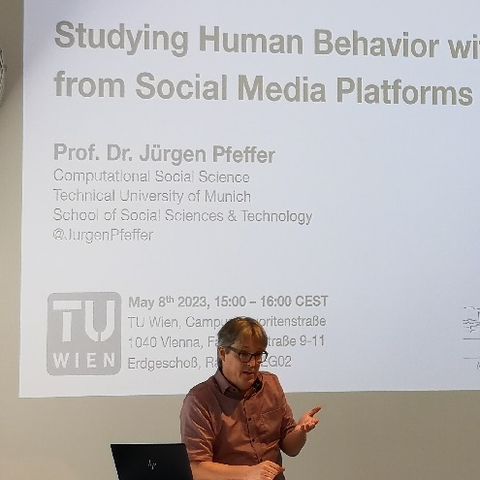
Jürgen Pfeffer is a Professor of Computational Social Science & Big Data at the Technical University of Munich's School of Social Sciences and Technology, with an additional appointment as Adjunct Professor at Carnegie Mellon University's Institute for Software Research. His interdisciplinary work bridges computer science and social science with a focus on analyzing large-scale socio-technical systems. His research expertise spans computational social science, network analysis, and big data methodologies. Pfeffer's work examines methodological, algorithmic, and theoretical challenges in analyzing dynamic social systems, with current projects focusing on modeling and detecting negative dynamics from social media, particularly online firestorms and hate speech against politically active women. His research combines network science approaches with computational methods to understand complex social phenomena. Pfeffer's publication record demonstrates significant contributions to the field since his 2010 doctorate, with high-impact papers in journals like Science and EPJ Data Science. His work on social media analysis, particularly the influential 2014 Science paper 'Social Media for Large Studies of Behavior' co-authored with Derek Ruths, has shaped methodological approaches in the field. His research shows consistent evolution from foundational network analysis to contemporary applications in political discourse, hate speech detection, and multi-layer network analysis. Hennig, M., Brandes, U., Pfeffer, J., & Mergel, I. (2012). Studying Social Networks. A Guide to Empirical Research Ruths, D., & Pfeffer, J. (2014). Social Media for Large Studies of Behavior Pfeffer, J., Morstatter, F., & Mayer, K. (2018). Tampering with Twitter's Sample API As an advisor and collaborator, Pfeffer has worked extensively with researchers including Raji Ghawi, Mirco Schönfeld, Momin Malik, and Kathleen Carley. His work demonstrates strong connections between theoretical network science and practical applications in social media analysis. His current research continues to address pressing issues in online discourse, with recent work focusing on hate speech classification, lexical change in negative word-of-mouth, and polarization dynamics in social media environments. Pfeffer leads the Pfeffer Lab, which focuses on developing methodological approaches for analyzing complex social systems through computational methods. His work has implications for understanding political legitimacy, social influence, and community dynamics in both online and offline contexts.
Andrey Vladimirovich Savchenko is a prominent researcher and educator in computer vision and artificial intelligence at the National Research University Higher School of Economics (HSE) in Nizhny Novgorod. He holds multiple positions including Professor at the Faculty of Informatics, Mathematics, and Computer Science, Leading Researcher at the Faculty of Computer Science and Institute of Artificial Intelligence and Digital Sciences, and Academic Director of the "Artificial Intelligence and Computer Vision" educational program. His educational background includes: 2016: Doctor of Technical Sciences from Nizhny Novgorod State Technical University 2015: Academic title of Associate Professor 2011: Candidate of Technical Sciences 2008: Specialist degree in Applied Mathematics and Computer Science Savchenko's research focuses on computer vision, pattern recognition, and artificial intelligence, with particular emphasis on facial recognition, emotion analysis, and efficient deep learning algorithms. His work bridges theoretical foundations with practical applications, especially in mobile computing environments where computational resources are limited. He has developed innovative methods for making AI systems more efficient without significant loss in accuracy. His recent publications demonstrate a strong trend toward multimodal analysis, combining visual, audio, and textual data for more robust recognition systems. There's a clear emphasis on making AI systems more efficient, especially for mobile devices, and on developing methods that can work with limited computational resources while maintaining high accuracy. His work spans fundamental research on neural network architectures and practical applications in education, healthcare, and human-computer interaction. Among his notable scientific achievements: Gratitude from the Governor of Nizhny Novgorod region (2022) Multiple gratitude awards from HSE (2021-2022) Best Teacher Award (2018-2019) Leaders of IT Industry Award from NEYMARK IT Campus (2023) Academic Success Bonus at HSE (2011-2013) Savchenko has successfully supervised numerous master's students and currently mentors PhD candidates working on cutting-edge topics like large language models for recommendation systems and document analysis. He has secured significant research funding, including projects with Huawei, Sberbank, and the Russian Science Foundation, totaling millions of rubles. His laboratory focuses on developing efficient algorithms for computer vision and multimodal data analysis. He leads the Laboratory of Theoretical Foundations of Artificial Intelligence Models and has established strong industry partnerships that ensure his research has practical impact. His NVIDIA Deep Learning Institute certification demonstrates his commitment to staying current with the latest AI technologies.
Yuhong Nan is an Associate Professor in the School of Software Engineering at Sun Yat-sen University, China, specializing in software security and privacy leakage analysis for emerging platforms including IoT, mobile systems, and blockchain. Previously a Post-doctoral Research Associate at Purdue University under Prof. Dongyan Xu, she builds practical security tools to detect and mitigate vulnerabilities in real-world systems. Dr. Nan earned her PhD from Fudan University in 2018 supervised by Prof. Min Yang. Her academic journey spans rigorous research in security engineering with emphasis on empirical validation and tool development for complex platform ecosystems. Her research program focuses on uncovering systemic security flaws through innovative analysis techniques. Key contributions include vulnerability detection in smart contracts (e.g., state dependencies, reentrancy), privacy leakage analysis in mobile/IoT ecosystems, and countermeasures against deceptive UI patterns. She employs hybrid approaches combining static/dynamic analysis, machine learning, and large-scale empirical studies to develop deployable security solutions. Analysis of her 15 most recent publications (2023-2025) reveals dominant themes in blockchain security (60%), particularly smart contract/DApp vulnerabilities, with significant work in mobile privacy (30%) and cross-platform threats (10%). Her methodology consistently leverages fine-grained static analysis, semantic enrichment, and feedback-driven fuzzing, yielding tools like SmartAxe and Midas that have influenced industry practices. Dr. Nan actively mentors graduate researchers with 17 advisees including Tencent-employed graduates, and serves as a trusted reviewer for premier journals (IEEE TDSC, TMC, TOPS) and conference committees (ASIACCS, ICICS). Her leadership in security communities bridges academic research with practical defense mechanisms. At Sun Yat-sen University, she directs a high-output research group that collaborates with industry partners to address evolving threats in decentralized systems, maintaining her position among top publishing authors in USENIX Security, CCS, and NDSS venues through rigorous technical innovation.
Baishakhi Ray is an Associate Professor of Computer Science at Columbia University, working at the intersection of AI, Software Engineering, and Security. She received her Ph.D. from the University of Texas, Austin, and has established herself as a leading researcher in applying artificial intelligence to software engineering challenges. Her educational background includes a Ph.D. from the University of Texas, Austin, which provided the foundation for her research career at the forefront of AI and software engineering. Dr. Ray's research focuses on leveraging artificial intelligence to solve fundamental challenges in software engineering and security. Her work spans multiple areas including code generation with large language models, vulnerability detection, software testing, and program analysis. She has pioneered approaches that combine deep learning with traditional software engineering techniques to create more robust, secure, and efficient software development processes. Her research has practical implications for improving code quality, enhancing software security, and accelerating development cycles through AI assistance. Her recent work demonstrates a strong emphasis on semantic-aware code generation, execution reasoning, and addressing hallucinations in code language models. She has also made significant contributions to evaluating the functionality and security of AI-generated code, identifying critical challenges in the practical adoption of AI for software development. Dr. Ray has received numerous prestigious awards recognizing her contributions to the field: IEEE TCSE Rising Star NSF CAREER award IBM faculty award VMware Faculty award Distinguished Paper awards at FSE'17, ASE'22, and ISSTA'23 ICSME Most Influential Paper award Publications featured in CACM Research Highlights As an Amazon Visiting Academic and active participant in major software engineering conferences, Dr. Ray has established herself as a thought leader in AI for software engineering. Her research has been widely covered in trade media, indicating its relevance and impact on industry practices. She has mentored numerous students through their research and has been instrumental in shaping the next generation of researchers in this interdisciplinary field. Her work demonstrates a consistent focus on bridging theoretical advances with practical applications, ensuring that her research has tangible benefits for the software development community. The trajectory of her publications shows an evolving research agenda that has successfully adapted to the rapidly changing landscape of AI and its applications to software engineering.