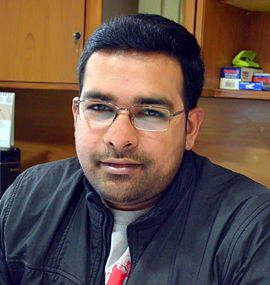
Sanjay MittalView profile
Professor
Sanjay Mittal is a Professor in the Department of Aerospace Engineering at the Indian Institute of Technology Kanpur, where he has established himself as a leading researcher in fluid dynamics and computational aerodynamics. Education: PhD (Aerospace Engineering), University of Minnesota, Minneapolis, MN, USA, 1992 M.S. (Aerospace Engineering), University of Minnesota, Minneapolis, MN, USA, 1990 B.Tech (Aeronautical Engineering), IIT Kanpur, 1988 Professor Mittal's research spans multiple specialized areas within fluid dynamics, with particular expertise in bluff body flows, vortex-induced vibrations, and fluid-structure interactions. His work combines theoretical analysis with advanced computational methods to address complex aerodynamic problems. He has made significant contributions to understanding transition and turbulence phenomena, developing optimization techniques for aerodynamic shapes, and applying these principles to practical engineering challenges including air intake design and traffic flow modeling. His publication record shows a strong focus on fundamental fluid mechanics phenomena with increasing emphasis on computational methods and practical applications over time. The research demonstrates sophisticated approaches to modeling complex flow behaviors and their interactions with structures. Scientific Awards and Recognitions: Shanti Swarup Bhatnagar Prize, Engineering Sciences, 2006 JC Bose Fellowship, Department of Science & Technology – 2013 Fellow, Indian National Science Academy (INSA), since 2011 Corresponding Editor, Computer Modeling in Engineering & Sciences (CMES), Tech Science Press, since 2011 Fellow, Indian Academy of Sciences, 2007 Scopus Young Scientist in Engineering, 2007 Professor Mittal has received significant research funding through various grants supporting his work in computational fluid dynamics. His supervision of graduate students has produced quality research in aerodynamics, as evidenced by his publication record with co-authors who appear to be students and collaborators. While specific laboratory details aren't provided in the available information, his research program likely includes computational facilities for fluid dynamics simulations and potentially wind tunnel testing capabilities given his research interests in experimental validation.