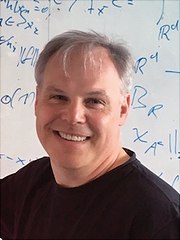
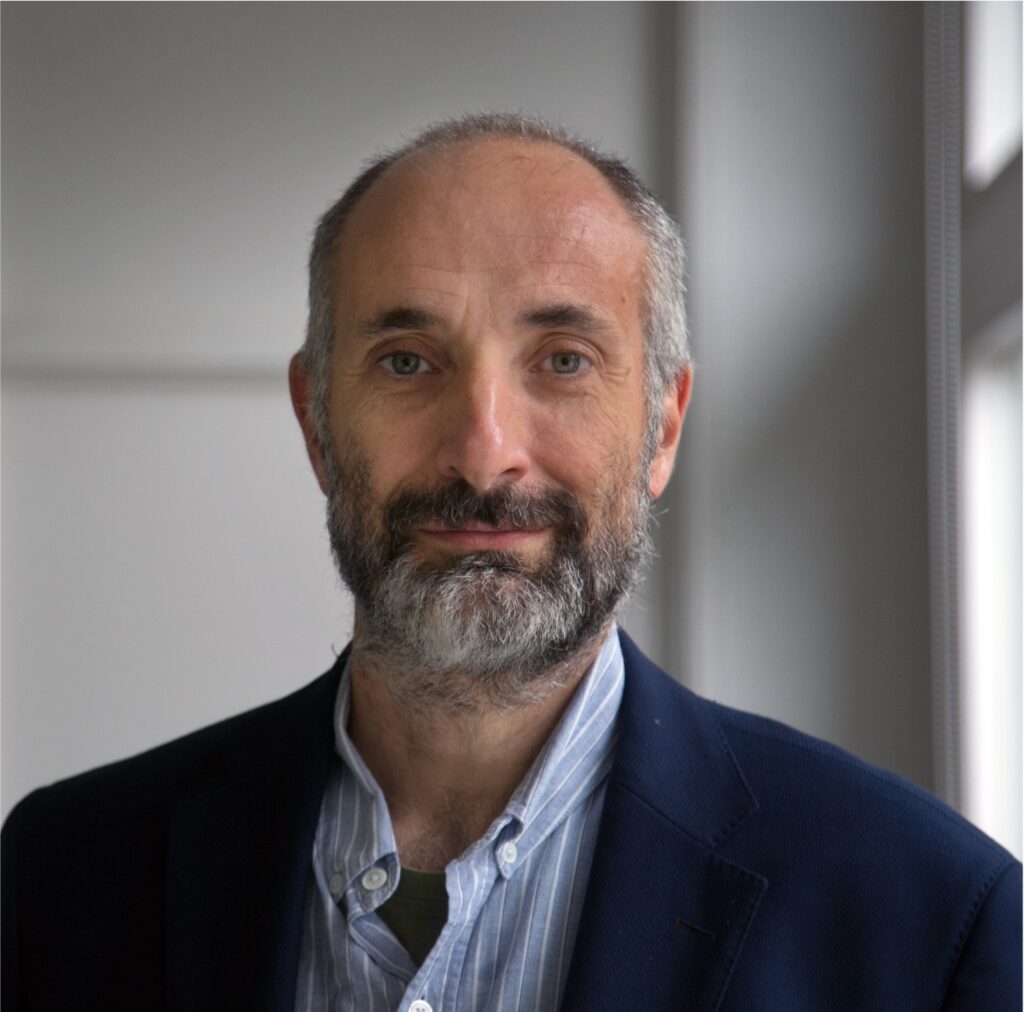
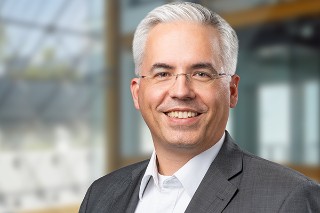
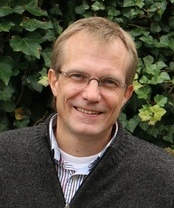
Dr. Dmitry Sidorenko is a Researcher in Climate Dynamics at the Alfred Wegener Institute, focusing on high-resolution ocean modeling, Arctic Ocean dynamics, and the Atlantic Meridional Overturning Circulation (AMOC). His work emphasizes understanding climate change impacts through advanced simulations using models like FESOM2 and IFS. Research interests include eddy-resolving ocean simulations, AMOC variability, and the effects of freshwater forcing on climate systems. He contributes to projects such as nextGEMS, advancing kilometer-scale Earth system modeling. His studies address Arctic sea ice decline, Antarctic basal melt thresholds, and the role of mesoscale eddies in ocean circulation. Key projects involve coupled ocean-atmosphere models, data assimilation techniques, and improving model resolution to capture subgrid-scale processes. His work bridges climate projections with real-world observations, informing global climate policy and scientific understanding.
Michael A. Goodrich is a Professor in the Department of Computer Science at Brigham Young University, with an extensive research career spanning over two decades in robotics, human-robot interaction, and swarm intelligence. His work bridges theoretical foundations with practical applications, particularly in autonomous systems and multi-agent coordination. His research interests focus on Robotics , Human-Robot Interaction , Swarm Robotics , Artificial Intelligence , and Autonomous Systems . Goodrich's work explores how humans and robots can effectively collaborate, with particular emphasis on proficiency assessment, resilience, and communication in human-robot teams. His research has significant applications in search and rescue operations, swarm robotics, and autism therapy. Analysis of his recent publications reveals a strong focus on robot self-assessment capabilities, swarm behavior optimization, and resilience in multi-agent systems. His work increasingly integrates formal methods with practical robotics applications, creating frameworks for robots that can assess their own capabilities and communicate this information effectively to human teammates. Among his notable contributions are frameworks for robot proficiency self-assessment using assumption-alignment tracking, methods for designing resilient swarm behaviors, and formalizations of resilience for goal-oriented agents. His work has been published consistently in top venues including IEEE Transactions on Robotics, ACM Transactions on Human-Robot Interaction, and International Journal of Robotics Research. Dr. Goodrich has advised numerous students who have become active researchers in the field, including Aadesh Neupane, Daqing Yi, Xuan Cao, and Puneet Jain. His collaborative work spans multiple institutions and has practical applications in wilderness search and rescue, autism therapy, and multi-robot coordination systems.
Prof. Dr. Armin Iske is a Full Professor of Numerical Approximation at the University of Hamburg's Department of Mathematics, within the Faculty of Mathematics, Computer Science and Natural Sciences. He holds a PhD from the University of Göttingen (1994) and habilitation from TU Munich (2002). His research focuses on numerical approximation, kernel-based methods, computational fluid dynamics, and medical imaging. He has held academic positions globally, including visiting roles at ANU (Australia) and the University of Leicester (UK). Research interests include scattered data approximation, adaptive particle methods for flow simulation, and high-dimensional data analysis. He has authored 118+ publications, including works on kernel interpolation, medical imaging reconstruction, and machine learning applications. He serves on editorial boards for journals like Advances in Computational Mathematics and Sampling Theory . His contributions span interdisciplinary projects, such as SFB/TRR 181 on energy transfer in atmosphere and ocean, and collaborations in nanotechnology for brain interfaces. His work bridges theoretical mathematics with practical applications in engineering and biosciences.
Giuseppe Sansone is a full professor of experimental physics at the University of Freiburg, leading the Attosecond and Strong Field Physics group. He holds an Internal Senior Fellow position (Sep 2024–Apr 2025) and previously held postdoctoral fellowships at RIKEN (Japan) and the Max-Planck-Institute (Germany). His work focuses on attosecond metrology at free-electron lasers and ultrafast molecular dynamics using coincidence spectroscopy. Key contributions include the development of the Extreme Light Infrastructure Attosecond Light Pulse Source (ELI-ALPS) in Hungary. His research spans attosecond pulse characterization, quantum control in extreme UV domains, and coherent control mechanisms in molecular systems. Education: PhD in Physics (2004, Politecnico Milano), career progression from assistant to associate professor at Politecnico Milano before joining Freiburg in 2016. Research interests include: attosecond temporal structure analysis, nonlinear XUV applications, wave-packet manipulation in Rydberg states, and femtosecond polarization shaping. His experimental setups leverage seeded free-electron lasers and advanced spectroscopic techniques. Publications highlight advancements in photoelectron interferometry, resonance dynamics, and ultrafast nuclear motion studies. His work bridges atomic/molecular physics with cutting-edge laser technologies. Awards: JSPS Short-Term Postdoc Fellowship (2007), Alexander von Humboldt Fellowship (2009-2010). Lab leadership: Director of the Attosecond and Strong Field Physics group at Freiburg, contributing to ELI-ALPS infrastructure development. His team focuses on time-resolved XUV-IR coincidence spectroscopy and novel attosecond timing tools.
Overview Prof. Dr. Raphaela Vogel is a tenure-track professor (W2) at the University of Hamburg's Meteorological Institute, part of the Department of Earth System Sciences. She leads research on cloud dynamics, convective processes, and climate feedbacks, with a focus on rain evaporation and cold pool effects. She received an ERC Starting Grant (2023) to study rain evaporation's climatic impacts. Educational Background B.Sc. Environmental Sciences (ETH Zurich & University of Edinburgh, 2010) M.Sc. Atmospheric and Climate Science (ETH Zurich, 2013) PhD in Meteorology (Max Planck Institute for Meteorology, Hamburg, 2017) Research Interests Her work combines observations, simulations, and conceptual models to study cloud responses to environmental changes. Key areas include: Evaporation of raindrops and cold pool dynamics Mesoscale convective organization Climate feedbacks of trade-wind cumulus clouds Improving climate models via Supertropfen approaches Publications & Projects Recent work highlights include a 2022 Nature paper on weak trade cumulus feedback and leadership in the ORCESTRA field campaign. She co-leads the Cold Pool Model Intercomparison Project (CP-MIP) and is PI of the SCORE project. Awards & Grants ERC Starting Grant (2023) for the ROTOЯ project, valued at €1.5M. Recognized as a climate physics editor for Atmospheric Chemistry and Physics. Teaching & Supervision Teaches courses on meteorology and tropical cloud systems. Supervises 9 current PhD/MSc students and postdocs, including projects on cold pools and precipitation dynamics. Labs & Collaborations Part of the University of Hamburg's Clouds and Convection research group and affiliated with the Centrum für Erdsystemforschung und Nachhaltigkeit (CEN). Collaborates with Barbados Cloud Observatory and international modeling initiatives.
Jochen Schiewe is a Researcher specializing in geovisualization, GIS, and spatial uncertainty analysis, with a career spanning over two decades. His work bridges cartography, urban planning, and computational methods. Key Affiliations: University of Hanover (PhD), ISPRS community, EuroVA workshop Research Focus: Geovisualization techniques, uncertainty quantification, smart cities, and historical map analysis His 2024 publication introduces agent-based approaches for preserving spatial patterns in urban data. Earlier works examine sound maps for data representation, land cover change analysis, and interactive GIS for public participation. Schiewe's scholarly contributions emphasize human-computer interaction and cognitive aspects of mapping . He has served as editor for special issues on smart city solutions and collaborated with leading experts in GIS and visualization.
Roghayeh Barmaki is a researcher with extensive publications in virtual reality, augmented reality, and educational technology. Her work spans rehabilitation systems, autism therapy, and neuroimaging analysis using fNIRS. She collaborates with institutions including Georgia Institute of Technology and University of Florida. Key Collaborators : Anjana Bhat, Jicheng Li, Shayla Sharmin, Vuthea Chheang Research Themes : Wearable sensors, LSL framework, movement synchrony, multimodal learning analytics Research Interests She focuses on immersive technologies for education and therapy, with expertise in: Functional Near-Infrared Spectroscopy (fNIRS) for cognitive engagement Wearable sensor integration in rehabilitation Gender perspectives in AR/VR education Multimodal affect analysis for autism Privacy-preserving behavioral analytics 3D visualization for anatomy training Publication Trends Recent work emphasizes fNIRS applications in gaming environments and hybrid deep learning models for cognitive analysis. Earlier studies focused on gesture recognition, movement synchrony estimation, and autism intervention datasets. Impactful Projects She developed the MMASD dataset for autism research and contributed to VR therapy systems. Her collaborations include: Georgia Tech's Autism Technology Research University of Florida's TeachLivE virtual classroom Germany's AIxVR conference contributions International collaborations on sensor systems
Prof. Dr. Jörn Kohlhammer is an Honorary Professor at TU Darmstadt and Head of the Information Visualization and Visual Analytics department at Fraunhofer Institute for Computer Graphics Research IGD. His work focuses on decision-oriented visualization using semantics, visual business analytics, and applications in medical data analysis, internet security, and industrial sectors. He holds a PhD from TU Darmstadt (2005) and has authored over 50 publications in journals and conferences like IEEE VAST and EuroVis. Education: B.Sc./M.Sc. in Computer Science with Business Administration Minor (1993-1999), Ludwig-Maximilians-Universität München Research Interests: Context-dependent visualization solutions Medical data analysis and cohort visualization Decision support systems Visual analytics for cybersecurity and network traffic Professional Activities: Regular member of program committees for IEEE VAST, EuroVis Reviewer for journals/conferences including IEEE Transactions on Visualization and Computer Graphics Co-chair of IEEE VAST (2009) and founder of EuroVA (2010) Labs/Teams: Leads Fraunhofer IGD's Information Visualization & Visual Analytics group Projects: ATHENA, CorASiV (health authority support), SoBigData (social big data analytics)
Prof. Bettar Ould el Moctar is a Full Professor for Ship Technology and Ocean Engineering at the University of Duisburg-Essen, Germany, where he has served as Head of the Institute of Sustainable and Autonomous Maritime Systems (INAM) since 2008. He also directs the Model Basin: Development Centre for Ship Technology and Transport Systems (DST) in Duisburg. His academic career spans naval architecture, ocean engineering, and computational fluid dynamics with extensive industry experience in maritime technology. Prof. el Moctar earned his Graduate Engineer Degree in Naval Architecture & Ocean Engineering from the University of Hamburg (1990-1997), followed by a PhD in Computational Fluid Dynamics from the Hamburg University of Technology (1997-2001). His doctoral research focused on "Numerical Computation of Flow Induced Forces Acting on Manoeuvring Ships." Prof. el Moctar's research spans ship technology, ocean engineering, computational fluid dynamics, cavitation, hydrodynamics, and hydroelasticity. His work addresses critical challenges in maritime systems including wave-structure interactions, fluid-structure dynamics, cavitation control, and energy harvesting from marine environments. He has pioneered research in computational methods for seakeeping problems and developed innovative approaches for analyzing wave-induced loads and hydroelasticity effects. His extensive publication record demonstrates significant contributions across fluid dynamics, ship technology, and ocean engineering. Recent work shows a strong focus on cavitation phenomena, energy harvesting from marine environments, hydroelasticity of floating structures, and advanced computational methods. His research integrates experimental, numerical, and data-driven approaches to solve complex maritime engineering challenges. Georg Weinblum-Award (for dissertation, 2001) Landrini Award (for research activities, 2005) Prof. el Moctar has served as Editor in Chief of the Journal of Ship Technology Research and holds editorial positions with several prominent journals. His professional activities include membership on numerous advisory boards including the German Research Ships "Meteor" and "Merian," the German Academic Exchange Service (DAAD), and the Federal Ministry for Economic Affairs and Climate Action. He previously held leadership positions at Germanischer Lloyd AG and DNV GL SE before his academic appointment. As Director of INAM and the Model Basin DST, Prof. el Moctar oversees advanced research facilities for maritime technology development. His institute conducts cutting-edge research in sustainable and autonomous maritime systems, with capabilities in computational modeling, experimental testing, and technology transfer to industry partners.
Björn Annighöfer is a Professor at the Institute of Aviation Systems (ILS) at the University of Stuttgart, where he serves as Managing Director. His work focuses on complex, digital, and safety-critical avionics systems, including self-adaptive platforms, cybersecurity, and AI-supported aerospace systems. Research interests include: Self-adaptive avionics platforms Model-based cybersecurity frameworks Integrated Modular Avionics (IMA) development Virtualization and middleware for safety-critical systems AI applications in aerospace Automated development and certification processes Recent publications highlight advancements in PLUG-AND-FLY avionics, security assessment using large language models, and domain-specific modeling tools. He leads a team of ~25 scientists at ILS, which operates modern labs, flight simulators, and research aircraft for testing.
Prof. Vasileios Angelidakis is a Professor at Friedrich-Alexander-Universität Erlangen-Nürnberg (FAU), specializing in Discrete Element Method (DEM) modeling, granular materials, and particle dynamics. His research focuses on numerical simulations of particulate systems, including particle shape characterization, DEM framework comparisons, and applications in additive manufacturing, railway ballast, and material science. He has collaborated internationally, contributing to open-source DEM software like MercuryDPM and Yade, and has published extensively on topics such as clump dynamics, thermal-particle interactions, and global benchmark studies on granular behavior. He has also worked on seismic engineering, analyzing structural responses to earthquake-induced ground motion. Education: PhD in Engineering (Newcastle University, 2022), MSc in Structural Engineering (National Technical University of Athens, 2016), Diploma in Civil Engineering (National Technical University of Athens, 2014). Research Interests: DEM modeling, particle shape effects, granular flow, computational mechanics, additive manufacturing processes, and seismic structural analysis. Publications highlight his work on open-source frameworks, particle morphology analysis, and validation studies across disciplines. His contributions include algorithms for rotational motion integration and tools like CLUMP and SHAPE for particle representation.
Prof. Dr. Frauke Liers holds the Professorship of Optimization under Uncertainty & Data Analysis at the Department of Data Science (DDS), Friedrich-Alexander-University Erlangen-Nürnberg. Her research focuses on robust and distributionally robust optimization, mathematical programming, and applications in energy systems, healthcare logistics, and quantum computing. Email: frauke.liers@fau.de ResearchGate: Frauke Liers Research Interests span optimization under uncertainty, data-driven mathematical programming, and interdisciplinary applications. Key areas include: Distributionally robust optimization with scenario reduction and chance constraints Quantum computing optimization for gate routing and noise suppression Energy system modeling (photovoltaics, gas networks, electricity networks) Healthcare logistics (patient transport scheduling under uncertainty) Nanoparticle technology and chemical process optimization Recent Publications emphasize: Advancements in quantum circuit optimization (2025) Explainable optimization methods (2024) Robust approaches for particle precipitation control (2024) Dynamic trajectory optimization (2023) Time-expanded models for network flows (2022)
Prof. Dr. Manfred Lein is a Professor at the Institute of Theoretical Physics within the Faculty of Mathematics and Physics at Leibniz University Hannover. He holds key roles including Dean of Studies in the Faculty and membership in the Executive Board of the Institute. His research focuses on ultrafast quantum phenomena, strong-field ionization, and high-order harmonic generation (HHG), with contributions to attosecond science and machine learning applications in quantum systems. His work bridges theoretical modeling and experimental techniques, including the use of bicircular attoclocks and neural networks for molecular imaging. Positions: Dean of Studies (Faculty of Mathematics and Physics), Executive Board Member (Institute of Theoretical Physics), Professor Contact: manfred.lein@itp.uni-hannover.de | +49 511 762 3291 Lab: Group website: lein group Research interests emphasize electron dynamics in strong laser fields, molecular structure retrieval via HHG, and ultrafast processes. His articles highlight advancements in attosecond timing, Coulomb effects, and quantum control using THz and bicircular fields.
Franziska Nestler is a Researcher at the Department of Mathematics , Chemnitz University of Technology , with a focus on applied functional analysis and computational methods. She leads the BMBF junior research group SALE (Fast Algorithms for explainable recommendation systems) and contributes to E-learning initiatives at the Faculty of Mathematics. Education : Diploma in Mathematics (2012), PhD in Applied Functional Analysis (2018) Research interests center on fast Fourier-based algorithms for electrostatic interactions in particle systems, machine learning with interpretable kernel methods, and E-learning tools for mathematics education. Her work bridges numerical analysis, computational physics, and pedagogical innovation. Key scientific awards include the Best Poster Award at the Strobl18 Workshop. She has collaborated on projects like DFG's Fast Fourier-based Coulomb solvers and BMBF's Qualitätspakt Lehre for teaching digitalization. Advising : Supervised Master’s and Bachelor’s theses in fast summation methods and inverse NFFT techniques
Prof. Dr. rer. nat. Christopher Wiebusch is a University Professor at the III. Physikalisches Institut B (Experimental Physics III B) at RWTH Aachen University. His research focuses on Particle and Astroparticle Physics , with active involvement in major experiments: IceCube, Double Chooz, EnEx-RANGE, and JUNO. His work spans neutrino astronomy, dark matter searches, cosmic ray anisotropy studies, and detector development.