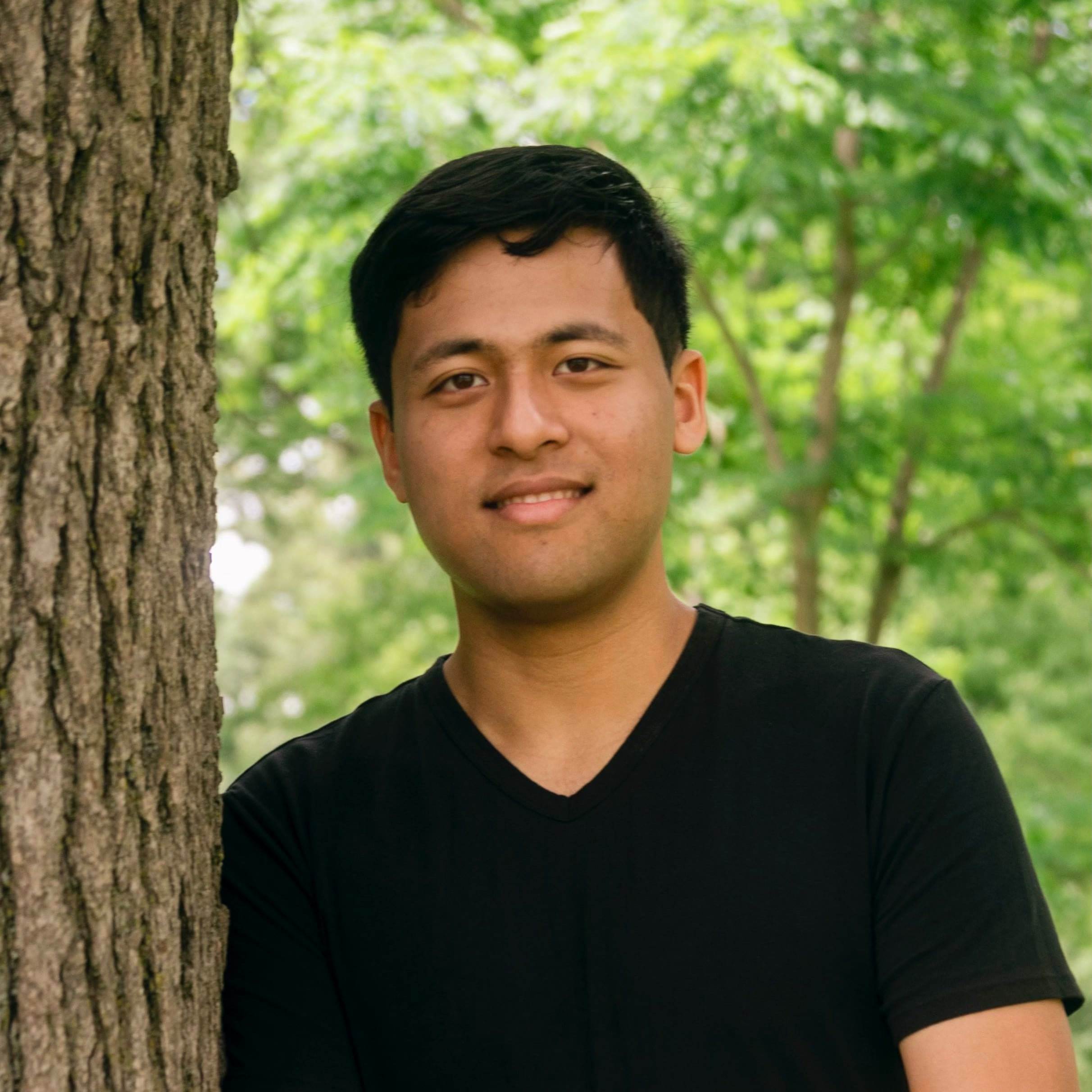
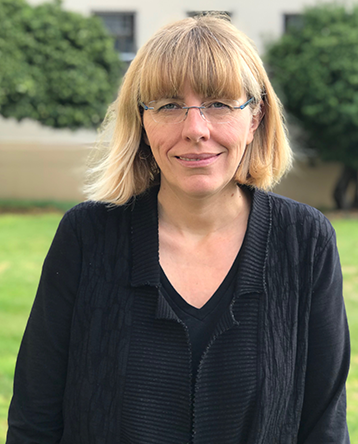
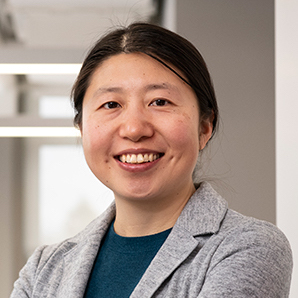
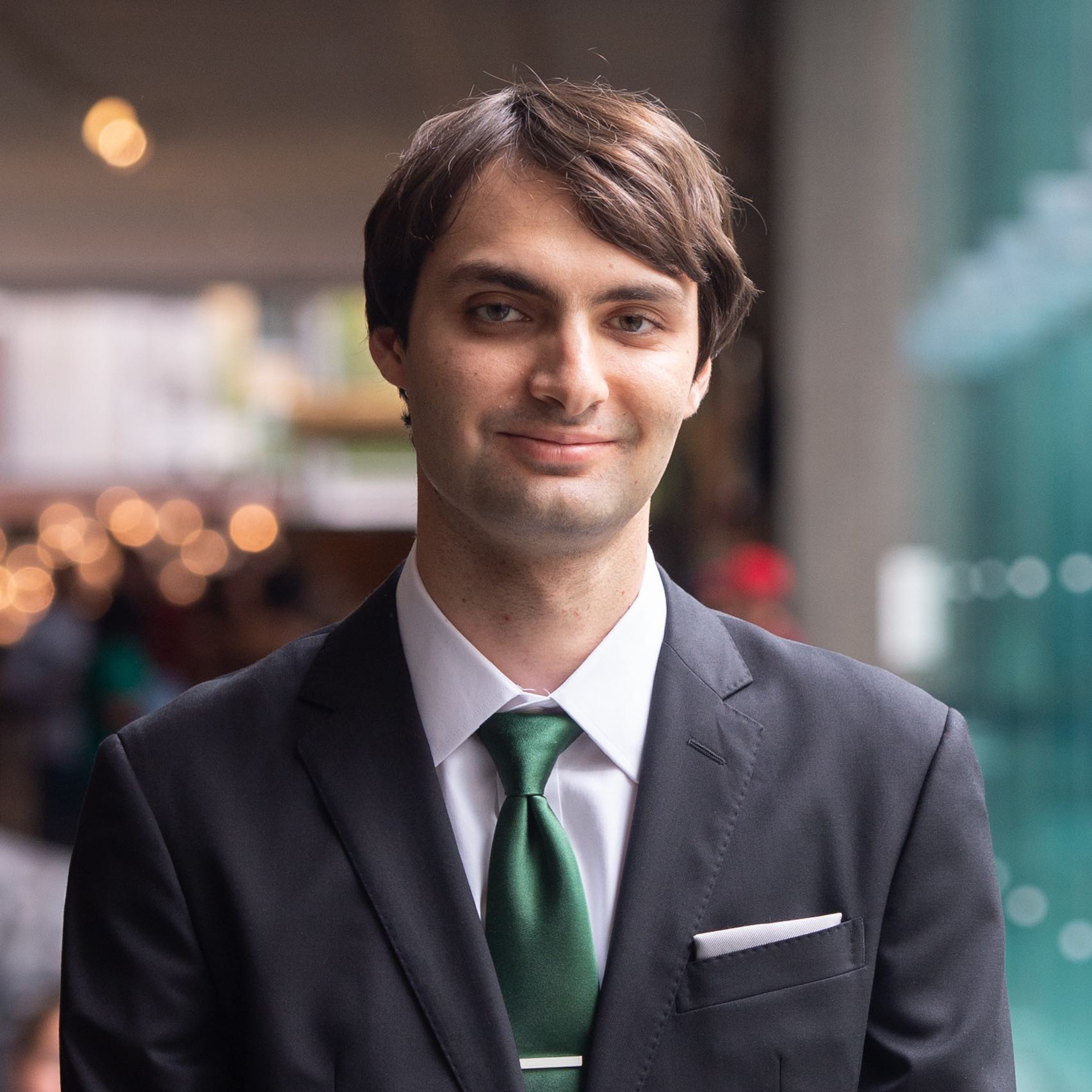
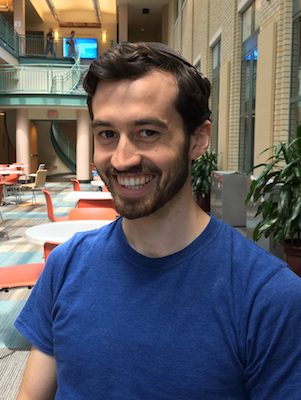
Yang P. Liu is an Assistant Professor in the Computer Science Department at Carnegie Mellon University. Previously, he was a Postdoctoral Member at the Institute for Advanced Study and earned his PhD from Stanford University under the supervision of Aaron Sidford. His research focuses on theoretical computer science and mathematics, emphasizing graph algorithms, optimization, high-dimensional geometry, and additive combinatorics. He has received notable awards including the A.W. Tucker Prize and Google PhD Fellowship, alongside multiple best paper recognitions at major conferences like FOCS, STOC, and ITCS. Education: PhD in Computer Science from Stanford University (2023); BS from MIT (2018). Research Interests: Graph Algorithms Optimization (especially convex and high-dimensional) Algorithmic Techniques in Additive Combinatorics Geometric and Structural Aspects of Computation Teaching: Currently instructing CS 15-759: A Principled Approach to Optimization (Spring 2025), covering topics like gradient descent, interior-point methods, and sparsification techniques. Course emphasizes rigorous mathematical foundations. Awards: Recognized for contributions to optimization theory and algorithmic complexity. His work bridges discrete mathematics and continuous optimization paradigms.
Corina Pasareanu is a Principal Scientist at Carnegie Mellon University's CyLab and Technical Professional Leader for Data Science at NASA Ames Research Center (working through KBR). She maintains strong affiliations with both CMU's School of Computer Science and NASA Ames, leading cutting-edge research at the intersection of formal verification, AI safety, and software security. She earned her Ph.D. in Computer Science from Kansas State University in 2001, following MS (1995) and BS (1994) degrees in Computer Science from University Politehcnica of Bucharest. Her academic foundation has propelled her to become a leading expert in verification techniques for complex software systems. Dr. Pasareanu's research program focuses on model checking, symbolic execution, compositional verification, and probabilistic software analysis, with growing emphasis on ensuring safety and reliability of AI systems. Her work bridges theoretical formal methods with practical applications in autonomous systems and security-critical domains. Recent efforts target verification challenges in large language models and vision-based autonomous systems, developing techniques to provide mathematical guarantees of system behavior despite AI component uncertainties. Analysis of her publication trends reveals a strategic evolution from foundational verification techniques toward increasingly complex AI systems, with strong emphasis on practical applications in safety-critical contexts. Her work consistently connects theoretical advances in formal methods with real-world security and safety challenges. Her scientific contributions have earned exceptional recognition: ACM Fellow and IEEE ASE Fellow ETAPS Test of Time Award (2021) ASE Most Influential Paper Award (2018) ESEC/FSE Test of Time Award (2018) ISSTA Retrospective Impact Paper Award (2018) Multiple historical impact awards including ACM Impact Paper Award (2010) and ICSE Most Influential Paper Award (2010) Dr. Pasareanu actively mentors the next generation of computer scientists, currently advising PhD students Aymeric Fromherz (with Bryan Parno), Yoshiki Takashima, Zichao Zhang, and Chi Zhang (all with Limin Jia), plus postdoc Ravi Mangal. She has secured substantial research funding from NSF, DARPA, AWS, NASA, and industry partners for projects including 'LLM Self-Defense Against Adversarial Attacks,' 'Trinity: Neurosymbolic Learning and Reasoning,' and 'HUGS: Human-Guided Software Testing.' Her leadership extends to Program Co-Chair for ICSE 2025 and multiple other major conferences, plus service on steering committees for ICSE, ETAPS, TACAS, and ISSTA. As Principal Scientist at CMU CyLab, she leads research teams developing verification techniques for AI systems, with particular focus on autonomous vehicles and large language models. Her NASA Ames work applies formal methods to space-related autonomous systems, while her collaborations with industry partners translate theoretical advances into practical tools. She remains at the forefront of addressing verification challenges for increasingly complex AI technologies, with upcoming keynotes at CAV 2025 and FormaliSE 2025 demonstrating her continued leadership in the field.
Matt Fredrikson is an Associate Professor in the Computer Science Department at Carnegie Mellon University , affiliated with CyLab and the Principles of Programming Group . His research bridges security, privacy, and formal methods in machine learning and software systems. PhD in Computer Science, University of Wisconsin–Madison (2015) M.S. in Computer Science, University of Wisconsin–Madison (2012) Bachelor's in Mathematics and Computer Science, Duquesne University (2007) His work focuses on privacy in machine learning , particularly adversarial inference and differential privacy limitations. He develops formal methods for privacy-aware programming , using logics with counting to model adversarial uncertainty. Additionally, he explores probabilistic program analysis to enhance machine learning security and reliability. Recent publications highlight his contributions to LLM security , including attacks on alignment and robustness certification. His 2025 paper LLM Whisperer reveals biases in LLM responses, while 2024 works address certifiable robustness and automated adversarial attacks on coding models. Best Paper Award, USENIX Security Symposium 2014 He advises students on topics spanning AI ethics , program verification , and IoT security . Courses taught include Software Foundations of Security and Privacy and Bug Catching: Automated Program Verification and Testing .
Zeliha Dilsun Kaynar is an Associate Teaching Professor at the School of Computer Science, Carnegie Mellon University (CMU). She holds a Ph.D. (2002, University of Edinburgh) and B.Sc. (1996, Middle East Technical University) in Computer Science, and a Doçent degree from Turkey's higher education council. Prior to CMU, she worked at CMU CyLab and MIT's Theory of Distributed Systems Group (2001–2006). Her teaching focuses on principles of programming, programming languages, formal modeling, and verification. Research interests include distributed systems, security, formal verification of protocols, and accountability via causation. Notable work includes the Theory of Timed I/O Automata (2006/2010) and NSF-funded projects on blameworthy programs and accountability determination. Collaborations span cybersecurity, education technology (e.g., Open Learning Initiative), and healthcare sustainability. She advises undergraduate CS students and co-authored over 50 peer-reviewed papers across journals like Journal of Computer Security and conferences such as CSF and Oakland.
Felipe Trevizan is Senior Lecturer at the Australian National University's School of Computing. His research integrates artificial intelligence, operations research and machine learning to solve planning and scheduling problems. Research Focus: Develops algorithms for automated planning under uncertainty, including heuristic search methods and machine learning approaches for probabilistic systems. Current projects include domain-independent heuristic learning and constrained stochastic path optimization. Recent Advances: Created novel algorithms like partial-space search for learned heuristics and constraint generation techniques for stochastic path problems. Research enables more efficient planning in complex environments with uncertainty.
Nicholas Boffi is an Assistant Professor split equally between the Machine Learning Department and the Department of Mathematical Sciences at Carnegie Mellon University. He is also a member of the Center for Nonlinear Analysis. His research focuses on the foundations of generative modeling and its applications in science and engineering, particularly addressing computational challenges through machine learning innovations. Boffi's work integrates applied mathematics disciplines including numerical analysis, partial differential equations, dynamical systems, control theory, stochastic processes, and optimization. Education: Ph.D. in Applied Mathematics from Harvard University (co-advised by Jean-Jacques Slotine and Chris Rycroft), B.S. in Mathematics, Physics, and Integrated Science from Northwestern University. Awards: DOE Computational Science Graduate Fellowship (2015-2019), Fulbright Scholar (2014-2015). Previous Affiliations: Courant Institute (2021-2024), Google Brain (2020). His research explores the intersection of machine learning and computational mathematics, emphasizing generative models for scientific problems. Notable projects include developing numerical methods for PDEs, stochastic simulation of evolutionary dynamics, and model-free learning in nonequilibrium systems. Boffi's recent work investigates scalable interpolant frameworks for flow-based generative models and entropy production in active matter systems. He advises PhD students in CMU's Machine Learning and Mathematics programs, focusing on candidates interested in applied mathematics and machine learning intersections. His lab collaborates across disciplines to advance foundational theory and practical applications in computational science.
Limin Jia is a Research Professor affiliated with Carnegie Mellon University's CIT Department of Electrical and Computer Engineering and the Computer Science Department. He leads research in systems security, formal verification, and programming language foundations. His work emphasizes compositional assurance for cyber-physical systems and secure software development practices. Education background is not explicitly stated in the text, but his research focuses on advanced technical domains requiring doctoral-level expertise. Current research interests span cyber-physical systems assurance, software security, and formal methods for program analysis. Recent work includes groundbreaking studies on compositional assurance for large systems (2025), adversarial attacks on large language models (2024), and Rust-based program verification tools like Crabtree (2024). His team also develops tools such as Nodemedic (Node.js vulnerability analysis) and ProInspector (protocol bug detection). Research outputs bridge theory and practice, with 15+ publications in 2023-2025 alone. Current advisees include Myra Dotzel, Nuno Sabino, and Rafael Goncalves. Research collaborations involve multi-institutional projects in network security, IoT safety, and compiler verification. Active in both ACM and IEEE conferences, his work has been funded through multiple NSF and industry grants (details not specified in text). Operates within the Mehrabian Collaborative Innovation Center, fostering interdisciplinary projects at the intersection of electrical engineering, computer science, and cybersecurity. His lab develops both foundational theories and practical tools for improving system security and reliability across domains.
Summary Ann B. Lee is a Professor in the Department of Statistics & Data Science and the Machine Learning Department at Carnegie Mellon University (CMU). She serves as Co-Director of the Ph.D. Program in Statistics. Previously, she was the J.W. Gibbs Assistant Professor at Yale University and a visiting researcher at Brown University. Her research focuses on developing statistical methods for complex data in physical sciences, including trust-worthy uncertainty quantification, likelihood-free inference, and applications in astronomy, climate science, and hurricane dynamics. Education: Ph.D. in Physics from Brown University (2002); M.Sc./B.Sc. in Engineering Physics from Chalmers University of Technology (Sweden). Key Research Interests: - Scientific Machine Learning - Uncertainty Quantification (UQ) - Likelihood-Free Inference - Tropical Cyclone Analysis - High-Dimensional Data Modeling She leads the STAMPS (STAtistical Methods for Physical Sciences) research group, which bridges classical statistics and machine learning. Recent work includes methods for estimating ocean thermal responses to hurricanes, probabilistic forecasting, and diagnostics for generative models. Her team collaborates with climate and astrophysics communities, hosting public webinars and symposia. Advising: Supervised over 15 PhD students, including graduates now in academia and industry. Current advisees include Luca Masserano and Alex Shen. Labs/Teams: Co-directs the STAMPS Research Center at CMU, launching in Fall 2024 as a university-wide initiative.
Reid Simmons is a Research Professor at the Robotics Institute , part of the School of Computer Science at Carnegie Mellon University . His work focuses on creating reliable, highly autonomous systems that operate in uncertain environments, particularly mobile robots. He leads the Reliable Autonomous Systems Lab and serves as Director of the Artificial Intelligence Major at CMU. Research Interests: Autonomy, AI reasoning, human-robot interaction, multi-robot coordination, probabilistic planning Projects: SUCCESS (proficiency metrics), Social Robot (personality-driven interaction), Data Analysts (AI for data science) Recent Publications: 15 articles (2017-2023) on topics like human-robot teaming, machine teaching, and affective computing His research emphasizes model-based reasoning , error recovery , and socially acceptable robot behavior , including projects like the Tank and Victor robots for interactive tasks. Students and affiliates span PhD/Master's programs, with past advisees now leading in robotics (e.g., Heather Knight, Christopher Urmson).
Eric Poe Xing is a Professor at Carnegie Mellon University's School of Computer Science, holding joint affiliations with the Machine Learning Department, Language Technology Institute, and Computer Science Department. He also serves as President of the Mohamed bin Zayed University of Artificial Intelligence. His research focuses on machine learning methodology, statistical systems, and large-scale computational architectures, with recent work on foundation models for biology (AIDO), world/agent models (PAN), and open-source LLM initiatives (LLM360). He advises numerous students and postdocs in areas like AI, NLP, and computational biology. He teaches graduate courses in Machine Learning and Probabilistic Graphical Models, and actively contributes to academic leadership roles, including ICML program chairs and editorial boards. Research interests span automated reasoning, AI ethics, and scalable computing. His lab, SAILING, develops cutting-edge models for vision-language tasks, bioinformatics, and multi-modal learning. Notable projects include LLM360's open-source AGI efforts and innovations in distributed ML systems. His work emphasizes interdisciplinary applications, from healthcare decision-support (PetuumMed) to climate modeling (ClimSatDiff).
Po-Shen Loh is a Professor of Mathematics at Carnegie Mellon University, affiliated with the Mellon College of Science's Department of Mathematical Sciences since 2010. He is renowned for his dual focus on academic research and innovative educational outreach. Loh’s research spans combinatorics, probability theory, and extremal networks, with notable contributions to understanding network properties and their applications. He led the U.S. International Mathematical Olympiad (IMO) team to four first-place finishes between 2015–2023, emphasizing collaborative problem-solving and global peer engagement. Beyond academia, Loh developed the NOVID app for pandemic control, leveraging network science to empower users in avoiding infection. He also founded Expii.com, a free platform offering diverse explanations for math and science concepts, and launched the LIVE learning platform blending math education with performing arts. His work bridges disciplines, aiming to democratize education and prepare future leaders in an AI-driven world. Education & Background : Grew up in a math-centric household in Madison, Wisconsin, with parents in academia. Earned his Ph.D. in Algorithms, Combinatorics, and Optimization from Carnegie Mellon (though exact dates not specified in texts). Research & Leadership : Specializes in extremal combinatorics, including network structure analysis. His research on probabilistic network existence proofs has advanced graph theory. As IMO coach, he pioneered cross-national training programs, inviting international teams to U.S. camps. Awards & Recognition : Recipient of the 2019 Presidential Early Career Award (PECASE). Recognized for pandemic control innovations and educational initiatives. Outreach : Conducted a record-breaking 40-city math tour in 2021, developed the Daily Challenge math curriculum, and launched Moderate Zoom Chat to improve virtual engagement. Active in mentorship programs like LEAD NATURALLY, targeting culturally diverse leaders. Notable Projects : NOVID app (pandemic control), Expii (free educational resource), and LIVE platform (math education via live-streaming).
Geoffrey J. Gordon is a Professor in the Machine Learning Department at Carnegie Mellon University and affiliated with the Robotics Institute. His research spans multi-agent planning, reinforcement learning, decision-theoretic planning, statistical models of complex data, computational learning theory, and game theory. He leads the SELECT lab (SEnse, LEarn, and aCT), focusing on predictive state representations, spectral learning, and applications in robotics. His recent work integrates deep learning with controlled dynamical systems and optimization, as seen in publications at AAAI and AISTATS. Research Interests: Multi-agent systems and game theory Reinforcement learning and dynamical systems Statistical models for high-dimensional data Spectral learning and quantum Markov models Scientific Awards: Best paper award at ICML 2010 Teaching: 10-405/605: Machine Learning with Large Datasets (2023) 10-606/607: Mathematical/Computational Background for ML (2022, 2017) 10-701: Intro to Machine Learning (2021, 2014) Labs & Teams: SELECT Lab (SEnse, LEarn, and aCT) Collaborations with Stanford Robotics Lab, AUTON Lab, and others
Jian Ma is the Ray and Stephanie Lane Professor of Computational Biology in the Ray and Stephanie Lane Computational Biology Department at Carnegie Mellon University's School of Computer Science, based in the Gates Hillman Center. His research focuses on developing AI/ML methods to study human genome structure, cellular organization, and their implications for health and disease. Primary research areas include nuclear architecture, single-cell epigenomics, spatial omics, and molecular interactions. The lab employs probabilistic modeling and deep learning techniques (especially graph representation learning) to analyze multi-scale biological systems, with recent exploration of large language models for decoding gene regulatory mechanisms. Dr. Ma leads an NIH Center in the 4D Nucleome (4DN) Program and participates in the NIH SenNet and IGVF Consortia. He advises multiple PhD students and researchers working on computational biology and machine learning projects.
Peter Manohar is a postdoctoral researcher in the Computer Science and Discrete Math group at the Institute for Advanced Study , focusing on Theoretical Computer Science with emphasis on algorithms, coding theory, and cryptography. His work explores spectral algorithms for semirandom and smoothed instances of NP-hard constraint satisfaction problems, linking these methods to coding theory, extremal combinatorics, and cryptography. Education: PhD in Computer Science from Carnegie Mellon University, advised by Venkatesan Guruswami and Pravesh K. Kothari B.S. in EECS from UC Berkeley, advised by Alessandro Chiesa and Ren Ng Research Trends: His recent publications highlight advancements in spectral refutation techniques, locally decodable/correctable codes, and connections between complexity theory and coding. Articles span venues like FOCS, STOC, APPROX, and arXiv, reflecting his interdisciplinary approach. Awards: He has received prestigious NSF and Cylab Presidential Fellowships, along with ARCS scholarships during his PhD. His work on quantum proofs (TCC 2019) and constraint satisfaction problems has been recognized in invited journal special issues. Teaching & Collaboration: Peter has taught courses at Carnegie Mellon, including Quantum Computing and Computer Graphics. He interned at TTIC in Summer 2023 and co-organized CMU's Theory Club, demonstrating active engagement in academic communities.
Charles Joseph Argue is a Lecturer in Mathematics at Yale University since July 2022, specializing in Algorithms, Combinatorics, and Optimization. He received his PhD in Mathematics from Carnegie Mellon University, where he was advised by Anupam Gupta. Specialties: Online algorithms, convex geometry, convex optimization, combinatorial optimization Current research focuses on information-theoretic questions in algorithms, convex optimization, and their applications to theoretical computer science. The trends in his publications emphasize algorithmic design for convex and combinatorial optimization problems, with significant contributions to competitive algorithms for convex body chasing and packing integer programs. His work spans both theoretical foundations and practical applications. Scientific awards include: SODA 2020 Best Paper SODA 2019 Best Paper At Carnegie Mellon University, he taught courses in multivariate analysis, matrix algebra, discrete mathematics, and calculus. Since 2016, he has coached the Western Pennsylvania ARML Team, mentoring high school and middle school students in mathematics competitions.