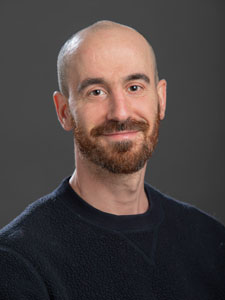
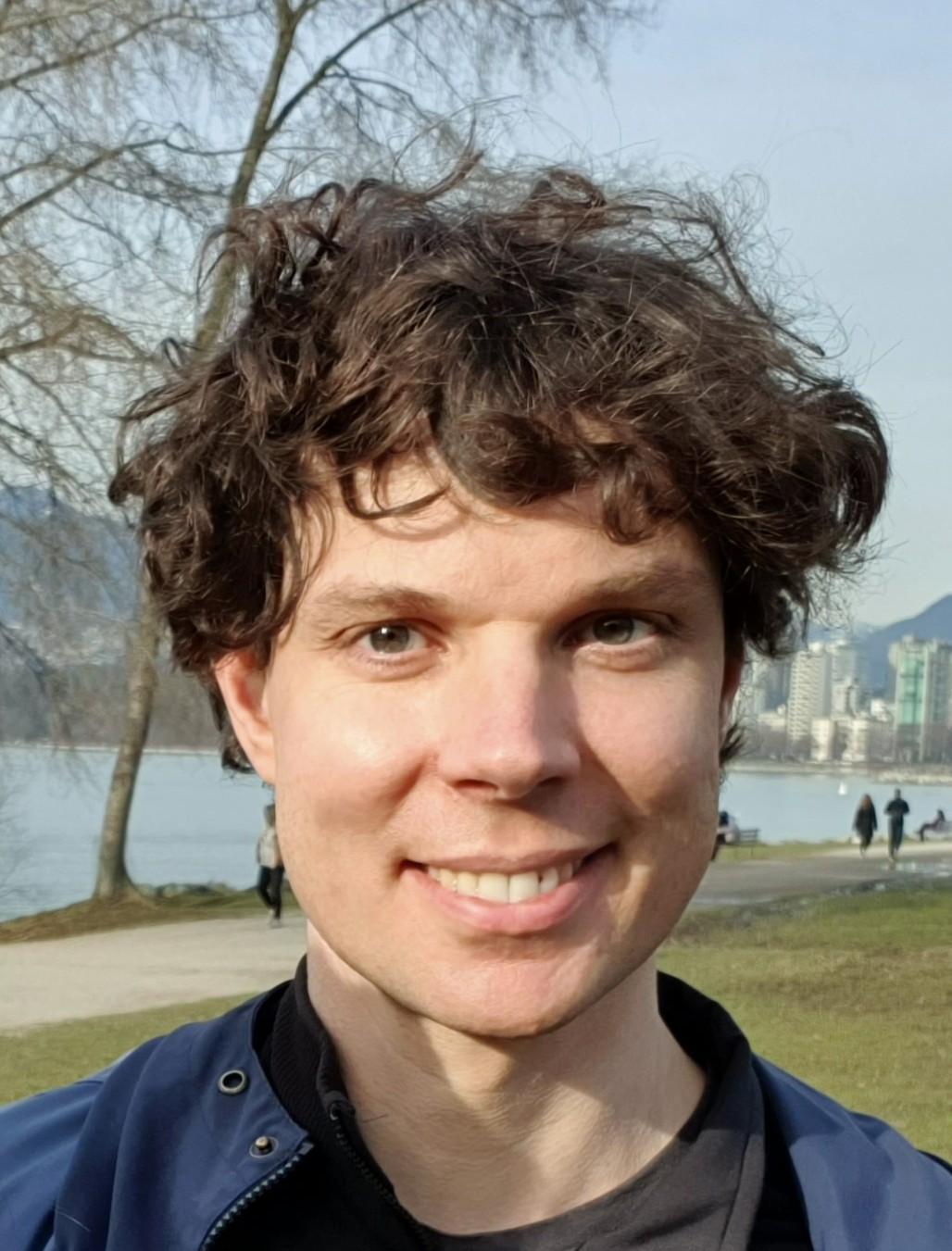
Joni Teräväinen is an Assistant Professor at the University of Cambridge , affiliated with the Department of Pure Mathematics and Mathematical Statistics. His research is funded by an ERC Starting Grant and has been supported by prestigious fellowships including the Academy Research Fellow, Marie Curie Fellow, and von Neumann Fellow. Current Role: Assistant Professor, University of Cambridge Previous Roles: Academy Research Fellow (University of Turku), von Neumann Fellow (IAS), Titchmarsh Research Fellow (University of Oxford) His research interests lie at the intersection of analytic number theory , additive combinatorics , and ergodic theory , with a focus on multiplicative functions, prime distribution, and higher-order Fourier analysis. Recent work explores correlations of multiplicative functions, Fourier uniformity in short intervals, and applications to the Chowla and Elliott conjectures. Joni has published extensively in top journals including the Journal of the European Mathematical Society , Annals of Mathematics , and Proceedings of the London Mathematical Society . His publications reveal a trend toward quantitative bounds for Gowers uniformity, shifted exponential composites, and function field analogues of classical problems. Scientific Awards: ERC Starting Grant Academy Research Fellow Marie Curie Fellow von Neumann Fellow Academy of Finland Postdoctoral Researcher Titchmarsh Research Fellow Contact: jt945@cam.ac.uk . More details are available on his personal homepage .
Julia A. Palacios is an Associate Professor of Statistics and Biomedical Data Science at Stanford University, with a courtesy appointment in Biology. She leads the Palacios Lab, focusing on developing statistical methods for evolutionary genomics, infectious diseases, and stochastic processes impacting public health. Her work integrates Bayesian nonparametric techniques, probabilistic AI, and computational statistics to address challenges in genetics, health, and cancer research. Her educational background includes a PhD in Statistics and postdoctoral research in computational biology. Current lab members include postdocs Bingjing Tang and Isaac Goldstein, PhD students Yi-Ting Tsai, Ivan Specht, Julie Zhang, and Leda Liang, and undergraduate researcher Shinnosuke Yagi. Former postdocs like Airam Blancas and Jaehee Kim have moved to faculty positions at ITAM and Cornell, respectively. Research funding includes NIH, NSF, Sloan Foundation grants, and the Terman Fellowship. Key contributions span phylodynamic modeling, coalescent theory, and real-time pathogen surveillance. Her lab's software tools include phylodyn (R package for phylodynamic inference) and adaPop (Bayesian population dynamics inference). Awards include the Sloan Research Fellowship and Gabilan Fellowship. Teaching roles include courses like Stats 376 and Stats 305A . Her lab actively recruits students and postdocs for research in evolutionary stochastic processes and biomedical data science. Labs/Teams: Palacios Lab at Stanford's Department of Statistics, collaborating with institutions globally on pandemic tracking and genomic studies. Current projects focus on multifurcating trees in infectious diseases, Bayesian nonparametric coalescent models, and computational tools for public health.
Dr. Luke Postle is a Canada Research Chair in Graph Theory and a Professor in the Department of Combinatorics and Optimization at the University of Waterloo. His research focuses on Graph Coloring, Graph Decompositions, Topological and Structural Graph Theory, Extremal and Probabilistic Combinatorics, and Matroids. He has received the 2021 Coxeter-James Prize for his contributions to combinatorics. His work includes theoretical advancements in graph coloring, decomposition algorithms, and structural properties of graphs on surfaces. He teaches courses on Graph Theory and Probabilistic Methods, with lecture series available on YouTube. Postle’s research has been published in top journals such as Journal of Combinatorial Theory Ser. B , Journal of Graph Theory , and Transactions of the American Mathematical Society . His articles address problems in list coloring, cycle counting, matroid structure, and probabilistic graph decomposition. Key Awards: 2021 Coxeter-James Prize Teaching: Graph Theory and Probabilistic Methods courses on YouTube Research Themes: Structural Graph Theory, Combinatorial Optimization, Probabilistic Methods
Daniel Dadush is a part-time Professor of Geometry of Optimization at Utrecht University and leads the Networks & Optimization group at Centrum Wiskunde & Informatica (CWI). He has held previous positions as a Simons Postdoctoral Fellow at the Courant Institute of Mathematical Sciences (New York University) and a PhD in the ACO program (Algorithms, Combinatorics, and Optimization) at Georgia Tech. Research Interests: Lattice Algorithms, Geometry of Numbers, Linear/Integer Programming, Extended Formulations, Discrepancy Theory, Convex Optimization, Asymptotic Convex Geometry. Awards: Van Dantzig Prize (2020), Best Paper Award at CCC'20 (2020), Tucker Prize (2015). Advising: Supervised PhD/MSc students including Ben Bals, Samarth Tiwari, Sander Borst, Sophie Huiberts, Huck Bennett, and Yilin Li. Recent Publications: His 15 most recent articles focus on strongly polynomial algorithms, exact integer programming, convex optimization in the oracle model, matrix discrepancy, circuit diameter bounds, and integrality gaps, spanning journals and conferences like STOC, SODA, FOCS, and Mathematical Programming. Professional Activities: Organizer of the Dutch Day on Optimization (2022), co-organizer of workshops on Discrepancy Theory, Lattices, and Discrete Optimization at institutions like HIM Bonn and the Simons Institute. Served on program committees for STOC 2025, SODA 2024, and other major conferences. Teaching: Lectured on Interior Point Methods, Straight-Line Complexity, and courses in Continuous Optimization at Utrecht University and Mastermath.
Leonard J. Schulman is a Professor of Computer Science at the California Institute of Technology (Caltech), where he has been on the faculty since 2000. He is affiliated with the Caltech Center for the Mathematics of Information (which he directed from 2003 to 2017) and the Institute for Quantum Information and Matter. His academic appointments have included positions at UC Berkeley, the Weizmann Institute of Science, the Georgia Institute of Technology, and the Mathematical Sciences Research Institute. Schulman received his BSc in Mathematics in 1988 and his PhD in Applied Mathematics in 1992, both from the Massachusetts Institute of Technology (MIT). Schulman's research spans several overlapping areas in theoretical computer science and applied mathematics. His work focuses on algorithms and communication protocols , combinatorics and probability , coding and information theory , and quantum computation . More recently, his research has expanded into causal inference and machine learning , particularly in the areas of mixture models, causal discovery, and structure learning. His approach combines deep theoretical insights with practical applications across multiple domains. An analysis of Schulman's recent publications (2019-2025) reveals a strong focus on causal inference and machine learning, particularly in the areas of mixture models, causal discovery, and structure learning. His work bridges theoretical computer science with statistical learning, often developing novel algorithms with provable guarantees. He has also maintained his foundational work in coding theory, algorithms, and quantum computation, demonstrating remarkable breadth across theoretical computer science. IEEE Schelkunoff Prize (2004) ACM Notable Paper (2012) UAI Best Paper Award (2016) FOCS Test of Time Award (2022) S. A. Schelkunoff Transactions Prize Paper Award (2004) SIAM Fellow NSF CAREER award NSF mathematical sciences postdoctoral fellowship MIT Bucsela prize in mathematics Schulman has advised numerous PhD students and postdoctoral researchers who have gone on to successful careers in academia and industry. His former students and postdocs include notable researchers such as Ashwin Nayak, Yaoyun Shi, Sean Hallgren, Jie Gao, and Michael Langberg. He served as Editor-in-Chief of the SIAM Journal on Computing from 2013 through 2018 and has been on the editorial boards of several prestigious journals including the Journal of the ACM, ACM Transactions on Algorithms, and SIAM Journal on Discrete Mathematics. Schulman directs the Caltech Center for the Mathematics of Information, a research center focused on the mathematical foundations of information processing, communication, and computation. His work often involves interdisciplinary collaborations across computer science, mathematics, physics, and economics.
Raffaella Mulas is an Assistant Professor in the Department of Mathematics at the Faculty of Science, Vrije Universiteit Amsterdam. She previously served as a Group Leader and Minerva Fast Track Fellow at the Max Planck Institute for Mathematics in the Sciences, where she maintains an ongoing affiliation. Her research lies at the intersection of spectral graph theory, discrete mathematics, and network science. Research Interests: Her work focuses on the spectral theory of graphs and hypergraphs, particularly the properties of discrete Laplacians and non-backtracking operators. She investigates extremal combinatorics problems such as graph coloring and the Turán problem, often applying spectral methods to derive sharp bounds. Her research has strong applications in modeling and analyzing complex networks. Recent Research Trends: Analysis of the 15 most recent publications reveals a consistent focus on spectral characterizations of graphs and hypergraphs, including signed and complex unit hypergraphs. She frequently studies the normalized Laplacian and its extremal eigenvalues, develops non-backtracking operators, and explores measure-theoretic and geometric representations of networks. A strong thread connects spectral bounds to combinatorial invariants like chromatic number. VU Startpremie Grant Elected Member, European Mathematical Society Young Academy (EMYA) Elected Member, Elisabeth-Schiemann-Kolleg, Max Planck Society Minerva Fast Track Fellow, Max Planck Institute Advising and Grants: While no formal students are listed, she is an active researcher with significant grant funding, notably the VU Startpremie Grant. She collaborates internationally and supervises research projects in spectral graph theory and network analysis. Her affiliation with both VU Amsterdam and MPI-MiS enables broad academic mentorship and collaborative supervision. Labs and Research Groups: Raffaella Mulas leads research within the Mathematics Department at VU Amsterdam and is affiliated with the research group at the Max Planck Institute for Mathematics in the Sciences. Her work contributes to advancing theoretical foundations in discrete mathematics with applications in data science and network modeling.
Roie Levin is an Assistant Professor at Rutgers University's Department of Computer Science. He received his PhD in Algorithms, Combinatorics and Optimization from Carnegie Mellon University in 2022, advised by Anupam Gupta. Prior to that, he worked at the Allen Institute for Artificial Intelligence (2015-2017) and earned dual BSc degrees in Computer Science/Applied Mathematics and Mathematics from Brown University (2015). Before joining Rutgers, he was a Fulbright Postdoctoral Fellow at Tel Aviv University under Niv Buchbinder. Current Role: Assistant Professor in Computer Science Academic Training: PhD (2022) CMU, BSc (2015) Brown University Postdoctoral: Fulbright Fellow at Tel Aviv University Levin's research focuses on approximation algorithms for uncertain environments (online/dynamic/streaming models) and submodular function optimization. His work spans theoretical foundations and practical implementations across distributed systems, geometric constraints, and reinforcement learning paradigms. Teaching includes graduate and undergraduate algorithms courses (CS 344, CS 513) with emphasis on problem-solving techniques, computational complexity, and modern algorithmic trends. His publications showcase expertise in online algorithms, submodular optimization, and approximation theory with applications in clustering, caching, and machine learning. The 2025 articles demonstrate continued exploration of online consistency and contention resolution, while 2023-2024 works focus on submodular optimization under uncertainty and dynamic environments. Earlier publications (2015-2017) cover semantic parsing, geometric approximation, and planar graph optimization. Fulbright Postdoctoral Fellow Levin's research connects theoretical guarantees with practical implementations, bridging classical algorithm design with modern machine learning applications. His recent work explores primal-dual methods in online settings and robust subspace approximation techniques for streaming data environments.
Ron Peled is a Full Professor in the School of Mathematical Sciences at Tel Aviv University. Starting in summer 2024, he will serve as a Brin Professor in the Department of Mathematics at the University of Maryland, on leave from Tel Aviv University. During the 2022-2024 academic years, he visited Princeton University and the Institute for Advanced Study. His research spans multiple areas of probability theory and statistical physics, with significant contributions to understanding random surfaces, first-passage percolation, spin systems, and disordered models. Peled's research interests primarily focus on Probability Theory and Statistical Physics. His work examines the behavior of random systems, particularly in the presence of disorder or constraints. He has made significant contributions to understanding minimal surfaces in random environments, the structure of geodesics in first-passage percolation, phase transitions in spin systems, and the properties of random surfaces. His research often combines deep probabilistic insights with connections to statistical mechanics and mathematical physics, revealing universal behaviors in complex random systems. Analysis of Peled's recent publications reveals a strong focus on understanding the effects of disorder in statistical physics models. His work spans multiple domains including first-passage percolation, random surfaces, spin systems, and random matrix theory. A recurring theme is the investigation of how microscopic randomness affects macroscopic properties, with particular attention to phase transitions, correlation decay, and geometric structures emerging in random environments. His research often employs sophisticated probabilistic techniques combined with insights from statistical mechanics. Peled has received significant recognition through prestigious grants including multiple Israel Science Foundation grants (1048/11, 861/15, 1971/19, 2340/23), a Marie Skłodowska-Curie Actions International Reintegration Grant (SPTRF), an ERC Starting Grant (LocalOrder), and an ERC Consolidator Grant (Transitions). These awards reflect the importance and impact of his research in the mathematical community. Peled has supervised numerous students and postdocs throughout his career. His Ph.D. students include Daniel Hadas (joint with Wojciech Samotij) and Yinon Spinka (graduated August 2018). His Master's students include Michal Bassan (joint with Shoni Gilboa), Daniel Hadas, Yoav Bar Nir, Dor Elboim (who went on to do a Ph.D. at Princeton), Vital Kharash, Omri Cohen-Alloro, Alexey Gladkich, and Yinon Spinka. He has also mentored postdoctoral fellows including Lakshmi Priya, Paul Dario, Matan Harel, Raimundo Briceño, Alexander Glazman, Alexander Magazinov, Xiaolin Zeng, Nishant Chandgotia, Jeremiah Buckley, Wojciech Samotij, and Tom Ellis. Peled is actively involved in the academic community, serving as one of the organizers of the online Joint Israeli Probability Seminar and previously organizing the Horowitz Seminar on Probability, Ergodic Theory and Dynamical Systems. He has also organized several workshops and conferences including "Challenges in probability and statistical mechanics" at the Technion in 2022, the "Workshop on Strongly Correlated Random Interacting Processes" at Oberwolfach in 2018, and "Elegance in probability: A conference honoring Russell Lyons' 60'th birthday" at Tel Aviv University in 2017.
Tsui-Wei Weng is an Assistant Professor at the Halıcıoğlu Data Science Institute, affiliated with the Department of Computer Science and Engineering at the University of California, San Diego (UCSD). Her research focuses on enhancing the robustness, reliability, and safety of AI systems and deep learning models. Education: Ph.D. in Electrical Engineering and Computer Science (EECS), Massachusetts Institute of Technology (MIT), 2020; M.S. in Communication Engineering, National Taiwan University, 2013; B.S. in Electrical Engineering, National Taiwan University, 2011. Her research interests span neural network robustness, AI safety, adversarial robustness certification, control policy verification, and theoretical machine learning. She has contributed foundational work on probabilistic and deterministic robustness certification frameworks like PROVEN and CNN-Cert, with a focus on improving the scalability and efficiency of verification methods. Her publications from 2018–2021 reveal a trajectory in adversarial robustness, randomized smoothing, deep reinforcement learning, and interpretable AI. Collaborative efforts with institutions like MIT-IBM Watson AI Lab, Google DeepMind, and IBM Research further underscore her interdisciplinary approach. Scientific awards include the Best Paper Award at IEEE Components, Packaging and Manufacturing Technology (2016). She actively collaborates with students and postdocs, emphasizing mathematical and machine learning rigor in their research contributions.
Prof Ian M. Wanless is a Professor in the School of Mathematics at Monash University, Melbourne, Australia. He has held academic positions at institutions including the Australian National University (ANU), University of Melbourne, Christ Church Oxford, and Charles Darwin University. His research primarily focuses on combinatorics, with specializations in Latin squares, matrix permanents, graph theory, and algebraic structures. He has made significant contributions to the enumeration and properties of Latin squares, including groundbreaking work on transversals, orthogonality, and symmetry. Wanless has also explored connections between Latin squares and algebraic structures like quasigroups and loops. His education includes a PhD from ANU (supervised by Brendan McKay) and postdoctoral fellowships at Oxford and ANU. He has been awarded an Australian Research Council Future Fellowship (2011) and has led major research initiatives, including organizing international conferences (e.g., 5ICC in 2017). His work spans theoretical results and computational methods, with over 100 publications in top journals like Journal of Combinatorial Theory and SIAM Journal on Discrete Mathematics . Wanless’s research interests extend to design theory, hypergraphs, and permutation polynomials. He co-edits the Electronic Journal of Combinatorics and has held leadership roles in professional societies, including president of the Combinatorial Mathematics Society of Australasia. His current projects include studies on perfect 1-factorizations, covering radii of permutation sets, and algebraic properties of Latin squares.
Jonah Gaster is an Assistant Professor in the Department of Mathematical Sciences at the University of Wisconsin-Milwaukee, where he also serves as the Program Coordinator for the Topology Research Group and Colloquium Chair. His research focuses on mathematical topology, geometric group theory, and combinatorial structures in low-dimensional topology. His research explores the interplay between combinatorial methods and geometric structures, with specific interests in curve systems on surfaces, harmonic maps between manifolds, and the computational aspects of topological invariants. Recent work investigates combinatorial representations of geometric objects and their applications in low-dimensional topology. Analysis of Dr. Gaster's recent publications reveals a consistent focus on topological combinatorics, surface embeddings, and geometric group theory. His work bridges discrete mathematics with continuous geometric structures, particularly in the contexts of hyperbolic geometry and curve complexes. He leads the Topology Research Group at UWM, fostering collaborative investigations into fundamental questions in geometric topology and discrete mathematics.
Hemanshu Kaul is an Associate Professor of Applied Mathematics at Illinois Institute of Technology (IIT), part of the College of Computing. He serves as Co-Director of the M.S. in Computational Decision Science and Operations Research (CDSOR) program. His expertise spans Discrete Mathematics, Operations Research, Graph Theory, and Network Optimization, with applications in transportation, computer science, and engineering. Education: PhD in Mathematics from the University of Illinois at Urbana-Champaign (UIUC), MS in Mathematics from the Indian Institute of Technology Bombay. He has held roles including Distinguished Teaching Fellow (2016–2018) and AMS Project NExT Fellow (2007–2008). Research Interests : Focus on Graph Packing, DP-coloring, List Coloring, and algorithmic solutions for discrete optimization problems. His work bridges theoretical foundations with practical applications such as transportation networks and computer science systems. Publications & Grants : Over 50 publications in combinatorics and optimization, including NSF/NSA-funded projects like the EXCILL III Conference (2016–17). Recent work explores spectral Turán problems, DP-coloring algorithms, and longitudinal network models. Awards : Board of Trustees Award for Excellence in Teaching (2019) Excellence in Teaching Award (2017, College of Science, IIT) Interdisciplinary Research Grant (2009–2010, Transportation Networks) Advising & Leadership : Co-advisor for IIT's SIAM Student Chapter. Led restructuring of the Applied Math M.Sc. program (2018–19). Advised teams in the Mathematical Contest in Modeling (MCM), including a 2019 Meritorious Winner team for a disaster response system design. Labs & Collaborations : Involved in interdisciplinary projects combining applied math with computer science and engineering, including work on equitable public transit systems and network optimization.
Roland Bauerschmidt is a Professor of Mathematics at the Courant Institute of Mathematical Sciences, New York University. He previously held a professorship at the University of Cambridge and conducted postdoctoral research at Harvard and the Institute for Advanced Study. His research focuses on probability theory, mathematical physics, and statistical mechanics, particularly in spin systems, renormalization group methods, stochastic dynamics, and random matrices. He has contributed extensively to understanding phase transitions, critical phenomena, and universality classes. Education: PhD from the University of British Columbia (advised by David Brydges and others), undergraduate degrees from ETH Zurich. Research interests include applications of supersymmetry in probability, Coulomb systems, and log-Sobolev inequalities. He has organized programs such as the HIM Trimester Program on Probabilistic Methods in Quantum Field Theory. His teaching spans graduate and undergraduate courses in probability theory, stochastic dynamics, and mathematical analysis at NYU, Cambridge, and international institutions. His work frequently intersects with renormalization group techniques, spectral gaps, and non-equilibrium dynamics. Recent publications explore log-Sobolev inequalities in spin systems, high-temperature discrete Gaussian models, and percolation transitions in random forests.
Joy Morris is a Professor at the Department of Mathematics & Computer Science at the University of Lethbridge. She earned her BSc from Trent University in 1992 and her PhD from Simon Fraser University in 2000 under Brian Alspach. Her academic journey includes tenure in 2005, promotion to Associate Professor, and full Professor status in 2015. Research Focus: Interactions between group theory and graph theory, with emphasis on Cayley graphs and automorphisms Key Contributions: Solving the distinguishing number problem for various graph families, advancing DCI/CI group theory Research Overview Her work bridges abstract algebra with graph theory through Cayley graphs. She investigates automorphism groups, Hamilton cycles, and graph symmetry properties. Notable contributions include resolving the DCI property for specific groups, analyzing Praeger-Xu graphs, and studying color-preserving automorphisms. Academic Leadership As a co-author of two influential open-access textbooks ( Proofs and Concepts with Dave Morris and her own Combinatorics text), she has shaped curriculum development and mathematical education outreach programs for parents in Alberta. Her teaching portfolio includes foundational courses like Math 2000 and advanced combinatorial theory instruction. Collaborative Impact With over 30 publications since 1996, her collaborations span international researchers including C. Praeger, P. Spiga, and E. Dobson. Current projects involve hypercube distinguishing costs and automorphism group analysis of vertex-transitive digraphs. She maintains active research into graphical regular representations and graph isomorphism problems.
Prasad Tetali is a Regents' Professor at the Georgia Institute of Technology , with appointments in both the School of Mathematics and the School of Computer Science . He also holds an adjunct professor position at Emory University's Mathematics and Computer Science departments. Education: PhD in Mathematics (1991) from the Courant Institute of Mathematical Sciences at NYU; MS in Mathematics (1987) from the Indian Institute of Science; Postdoc at AT&T Bell Labs His research spans Discrete Mathematics, Probability Theory, and Theoretical Computer Science , focusing on Markov chains, Isoperimetry, Combinatorics, Computational number theory, and Algorithms. Recent work includes applications to statistical physics models and hypergraph structures. He has served as Director of the ACO Ph.D. Program since 2019 and held leadership roles like Interim Chair of the School of Mathematics. His publications reflect a blend of discrete geometry, stochastic processes, and algorithmic analysis . Key Honors: AMS Fellow (2012) SIAM Fellow (2009)