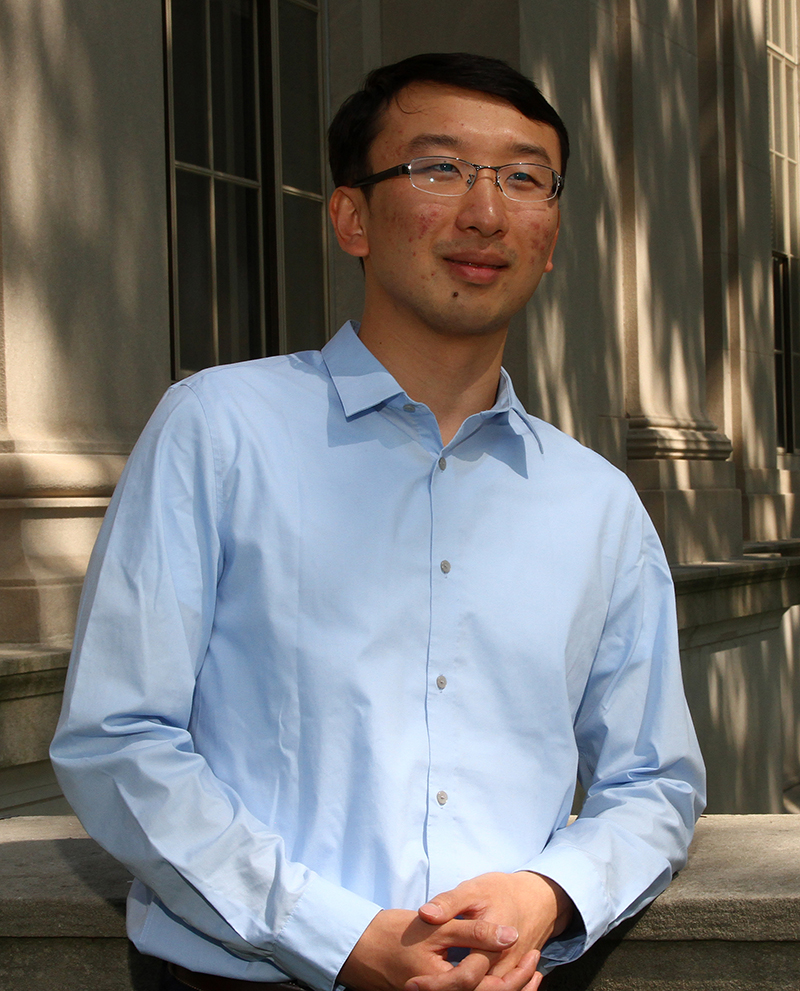
Natan RubinView profile
Professor
Natan Rubin is a faculty member in the Computer Science Department at Ben-Gurion University of the Negev, Beer-Sheba, Israel, where he has been conducting research in combinatorial and computational geometry since 2014. He is the principal investigator of a 5-year ERC Starting Grant project titled 'Combinatorial Aspects of Computational Geometry' (CombiCompGeom), which supports graduate students and postdocs in geometric algorithms and structures. Ph.D., Tel Aviv University, 2012 Advisor: Prof. Haim Kaplan and Prof. Micha Sharir His research focuses on fundamental problems in computational geometry, including geometric transversals , epsilon-nets , Voronoi diagrams , Delaunay triangulations , and intersection patterns of geometric objects . He has made significant contributions to the understanding of combinatorial bounds in geometric settings, such as resolving the Richter-Thomassen conjecture for pairwise intersecting Jordan curves and improving long-standing bounds on weak epsilon-nets. The recent publications reveal a consistent trend toward improving asymptotic bounds in high-dimensional and planar geometric configurations, with a strong emphasis on combinatorial methods and topological reasoning. His work often intersects with extremal combinatorics and discrete geometry, particularly in analyzing crossing and touching structures in planar graphs and families of convex sets. His scientific recognition includes: Best Paper Award at FOCS 2013 Best Paper Award at SoCG 2012 Rubin actively contributes to the academic community through service, having organized major workshops such as SODA 2018 and SoCG 2022, and hosting international researchers. He collaborates widely with leading figures in the field, including Pankaj Agarwal, János Pach, Micha Sharir, and Haim Kaplan. Though no formal list of students is provided, his ERC-funded project explicitly advertises multiple graduate and postdoctoral positions, indicating active mentorship. He is also involved in organizing international workshops and fostering collaboration within Israel’s strong computational geometry community, including researchers at BGU, Tel Aviv, and Jerusalem. His research is supported by competitive grants and involves the development of robust kinetic data structures and stable geometric graphs, with applications in dynamic environments and algorithmic stability.