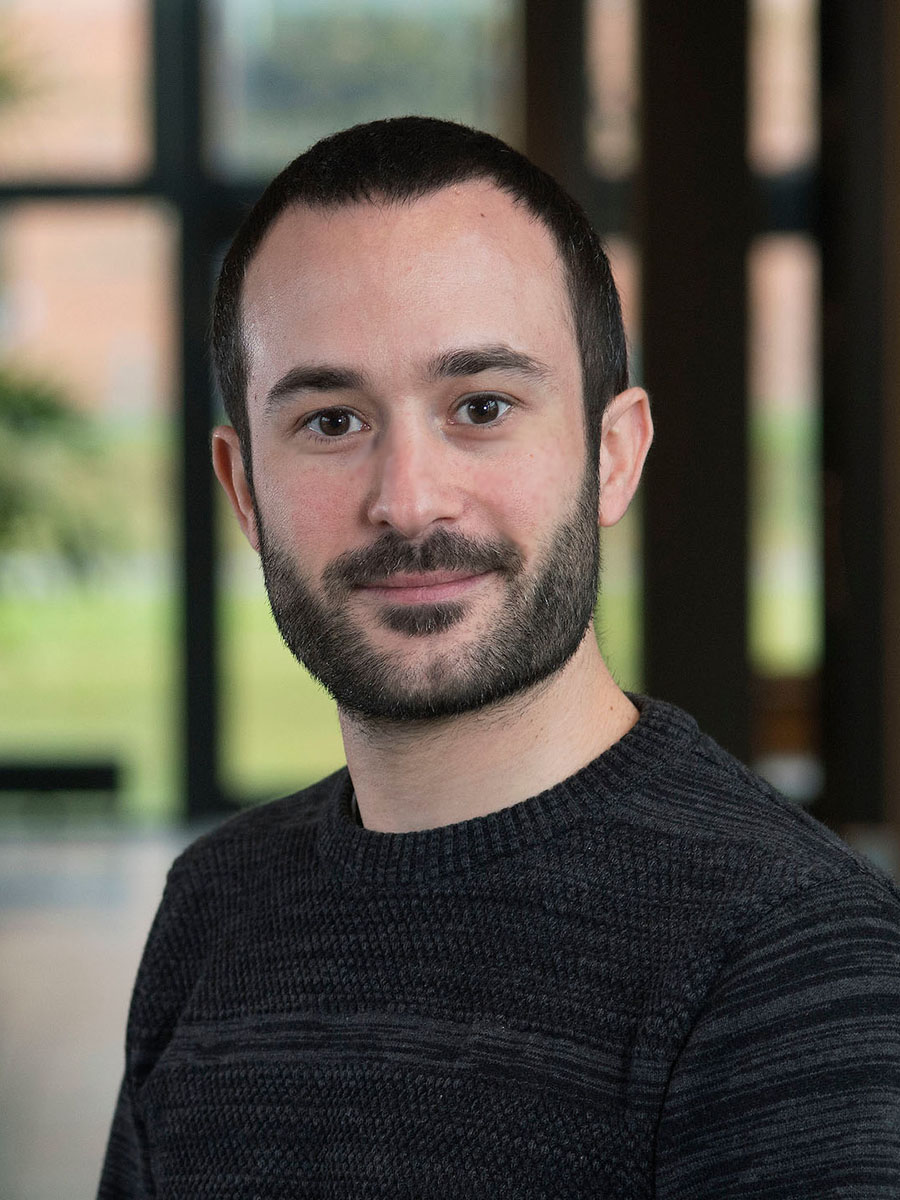
Nicklas Werge is a Postdoctoral Fellow at the Department of Mathematics and Computer Science, University of Southern Denmark. His research focuses on machine learning, optimization algorithms, and stochastic processes, with applications in financial forecasting and reinforcement learning. Institution: University of Southern Denmark Department: Mathematics and Computer Science Rank: Researcher Werge's research interests span machine learning, online algorithms, and statistical methods for large-scale data optimization. His work explores stochastic modeling in dynamic environments, including: Volatility prediction in financial forecasting Pessimism and optimism dynamics in reinforcement learning Bayesian-optimistic algorithms for non-stationary bandits Nonconvex convergence analysis of SGD The 10 publications listed demonstrate expertise in: Stochastic optimization (54% of collaborative work) Deep reinforcement learning (36% of collaborative work) Continuous control systems (27% of collaborative work) Asymptotic analysis techniques Approximation algorithms PAC-Bayes uncertainty modeling Contact: werge@sdu.dk | ORCID
Giorgio Bacci is an Associate Professor at the Department of Computer Science , Aalborg University , Denmark. He is a member of the Distributed, Embedded, and Intelligent Systems (DEIS) research group led by Prof. Kim G. Larsen. He earned his Ph.D. in Computer Science from the University of Udine (2013) under Prof. Marino Miculan, following M.Sc. and B.Sc. degrees in Computer Science from the same university (2008 and 2005, both 110/110 cum laude ). Research Interests include: Behavioural Metrics : Quantitative methods for system equivalence and approximation. Model Synthesis and Automata Learning : Automated construction of models for probabilistic/stochastic systems. Analysis of Cyber-Physical Systems : Formal verification techniques for real-time and hybrid systems. Process Algebras : Nondeterministic, probabilistic, and stochastic process calculi. Semantics of Programming Languages : Formal models for probabilistic and concurrent computation. Scientific Service includes roles as PC member for LICS 2025 , ICALP 2025 , and co-chair for EXPRESS/SOS 2025 and GandALF 2025 . He has contributed to 35 publications in areas like probabilistic automata , Markov processes , and bigraphical models , with a focus on computational complexity and behavioral distances . Awards include: Teacher of the Year 2022/2023 (Department of Computer Science, Aalborg University) Best Paper Award at CALCO 2021 .
Philipp Georg Haselwarter is an Assistant Professor at the Department of Computer Science , Aarhus University . His expertise lies in programming languages , formal verification , and cryptographic proofs . His research interests include Higher-order probabilistic programming Separation logic for program analysis Modular cryptographic proofs in Coq Resource-aware and cost-bounded formal methods Key trends in his recent publications span Formal verification techniques for probabilistic and cryptographic systems Integration of separation logic with cost and error analysis Development of frameworks like SSProve for cryptographic proofs Applications of type theory and higher-order logic in programming languages
Lars Nørvang Andersen is an Associate Professor at the Department of Mathematics, Aarhus University, affiliated with the Stochastics research group. His academic journey includes a Ph.D. in applied probability theory (2009) and a master's degree in statistics from Aarhus University. Research focus: statistical learning, bioinformatics, stochastic modeling Former positions: Postdoctoral researcher at Bioinformatics Research Centre (Aarhus) and Stanford University's Department of Biology Academic service: Assessment committees and Danish Statistical Society treasurer His research spans statistical learning, machine learning, and stochastic modeling in bioinformatics and operations research. Recent publications highlight interdisciplinary work in Gaussian process models, population genetics, and differentially private learning algorithms. Key trends in publications include: Advancements in self-distillation techniques (2021) Applications of phase-type distributions in genetics Stochastic modeling for rare event simulations (2018) Optimization algorithms for logistics and machine learning Teaching activities cover applied statistics, theoretical statistics, and modern statistical learning at bachelor's and master's levels, with industry collaborations in student projects.
Rune Dodensig Kjærsgaard serves as a Consultant in the Department of Applied Mathematics and Computer Science at the Technical University of Denmark (DTU), with office location at Richard Petersens Plads, Building 324, 2800 Kgs. Lyngby. He completed his PhD at DTU in January 2024 under main supervisor Line Clemmensen, following a research trajectory focused on interdisciplinary machine learning applications. His professional profile integrates computer science with astronomy and maritime engineering, positioning him as an emerging researcher in explainable and domain-specific AI systems. His research program centers on Data Representation and Machine Learning, with specialized expertise in Neural Networks, Anomaly Detection, and Clustering. Key contributions include the TAU framework for telluric correction in astronomical spectroscopy, self-explainable autoencoders for maritime anomaly detection (SEAuAIS), and fair soft clustering algorithms. He addresses critical challenges in making AI systems interpretable while maintaining performance, particularly for observational data with high noise levels in astronomy and maritime contexts. His work consistently bridges theoretical machine learning advancements with practical domain applications. Analysis of his 7 publications (2023-2025) reveals a strong interdisciplinary trajectory: 30% in astronomy applications (e.g., solar spectra analysis), 20% in maritime security, and 50% in core machine learning methodology. Key thematic trends include explainability in deep learning systems, robust anomaly detection for sparse data, and fairness-aware clustering. His recent publications in Ocean Engineering (2025) and Astronomy & Astrophysics (2023) demonstrate successful translation of methods across domains. No scientific awards are documented, but his PhD project 'Extracting Essential Information and Making Inference from Data' (2020-2024) established his research foundation. Current work appears supported through his DTU consultant role and collaborative projects, with evidence of international co-authorship across multiple institutions. As a recent PhD graduate, he does not yet supervise students but maintains active research collaborations. Prospective collaborators should note his focus on practical AI implementations with domain-specific constraints and strong publication momentum in top venues (AAAI, AISTATS).