Letterio Galletta is an Assistant Professor of Computer Science at IMT School for Advanced Studies Lucca, within the SySMA research unit. Previously, he held a postdoctoral researcher position at the University of Pisa's Department of Computer Science and earned his Ph.D. in Computer Science from the University of Pisa in 2014. His research focuses on language-based security, leveraging programming languages, compilers, and formal verification to address security challenges in adaptive software, IoT, firewalls, and blockchain technologies. Key research areas include secure compilation, access control policy analysis, smart contract formal models, and static analysis techniques. His work bridges theoretical foundations with practical applications, such as securing satellite communication systems (IRIS2) and enhancing firewall policy enforcement. Publications highlight contributions to blockchain transaction parallelism, IoT security metrics, and formal methods for SELinux configurations. He actively contributes to tools like FWS (Firewall Synthesizer) and VeriOSS for bug bounty protocols. His research emphasizes interdisciplinary approaches, combining cybersecurity with distributed systems and embedded computing.
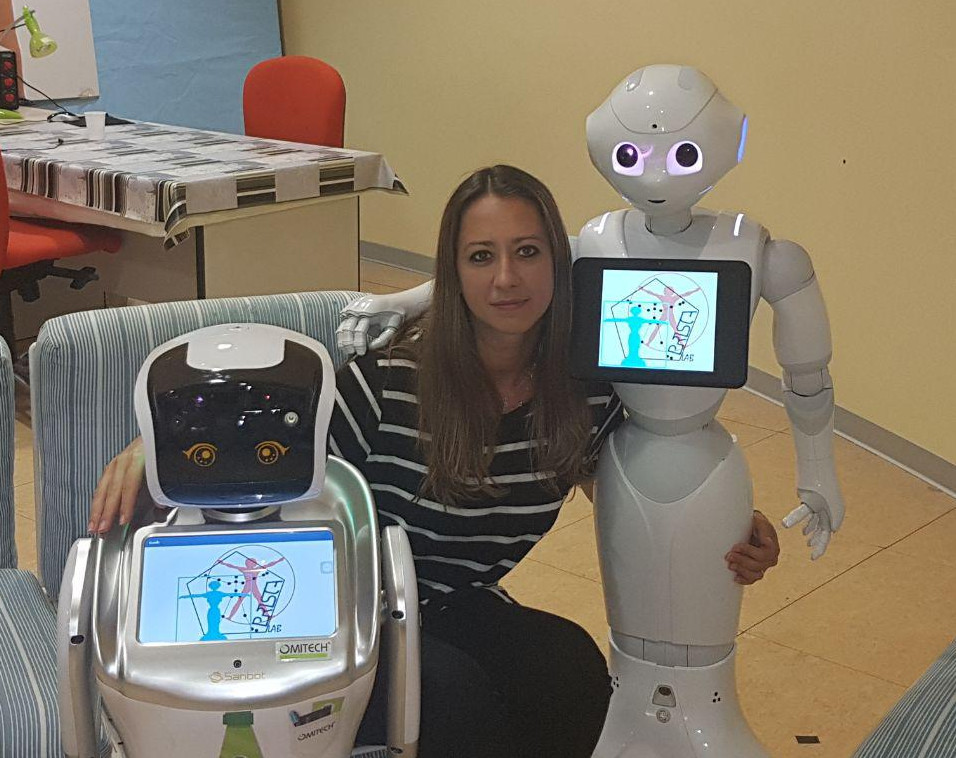
Silvia Rossi is an Associate Professor at the Department of Electrical Engineering and Information Technology (DIETI), University of Naples Federico II, Italy. She co-manages the PRISCA Lab focused on Intelligent Robotics and Advanced Cognitive Systems and coordinates the national project UPA4SAR (User-centered Profiling and Adaptation for Socially Assistive Robotics). Her research emphasizes Multi-agent Systems, Human-Robot Interaction, and Cognitive Architectures. She holds an M.Sc. in Physics from the University of Naples Federico II (2001) and a Ph.D. in Information and Communication Technologies from the University of Trento (2006). Professional experience includes roles at the ITC-irst (Italy), Institute of Cybernetics E. Caianiello (CNR, Italy), and visiting research at Oregon Health and Science University (USA). Research interests span socially assistive robotics, user profiling, and emotion recognition. Key contributions include adaptive robot behaviors for healthcare and education, transparent HRI, and multi-agent systems for smart environments. She teaches courses such as Multi-agent Systems, Distributed Intelligence, and Programming I. Her work integrates AI, robotics, and human-centered design to address challenges in assistive technologies and human-robot collaboration. Publications focus on socially assistive robotics, emotion-aware systems, and transparent AI. Projects include field trials of social robots for elderly care and pediatric emotional support. Awards and recognitions are not explicitly listed but reflect her leadership in socially impactful robotics research.
Giuseppe Sanfilippo is a Full Professor of Probability (MAT/06) in the Department of Mathematics and Computer Science at the University of Palermo, Italy. He holds the position of FULL PROFESSOR (MATH-03/B) and maintains office hours on Thursdays from 9:00 to 11:00 at DMI, Via Archirafi 34, second floor, Room 213. His academic appointments include teaching positions across multiple schools at the University of Palermo: School of Basic and Applied Sciences (Mathematics program) School of Basic and Applied Sciences (Artificial Intelligence program) Polytechnic School (Statistics for Data Analysis program) School of Basic and Applied Sciences (Computer Science program) Professor Sanfilippo's research focuses on the theoretical foundations of probability theory, particularly exploring the intersection between probability, mathematical logic, and conditional reasoning. His work centers on conditional events, coherence principles, trivalent logics, and connexive logic. He has made significant contributions to understanding the probabilistic interpretation of Aristotelian syllogisms, entropy and extropy measures, and the mathematical structures underlying compound conditionals. His research has important applications in artificial intelligence, uncertainty management, and decision theory, with over two decades of publications showing consistent development of these themes. Professor Sanfilippo has been actively involved in the academic community, organizing and participating in numerous international conferences including SUM (Scalable Uncertainty Management), ECSQARU (European Conferences on Symbolic and Quantitative Approaches to Reasoning with Uncertainty), and specialized workshops on connexive logic and probabilistic reasoning. His work bridges theoretical developments with practical applications in knowledge representation and reasoning under uncertainty, as evidenced by his extensive conference participation from 2014-2024 across Europe. He mentors students through various academic programs and has supervised numerous theses in probability theory and its applications. His teaching portfolio includes core courses such as 'Calculation of Probabilities' across Mathematics, Artificial Intelligence, Statistics for Data Analysis, and Computer Science programs, as well as specialized courses like 'Uncertain Reasoning and Probability,' reflecting his commitment to both foundational education and advanced research training. Professor Sanfilippo maintains an active research laboratory focused on probabilistic reasoning, where interdisciplinary teams explore the mathematical foundations of uncertainty and their applications in artificial intelligence and decision systems. His current research agenda includes extending coherence principles to complex conditional structures and developing scalable methods for uncertainty management in AI systems, as demonstrated by his upcoming conference chair position for SUM 2024 in Palermo.
Alessandro Aldini is an Associate Professor in the Section of Informatics and Mathematics within the Department of Pure and Applied Sciences (DiSPeA) at the University of Urbino Carlo Bo. His academic work focuses on theoretical computer science with applications to security and verification of complex systems. His research interests span several key areas: Design and verification of concurrent and distributed computer, network, and software systems Trust models and trustworthy systems Concurrency theory and (nondeterministic, probabilistic, and Markovian) process algebra Exact and approximate behavioral equivalences and equivalence checking Exact and approximate noninterference approach to information flow analysis Modal logics and model checking Security, dependability, and performability analysis Professor Aldini serves as the UNIURB research unit leader for the PRIN project AsCoT-SCE (Assessing Compliance of IoT API for Security Critical Environments) and participates in other significant research initiatives including DeKLA (Developing Kleene Logics and their Applications) and NiRvAna (Noninterference and Reversibility Analysis in Private Blockchains). He is actively involved in the academic community through the Italian Chapter of the EATCS and IFIP WG 11.14 Secure Engineering. His teaching responsibilities include Programming Languages and Software Verification and Cybersecurity courses across multiple Informatics degree programs. Professor Aldini has supervised numerous PhD students and postdoctoral researchers. His academic contributions include the book "A Process Algebraic Approach to Software Architecture Design" and his PhD thesis "Security and Performance Analyses in Distributed Systems."