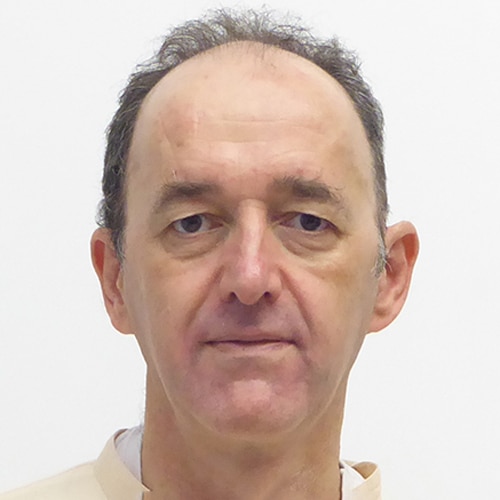
Thomas Wim Hamelryck is a Professor at the Department of Computer Science (Programming Languages and Theory of Computation) and the Department of Biology (Computational and RNA Biology) at the University of Copenhagen . With a PhD in Protein Crystallography from the Free University of Brussels (VUB), he specializes in Bayesian modeling , probabilistic machine learning , and statistical structural bioinformatics , focusing on protein structure prediction, evolution, and non-Euclidean data representation.
Kristian Olesen is an Associate Professor in strategic spatial planning at the Department of Sustainability and Planning, Aalborg University, affiliated with The Technical Faculty of IT and Design. He is a member of the Planning for Urban Sustainability (PLUS) research group and serves as program coordinator for the Urban Planning and Management master’s program. His work focuses on linking spatial planning to politics, urban infrastructure investments, and neoliberalization trends in Denmark. Research Interests: Strategic spatial planning at multiple scales (transnational to neighborhood) Urban redevelopment of deprived neighborhoods via housing associations Integration of energy and urban planning for Positive Energy Districts Neoliberalization of Danish spatial planning systems Urban governance and public participation Projects: Lead investigator for PED-JUST (2025-2027): Energy transition strategies in disadvantaged neighborhoods FLEXPOSTS (2022-2025): Flexible positive energy district systems Fremtidens Boligorganisation (2021-2025): Housing associations as urban developers Teaching: 10+ years leading problem-based learning in urban planning aligned with UN SDGs Focus on sustainable development goals integration in curricula Collaborations: Active partnerships with Realdania, Landsbyggefonden, and Innovation Fund Denmark International collaborations on Nordic housing policy and urban development
Anders Læsø Madsen is a Professor at the Department of Computer Science , part of The Technical Faculty of IT and Design at Aalborg University . His research focuses on probabilistic graphical models, with a particular emphasis on Bayesian networks and their applications in industrial and environmental domains. Current affiliation: Aalborg University Research areas: Bayesian networks, probabilistic inference, decision support systems, data stream modeling His recent work spans control room engineering , where AI systems aid human operators, and environmental risk assessment using probabilistic models of pharmaceutical impacts. He also contributes to artificial intelligence in power grid monitoring , addressing anomaly detection through Bayesian reasoning. Publications from 2024-2025 demonstrate interdisciplinary applications, including electricity grid data validation , explainable AI frameworks , and pharmaceutical risk modeling . These works integrate probabilistic methods with domain-specific challenges in energy systems, industrial automation, and environmental science.
Matteo Marsili is a Senior Research Scientist at the Quantitative Life Sciences Section of the Abdus Salam International Centre for Theoretical Physics (ICTP) in Trieste, Italy. He holds a PhD from SISSA, Trieste (1994) and has held postdoctoral positions at Manchester University, Fribourg University (Switzerland), and SISSA. He joined ICTP in 2002, initially in the Condensed Matter and Statistical Physics (CMSP) Section before transitioning to the Quantitative Life Sciences Section. His research spans interdisciplinary domains, applying statistical physics to complex systems. Key areas include non-equilibrium statistical mechanics, critical phenomena, quantitative finance, statistical inference, machine learning, systems biology, and neuroscience. He investigates how collective behaviors emerge from interactions among simple units—such as particles, neurons, or financial traders—using tools from probability, information theory, and thermodynamics. His recent publications (2020–2025) show a strong focus on information-theoretic approaches to learning, relevance quantification, deep learning, and optimal inference. Themes include Bayesian modeling, minimal complexity, self-organized criticality in neural networks, and thermodynamics of information in financial markets. His work frequently appears in journals like Physical Review E , Journal of Statistical Mechanics , Physics Reports , and PLoS ONE . Matteo Marsili has collaborated extensively with researchers such as Y. Roudi, R.J. Cubero, J. Song, and R. Xie, suggesting active mentorship and team leadership. While no formal awards are listed, his sustained publication record in high-impact journals reflects significant scientific contributions. His lectures at institutions like the Kavli Institute and IHÉS further highlight his academic influence.