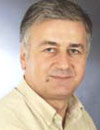
Stavrakakis Ioannis is a Professor at the Department of Informatics and Telecommunications, School of Science, University of Athens, where he has served since 2002. He previously held academic positions at Northeastern University (1994-1999) and University of Vermont (1988-1994). Ph.D., Electrical Engineering (1988), University of Virginia Diploma, Electrical Engineering (1983), Aristotle University of Thessaloniki His research focuses on network resource allocation algorithms , cooperative content dissemination , mobile ad hoc networks , and privacy-aware protocols . He leads the Advanced Networking Research (ANR) Group. Recent publications highlight trends in AI-driven network optimization , edge computing for VR , drone-assisted sensor networks , and privacy in vehicular systems . Key themes include game theory applications, energy-efficient protocols, and distributed learning frameworks. Contact: ioannis@di.uoa.gr
Dr. James A. Russell is an Associate Professor in the Department of National Security Affairs at the Naval Postgraduate School, specializing in U.S. security strategy in the Persian Gulf, nuclear strategy, and military innovation. He holds a PhD in War Studies from the University of London. His research examines security dynamics in the Middle East, naval power projection, and the intersection of climate change and defense policy. Dr. Russell teaches courses on U.S. foreign policy in the Middle East, military innovation, and national security strategy. Analysis of Dr. Russell's publications reveals evolving focus areas: from nuclear strategy and counterinsurgency in early work to contemporary examinations of great power competition and naval innovation. Recent scholarship emphasizes maritime security challenges in the Indo-Pacific, unmanned systems integration, and climate change impacts on naval operations. Dr. Russell served in the Office of the Assistant Secretary of Defense for International Security Affairs (Near East South Asia) from 1988-2001, gaining extensive field experience in the Persian Gulf and Middle East that informs his academic work.
Juan Manuel Cebrian Gonzalez is an Assistant Professor at the Department of Computer Engineering and Technology, Faculty of Informatics, University of Murcia. His work focuses on computer architecture, parallel systems, and energy-efficient computing. Doctorate: University of Murcia (2011), thesis on fine-grain power and thermal management in multicore processors. Research interests: Designing architectural mechanisms for optimizing power consumption and thermal management in multicore systems, cache coherence in parallel architectures, and vectorization techniques for high-performance computing. His work also explores heterogeneous architectures, fault tolerance, and efficient memory systems. Recent article trends: Focus on cache management, speculative execution, lock-free constructs, and performance-energy trade-offs in edge and heterogeneous computing. Key methodologies include gem5 simulation, Arm SVE, and AVX-512 vectorization. Collaboration: Supervised by Dr. Juan Luis Aragón Alcaraz and Dr. Stefanos Kaxiras. Active in the Computer Architecture and Parallel Systems research group.
Y. Charlie Hu is the Michael and Katherine Birck Professor of Electrical and Computer Engineering and Professor of Computer Science (by courtesy) at Purdue University, where he leads the PurNET Lab and contributes to the Systems and Networking Group. His research spans Mobile Systems, Distributed Systems, Operating Systems, and Computer Networks , with a focus on energy-efficient AI systems and edge computing. His groundbreaking work on smartphone energy management has been widely adopted by the mobile industry and recognized with multiple test-of-time awards , including from ACM SIGOPS and ACM SIGMOBILE . He has received prestigious honors like the NSF CAREER Award , Honda Initiation Grant , and industry accolades from Google Research and Qualcomm . Notable Funded Projects: NSF's NeTS: Black-box Optimization of White-box Networks (2023-2026) Intel -NSF's SPLICE initiative His research has produced 15+ PhD graduates now in academia (University of Arizona, Virginia Tech) and industry (Google, Apple, Qualcomm). The articles reflect a career-long focus on edge computing , 5G network optimization , and energy-aware systems , with recurring themes in mobile AR/VR , video analytics , and network protocol design . Scientific Awards Honda Initiation Grant NSF CAREER Award Purdue Early Career Research Award Google Research Award Qualcomm Faculty Award ACM SIGOPS EuroSys Best Student Paper Award ACM MobiCom Best Community Paper Award IEEE Fellow ACM Distinguished Scientist Purdue PRF Innovator Hall of Fame
Dong S. Ha is a Professor in the Bradley Department of Electrical and Computer Engineering at Virginia Tech. As Founding Director of the Multifunctional Integrated Circuits & Systems (MICS) Lab, he focuses on advanced circuit design for energy harvesting, RF systems, and high-temperature electronics. His work spans analog/RF ICs, power management circuits, and wireless IoT solutions with machine learning integration. Education: PhD (1986) and MS (1984) in Electrical and Computer Engineering from the University of Iowa; B.S. (1974) in Electrical Engineering from Seoul National University. Research interests include energy harvesting (piezoelectric, thermal, RF), high-temperature RF circuits for oil/gas/spacecraft applications, and smart IoT systems. He actively seeks students for projects in RF design, energy harvesting, and embedded systems. His lab develops cutting-edge solutions for harsh environment communication, sustainable energy systems, and smart agriculture monitoring. Awarded IEEE Fellow (2008) for contributions to VLSI design/test. Key publications span energy harvesting circuits, GaN-based high-temperature systems, and low-power IoT architectures. Current projects include self-sustaining smart farm networks using federated learning and attack-resistant sensor systems. Labs/Teams: Leads MICS Lab focusing on integrated circuits and systems. Collaborates on cross-disciplinary projects involving machine learning, embedded systems, and sustainable energy. Active in industry partnerships for aerospace and automotive applications.
Dr ASM Kayes serves as Senior Lecturer in Cybersecurity and Cyber Curriculum Lead at La Trobe University's Department of Computer Science and Information Technology, where he shapes cybersecurity education programs including Master's, Bachelor's, and Double Degrees. His academic journey began with a PhD from Swinburne University of Technology in 2015, followed by postdoctoral research at La Trobe before joining as Lecturer in 2019 and promotion to Senior Lecturer in 2022. His research spans critical cybersecurity domains including data security, privacy preservation, context-aware access control, malware/ransomware defense, and IoT/fog/cloud security leveraging AI/ML techniques. Dr Kayes has established himself as a leading voice in blockchain security frameworks, privacy policy analysis, and cyber incident response through publications in top-tier venues like ACM Computing Surveys, IEEE Internet of Things Journal, and Computers & Security. His recent publications reveal a strong trajectory toward integrating AI with traditional security frameworks, particularly in blockchain risk assessment (2025), cross-domain access control (2025), and IoT behavior prediction (2024). The research demonstrates consistent focus on practical security solutions addressing ransomware mitigation, privacy breaches, and emerging threats in decentralized systems. Over $880,000 secured as Chief Investigator for cybersecurity projects Australian Government Department of Social Services grant (2023-2026) for cyberbullying prevention AustCyber research funds with industry partners (2020-2023) SmartSat CRC and ASCRIN PhD scholarship grants (2021) Dr Kayes has successfully supervised 5 PhD candidates to completion and currently mentors 5 doctoral students across diverse topics including AI-driven threat hunting, satellite network security, and blockchain risk frameworks. His collaborative network spans UK, USA, Europe, and Asia, with active industry partnerships through Westpac, BHP, and Quantum Victoria. He serves on editorial boards for leading cybersecurity journals and has examined HDR dissertations globally, reflecting his significant standing in the academic community.
Professor David Stone is a faculty member in the School of Electrical and Electronic Engineering at the University of Sheffield, where he holds the position of Professor in Electrical Engineering and serves as Theme Lead for Electrical Machines. He earned his BEng (Hons) in Electronic Engineering from the University of Sheffield (1982–1985) and a PhD in Automatic Weld Penetration Control from Liverpool University (1989). Since joining the University of Sheffield in 1989, he has been affiliated with the Electrical Machines and Drives (EMD) Group, advancing to full professorship in 2013. His research focuses on power electronics , energy storage systems , and their applications in electric vehicles (EVs) and renewable energy integration . Notable work includes leading the CREESA initiative, which operates the UK's largest grid-connected lithium titanate battery storage system. Current projects explore hybrid energy storage, EV battery second-life applications, and high-frequency resonant converters for industrial heating. Research interests span: Simulation of energy systems and hybrid storage technologies Electric vehicle energy consumption modeling using dashcam telemetry Smart battery management for EVs and grid support High-efficiency wireless EV charging systems Advanced control strategies for power converters His publications (2020–2025) reflect contributions to: Energy storage system design and control Electric machine fault detection and diagnostics Grid integration of renewable energy sources Piezoelectric transformer-based power supplies Microgrid optimization with hybrid energy storage He collaborates with industry through initiatives like the EPSRC Prosperity Partnership in Offshore Wind and the TransEnergy project linking road-rail energy exchange. His work addresses challenges in sustainable energy systems and smart grid technologies.
Amitabh Mishra is an Adjunct Professor at the University of Delaware. His research focuses on three core areas: computer-communication networks (wireless architectures, cross-layer design, mobile cloud computing), network performance analysis (stochastic models, numerical optimizations), and network security (vulnerability assessments, authentication protocols). He has contributed to interdisciplinary fields including IoT security, smart healthcare frameworks, and socio-technical systems analysis. His work spans technical domains like wireless sensor networks, tactical network management, and quantum dot material studies, alongside applied research in tourism economics, healthcare data analytics, and educational technology. Notable contributions include frameworks for energy-efficient physiological monitoring, secure IoT configurations, and machine learning-driven security protocols. Recent research highlights include: Developing secure mobile cloud computing paradigms Modeling Multipath TCP capacity bounds using stochastic theory Investigating AI applications for deepfake ethics and tourism marketing His publications span technical journals in computer networks, medical IoT systems, and interdisciplinary studies in cultural tourism and climate change resilience.
Davide Previtali is an Assistant Professor at the University of Bergamo's Department of Engineering. His research focuses on control systems, black-box and preference-based optimization, and lithium-ion battery technologies. He teaches the 'Data science and automation' course (6 CFU). Education: Master’s in Computer Science Engineering (2019), PhD in Engineering and Applied Sciences (2022), both from University of Bergamo Research interests include model predictive control, thermal systems optimization, regenerative braking systems, and integration of biological models with neural networks. Recent work emphasizes energy-efficient industrial processes and algorithms for preference-based optimization with convergence guarantees. Publications span industrial oven modeling, shrink tunnel control systems, and advanced optimization algorithms. He leads the Control systems and Automation Laboratory, focusing on practical applications of control theory in manufacturing and energy systems. Labs/Teams: Control systems and Automation Laboratory
Daniela IUBATTI is an Assistant Professor at SKEMA Business School—Université Côte d’Azur (GREDEG), specializing in Management & Organization. Her research focuses on intra-organizational networks, innovation, digitalization, and gender studies. She holds a PhD in Management from IESE Business School (Spain), and has held roles at the University of Bologna, University of Trento, and University of Chicago. Her work explores how network structures influence innovation and how digitalization impacts organizational practices. Notable contributions include studies on core-periphery networks in R&D productivity and the sociomaterial effects of digital machines in manufacturing. She has published in top journals like Organization Science and Journal of Product Innovation Management . Awards include the 2020 EBS Best Paper Award. She reviews for journals such as Journal of Management and Journal of Business Ethics . Academic activities include SIG committee roles at EURAM and conference presentations at the Academy of Management.
Loïc Guégan is an Associate Professor in the Department of Informatics at UiT The Arctic University of Norway, affiliated with the Faculty of Science and Technology. His work is centered on energy-efficient cyber-physical systems and distributed computing, particularly in extreme and constrained environments such as the Arctic. His research focuses on cyber-physical systems (CPS) , distributed data dissemination , IoT and edge computing , and energy-efficient protocols . He actively contributes to the development of the Distributed Arctic Observatory (DAO) project and has designed tools like the ESDS simulator for evaluating distributed systems in challenging conditions. His technical work includes power monitoring using single-board computers and the design of the LoRaLitE protocol for low-energy wireless communication. The recent publications highlight a consistent trend in data dissemination strategies , simulation frameworks , and energy optimization for IoT and edge systems deployed in remote, resource-limited settings. These studies often leverage real-world Arctic deployments and epidemic-style algorithms to ensure robustness and scalability. Loïc is a member of the Cyber Physical Systems (CPS) research group and contributes to projects including The IoT-to-Extreme-Edge Infrastructure and Sustainable Distributed Systems for Sustainable Research and Education . He teaches courses such as Parallel Programming and Operating Systems . His research is supported through institutional and project-based funding, though specific grants are not detailed in the text.
Prof. Dr. Po Wen Cheng is a Professor and Head of the Stuttgart Chair of Wind Energy (SWE) at the Institute of Aircraft Design, University of Stuttgart. His research focuses on wind energy systems, including floating offshore wind turbines, lidar applications in wind farm control, and structural dynamics of renewable energy systems. He leads interdisciplinary projects addressing challenges in mooring systems, aeroelastic analysis, and noise mitigation. Key areas of expertise include aerodynamic load optimization, lidar-assisted control strategies, and numerical modeling of wind farm interactions. His work integrates advanced machine learning techniques for predictive maintenance and performance enhancement. Cheng collaborates with international institutions and participates in high-profile wind energy initiatives like the Alpha Ventus offshore wind farm study. Teaching: Courses on Wind Turbine Design and Wind Energy Utilization Research Labs: Stuttgart Chair of Wind Energy, Institute of Aircraft Design Recent Projects: Scaled Flight Demonstrator e-Genius-Mod, Passively Self-Adjusting Floating Wind Farms, Lidar-Based Virtual Sensors His research emphasizes sustainable energy transitions, with particular attention to offshore wind infrastructure and turbulence mitigation in complex environments.
Stephan Packard is a Professor for Cultures and Theories of Popularity at the Institute for Media Culture and Theatre at the University of Cologne, where he has held a full professorship since 2017. Previously, he served as Junior Professor for Media Cultural Studies at Albert Ludwig University of Freiburg (2010-2017) and was repeatedly an acting professor for Cultures and Theories of Popularity at the University of Cologne (2015-2017). His research focuses on media control (including censorship, surveillance, and propaganda), popular visual cultures with particular emphasis on comics research, and the complex relationships between factuality, fictionality, and virtuality. As a media semiotician and discourse analyst, Packard examines how meaning is constructed across different media forms and how power operates through media systems. Packard's scholarly output shows a clear trend toward examining the intersections of comics studies with broader media theory, political philosophy, and critical social analysis. His recent publications increasingly address digital sovereignty, algorithmic control, and the transformation of media landscapes in the digital age, while maintaining his foundational work in comics theory and media semiotics. His research connects historical analysis of media forms with contemporary concerns about digital media power structures. Heinz Maier-Leibnitz Prize of the German Research Foundation (2015) Packard leads several significant research projects including the OER-Verbundprojekt 'Comicforschung.nrw,' 'The Adventure as a Popular Nomad: Transformations of Adventure Narratives in Comics,' and the 'Glossary of Digital Sovereignty.' He is actively involved in multiple academic networks including the Global South Studies Center (since 2025), the Key Profile Area Skills and Structures in Language and Cognition (since 2024), and was the first chairman of the Society for Comics Research (ComFor) from 2013-2019. His work bridges theoretical media studies with practical concerns about digital citizenship and media literacy in contemporary society.
Per Bækgaard is an Associate Professor at the Department of Applied Mathematics and Computer Science, Technical University of Denmark (DTU), specializing in Cognitive Systems. He serves as Head of Study for Human-Centered Artificial Intelligence, leading research in human-computer interaction, user experience, eye tracking, and cognitive neuroscience. His work bridges AI and human cognition to create systems that enhance daily life and support meaningful tasks. PhD, MSc EE, Technical University of Denmark His research interests center on Human-Computer Interaction (HCI) , User Experience , and Human-Centered Artificial Intelligence , with strong emphasis on Eye Tracking , Cognitive Neuroscience , and Digital Media . He explores how digital systems can adapt to users’ cognitive states using physiological signals like pupil dilation and gaze patterns, aiming to improve learning, health, and decision-making. His work aligns with UN Sustainable Development Goals in health and education. The recent publications reflect a strong trend in integrating eye tracking and pupillometry with AI-driven adaptive systems , particularly in education and healthcare. Themes include generative AI in learning , trustworthy AI in supply chains , and digital micro-interventions for mental health . The interdisciplinary nature spans computer science, psychology, and biomedical engineering, showcasing a cohesive focus on human-centered technology evaluation. Scientific Awards: Best Paper Award, 26 Jun 2020 – for contributions to gaze interaction research Per Bækgaard actively supervises PhD students and leads multiple research projects, including those involving generative AI in education , digital phenotyping , and AI in nursing and mental health . He is the main supervisor for several PhD projects and a co-supervisor or examiner in others, demonstrating a strong commitment to academic mentoring. His grant involvement includes projects funded by DTU and collaborative research initiatives in digital health and AI. He is part of the Cognitive Systems group at DTU, contributing to interdisciplinary research in AI, neuroscience, and human factors. His team collaborates on projects involving real-time physiological monitoring, adaptive interfaces, and AI-mediated learning systems, positioning him at the forefront of human-centered AI research in Scandinavia.
Alexey Pavlov is a Professor of Petroleum Cybernetics at the Department of Geosciences and Petroleum, Norwegian University of Science and Technology (NTNU). He holds an MSc in Applied Mathematics from St. Petersburg State University, a PhD in Mechanical Engineering from Eindhoven University of Technology, and has industrial R&D experience from Statoil and Ford Motor Co. Education: MSc (Applied Mathematics, St. Petersburg State University), PhD (Mechanical Engineering, Eindhoven University) His research focuses on control systems for petroleum engineering applications, including nonlinear control theory, iterative learning control, and data-driven optimization methods. Publications reveal a strong emphasis on real-time drilling optimization, well integrity monitoring, and synchronization in networked systems. Recent work trends include machine learning integration for oil well monitoring, moment matching in model reduction, and extremum seeking control for multi-agent systems. Collaborations span institutions like Ford Motor Co., Statoil, and Eindhoven University of Technology. Current affiliations include the Department of Geosciences and Petroleum at NTNU. No scientific awards or advisee information is explicitly mentioned in the provided texts.