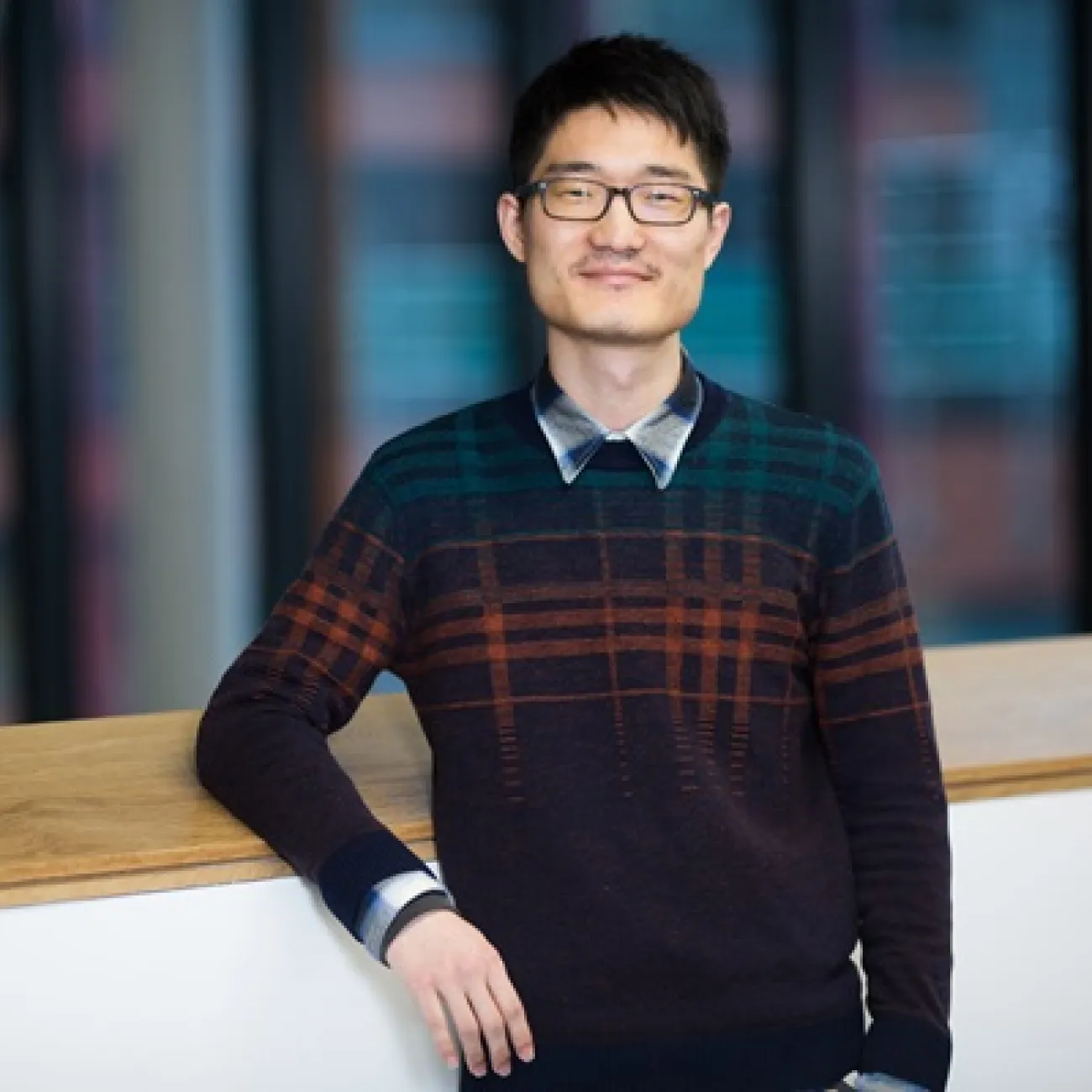
Jari Vepsäläinen is an Assistant Professor at Aalto University's Department of Energy and Mechanical Engineering under the College of Engineering. He serves as Director of the Fluid Power group and specializes in mechatronics design, energy efficiency, and generative design methodologies. Research focuses on physics-based modeling for energy recovery AI/ML applications in electromechanical system design Applications in robotics, heavy machinery, and sustainable transportation His recent publications demonstrate expertise in hybrid systems, fluid power optimization, and AI-driven engineering, with a strong emphasis on electrification and efficiency across automotive, maritime, and industrial domains. Key areas: Mechatronics, Energy Systems, Generative Design Technologies: Digital Twins, IoT, Machine Learning Current projects involve thermal energy systems, electric motor optimization, and advanced control algorithms for mobile machinery.
Dr. Zixu Liu is a Lecturer in Decision Analytics and Risk at Southampton Business School, University of Southampton. He focuses on applying machine learning and optimization techniques to business analytics problems, particularly in decision-making, smart grids, and industrial systems. PhD in Computer Science, University of Manchester (2013-2017) MSc in Computation and Game Theory, University of Liverpool (2012-2013) BSc in Computer Science and Technology, Jilin University (2007-2011) His research integrates advanced algorithms with cloud/web-based information systems to solve real-world challenges in multicriteria decision-making, electricity market pricing, and computer vision applications. Current projects emphasize industry transferability through API-driven solutions. Recent publications highlight diverse applications including: Smart grid optimization and demand response Hesitant fuzzy linguistic decision models Industry 4.0 collaboration platforms Deep learning benchmarks for object counting Wireless mesh network architecture He actively supervises PhD students and teaches undergraduate courses on spreadsheets, databases, algorithmic thinking, and data visualization.
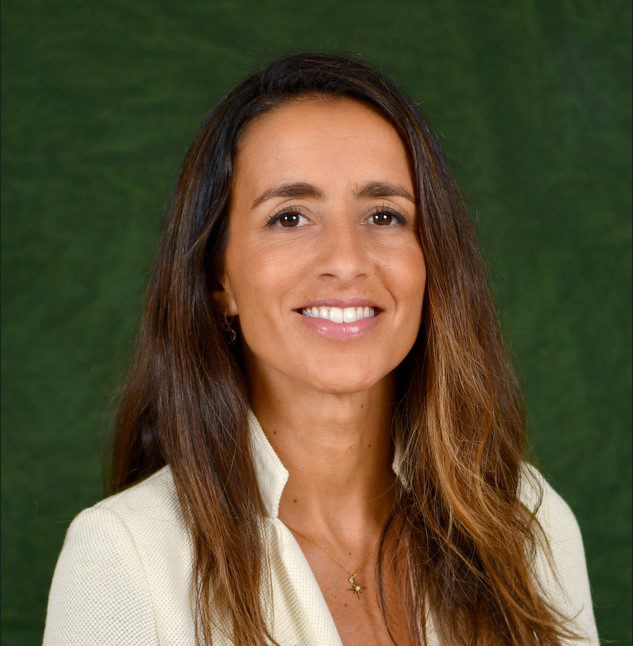
Valentina Cecchi is Associate Professor of Electrical and Computer Engineering and Associate Director of the same department at the University of North Carolina at Charlotte (UNC Charlotte), where she has been a faculty member since 2010. She previously served as Graduate Program Director and Associate Chair of the department from 2019 to 2024. Education background: Ph.D. in Electrical Engineering, Drexel University, Philadelphia, PA Research interests center on electric power systems modeling and analysis, with particular emphasis on optimization of transmission and distribution system planning and operation, grid-enhancing technologies, dynamic line rating of transmission lines, and the integration of renewable and distributed energy resources. Her work spans power system protection, resilience, data-driven analytics, and pedagogical innovation in power engineering education. A consistent thread in her recent publications (2023-2025) is the application of advanced analytics and machine learning to improve real-time monitoring, protection, and restoration of active distribution networks. A complementary focus is the development and evaluation of modern educational methodologies to prepare students for emerging challenges in power and energy systems. Scientific awards: William States Lee College of Engineering Graduate Teaching Excellence Award (2022) Advising & grants narrative: While specific PhD/Master’s students are not listed in the provided text, Dr. Cecchi’s service as Graduate Program Director and her active publication record with student co-authors suggest significant mentoring activity. She has led NSF-supported curriculum updates and educational research efforts, and her work on distribution system resilience, renewable integration, and protection coordination has been funded by multiple agencies and industry partners. Laboratory & teams: Dr. Cecchi is affiliated with the EPIC building (Energy Production and Infrastructure Center) at UNC Charlotte, specifically office 1224, and contributes to the university’s power and energy systems research infrastructure.
Wako Yoshida is Professor of Clinical Neuroscience at the University of Oxford's Nuffield Department of Clinical Neuroscience, leading research at the intersection of computational neuroscience, decision theory, and social cognition. Her work focuses on neural mechanisms of belief construction during partially observable decision-making and social interactions, with particular emphasis on prefrontal cortex function. Her research interests include: Computational modeling of uncertainty resolution in cognitive decision-making Neural basis of Theory of Mind during cooperative social interactions Pain neuroscience and aversive learning mechanisms Application of hyper-scanning fMRI for group decision-making studies Brain-machine interfaces for pain control through co-adaptive learning Analysis of her 15 most recent publications (2016-2024) reveals three dominant trends: (1) Neural mechanisms of hierarchical belief inference in spatial navigation and social contexts, (2) Uncertainty processing in pain modulation involving prefrontal-periaqueductal circuits, and (3) Development of computational frameworks for brain-machine interfaces targeting chronic pain management. Her work consistently bridges machine learning concepts with human neuroimaging. Scientific awards: No awards mentioned in source material. Advising and grants: Source text provides no details about students, advisees, or grant funding. Yoshida directs the Pain and Aversive Learning research group at Oxford, collaborating with Ben Seymour and others to investigate computational and neural mechanisms underlying pain, aversion, and decision-making using fMRI, hyper-scanning, and computational modeling approaches.
Mile Šikman serves as an active Associate Professor at the Faculty of Law, University of Banja Luka, specializing in Criminal Law and Criminal Procedural Law with concentrated expertise in Organized Crime. His academic role involves teaching core legal subjects while maintaining direct engagement with Bosnia and Herzegovina's evolving justice system through research and policy analysis. Research interests center on terrorism, gender-based violence, and transnational crime, with particular emphasis on Western Balkan security challenges. His work examines legal frameworks for victim protection, money laundering countermeasures, and digital environment impacts on juvenile behavior, consistently bridging theoretical criminology with practical law enforcement applications in post-conflict societies. Recent publications (2021-2024) reveal a pronounced focus on Bosnia and Herzegovina's specific security landscape, analyzing organized crime networks, terrorism trends, and gender violence legislation through transdisciplinary lenses. Key patterns include adaptation of legal systems to emerging threats like cybercrime and narcotics trafficking, alongside critical assessments of international convention implementation at national level.
Valbona Muzaka is a Professor at the Department of Economic History, Uppsala University, and affiliated with the Center for the History of Entrepreneurship. Her research focuses on the intersection of intellectual property rights (IPR), international trade, development studies, and global health governance. Current Faculty: Professor, Department of Economic History, Uppsala University Key Affiliation: Center for the History of Entrepreneurship Her work explores the political economy of IPR, particularly in pharmaceuticals, agriculture, and technology transfer. She analyzes global governance mechanisms like the WTO TRIPS Agreement, WIPO Development Agenda, and patent systems in India and Brazil, emphasizing equity and access challenges in developing countries. Recent publications highlight IPR conflicts in global trade, AI applications in drug patent searches, and the role of trademarks as innovation indicators. Her research spans 2009–2024, with a focus on Brazil's healthcare system, India's patent reforms, and global South-North power dynamics. Collaboration Highlights: Co-authored work with James Scott (2024) and Omar Ramon Serrano (2020) Key Themes: Regime conflicts, benefit-sharing, neoliberalism, and financialization
Kathleen Adelgais, MD, MPH, is a Professor at the University of Colorado Anschutz Medical Campus School of Medicine in the Department of Pediatrics-Emergency Medicine. She serves as Project Director for the Colorado EMS for Children Program and holds board certifications in Pediatrics (1998), Pediatric Emergency Medicine (2004), and Emergency Medical Services (2022). Her research focuses on pediatric emergency care , EMS for children , simulation training , and child abuse recognition . Recent work explores AI-powered speech recognition in emergency settings, sepsis management, trauma triage protocols, and health equity in pain medication administration. Notable contributions include: Co-developer of the PECARN cervical spine imaging prediction rule Advocate for standardized pediatric disaster triage simulations Research on smart glasses in EMS workflows Leadership in statewide EMS guideline implementation Awards include Fellow status at the American Academy of Pediatrics and National Association of EMS Physicians. She collaborates extensively with organizations like PECARN and NAEMSP, and her work appears in journals such as Lancet Child & Adolescent Health and Academic Emergency Medicine .
Dr. Yulin Hu serves as a Visiting Professor at RWTH Aachen University, holding the Chair of Information Theory and Data Analytics. His research program bridges theoretical foundations with practical implementations in next-generation wireless systems, with particular emphasis on UAV-aided networks and information-theoretic approaches to communication challenges. His core research interests span multiple interconnected domains: Wireless Communications (especially finite blocklength regimes) Information Theory applications in network design UAV trajectory optimization and network integration Wireless power transfer with nonlinear energy harvesting Edge computing and distributed learning systems Data analytics for network performance optimization Analysis of Dr. Hu's 2025 publication record reveals a concentrated research thrust on UAV trajectory design, where he develops joint optimization frameworks addressing energy efficiency, security, and reliability constraints. His work consistently integrates information-theoretic principles—particularly finite blocklength analysis—to solve practical challenges in ultra-reliable low-latency communications (URLLC) and wireless power transfer. A distinctive feature of his approach is the fusion of deep reinforcement learning with traditional optimization methods for dynamic network scenarios, including no-fly zone constraints and covert operations. While no specific scientific awards are documented in the available materials, his prolific output across top-tier venues demonstrates significant scholarly impact. Details regarding graduate student mentoring and research funding mechanisms remain unspecified in the current documentation. The Chair of Information Theory and Data Analytics, which Dr. Hu leads, functions as a specialized research unit focused on theoretical rigor and algorithmic innovation for wireless systems, though specific laboratory infrastructure or team composition details are not provided.
Professor James Taylor is a distinguished academic at Lancaster University where he holds a Personal Chair in Control Engineering within the School of Engineering . As Impact Champion for the School of Engineering and lead for Robotics & Control, he has been instrumental in advancing control engineering research. Previously, he served as group lead for Nuclear Science & Engineering (2019-24) and held senior administrative roles including Director of Teaching and Deputy Head of Engineering (2005-2018). Professor Taylor's research spans data-driven modelling and automatic control for challenging, uncertain systems with applications in Energy systems Healthcare Robotics Environmental monitoring His work has attracted over £10m in UK research council funding as co-investigator across 10+ projects. He has made significant contributions through his research on topics such as Electricity theft detection using machine learning Nuclear fuel analysis with hyperspectral imaging Digital twins for nuclear manufacturing Adaptive medical treatment systems Robotic plant phenotyping platforms Scientific recognition includes: Fellow of the Institution of Engineering & Technology (FIET) Member of IET Academic Accreditation Committee Editorial board member for three Elsevier journals Active participation in UK Automatic Control Council Professor Taylor has supervised numerous PhD students to successful completion and co-develops the internationally used CAPTAIN Toolbox (MATLAB) for system identification and control. He has been involved in developing control systems for Hydraulically actuated dual-arm robots Wave energy converters Assisted tele-operation systems Grow-cell agricultural facilities Motion planning algorithms
Sai Mounika Errapotu is an Assistant Professor in the Department of Electrical and Computer Engineering at the University of Texas at El Paso (UTEP). She leads the Cyber Physical Systems Privacy and Security Enhanced Computing (CyPSEC) Lab, focusing on developing practical security and privacy solutions for hardware and software systems in distributed networks, IoT, and smart grids. Her research integrates cryptography, differential privacy, and optimization to address emerging challenges in cyber-physical systems. Education: Ph.D. in Electrical and Computer Engineering (University of Houston, 2018), B.Tech. in Electronics and Communication Engineering (Jawaharlal Nehru Technological University, 2013). Postdoctoral work: AI, Networking Technologies, and Security Lab, University of Houston (2018–2019). Her research interests span cybersecurity, privacy-preserving protocols, trust modeling, and optimization in smart grids, IoT, and wireless networks. She emphasizes application-specific solutions that balance security, privacy, and scalability. Recent articles highlight advancements in intrusion detection via GANs and neural networks, smart home IoT security protocols, and privacy-preserving techniques in healthcare and transportation systems. Major Grants: $782,500 ARL grant for GAN-based intrusion detection, $1.1M DOE NNSA consortium for power systems, and $140K PNNL grant for healthcare synthetic data. Awards: Miguel Izquierdo Teaching Excellence Award (2021), Rising Stars Award, and Best Dissertation Award (2018). Advising highlights include mentoring students like Humaira (CPS Rising Star), Nicholas Lopez (M.S. grad in IoT security), and Ismael Holguin (LLNL intern). The CyPSEC Lab actively publishes in IEEE and NAPS conferences, addressing vulnerabilities in protocols like DNP3 and smart home IoT systems. Labs/Teams: CyPSEC Lab focuses on bridging theory and practice in CPS security, collaborating with industry partners and national labs.
Bo Wang is an active academic researcher primarily affiliated with multiple Chinese institutions, with strong connections to Tsinghua University, Beijing Jiaotong University, and other leading Chinese universities. His research spans artificial intelligence, machine learning, computer vision, medical image analysis, and intelligent control systems, demonstrating significant interdisciplinary work across computer science, engineering, and biomedical applications. Primary institutional affiliation: School of Computer Science and Technology at multiple Chinese universities Active research areas: AI/ML applications in healthcare, computer vision, federated learning, and intelligent control systems Extensive publication record across top-tier venues in multiple disciplines Wang's research interests focus on the intersection of artificial intelligence and practical applications. His work demonstrates strong expertise in developing novel machine learning architectures for medical image analysis, including applications in CT imaging, MRI, and sperm tracking. He has made significant contributions to federated learning approaches for large language models, sliding mode control systems, and molecular optimization frameworks. His research consistently bridges theoretical advances with practical implementations across healthcare, manufacturing, and environmental monitoring domains. Analysis of Wang's recent publications reveals a strong trend toward interdisciplinary AI applications, particularly in medical imaging and bioinformatics. His work on VAE-GANMDA for microbe-drug association prediction, ACE-QSM for accelerating MRI acquisition, and text-guided molecular optimization demonstrates innovative approaches at the intersection of AI and life sciences. Wang also maintains active research in industrial applications including digital twin technology for energy systems and robust scheduling approaches for multi-factory production. Notable research contributions include: FLFT: A Large-Scale Pre-Training Model Distributed Fine-Tuning Method with Federated Learning VAE-GANMDA: Microbe-drug association prediction model ACE-QSM: Accelerating quantitative susceptibility mapping using diffusion models Digital twin-empowered power consumption prediction systems Wang actively collaborates with researchers across China and internationally, with publications spanning computer science, engineering, medical imaging, and environmental science journals. His work demonstrates strong technical depth across multiple AI methodologies while maintaining focus on practical applications that address real-world challenges in healthcare, manufacturing, and environmental monitoring.
Sunwook Kim is an Associate Professor in the Department of Industrial and Systems Engineering at Virginia Tech, part of the College of Engineering. His work focuses on human factors engineering, ergonomics, and occupational biomechanics with a strong emphasis on exoskeleton technology and neurodiverse collaboration. Kim holds a Ph.D. in Industrial & Systems Engineering from Virginia Tech. His research explores how exoskeletons impact physical demands and safety in construction, manufacturing, and healthcare settings. Notable studies include evaluating passive and powered exoskeletons for tasks like lifting, overhead work, and gait assistance, alongside investigating their effects on postural control, muscle activity, and user acceptance. He also examines neurodiverse team dynamics using advanced methodologies like Hidden Markov Models and physiological signal analysis. Kim's work bridges human performance, assistive technology, and workplace safety, with applications in falls prevention, biomechanical monitoring, and ergonomic intervention design. His interdisciplinary approach integrates machine learning, sensor technologies, and biomechanical modeling to address real-world challenges. His recent articles highlight trends in exoskeleton adoption factors, human-robot collaboration, and motor adaptation during exoskeleton use. Ongoing research includes fall monitoring systems using radar sensing and feature-resonated neural networks, reflecting his commitment to advancing both theoretical and applied human factors engineering.
Cristiano Bocci is a Full Professor at the Department of Information Engineering and Mathematical Sciences, University of Siena. His research focuses on Algebraic Geometry, Commutative Algebra, and their applications in sensor networks and statistics. He teaches courses like Computational Geometry and Analytical Geometry, and his work extends to interdisciplinary projects involving engineering and data science. Contact him at cristiano.bocci@unisi.it. Research Interests: Geometric constructions in projective spaces Hadamard products of varieties and ideals Applications of algebraic methods in sensor networks and granular material measurement Recent Trends in Publications: Over 2023-2024, Bocci has explored Hadamard products' algebraic properties, Gorenstein points in projective spaces, and sensor network designs. His work bridges pure mathematics with engineering solutions like LoRaWAN-based systems for granular material volume measurement. Grants & Advising: While specific grants aren't listed, his active publication record suggests ongoing research projects. No student advisees are explicitly mentioned. Labs/Teams: Collaborates on interdisciplinary teams applying algebraic geometry to sensor technology and data modeling.
Professor Peter Fussey holds a dual role at the University of Sussex as a Professor in the School of Engineering and Informatics and Associate Dean for Global and Civic Engagement at the Faculty of Science, Engineering and Medicine. He leads the Energy and Materials Engineering Research Centre, focusing on Thermal Systems , Battery and Vehicle Energy Management , Model Predictive Control , and Data Analytics . Previously, he spent over 25 years at Ricardo UK, leading the Control Department and developing advanced control systems for hybrid/electric vehicles and thermal management. His career also includes rail acoustics research at British Rail Research and SNCF. Education: DPhil in Engineering from the University of Oxford MA in Engineering from the University of Cambridge Research Interests: Professor Fussey’s work spans automotive and mechanical engineering , with a focus on low-emission powertrains , energy management systems , and advanced control algorithms . His recent projects include optimizing EV cabin climate control for extended range, geofencing for smart mobility, and neuro-fuzzy modeling for thermal systems. He has also pioneered applications of model predictive control (MPC) in selective catalytic reduction (SCR) systems and engine combustion optimization. Teaching: Courses include Low Emission Vehicle Propulsion , Vehicle Dynamics , and supervising Formula Student projects. His teaching emphasizes practical applications of control theory and sustainability. Labs/Teams: Leads the Energy and Materials Engineering Research Centre , fostering interdisciplinary research in sustainable energy and advanced propulsion systems.
Serkan Gugercin is the Class of 1950 Professor of Mathematics and Deputy Director of the Division of Computational Modeling and Data Analytics (CMDA) at Virginia Tech's College of Science. He is also affiliated with the Department of Mechanical Engineering. His research focuses on model reduction, dynamical systems, numerical analysis, and scientific computing, with applications in engineering and data-driven methods. Gugercin has held prestigious titles such as the A.V. Morris Professorship (2016–2019) and received awards like the NSF Early CAREER Award (2007) and Alexander von Humboldt Fellowship (2016). He earned his Ph.D. in Electrical Engineering from Rice University (2003) and has secured over $5.5M in research funding. His work bridges numerical methods, control theory, and optimization, emphasizing high-fidelity reduced models for complex systems. Education: B.S., Middle East Technical University (1997); M.S. and Ph.D., Rice University (1999, 2003). Key contributions include co-authoring the textbook *Interpolatory Methods for Model Reduction* (SIAM) and advancing structure-preserving interpolation techniques for nonlinear systems. Research areas include data-driven modeling, parametric systems, and energy-based approximation methods. Labs/Teams: CMDA Program, part of Virginia Tech’s Academy of Integrated Science. Collaborates on interdisciplinary projects involving power networks, fluid dynamics, and mechanical systems. Active in editorial roles for SIAM Journal on Scientific Computing and Systems & Control Letters.