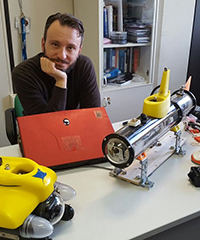
Daniele Costa is a Researcher at the Department of Industrial Engineering, Polytechnic University of Marche. He holds a PhD in Industrial Engineering from the same university and coordinates technical activities at the i-Labs Industry laboratory. His research encompasses Collaborative Robotics, Biomechanics of Swimming, Marine Robotics, and Educational Robotics. His work includes developing tools for safe human-cobot cooperation, studying marine propulsion mechanisms, designing underwater robots, and creating 3D-printed robotic fish for STEM education. He teaches Applied Mechanics and Functional Design part-time at eCampus University.
Dr. Kwadwo Appiah-Kubi is an Assistant Professor in the Department of Physical Therapy at Clarkson University's Lewis School of Health & Life Sciences. His research investigates sensory reweighting mechanisms in postural control and develops VR-based vestibular rehabilitation protocols. Current NIH-funded projects examine how concurrent vestibular activation and postural training using virtual reality recalibrate sensory integration in neurological populations. Additional work develops low-cost balance assessment tools for stroke patients in resource-limited settings. Teaches graduate courses in Neuromuscular Physical Therapy and Research Methods. Recipient of NIH Loan Repayment Award (2022-2024) and Restore Center Pilot Project Award (2023-2024). Holds PhD in Neuromotor Science from Temple University and clinical degrees from Cardiff University and University of Ghana.
Benjamin Schaller is a Lecturer at the Center for Peace Studies (CPS) at UiT The Arctic University of Norway in Tromsø. His academic work focuses on Arctic Security, Confidence- and Security-Building Measures (CSBMs), Arms Control, and NATO-Russia relations. He holds a Master of Science in Peace & Conflict Studies from Uppsala University (2012-2014) and a Magister Artium in Political Sciences (1st Major) and Media Sciences (2nd Major) from the University of Trier (2007-2012). His research emphasizes trust and distrust dynamics in defense politics, particularly analyzing defense relations between Norway, Sweden, Canada, and Russia. He is a member of the War and Peace Dynamics research group (WarPeD). Teaching responsibilities include lecturing on Integrated Peace and Conflict Studies (SVF-3021), Conflict Resolution and Transformation (SVF-3024) at the master's level, and Critical Approaches to Peace and Conflict Studies (SVF-2058) at the bachelor's level. Previously served as a seminar leader for peace studies courses. Key research trends include analyzing Arctic security narratives, OSCE's evolving role in crisis management, and CSBMs as structural conflict prevention tools. His work bridges historical security frameworks with modern AI applications in arms control. Active in policy discussions about military transparency and geopolitical stability in the High North. No formal scientific awards listed, though his contributions to Arctic security discourse are widely recognized in academic circles. Engaged in both teaching and research, maintaining active participation in international conferences and policy dialogues.
Dr. George O.M. Yee is an Adjunct Professor at the School of Computer Engineering, Carleton University. He holds a Ph.D. from Carleton and is a licensed Professional Engineer (P.Eng.). His research focuses on information security, privacy protection, computational intelligence, software engineering, and performance optimization. He has received numerous awards, including the IARIA Fellow (2017), AINA-2007 Outstanding Service Award, and multiple Nortel and IEEE accolades. His work emphasizes secure system design, privacy compliance, and cybersecurity metrics. Recent publications address behavioral security postures, attack surface reduction, and threat mitigation strategies. He has contributed to frameworks for privacy protection in distributed systems and cloud computing, leveraging computational methods for policy enforcement and vulnerability analysis. Dr. Yee’s awards reflect his industry and academic impact, including awards for innovation (Nortel Gold Pride, 2000) and IEEE recognition. His research aligns with Carleton’s focus on engineering excellence and interdisciplinary collaboration.
Daniel Thomas Chalkley is a Senior Lecturer in the School of Behavioural and Health Sciences at Australian Catholic University, within the Faculty of Health Sciences. His research focuses on biomechanics, sports science, and neurorehabilitation, with particular emphasis on motor control, sensor technology applications, and performance analysis in athletes and clinical populations. Key research interests include gait analysis in neurological disorders (e.g., Parkinson’s disease), visual exploration strategies in sports (e.g., football and hockey), and the biomechanics of athletic movements such as paddling in surfing. He collaborates extensively with researchers like Michael Cole, Thomas McGuckian, and Gert-Jan Pepping on projects involving inertial measurement units (IMUs), biofeedback systems, and algorithm development for movement analysis. Recent work explores the validity of sensor technologies (e.g., thoracic-mounted IMUs) for gait assessment and sprint performance metrics. His studies also address practical applications, such as fall prevention in older adults and optimizing training methods in elite sports. Education: Not explicitly stated in available texts. Grants/Awards: None documented in provided information. Chalkley’s publications span high-impact journals like the International Journal of Sports Science and Coaching , Journal of NeuroEngineering and Rehabilitation , and Frontiers in Behavioral Neuroscience . His work frequently bridges clinical and sports performance domains, emphasizing technological innovation in movement analysis.
Vasabjit Banerjee is an Assistant Professor in the Department of Political Science at the University of Tennessee, specializing in comparative politics and international relations. His research examines insurgencies, civil-military relations, and state formation in South Asia, Latin America, and Southern Africa, as well as electoral institutions and foreign policy dynamics. His research interests include: Comparative analysis of political systems and institutions Conflict dynamics and revolutionary movements Security sector governance and military politics Foreign policy decision-making in developing states Electoral volatility and political violence Dr. Banerjee's publications demonstrate consistent focus on security governance and political transitions, with recent work examining defense policy adaptations following geopolitical shifts. His articles reflect methodological diversity, combining case studies with quantitative analysis across multiple regions. As a scholar, he actively contributes to academic discourse through peer-reviewed publications in leading journals including the International Political Science Review and Studies in Conflict and Terrorism. His research has been recognized for its cross-regional comparative frameworks and empirical rigor.
Ashley King is an Assistant Professor of Audiology at Towson University's Department of Speech-Language Pathology & Audiology. Her clinical and research expertise focuses on vestibular assessment and rehabilitation for dizziness and imbalance disorders. She holds a Ph.D. and Au.D. from Gallaudet University and B.A. from Vanderbilt University. Research investigates: Perceptual changes following vestibular impairment Vestibular migraine pathophysiology and management Virtual reality applications for balance assessment Novel rehabilitation strategies including vagal nerve stimulation Dr. King's recent publications examine innovative approaches to evaluating visual-vestibular interactions using commercial VR technology, characterizing vestibular migraine comorbidities, and developing new therapeutic interventions for chronic dizziness. Her work integrates clinical practice with translational research to improve diagnostic and treatment approaches. She serves as a member of the American Balance Society and American Auditory Society, contributing to advancements in vestibular care through multidisciplinary collaboration.
Dr. Jennifer Didier is a Professor and Chair of the Kinesiology Department at Sam Houston State University (SHSU), part of the College of Health Sciences. She joined SHSU in 2010 after eight years as a professor at Southeastern Louisiana University. Her research focuses on motor learning, biomechanics, and injury prevention in athletes, particularly addressing ACL injury risks in female athletes. She also explores the application of virtual reality in motor skill acquisition and pedagogy. Dr. Didier holds a Ph.D. in Kinesiology (Motor Behavior) from Louisiana State University (2003), an M.S. from Texas A&M (1998), and a B.S. from Texas A&M (1996). She is certified in Effective College Instruction through ACUE and has extensive training in online pedagogy. She teaches undergraduate and graduate courses in Motor Learning and Biomechanics. Her community contributions include co-founding the Huntsville High School Mountain Bike Team (2011–2016) and volunteering in fitness education. Her research spans postural stability testing, caloric expenditure measurement, and behavioral interventions for distracted driving. She serves on the NASPSPA Motor Learning & Control Area Program Committee.
Dr. Mansoor Alameri is Associate Director of Clinical Education and Assistant Professor in Physical Therapy Programs at the University of St. Augustine for Health Sciences, Austin campus. He holds a PhD in Spine Biomechanics and Chronic Pain Disorders from Loma Linda University Health (2019), a Master of Science in Physical Therapy from Loma Linda (2015), and a Bachelor of Science in Physical Therapy from October 6th University (2013). His research examines the relationship between psychosocial factors and biomechanical elements in chronic low back pain , with emphasis on neuromuscular motor control and postural patterns. Additional investigations focus on translating pain research into clinical practice, clinical education methodologies, and injury prevention strategies. With over a decade of clinical experience in outpatient/inpatient settings, Dr. Alameri is an APTA-certified clinical instructor. He maintains Texas physical therapy licensure and participates in professional organizations including the American Council of Academic Physical Therapy and Texas Consortium for Physical Therapy Clinical Education. Analysis of his 15 most recent publications reveals concentrated research in biomechanics (lumbosacral kinematics, neuromuscular control), educational outcomes (simulation-based learning, clinical reasoning), and rehabilitation interventions for Parkinson's disease and musculoskeletal injuries.
Mohan Ganesan is a Professor in the PT Programs Campus at the University of St. Augustine for Health Sciences, affiliated with the College of Rehabilitative Sciences. He specializes in Neurological Rehabilitation with a focus on mobility, geriatrics, gait, and balance disorders. Dr. Ganesan holds advanced degrees from premier institutions including the National Institute of Mental Health and Neurosciences (India), and completed a postdoctoral fellowship at the University of Illinois, Chicago, followed by a Multiple Sclerosis Rehabilitation specialty fellowship at the Cleveland Clinic. His academic credentials include a Doctor of Neurophysiology, Master of Physical Therapy, and multiple post-graduate diplomas. His research spans over 40 peer-reviewed publications addressing neurological rehabilitation challenges, particularly in aging populations and individuals with MS. He has also contributed to interprofessional education models in rehabilitative sciences. Research interests emphasize balance control, fatigue management in neurological disorders, and the application of yoga-based interventions for cardiovascular health. His work frequently explores adaptations in para sports for athletes with spinal cord injuries and lower-limb amputations, focusing on performance measurement and classification systems. Dr. Ganesan has pioneered studies on the long-term benefits of hatha yoga and developed innovative training protocols for gait recovery using evidence-based locomotor guidelines. His contributions include analyzing the mental health impacts of pandemics on healthcare workers and MS patients, as well as investigating material science advancements in solid rocket propulsion systems. These diverse research threads reflect his expertise in translating clinical practice to real-world applications across rehabilitation, sports science, and aerospace engineering domains.
Dr. Joshua Byun is an Assistant Professor of Political Science at Boston College's Morrissey College of Arts and Sciences. His research focuses on grand strategy, alliance politics, and nuclear weapons, with a particular emphasis on how great powers manage their allies and adversaries. He holds a Ph.D. and M.A. from the University of Chicago and a B.A. from Korea University. Previously, he served as a postdoctoral fellow at the University of Pennsylvania's Perry World House and the University of Notre Dame's International Security Center. His work has been published in top journals like the American Political Science Review and International Studies Quarterly. Recent Publications: Black Troops, White Rage (APSR, 2025), Under No Circumstances? (ISQ, 2024) Teaching: International Security, U.S. Grand Strategy, Cold War Politics His research explores topics such as preventive war, nuclear deterrence, and the performative uses of violence. He has held fellowships from the Smith Richardson Foundation and the Charles Koch Foundation.
Jonathan Wheat is a Professor of Sport and Exercise Biomechanics and Associate Dean for Research and Innovation at the College of Health, Wellbeing and Life Sciences, Sheffield Hallam University. He leads the Biomechanics Research Group , focusing on developing innovative measurement systems using biomechanics, sensors, and motor learning principles. His work emphasizes affordable 3D imaging systems and cycling biomechanics, often collaborating across disciplines. Research interests revolve around Ecological Dynamics , movement variability, and biomechanical applications in sports and rehabilitation. Key projects include using consumer depth cameras for body morphology analysis and studying gait adaptations in runners. His interdisciplinary approach bridges biomechanics with engineering and computer science. Publications span biomechanical methodologies, sports equipment interactions, and injury prevention, reflecting his expertise in both theoretical and applied research. Notable recognition includes the EPSRC/Royal Academy of Engineering Rising Star award (2014). Awards: EPSRC/Royal Academy of Engineering Rising Star (2014) Advising: Supervised 14 doctoral students in biomechanics, sports engineering, and human movement analysis. Labs/Teams: Biomechanics Research Group, collaborating with SHU's sports and engineering departments.
Dr. Katherine Bain is an Assistant Professor in Health Professions at Shenandoah University. Her research focuses on anatomical sciences, chronic ankle instability, rehabilitation methodologies, and neurophysiological aspects of musculoskeletal injuries. Her work investigates the biomechanical, neurophysiological, and psychological dimensions of ankle injuries and rehabilitation. Research interests include chronic ankle instability mechanisms, neuroplasticity in injury recovery, balance interventions, and innovative rehabilitation technologies. Publications from 2021-2025 demonstrate consistent focus on ankle injury sequelae, with evolving research into neurophysiological correlates of chronic instability. Recent work expands into technology-assisted rehabilitation (VR, exergaming) and complex clinical decision-making frameworks. Bain received the 2023 Transformative Teaching Award for educational excellence. Her research integrates biomechanical analysis with clinical applications to improve rehabilitation outcomes for individuals with musculoskeletal injuries.
Dr. Susantha Herath is a Professor in the Information Systems Department at St. Cloud State University's Herberger Business School. He joined the department in Fall 2001 and has prior academic experience at the University of Aizu (1993-2001) and South West Texas State University (1990-1993). His primary teaching areas include Management Information Systems, Systems Analysis and Design, Security and Management of Operating Systems, IT Risk Management, and Research Methodology. Ph.D. in Electrical and Computer Engineering, Keio University, Japan, 1991 M. Eng. in Industrial and Computer Engineering, Electro-Communications University, Japan, 1987 B.S. in Business Administration, Sri Jayawardhanapura University, Sri Lanka, 1978 His research focuses on high-performance dependable systems, network security, natural language processing, and artificial intelligence. He explores probabilistic models for anomaly detection, statistical quality control approaches to intrusion detection, and interdisciplinary applications of computer forensics in accounting and healthcare. His work spans cybersecurity, machine learning, and educational innovations in information systems. Dr. Herath has received recognition as a Senior Member of IEEE. His publications demonstrate expertise in spam detection, economic modeling, and enhancing security curricula through active learning methodologies. He has also contributed foundational work in multilingual perception analysis and computer security laboratories.
Laurel Trainor is a Professor of Psychology, Neuroscience and Behaviour at McMaster University, where she holds multiple prestigious distinctions including Fellow of the Royal Society of Canada (FRSC), Fellow of the Canadian Institute for Advanced Research (CIFAR), and Fellow of the Association for Psychological Science. She is also a McMaster Distinguished University Professor and a Research Scientist at the Rotman Research Institute. Trainor earned her Ph.D. in Experimental Psychology from the University of Toronto in 1991, following an M.A. in the same field (1987) and a Bachelor of Music Performance (1981). Her pioneering research focuses on the neuroscience of auditory development and music perception, particularly how infants acquire musical systems similarly to language acquisition. Trainor has demonstrated that listening to a beat activates motor networks in the brain even without movement, reveals how predictive processes in rhythms shape communication between people, and shows that synchronous movement to musical beats increases prosocial behavior even in infants. Her work spans multiple disciplines including auditory neuroscience, cognitive development, and music therapy. Analysis of Trainor's recent publications (2023-2025) reveals a strong focus on infant and child development, particularly regarding rhythm processing, neural mechanisms of musical perception, and applications for developmental disorders. Her research increasingly incorporates advanced methodologies like machine learning for EEG analysis, online motion tracking, and live performance studies in the unique LIVELab environment. Key themes include the relationship between rhythm perception and motor coordination, cross-modal interactions in music processing, and the therapeutic applications of music. Fellow of the Royal Society of Canada (FRSC) Fellow of the Canadian Institute for Advanced Research (CIFAR) Fellow of the Association for Psychological Science McMaster Distinguished University Professor Lifetime Achievement Award from the Society for Music Perception and Cognition (2022) YWCA Woman of Distinction Award for Arts Culture and Design Co-holder of patent for the Neuro-compensator hearing aid Trainor has secured major funding from prestigious organizations including the Canadian Foundation for Innovation, Canadian Institutes of Health Research, Natural Science and Engineering Research Council of Canada, Social Science Research Council of Canada, and the Grammy Foundation. She is the founding and current director of the McMaster Institute for Music and the Mind (MIMM), which houses the LIVELab—a unique research-concert hall with high acoustic control equipped with multi-person motion capture and EEG systems. This facility enables groundbreaking studies on performer-audience interactions and music's role in health and well-being. Trainor is also an accomplished musician, serving as principal flute of the Burlington Symphony.