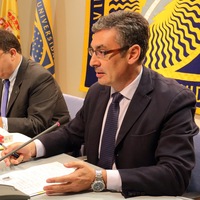
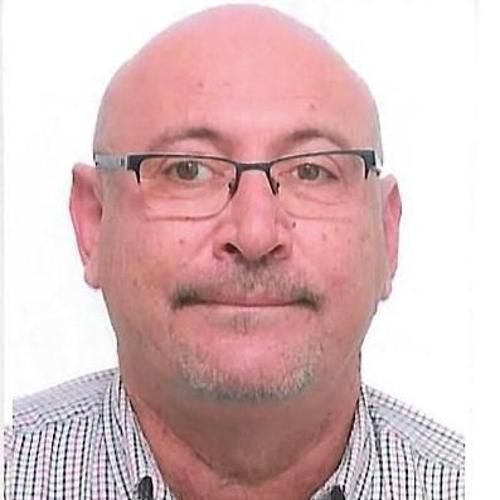
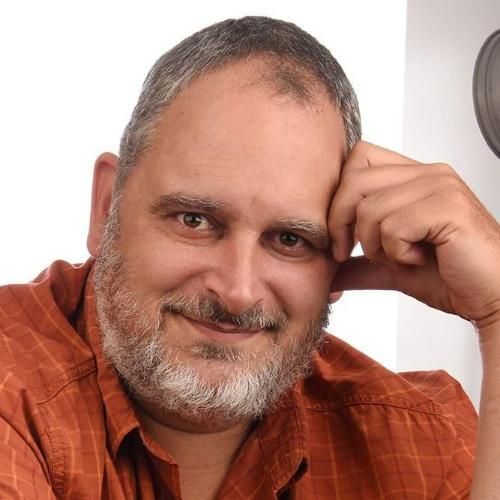
Bernardo Jesús Periñán Gómez, currently a Professor of Private Law at Universidad Pablo de Olavide (Seville, Spain) , specializes in Roman Law and its reception into modern legal systems. He leads the research group From the European Common Law to Civil Law and has established research stations at institutions like Harvard and Pavia. His work bridges historical jurisprudence with contemporary legal challenges, particularly in pandemic-related obligations and urban liability frameworks. Education: Doctorate in Roman Law from Universidad de Sevilla (1997) focusing on the Senatus Consultum Macedonianum. Research: Explores Roman legal structures, comparative law, and globalization's impact on individual juridical capacity. Publications: Over 40 articles and monographs in journals like Revista Internacional de Derecho Romano and Boletín Mexicano de Derecho Comparado , emphasizing doctrinal continuity and adaptation. Awards & Roles: Serves on international scientific committees, directs doctoral theses, and contributes to editorial boards including Persona Collection at Comares Publishing.
Ricardo Piñero Moral is a Professor at the University of Navarra, affiliated with the Faculty of Economics and Business Sciences and the Faculty of Philosophy and Letters. He holds positions in the Economics and Philosophy departments, and is part of the research group 'Estética y Arte Contemporáneo'. He earned his Doctorate from the University of Salamanca in 1994 with a thesis on Plotinus' aesthetics and contemplation, supervised by Dr. Mariano Álvarez Gómez. His research focuses on aesthetics, art theory, medieval studies, and the intersection of art with theology, mysticism, and philosophy. Key interests include medieval bestiaries, Spanish Golden Age art theory, contemporary art metaphysics, and the symbolic roles of animals in religious and cultural contexts. Recent publications explore themes like the transformational power of art, the aesthetics of evil in medieval contexts, and the philosophical underpinnings of artistic creation. His work bridges historical analysis with contemporary debates, emphasizing the role of beauty in ethical and existential frameworks. He has not been explicitly noted for scientific awards, though his prolific academic output and scholarly contributions are widely recognized. His advising and grant activities remain unspecified in available texts, though his involvement in interdisciplinary research groups suggests collaborative projects. He is associated with the 'Estética y Arte Contemporáneo' research group, focusing on contemporary aesthetic challenges and cultural dialogue.
Adela Cortijo Talavera is a Professor of French literature and cinema at the University of Valencia, specializing in comics studies with a particular focus on French-language comics, their inter-media relationships with literature and film, and the work of female comics authors from the 1970s to the present. She serves as Director of the University of Valencia's Cultural Service since January 2021 and has been a member of the SM Foundation's Chair of Comic Studies since 2019. Her research interests span comics studies, French literature, graphic novels, gender studies in comics, and the analysis of female comics authors. Cortijo has made significant contributions to understanding the representation of women in comics, autobiographical comics, and the cultural significance of French bande dessinée. She has co-directed a Diploma in Comic Translation and teaches 'Gender and Identity in Comics' in the University of Valencia's Comics and Education Master's program. Cortijo's scholarly work reveals trends across comics studies with particular emphasis on gender representation, autobiographical narratives, and the visual language of comics. Her articles span from analyses of specific authors like Phoebe Gloeckner and Rachel Deville to broader cultural examinations of comics as a medium. The interdisciplinary nature of her work connects comics studies with literary theory, film studies, gender studies, and cultural studies. As an active academic, Cortijo has organized international colloquia, served on scientific committees of numerous international comics conferences, and been a visiting researcher at universities including a residency at the CIBDI in Angoulême. She has directed numerous research projects and theses on comics and has coordinated special journal issues dedicated to comics studies.
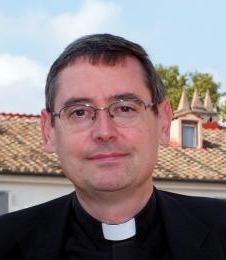
Dr. Federico M. Requena is a Professor of Contemporary Church History at the Pontifical University of the Holy Cross (PUSC) in Rome since 2009, with additional roles as Assistant Director of the Josemaría Escrivá Study Center (CEJE) and collaborator at the Church History Institute (IHI) of the University of Navarra. His academic journey includes two doctorates: Theology (1996) and History (2007), both from the University of Navarra, following earlier degrees in Theology (1993) from PUSC and Geography/History (1987) from the University of Murcia. Doctorate in Theology (1996), University of Navarra Doctorate in History (2007), University of Navarra Bachelor in Theology (1993), Pontifical University of the Holy Cross Bachelor in Geography and History (1987), University of Murcia As a leading scholar in European and US religious history, Dr. Requena specializes in the History of Opus Dei, Catholicism during the Primo de Rivera dictatorship and Second Republic, religious associations, and transnational church networks. His research spans institutional expansion, clerical leadership, and the interplay between religious identity and modernity. His publications include 15 recent articles analyzing transnational religious movements, with particular focus on Opus Dei's expansion (1948-1961), US-Latin American Vatican collaborations, and Cold War-era Catholic dynamics. Key methodologies include historiographical analysis, archival research across European and American institutions, and comparative studies of religious organizations. Director of Studia et Documenta journal (2023-present) Vice-Director of journal's Editorial Board (2010-2023) Member of Notre Dame's Cushwa Center Advisory Committee (2024) Dr. Requena has directed and co-directed multiple theses on Spanish spiritual literature and religious historiography while maintaining active roles in international conferences and research stays at prestigious institutions including Harvard, Notre Dame, and Oxford. He has pioneered digital resources like the Josemaría Escrivá Virtual Library and maintains extensive collaborations across Catholic academic networks. Current affiliations include the Pontifical University of the Holy Cross (Rome), University of Navarra's Centro de Estudios Josemaría Escrivá (Pamplona), and the Institute for Religious Sciences (Bologna). His work bridges archival rigor with contemporary relevance, focusing on religious modernity and institutional adaptation in both European and American contexts.
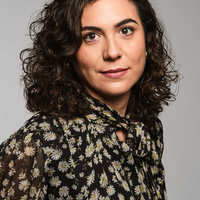
Maria de Los Angeles Rodriguez Alonso is a Professor at the Universidad de Murcia , affiliated with the Faculty of Arts and Humanities within the Department of Spanish Literature, Literary Theory and Comparative Literature . Her academic work focuses on critical discourse analysis and contemporary Spanish theater studies. Doctoral thesis: El discurso crítico sobre el teatro del franquismo a la transición (1966-1982) Research group: History and Epistemology of Literary Theory Research Interests span: Spanish Literature and Francoist Memory Comparative Dramaturgical Analysis Post-Transition Theater Evolution Critical Discourse Theory Publication Trends over the last decade reveal deep engagement with: Memory and Trauma in Spanish Theater Metaphorical Language in Performance Transatlantic Cultural Exchange Body Politics under Censorship
Manuel Aznar Soler is a Professor at the Autonomous University of Barcelona (UAB), affiliated with the Department of Spanish Philology. He is associated with the Center for Studies on Dictatorships and Democracies (CEDID) and the Literary Exile Studies Research Group (GEXEL). His career spans from 1974 to present, holding roles such as Department Director (1983–1985) and Head Professor (1985–1996). His research focuses on Republican Exile literature, Cultural Cold War dynamics, and 20th-century Spanish literary history. Education: PhD in Hispanic Philology (University of Barcelona, 1981); Graduate degree in Hispanic Philology (UB, 1973). Research Interests: Exile literary production post-1939 Cultural exchanges during the Cold War Spanish theater and drama in exile contexts Archival studies of intellectual correspondence Recent Publications: Focus on Republican Exile dramaturgy, poetical anthologies, and critical analyses of literary journals like 'Insula'. Grants: Principal Investigator in multiple projects (2007–2025), including 'La historia de la literatura española: exilio republicano de 1939 e interior' (2021–2025). Labs/Teams: Active in CEDID and GEXEL, leading interdisciplinary research on dictatorship and democracy transitions through cultural lenses.
Jorge Carrión Gálvez is a part-time lecturer at the UPF Barcelona School of Management and co-director of the Master in Literary Creation. He previously held academic roles including professor of Spanish at the University of Chicago, associate professor of Spanish Language and Literature at the Department of Humanities at Universitat Pompeu Fabra (UPF), visiting professor at the University of Los Andes (Colombia), and professor of the Master in Journalism Specializing in Culture at UPF-BSM. He also serves as Academic Director of UPF Barcelona School of Management and leads the Management, Law, Society & Humanities academic unit there. Dr. Carrión Gálvez holds a PhD in Humanities with a thesis on comparative literature focused on contemporary travel. His research interests include travel literature, non-fiction narratives, television seriality, virality, and cultural studies. He explores intersections between literature and media, urban cultural landscapes, and the evolution of narrative forms in digital and traditional contexts. His scholarly work spans literary criticism, cultural analysis, and media studies. Notable trends in his publications include analyses of cultural institutions (museums, libraries), adaptations of classic texts for television, and the interplay between urban spaces and narrative forms. His books and essays address topics ranging from Madrid and Barcelona’s literary histories to experimental writing techniques and the future of television. Carrión Gálvez has directed academic programs such as the Master in Literary Creation and collaborated on interdisciplinary research initiatives like the MOOC on television’s golden age. His work bridges academic scholarship with cultural production, emphasizing the role of media and spatial narratives in shaping contemporary cultural discourse.
Noelia Ibarra Rius is an Associate Professor in the Department of Didactics of Language and Literature at the Universitat de València, Faculty of Teacher Training. She is actively involved in research and pedagogy, focusing on literary and intercultural education, particularly in children's and young adult literature. She is a member of the ELCIS research group, dedicated to Reading Literacy, Literary and Linguistic Education, Culture, and Society. Her research interests include Literary Education , Intercultural Didactics , Teacher Training , Children's and Young Adult Literature , Digital Narratives , and Migration in Literature . Her work emphasizes the role of literature in fostering inclusive citizenship and intercultural understanding in educational contexts. The analysis of her recent publications reveals a consistent focus on the intersection of literature, identity, and pedagogy. Her work spans from digital storytelling and book trailers in primary education to critical examinations of interculturalism, feminism, and migration in contemporary Spanish literature. She frequently collaborates with Dr. Josep Ballester Roca, and her scholarship is deeply rooted in both theoretical and practical educational concerns. Noelia Ibarra actively contributes to academic discourse through numerous peer-reviewed articles and book chapters. Her publications are widely accessed, indicating a strong scholarly presence. While no specific awards or fellowships are mentioned in the provided texts, her sustained research output and leadership in intercultural literary education underscore her academic impact. She mentors and collaborates with fellow researchers and educators, contributing to curriculum innovation and teacher training within the European Higher Education Area. Her work on reading-life histories of future teachers highlights her commitment to reflective pedagogy and the affective dimensions of literary engagement. She is also involved in projects related to final degree projects and educational innovation in higher education.
Ramon Girona Duran is a Professor at the University of Girona's Faculty of Arts, where he teaches Cultural Communication, Advertising/Public Relations, and the Master's in Communication and Cultural Studies. Since 2018, he has served as Vice-Dean and previously coordinated both the Advertising/PR (2012-2015) and Cultural Communication (2015-2018) degrees. He holds a doctorate from UdG and a degree from the Autonomous University of Barcelona. His research explores propaganda cinema, documentary film, cultural representation, and media history, with specific emphases on: WWII-era film propaganda (Frank Capra's works) Catalan and Francophone cultural expressions Intersections of cinema with tourism, advertising, and politics Historical trauma representation in audiovisual media Girona Duran leads projects within two research groups: Social and Institutional Communication and Theories of Contemporary Art . His publications analyze trends in political communication, wartime media, and rural imagery in Iberian cultures, reflecting interdisciplinary approaches blending film theory, history, and sociology. He has directed competitive research projects including: Virtual Worlds in Early Cinema (2019-2022) Women in Early Cinema (2016-2018) Think Tanks' Media Influence During Economic Crisis (2013-2016) WWI Newsreel Imagery (2013-2016) Current Sick Body Representations (2022-2025)
Carmen Medina Puerta is a postdoctoral researcher at the University of Valencia, affiliated with the Department of Spanish Philology within the Faculty of Philology, Translation and Communication. She earned her PhD from the Universitat de Lleida with a thesis on eroticism in Ana Rossetti’s early literary production. Her academic profile reflects a strong commitment to contemporary Spanish literary studies, particularly through feminist, gender, and queer lenses. PhD in Hispanic Philology, Universitat de Lleida BA in Hispanic Philology, University of Granada Her research interests center on Spanish literature from the 20th and 21st centuries, with a focus on feminist literary criticism, queer theory, motherhood, transgender poetics, and the representation of social and political transitions. She investigates how female authors navigate identity, memory, and marginalization in their works. Her scholarship often addresses the literary responses to historical events such as the Franco dictatorship, democratic transition, and the HIV/AIDS crisis. Her recent publications reveal a consistent thematic trajectory: analyzing contemporary poets like Ángelo Néstore through a transgender framework, exploring the poetic articulation of HIV/AIDS, and reinterpreting religious and mythical female figures such as Santa Bárbara. She also contributes to transatlantic dialogues on women’s poetry and participates in editorial and collaborative projects that promote inclusive literary discourse. Analysis of gender and sexuality in Spanish poetry Recovery of marginalized female literary voices Intersection of literature, politics, and identity Transnational feminist literary networks Literary representations of illness and stigma Avant-garde and vanguardist movements in Spain Carmen Medina Puerta has not received any explicitly mentioned scientific awards in the provided text. However, her extensive publication record in reputable journals and edited volumes indicates significant scholarly recognition. She has not published any information regarding student supervision or grant funding in the available materials. Her work appears to be primarily individual and collaborative research, often in partnership with other scholars on thematic issues such as feminist poetry and literary transition. There is no mention of lab affiliations or team-based research initiatives. Her academic presence is largely defined by her publications, conference involvement (e.g., Transficción project), and editorial contributions to collective volumes.
Margarita García Candeira is an Associate Professor in the Faculty of Humanities at the University of Huelva, where she specializes in literary theory, comparative literature, and contemporary peninsular poetry. Previously, she earned her doctorate from the University of Santiago de Compostela in 2011 with a thesis on Luis García Montero's work. Her academic journey reflects a deep engagement with Spanish and Galician literary traditions, modernity, and the cultural politics of literature. Her research interests focus on contemporary peninsular poetry, literary theory and comparative literature, modernity, theory of spaces and affects, canon and literary education, and cultural theory. García Candeira has made significant contributions to understanding the work of major Spanish poets including José Ángel Valente, Luis García Montero, Rosalía de Castro, and Emilia Pardo Bazán. Her scholarship often explores intersections between literature and broader cultural, political, and historical contexts, particularly examining how literary works engage with questions of identity, resistance, and modernity. Analysis of her recent publications (2019-2023) reveals a consistent focus on Galician literary identity, the relationship between poetry and political resistance, and the theoretical frameworks for understanding literary modernity. Her work demonstrates particular expertise in literary cartography, examining how spaces are represented and constructed in literature, and in the study of poetic diaries and autobiographical forms. She has also made important contributions to understanding the relationship between literary canon formation and educational policy, particularly during the Francoist period in Spain. García Candeira has secured research funding for significant projects including the Uberto Stabile Fund cataloging initiative (2019-2022), which focused on alternative and marginal forms of poetic and cultural production. Her scholarly output appears in prestigious journals such as Rilce, Bulletin of Hispanic Studies, Revista de Estudios Hispánicos, and Revista de Literatura. She has also edited important scholarly works including the catalog of José Ángel Valente's personal library and the volume on Juan Ramón Jiménez's poetic diary.
Francisco Javier Guzmán Armario is Professor of Ancient History at the University of Cádiz, affiliated with the Department of History, Geography and Philosophy and the Institute for Research in Hispanic World Studies (IN-EMHis). He leads the research group HUM-831 Archaeological Heritage in the Strait of Gibraltar. From Prehistory to the End of Antiquity . Education Doctor of Philosophy, University of Cádiz, 2001 – Thesis: Los Bárbaros en Amiano Marcelino , supervised by Dr. Francisco Javier Lomas Salmonte. Research Interests Guzmán Armario’s scholarship focuses on the political, military, and cultural history of Rome from the early Empire to Late Antiquity, with special attention to: Barbarian groups and their representation in Greco-Roman sources Historiography of Ammianus Marcellinus and other late-antique authors Transition from Roman Empire to medieval kingdoms in the Iberian Peninsula Reception of classical antiquity in modern historiography and popular culture His work integrates literary analysis with historical geography and prosopography to reassess traditional narratives of imperial decline and barbarian invasions. Publication Trends Over two decades Guzmán Armario has produced a steady stream of articles and monographs that illuminate the political discourse, military crises, and cultural self-definition of the Late Roman world. Recurring themes include the historiographical construction of the “barbarian,” the memory of military disasters (Teutoburg, Adrianople), and the ideological uses of Egypt and the Atlantic frontier. His recent pieces extend these inquiries to cinematic and modern popular receptions of figures such as Attila and the fall of Rome in 476 CE, demonstrating an enduring concern with how antiquity is re-imagined across media. Scientific Awards No specific awards are mentioned in the provided materials. Advising & Funding No lists of current or former students, doctoral advisees, or grant details are supplied in the text. Labs & Teams He coordinates the PAIDI-funded research group HUM-831 Archaeological Heritage in the Strait of Gibraltar. From Prehistory to the End of Antiquity , an interdisciplinary team examining long-term cultural interactions across the Ibero-African maritime corridor.
Ramon Girona Duran serves as Adjunct Professor in the Department of Philology and Communication at the University of Girona's Faculty of Arts, teaching Cultural Communication, Advertising and Public Relations degrees, and the Master's in Communication and Cultural Studies. He currently holds the position of Vice-Dean of Arts and previously coordinated both the Advertising/Public Relations Degree (2012-2015) and Cultural Communication Degree (2015-2018). His academic foundation includes a bachelor's degree from the Autonomous University of Barcelona and a doctorate from the University of Girona. Girona Duran specializes in propaganda cinema, particularly American WWII documentaries like Frank Capra's 'Why We Fight' series, examining their historical and rhetorical strategies. His research extends to film history (early cinema, surrealist movements), public relations theory, and intersections of cinema with advertising and tourism. Recent work analyzes mental health representations in post-war documentaries and rural imagery in contemporary Catalan/Francophone media. His publication trends reveal consistent focus on political communication through film, evolving from WWII propaganda studies to contemporary analyses of rural identity and gender representation. Key subfields include documentary discourse construction, archival footage utilization, and the role of film in shaping collective memory. Scientific awards: No awards or honors are documented in available sources. As an academic administrator, he has led curriculum development for two degree programs while securing competitive research funding. His project portfolio includes EU-funded initiatives like 'Shababuna: our youth' (2021-2023) and nationally funded studies on immigration competencies (2009-2010) and sick body representations in visual media (2022-2025). He actively contributes to the Research Group in Social and Institutional Communication and the Research Group on Theories of Contemporary Art, where interdisciplinary collaborations examine cinema's role in political discourse and cultural memory formation.
Pablo Rey García is a researcher at the Faculty of Communication from Universidad Pontificia de Salamanca , with expertise in Public International Law and International Relations . He co-leads the Media Cartography and ICS. Innovation in Social Sciences research groups. PhD in Communication (2005) from Pontifical University of Salamanca Focus on terrorism , political violence , digital photography ethics , and hybrid warfare His recent publications analyze Ukrainian conflict narratives , ISIS visual propaganda , and media coverage of women in terrorism . He has also studied municipal transparency and war journalism ethics. Co-authored works include studies on Brazilian photography with Charles Monteiro, and Colombian paramilitarism with Jorge Miranda-Galbe. His research combines visual analysis with geopolitical frameworks , emphasizing digital media's role in modern conflicts and governance.
María Luisa Juárez Hervás is an Associate Professor at the Department of Modern Philology, University of Alcalá. She specializes in American literature, Holocaust studies, post-colonialism, and gender studies, teaching courses like Multiculturalism in the United States and American Fiction . Her research explores themes such as trauma narratives, transnational memory, and the intersection of identity and history. She has contributed to multiple research projects, including a 2009 study on proto-nationalism in the Hispanic monarchy and a 2009 conference on Edgar Allan Poe. Her publications span chapters in volumes like Colonialism and Post-Colonialism in English Literature and articles analyzing works by Louise Glück, Cormac McCarthy, and Anzia Yezierska. Notable recent works include analyses of Holocaust memory in contemporary narratives and critical studies of visual arts addressing social justice. She directed the thesis La prensa norteamericana ante el Holocausto: ¿Testigo o cómplice? , advised by her. Her academic contributions extend to international conferences, addressing topics from Tillie Olsen’s proletarian feminism to the aesthetics of Kehinde Wiley’s presidential portraits. She actively engages with contemporary cultural issues through essays on feminist movements and Nobel laureates.