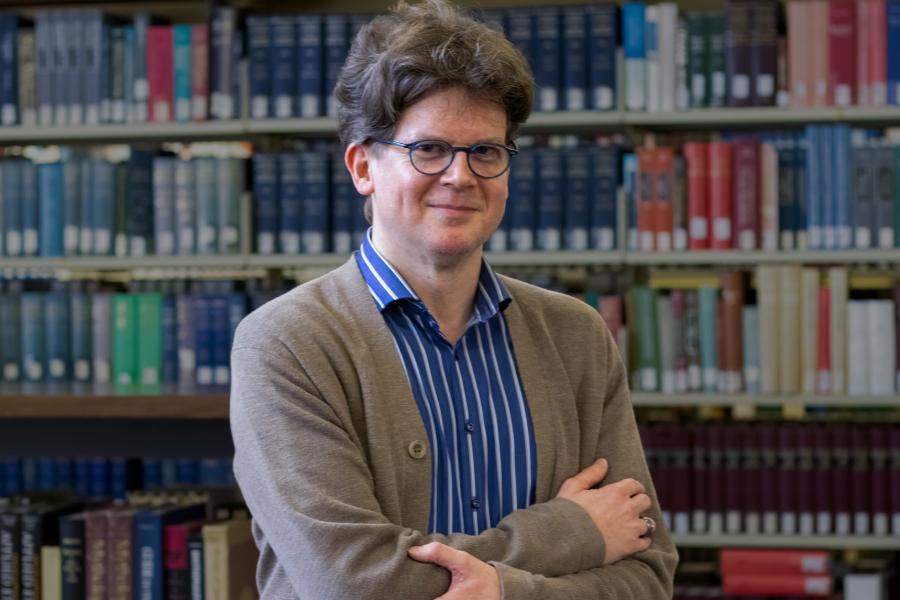
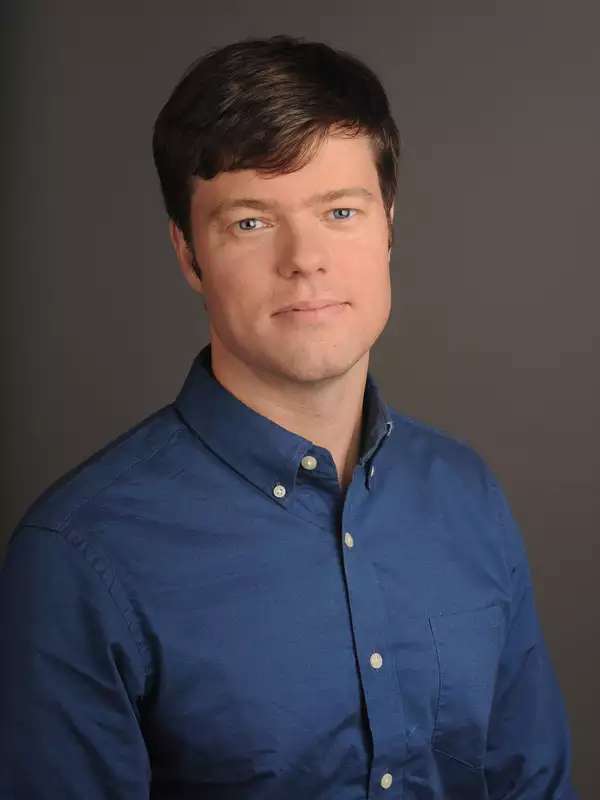
Bodhisattva Chattopadhyay is an Associate Professor at the Department of Culture, Religion, Asian and Middle Eastern Studies at the University of Oslo . His research focuses on contemporary future fictions , science fiction , and futurism across multiple media platforms including literature, graphic novels, films, video games, and visual arts. He previously pursued a Bachelors in Zoology (2014-15) before shifting to postdoctoral work on medical databases and classification systems. Established the Holodeck Games Research Lab (University of Oslo's only dedicated video game research facility) Co-founder of the global research collective Theory from the Margins (16,000+ members) Producer of the award-winning documentary Kalpavigyan: A Speculative Journey (2021) His research explores decolonial futures through projects like the ERC-funded CoFutures (2020-24) and CoFutures Literacy (2023-25). Key themes include: Technocratic vs. Decolonial Futures Composability of Futures across cultural contexts Infrastructure Ethics in resource extraction Temporal vs. Spatial Futures in global inequality Climate Fiction as political intervention Video Game Epistemology in future literacy Awarded European Research Council grants (2020), Norwegian Research Council grants (2018, 2020, 2022), and the World Fantasy Award (2020), he also serves on editorial boards for Fafnir: Nordic Journal of Science Fiction and the Routledge Book Series: Studies in Global Genre Fiction . His recent documentary examines Indian science fiction traditions, particularly Bangla Kalpavigyan.
Dominique Laporte is an Associate Professor in the Department of French, Spanish and Italian at the Faculty of Arts, University of Manitoba . His work focuses on 19th-century French literature, Franco-Canadian cultural history, and the preservation of French-speaking communities in Western Canada. He has chaired the Graduate Studies Committee and actively supervises graduate students. Research Interests: 19th-Century French Theatre & Novel History of French-Canadian Press Francophone Education in Western Canada Cultural Memory & Commemoration Western Francophone Communities Scientific Awards: 2015-2016 Outreach Award, University of Manitoba Publications Trends: His recent works examine historical narratives in Franco-Manitoban contexts, analyze editorial discourses on Francophone minorities, and contribute critical editions of 19th-century French plays. Key themes include cultural resistance, textual preservation, and intergenerational memory. Teaching: Courses include 19th-century French theatre (FREN 2740), modern French civilization (FREN 2810), and Canadian-French civilization (FREN 3850).
Karin Dean is a political geographer at Tallinn University since 2007, with a focus on Southeast Asian societies and politics. Her research integrates ethnographic fieldwork across Myanmar, China, Thailand, and Northeast India, examining interrelations between states, societies, and spaces. Interests: political geography, mobilities, Southeast Asia, Burma/Myanmar, Kachin, Asian urbanization, political anthropology Projects: Advancing Trans-Regional Border Studies Her work analyzes borders as dynamic social constructs, exploring how ethnic minorities navigate state power through mobility and spatial contestation. Recent publications examine China's Belt and Road Initiative in Myanmar and the spatial dimensions of ceasefire politics. As a supervisor, she guides BA, MA, and PhD students in Southeast Asian studies, political geography, and Asian urban research. Her fieldwork-based approach bridges critical geopolitics with lived experiences in contested borderlands.
Sara Koopman is an Assistant Professor in the School of Peace and Conflict Studies at Kent State University, within the College of Arts & Sciences. Her research focuses on geographies of peace, social movements, and the socio-spatial dynamics of conflict. She holds a PhD in Human Geography from the University of British Columbia. Her work emphasizes inclusive peacebuilding, particularly in Colombia, and explores how spatial practices can foster reconciliation. Notable projects include the Mapping May 4th initiative, a digital dialogue memorializing the Kent State shootings, and collaborative research with social movements in Colombia and beyond. She also maintains a blog, Decolonizing Solidarity , addressing colonial patterns in international solidarity work. Koopman’s teaching includes courses on nonviolence, reconciliation, and peacebuilding, reflecting her commitment to bridging theory and practice. Her recent publications analyze topics like tropicality, whiteness, and the weaponization of research, contributing to critical debates in peace studies and geography.
Barbara Christophe is a Research Professor at the Leibniz Institute for Educational Media , where she serves as Deputy Head of the Media Transformations department and Scientific Director of the Georg Eckert Doctoral Program (GEPP). She also contributes to academic discourse as a member of the editorial board of the Journal of Educational Media, Memory and Society . Education: PhD in Sociology (1996, University of Bremen), Habilitation in Ethnography (2005, European University Viadrina) Projects: Leads research on memory practices in classrooms, digital education in China, historical memes in Ukraine/Russia, Cold War narratives in schools, and post-Soviet cultural patterns Research Focus: Christophe’s work bridges history education, memory studies, and media analysis. She examines how post-Soviet societies negotiate collective memory through textbooks and oral narratives, explores the role of digital media in education, and investigates populist discourses in Brazil, India, and Ukraine. Her recent projects analyze historical appropriation in memes related to the Ukraine war. Publications: With over 68 publications, her scholarship includes monographs on post-socialist Georgia and Lithuania, edited volumes on authenticity in populist discourses, and peer-reviewed articles on Cold War memory, textbook analysis, and digital transformation. She frequently collaborates with international institutions like Palgrave Macmillan and the Volkswagen Foundation.
Tore Rye Andersen is an Associate Professor of Comparative Literature and Deputy Head of the School of Communication and Culture at Aarhus University. He serves on the university's board and the board of Aarhus University Press. His research focuses on American literary history, materiality/mediality of literature, and the Anthropocene in literary contexts. Key works include Planetary Pynchon: History, Modernity, and the Anthropocene (2023) and numerous articles on digital media and postmodern narrative forms. His academic career spans roles as project leader for Litteratur mellem medier (2014–2020) and active participation in literary evaluation committees. Research interests bridge traditional literary scholarship with digital humanities, emphasizing global infrastructures' impact on cultural production. Publications span peer-reviewed journals like Textual Practice , Nordic Journal of Media Studies , and Convergence . Notable contributions include analyses of Thomas Pynchon's paratextual strategies, Cormac McCarthy's apocalyptic narratives, and the resurgence of serialized storytelling in social media contexts. His work critiques late capitalism's cultural manifestations through commodity aesthetics and digital mediation frameworks.
Gilberto Rosas is a Professor of Anthropology and Latina/Latino Studies at the University of Illinois, affiliated with the Unit for Criticism and Interpretive Theory and the Carl R. Woese Institute for Genomic Biology. His work focuses on border studies, migration policy, and the intersection of race, state violence, and citizenship. He holds a Chair position and has authored influential books like Barrio Libre (2012) and Unsettling (2023), which critically examine U.S.-Mexico border dynamics. Research interests include criminalization of migrants, white nationalism resurgence, and the embodiment of border violence. His ethnographic work addresses pandemic-era fieldwork challenges and the psychological impacts of border policies. Rosas has been recognized with the 2014 ALLA Book Award for scholarly excellence. His interdisciplinary affiliations reflect engagement with critical theory, genomic ethics, and cultural interpretation. Advising focuses on graduate students researching transnational migration and border studies, though no specific advisees are listed. Current projects likely involve documenting the El Paso massacre aftermath and analyzing post-pandemic border enforcement strategies.
Peter R. Ives is a Professor in the Political Science Department at the University of Winnipeg, Canada, appointed in 2000 with tenure-track commencing July 1, 2001. He was tenured and promoted to Associate Professor in 2005, and to Full Professor in 2013. His current positions include Professor/Chair of Cultural Studies (as of July 1, 2024) and Graduate Chair of the Master of Arts in Cultural Studies Graduate Programme (2024-2026). Education: PHD (1998) - Graduate Programme in Social & Political Thought, York University, Toronto MA (1993) - Graduate Programme in Social & Political Thought, York University, Toronto BA (1991) - Political Science, Reed College, Portland, Oregon, U.S.A. Year 1 in Icelandic Philology (1990-91) - Háskóli Íslands (University of Iceland) Intermediate Italian (1994) - Università per Stranieri di Perugia, Italy Peter Ives' research focuses on the intersection of language, politics, and power, with particular expertise in Gramscian theory. His work critically examines Global English as a phenomenon of linguistic hegemony within global capitalism, challenging liberal perspectives on language policy. He explores how language shapes collective identity, political theory, and state formation, with special attention to Canadian language politics in comparative contexts. His scholarship bridges political theory, sociolinguistics, and cultural studies, emphasizing historical materialist approaches to understanding linguistic power dynamics. Ives' publications reveal a consistent trajectory examining the politics of language through Gramscian frameworks. His work has evolved from theoretical explorations of Gramsci's linguistic concepts to applied analyses of Global English in educational, political, and economic contexts. A recurring theme is the relationship between language, hegemony, and state power in both national and transnational settings. His research increasingly addresses contemporary challenges to free speech in digital environments and academic freedom in Canadian institutions. Scientific Awards: Raymond Klibansky Book Prize (2004-05) for "Gramsci's Politics of Language" BAAL (British Association of Applied Linguistics) Book Prize (2019) Erica and Arnold Rogers Award for Excellence in Research (2004) Advising and Grants: Ives has supervised numerous graduate students including Kent Suss and Justin Girard in the MA Cultural Studies program, and served on multiple honors thesis committees. His research has been supported by significant funding including SSHRC Insight Development Grants ($64,999, 2016-2019), University of Winnipeg Major Research Grants, and Social Sciences & Humanities Research Council Standard Research Grants ($41,000, 2007-2010). His current research examines how states promote Global English through shifting priorities in education policy across francophone countries. Ives maintains an active research group focused on Global English Education, with a dedicated website research portal. His collaborative work involves researchers from York University, University of Toronto, and international institutions. He has trained numerous student researchers through SSHRC-funded projects examining Global English in education systems, particularly focusing on francophone contexts. His research team has produced significant scholarship on linguistic hegemony, state policy, and educational practices in the context of globalization.
Dr. Hanna Muehlenhoff is a Lecturer in the Department of European Studies at the University of Amsterdam's Faculty of Humanities. Her research focuses on EU democracy promotion, human rights policies, gender and security frameworks, and critical analyses of EU-Turkey relations. She authored the book *EU Democracy Promotion and Governmentality: Turkey and Beyond* (2019), examining how EU civil society funding shapes politicization dynamics in contested contexts like Turkey's women's rights, LGBT rights, and Kurdish rights movements. Her work critiques neoliberal and liberal governmentality in EU external policies, emphasizing intersectional and feminist perspectives. Notable research areas include EU militarism, feminist approaches to security, and decolonizing methodologies. Muehlenhoff has contributed to journals like the *International Feminist Journal of Politics* and frequently engages with policy analysis through book reviews and edited volumes. Publications highlight tensions between EU security strategies and marginalized communities, questioning militarization trends in EU defense policies and their gendered impacts. Her recent work critiques EU's 'muscular militarism' post-2020 and analyzes Dutch implementation of UNSCR 1325 through a governmental/racial lens. Awards and grants are not explicitly listed, though her prolific scholarly output reflects sustained academic engagement. She advises no listed students but contributes to pedagogical discussions in international relations education. No specific lab/team affiliations are mentioned in available texts.
Ronald Briggs is a Professor of Spanish and Latin American Cultures at Barnard College, affiliated with the Department of Spanish and Comparative Literature. He joined Barnard in 2008 after teaching at Bard College and New York University, where he previously served as managing editor of the Journal of Spanish Cultural Studies. His research focuses on the intersection of education and literary theory in 18th- and 19th-century Latin America, with an emphasis on transatlantic intellectual networks and print culture. Briggs holds a B.A. from Sewanee: The University of the South, an M.A. from Middlebury College, and a Ph.D. from New York University. His academic work includes two monographs: The Moral Electricity of Print: Transatlantic Education and the Lima Women's Circuit, 1876-1910 (2017) and Tropes of Enlightenment in the Age of Bolívar (2010). He is also co-editor of Mercedes Cabello de Carbonera: Escritos en prensa extranjera (2024) and Latin American Literature in Transition. Vol. II: 1800-1870 (2023). His articles explore themes such as literary networks, feminist pedagogy, and transnational intellectual movements across Latin America. Briggs teaches courses on utopian literature, the politics of community in the 19th century, and the role of print culture in Pan-American contexts. His recent work highlights the global dimensions of Latin American intellectual history, particularly through analyses of marginalized voices like Clorinda Matto de Turner and Flora Tristán.
Melissa F. Weiner serves as Professor of Sociology in the Sociology & Anthropology Department at College of the Holy Cross, specializing in critical race and decolonial scholarship examining white supremacist mechanisms of racism and colonialism across the United States and Dutch Kingdom. Her research critically analyzes educational systems, historical slavery legacies, and transnational racial formations. Her academic foundation includes: BA in Sociology and BS in Journalism from Boston University (2000) Ph.D. in Sociology from University of Minnesota - Twin Cities (2006) Weiner's research centers on the intersections of race, colonialism, and education, with particular focus on Dutch primary schooling and US educational justice movements. She employs critical discourse analysis and historical sociology to expose how textbooks and classroom practices perpetuate racial hierarchies while advancing decolonial frameworks through works like Smash the Pillars: Decoloniality and the Imaginary of Color in the Dutch Kingdom (2018). Analysis of her fifteen most recent publications reveals consistent thematic threads: Dutch colonial amnesia in education (2014-2018), transnational slavery studies (2022-2023), and contemporary critiques of racial erasure in academic discourse (2023). Her methodology bridges historical analysis with ethnographic classroom observation, demonstrating how racial neoliberalism operates through seemingly neutral educational structures across national contexts.
Sandipto Dasgupta is an Assistant Professor of Politics at The New School for Social Research, part of The New School university system. He is currently on leave for the 2024-25 academic year as a member of the Institute for Advanced Study at Princeton University. His research focuses on the history of modern political and social thought, particularly the political theory of empire, decolonization, and postcolonial governance. He authored the book Legalizing the Revolution: India and the Constitution of the Postcolony (Cambridge University Press, 2024), which examines the institutionalization of postcolonial futures through India's constitutional history. Before joining The New School, Dasgupta held postdoctoral fellowships at Harvard University and the British Academy. His academic work bridges constitutional history, postcolonial studies, and political theory, with a focus on South Asia. He has been quoted in artnet news and contributed to The Wire and Research Matters . Dasgupta teaches advanced courses including Directed Dissertation Study, Field Seminar in Political Theory, and Law & Social Change. His courses explore themes such as decolonization, constitutional frameworks, and the political economy of postcolonial states. His research emphasizes critical engagement with colonial legacies and the construction of postcolonial legal-political orders.
Nivedita Majumdar is a Professor of English at John Jay College, part of the City University of New York (CUNY). She specializes in postcolonial literature, gender studies, and cultural critique, with a focus on South Asian literary traditions. Her seminal work The World in a Grain of Sand: Postcolonial Literature and Radical Universalism (2024) and The Other Side of Terror (2009) explore themes of neoliberalism, terrorism discourse, and cultural imperialism. She has been supported by grants from the Andrew W. Mellon Foundation and the American Association of University Women. As Academic Director of CUNY’s Faculty Fellowship Publication Program, she promotes scholarly publishing. Her professional service includes roles on the AFT Higher Education Programs and Policy Committee and eight years on the National Council of the American Association of University Professors. Her research interests center on postcolonial theory, the intersection of literature and politics, and the representation of marginal voices. Notable publications include analyses of contemporary novels addressing terrorism (e.g., Kamila Shamsie’s Home Fire ), critiques of neoliberal influences in Indian Anglophone literature, and explorations of gender in subaltern studies. Her work often bridges literary analysis with broader socio-political frameworks, such as BRICS dynamics and global resistance movements. Majumdar’s publications span over two decades, reflecting sustained engagement with themes like cultural commodification (e.g., Commodifying Culture: Language and Exoticism in IWE ), socialist thought ( The ABCs of Socialism ), and the legacy of colonialism in South Asian narratives. While no formal awards are listed, her extensive grants and institutional leadership highlight her scholarly and professional impact. Her advising and grants reflect a commitment to academic collaboration and institutional advancement. As an advocate for faculty rights and academic freedom, she has contributed to national policy discussions through her AAUP involvement. Though no formal labs or teams are mentioned, her directorship of the CUNY publication program underscores her role in fostering scholarly communities.
Dr. Sandra Aguilar is a Professor of History at Moravian University, located in Pennsylvania. She holds a B.A. from the Universidad del Claustro de Sor Juana in Mexico, an M.Phil from the University of Oxford, and a Ph.D. from the University of Manchester. Her research focuses on colonial and modern Latin American and Mexican history, with a particular emphasis on foodways, gender, race, and class dynamics. She teaches courses on these topics, including seminars on race, food, class, and gender in Latin America. Dr. Aguilar's research explores how cooking and eating practices in Mexico between 1920 and 1960 shaped social class, race, and gender relations. Her work examines the role of female health workers in transforming diets in rural Mexico and analyzes the cultural and political implications of food consumption, such as the promotion of milk and wheat as symbols of modernity and national identity. Her publications include articles in Anuario De Historia De América Latina , História, Ciências, Saúde - Manguinhos , and Food, Culture & Society , among others. These works highlight her contributions to understanding the intersections of food, power, and identity in 20th-century Mexico. Awards and grants: No specific awards or grants were mentioned in the provided text. Advising and grants: Information on her students and grants is not available in the current data. Labs/teams: Dr. Aguilar's work is primarily individual research and teaching, with no specific lab or team mentioned.
Dr. Ahmet S. Akturk is an Associate Professor of History at Georgia Southern University's College of Arts and Humanities. He holds a B.S. from Middle East Technical University (2004), an M.A. (2006), and a Ph.D. (2013) from the University of Arkansas. His teaching and research focus on Modern Middle Eastern history, Islamic Civilization, and World History since 1500. He specializes in Kurdish nationalism, Ottoman Empire dynamics, and nationalist discourse. His research includes studies on Kurdish identity formation, Bedirkhani family politics, and Kemalist historiography. Current research explores the Bedirkhan family's role in late 19th and early 20th century Kurdish nationalism. He teaches upper-level courses like HIST 3532 (Modern Middle East) and HIST 3250 (The Muslim World to Tamerlane). Publications analyze themes such as Kurdish cultural symbolism, gendered nationalist rhetoric, and mandatory Syria's Kurdish communities. His work bridges Ottoman-era dynamics with modern nation-state frameworks, emphasizing transnational and diasporic dimensions of identity.