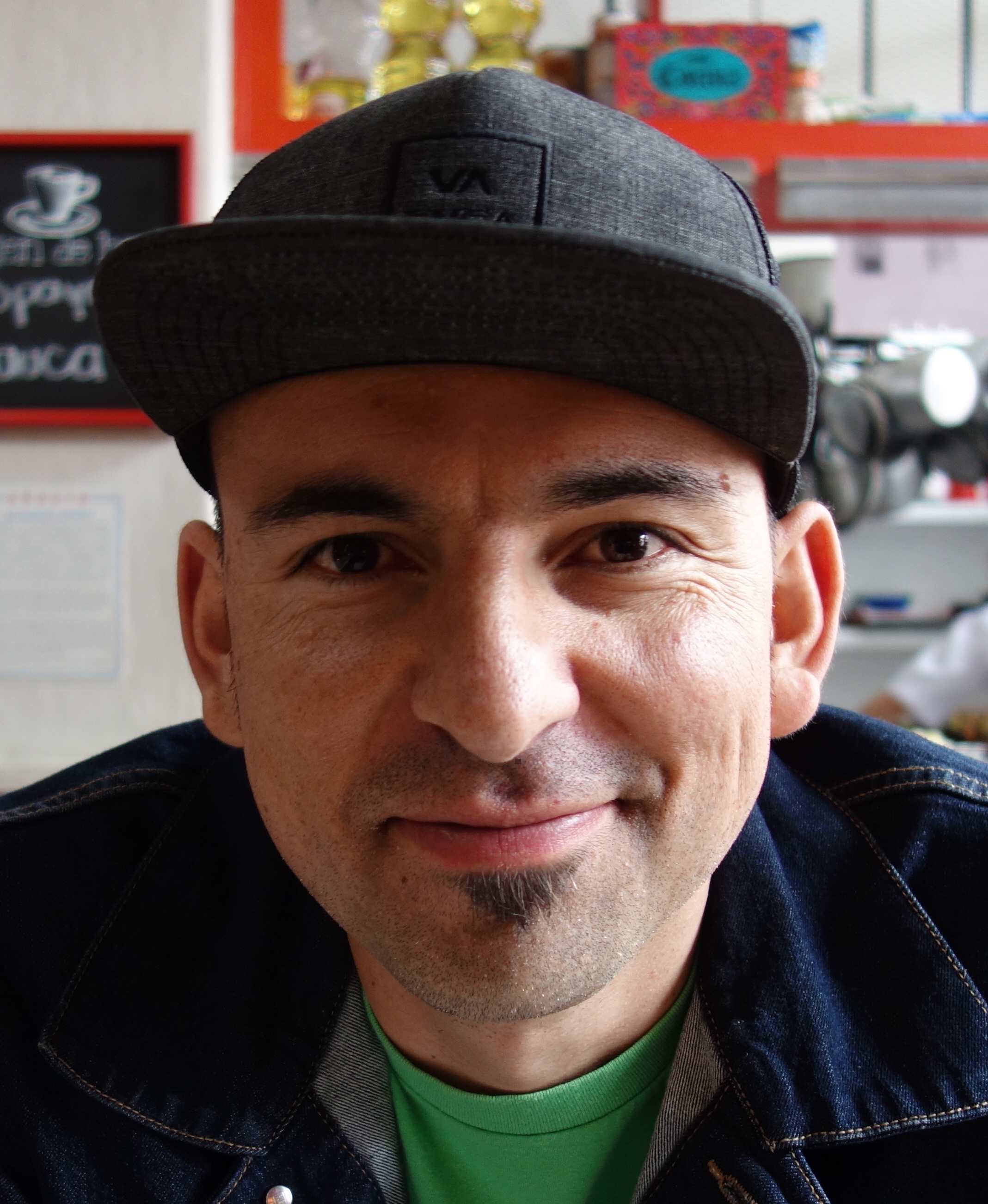
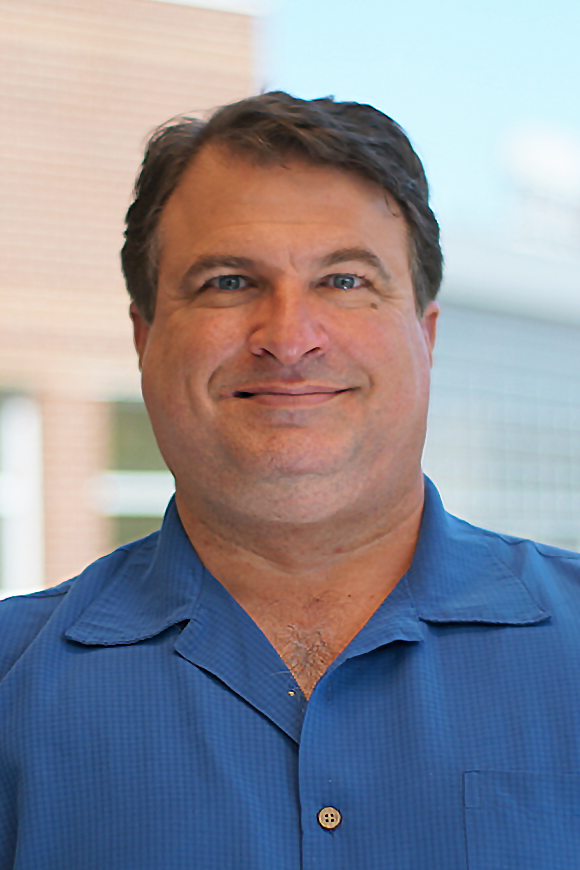
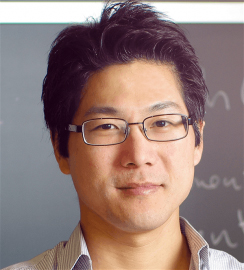
Federico Ardila-Mantilla is a Professor of Mathematics at San Francisco State University and an Adjunct Professor at Universidad de los Andes, Colombia. His research focuses on combinatorics and its connections to geometry, algebra, and topology, with notable contributions to matroid theory, polytopes, and tropical geometry. He is also deeply involved in promoting equitable and inclusive mathematics education through initiatives like the SFSU-Colombia Combinatorics Initiative . His work bridges pure mathematics and applications, particularly in robotics and discrete geometry. He has held visiting positions including at the Institute for Advanced Study (Princeton, 2024-25). His research spans over 60 publications, emphasizing interdisciplinary approaches to combinatorial problems. Ardila advocates for accessibility in mathematics through axioms such as 'Mathematical potential is equally present in all groups' (cited widely in educational contexts). Key areas of research include algebraic structures on polytopes, Lagrangian geometry of matroids, and geometric enumeration. He collaborates internationally and mentors students across institutions. His outreach efforts aim to make mathematics accessible to underrepresented communities.
Thomas E. DeCarlo , Ph.D., is the Ben S. Weil Endowed Chair of Industrial Distribution and Professor of Marketing and Industrial Distribution at the University of Alabama at Birmingham since 2009. He previously served at Iowa State University (1993-2006) and earned his Ph.D. in Business from the University of Georgia (1993) and BA in Accounting from North Carolina State University (1982). Research focus on strategic sales management , customer relationship management , and marketing communications Key methodologies: in-depth interviews , field experiments , and multivariable regression analysis Research Trends : His 15 most recent publications (2015-2025) examine: Salesperson ambidexterity and stress dynamics Consumer suspicion and persuasion knowledge Digital crowdfunding strategies Internal selling process optimization Service ecosystem theory in B2B contexts Scientific Awards : Recognized for outstanding teaching Multiple business impact awards Professional Activities : Served as Interim Department Chairperson (2014-2015) and ID Faculty Search Chair (2020). Actively reviews for journals like European Journal of Marketing and Industrial Marketing Management .
Prof. Dr.-Ing. Martin Hoffmann is a Professor of Microsystems Technology at the Faculty of Electrical Engineering and Information Technology, Ruhr University Bochum. His academic career began at the University of Dortmund, where he earned his doctorate in high-frequency technology and later habilitated in microsystems technology (2003). He held roles as a private lecturer and industry researcher before becoming a university professor at TU Ilmenau (2006). He joined Ruhr University in 2017, specializing in cutting-edge microsystems research. His research focuses on MEMS, THz technology, microactuators, and nanoimprint lithography. Key projects include cooperative microactuator systems, THz biosensors, and energy-autonomous sensors. He collaborates with institutions like TU Ilmenau, Purdue University, and Nagoya University through international programs like Double Degree and Erasmus. His work spans academic advising, grants, and industry partnerships (e.g., HL Planartechnik GmbH, Silicon Manufacturing Itzehoe GmbH). Notable contributions include silicon grass nanostructuring, palladium-based gas sensors, and wafer-scale MoS₂ deposition. His lab develops micromechanical systems for biomedical, environmental, and defense applications.
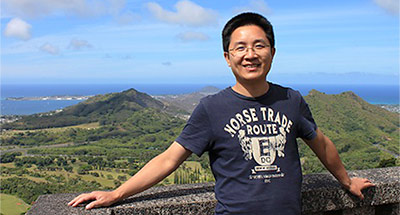
Qi Chen is a Professor in the Department of Geography at the University of Hawaii at Mānoa, specializing in remote sensing and geospatial technologies. His office is located in Saunders Hall, and he teaches undergraduate and graduate courses including GEO 370 (UAV and Aerial Photography), GEO 388 (Introduction to GIS), GEO 470 (Remote Sensing), GEO 489 (Applied GIS), and GEO 762 (Research Seminar: Remote Sensing. His research focuses on transforming earth observation data into actionable knowledge for environmental monitoring. Primary interests include: LiDAR applications for vegetation analysis and biomass estimation Climate change impacts on land cover and coastal systems Machine learning integration with geospatial data High-resolution mapping of agricultural and forest ecosystems Drone and satellite-based environmental assessment Chen's recent publications (2020-2025) demonstrate a strong focus on advancing remote sensing methodologies, particularly through: AI-driven approaches (GANs for vegetation indices, deep learning for marine debris) Multi-sensor fusion (LiDAR with camera systems, hyperspectral-multispectral integration) Novel applications in precision agriculture and infrastructure monitoring Hawaii-specific environmental studies incorporating indigenous knowledge systems He leads the Smart Remote Sensing Lab (smartremotesensing.org) where he mentors graduate students in developing cutting-edge geospatial solutions for ecological and societal challenges.
Dr David Johnson is an Associate Professor of Entrepreneurship at Durham University Business School, where he serves as Associate Chair for the £9 million Smart & Scale initiative supporting SME innovation in North-East England. He is also a Fellow of the Wolfson Research Institute for Health and Wellbeing and maintains active Visiting Fellow positions at international institutions. Johnson's educational background includes: PhD in Management (Entrepreneurship), University of Edinburgh Business School MSc by Research (Entrepreneurship), University of Edinburgh Business School MBA, Adam Smith Business School, University of Glasgow Master's degree in Science, University of Edinburgh Bachelor's degree in Science, University of Leeds PG Cert in Learning, Teaching, and Assessment Practice His research centers on academic entrepreneurship , life science commercialisation , and university-industry engagement , with particular focus on linguistic approaches and machine learning applications. Johnson examines how institutional practices shape entrepreneurial activities across contexts ranging from regenerative medicine to Freemasonry, emphasizing the built environment's role in ecosystem development. Johnson's publication trajectory reveals evolving methodological sophistication, shifting from early studies on regenerative medicine venturing (2014-2017) toward computational linguistics and machine learning applications (2024-2025). His work consistently bridges theoretical frameworks with practical innovation challenges, spanning entrepreneurial ecosystems, technology transfer, and narrative analysis in resource mobilization. His scientific recognition includes: NASA Innovation and Technology Transfer: Space2Pitch Final Visiting Research Fellow at Interface, Edinburgh Fellow of Wolfson Research Institute for Health and Wellbeing Visiting Research Fellow at Skolkovo Institute Visiting Research Scholar at Wisconsin School of Business Fellow of Higher Education Academy Johnson supervises postgraduate students including Clare Talbot-Jones and Olivia King, supported by over £500,000 in research funding: Science commercialisation activities at university-industry boundary (£390,824) Cardiology-focused point-of-care device development (£38,934) Primary Research Support Fund for Zambian field research (2025) Global Engagement Grant for Dartmouth College knowledge exchange (2024) He actively leads research infrastructure as Co-Director of Durham Enterprise Centre and through his Smart & Scale initiative role, while contributing to interdisciplinary health research via the Wolfson Institute fellowship.
Richard Kenyon is the Erastus L. DeForest Professor of Mathematics at Yale University, serving as Director of Undergraduate Studies. His research focuses on statistical mechanics, probability, and discrete geometry, with notable contributions to dimer models, random tilings, and integrable systems. He has explored topics such as limit shapes, phase transitions, and combinatorial configurations. His work intersects algebraic geometry, combinatorics, and mathematical physics, often involving the analysis of lattice models and their applications. His research includes open problems such as tiling optimization, geometric spanning surfaces, number theory questions, and rigidity of tilings. Kenyon's gallery showcases visualizations of mathematical concepts, including random triangulations, Vinnikov curves, and conformal mappings. His academic contributions span over three decades, with recent articles addressing dimers, webs, and eigenvalue properties. He actively collaborates on projects like the six-vertex model, multiwebs, and renormalizable dynamical systems. Kenyon’s academic service includes directing undergraduate studies at Yale and contributing to initiatives in discrete differential geometry. His work highlights the interplay between pure mathematics and applied probability, with applications in physics and combinatorial optimization.
Prof. Mihai Nica is an Assistant Professor in the Department of Mathematics and Statistics at the University of Guelph, affiliated with the CARE-AI institute and Vector Institute. His research focuses on probability theory, stochastic processes, and their applications to machine learning, particularly deep neural networks (DNNs). He explores scaling limits of DNNs, numerical methods using neural networks, and phase transitions in high-dimensional learning problems. Education: B.Math in Pure & Applied Math with Physics Option, University of Waterloo PhD in Mathematics, Courant Institute of Mathematical Sciences, New York University Postdoctoral Fellow at University of Toronto (supervised by Jeremy Quastel) Research Interests: His work bridges mathematical theory and practical AI applications, emphasizing topics like the neural tangent kernel, KPZ universality class, and stochastic processes in machine learning. Notable contributions include studies on neural network dynamics, random matrices, and directed polymers. Publications: Over 15 peer-reviewed articles in journals like Communications in Pure and Applied Mathematics and Electronic Journal of Probability , with a focus on theoretical foundations of AI and stochastic systems. Recent work explores infinite-width limits of neural networks and their connections to differential equations. Labs/Teams: Affiliated with CARE-AI (bridging mathematics, engineering, and philosophy) and the Vector Institute, fostering interdisciplinary collaborations.
Jayadev S. Athreya is an Associate Professor in the Department of Mathematics at the University of Washington, where he also serves as Director of the Washington Experimental Mathematics Lab. His primary affiliation is with the College of Liberal Arts & Sciences. He holds dual roles as a Professor of Mathematics and Professor of the Comparative History of Ideas. Athreya co-directs the Pacific Institute for the Mathematical Sciences and is a founder of the Washington Experimental Mathematics Lab, emphasizing interdisciplinary experimental mathematics. His research interests span dynamical systems, geometric topology, number theory, and algebraic geometry. He focuses on translation surfaces, billiards dynamics, geometric flows, and probabilistic methods in geometry. His work often intersects with problems in ergodic theory, Teichmüller theory, and moduli spaces. Athreya has an extensive publication record, with recent work exploring billiard complexity in regular polygons, linear flows on translation prisms, and spectral properties of marked tori. His papers frequently address counting problems, asymptotic distribution of geometric objects, and connections between number theory and dynamical systems. He has taught advanced courses such as Quasiconformal Maps and Teichmüller Theory, Complex Analysis, and Elementary Number Theory. His pedagogical approach emphasizes hands-on exploration through the Washington Experimental Mathematics Lab, fostering collaborative research projects with undergraduates. Athreya is committed to accessible mathematics education, reflecting his alignment with Federico Ardila-Mantilla's axioms on equity and inclusivity in mathematical experiences. His work bridges theoretical research with educational outreach, advocating for mathematics as a universal, adaptable tool.
Dr.-Ing. Nico Palleit is affiliated with the University of Rostock's Institute of Communications Engineering, part of the Faculty of Computer Science and Electrical Engineering. His research focuses on MIMO (Multiple-Input Multiple-Output) systems, channel estimation, and prediction techniques to enhance spectral efficiency. He holds a PhD titled Channel Prediction in Multi-Antenna Systems (2011) and has contributed to advancements in MIMO channel analysis, including frequency/time prediction and interference management. Research Interests: Nico's work addresses challenges in modern radio transmission systems, emphasizing the development of robust channel estimation strategies. Key areas include MIMO channel modeling, non-line-of-sight (NLOS) positioning, and optimizing transmitter-side channel state information. His research bridges theoretical frameworks with practical implementations in wireless communication systems. Publications Overview: His 15+ publications (2006–2012) span topics like MIMO channel prediction, antenna array design, and interference channel optimization. Recent work emphasizes frequency/time-domain channel prediction and power allocation strategies for maximizing system capacity. These contributions highlight interdisciplinary approaches combining signal processing with electrical engineering principles. Affiliations & Labs: As part of the Radio Communication Research Group, he collaborates on projects within the Institute's advanced wireless communication initiatives. His work supports next-generation radio systems through innovative solutions for MIMO-FDD and OFDM-based architectures.
Professor Silvio Franz is affiliated with the Department of Mathematics and Physics 'Ennio De Giorgi' at the University of Salento (Italy). His research career spans over 30 years with 110+ publications, focusing on the statistical mechanics of disordered systems and their interdisciplinary applications. Key contributions include the development of the Franz-Parisi potential for studying glass transitions and rigorous mathematical frameworks for spin glasses. PhD in Theoretical Physics Full Professor at University of Salento Research Interests center on spin glasses and glassy systems , with applications to: Theoretical Neuroscience Machine Learning Population Genetics Constraint Satisfaction Problems Random Matrix Theory Theoretical Computer Science His work connects statistical physics to: Information Theory Optimization Algorithms Neural Network Modeling Evolutionary Biology Complex Systems Theory Key Publications demonstrate: Landau theory for glasses Universality in jamming transitions Stochastic stability analysis Effective temperature formulations Replica symmetry breaking Applications to error-correcting codes
Armin Hafner is a Professor in the Department of Energy and Process Engineering at NTNU. His research focuses on clean cooling technologies, refrigeration systems, thermal energy storage, and CO₂-based heat pumps. He has contributed to advancements in natural refrigerant applications, industrial refrigeration optimization, and sustainable energy solutions for maritime, food processing, and commercial sectors. His work integrates experimental and numerical methods to improve the efficiency of CO₂ systems, absorption-compression hybrids, and thermal storage integration. Notable projects include cold thermal energy storage for supermarkets, freeze concentration of fish hydrolysates, and refrigeration systems for fish processing in India. Publications emphasize energy-efficient refrigeration cycles, novel ejector technologies, and the application of CO₂ in diverse climates. Collaborations span institutions globally, addressing challenges in high-temperature heat pumps and cryogenic cooling for CERN detectors. Academic advising includes numerous master's theses on topics like fossil-free heating systems, CO₂ plate freezers, and refrigerated transportation logistics in India. His research consistently targets decarbonization and sustainable energy solutions.
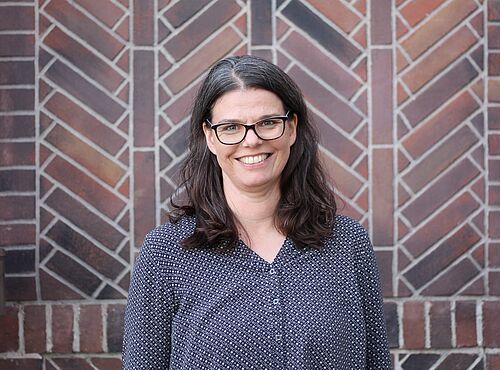
Prof. Dr.-Ing. Sabine C. Langer is a Full Professor of Acoustics and Director of the Institute of Acoustics at Technische Universität Braunschweig. She holds a PhD in Engineering and has extensive experience in academia, including leadership roles such as President of the Deutsche Gesellschaft für Akustik (DEGA) and Deputy Speaker of the DFG Collaborative Research Center 880 (SFB 880). Her research focuses on acoustics, numerical modeling, aircraft noise reduction, and innovative materials for sound absorption. She has pioneered studies on acoustic black holes, metamaterials, and AI-driven design optimization. Langer’s work also includes contributions to educational platforms, such as developing MATLAB-based sound quality analysis tools and online learning resources for engineering students. Education: Civil Engineering degree (1991–1996, TU Braunschweig), PhD in Engineering (2001, TU Braunschweig). Key positions include W2 Professor for Vibroacoustics (2013–2018) and Junior Professor for Wave Propagation and Building Acoustics (2003–2013). She led the Graduate School at SFB 880 and advised numerous research initiatives in structural acoustics and noise mitigation. Research interests span numerical acoustics, sound quality assessment, and sustainable acoustic design. Her recent work emphasizes AI integration in engineering design, stochastic modeling, and additive manufacturing of acoustic materials. She has published extensively on aircraft cabin noise prediction, vibration isolation, and metamaterial applications. Professional roles include membership in the DIN/VDI Normenausschuss Akustik and the Advisory Board of the Excellence Cluster Hearing4All. She has organized major acoustics conferences, including DAGA 2020 in Hannover, and contributed to standard-setting in noise reduction and vibration technology.
Marco Chiesa is an Associate Professor at the KTH Royal Institute of Technology in the Intelligent Network System Lab (INSight) group under the Division of Software and Computer Systems . His research focuses on computer networking, particularly Internet protocols and architectures, with emphasis on security, privacy, network design optimization, and Software Defined Networking (SDN) approaches. Current research areas: SDN, IXPs, stateful packet processing, network monitoring Teaching roles: Advanced Internetworking (IK2215), Computer Hardware Engineering (IS1200), Network Systems with Edge or Cloud Datacenters (IK2227) Email: mchiesa@kth.se Recent publications highlight advancements in high-speed packet processing, network security, and SDN applications. Key trends include leveraging programmable switches for stateful operations, improving BGP hijacking detection, and optimizing network monitoring on multi-pipeline architectures.
Stephen Eikenberry is a Professor of Optics & Photonics Physics at CREOL, The College of Optics and Photonics, University of Central Florida. His academic journey includes a Ph.D. in Astronomy from Harvard University (1997), a Sherman Fairchild Postdoctoral Prize Fellowship at Caltech, and prior tenured roles at Cornell University and the University of Florida. His research focuses on black holes, neutron stars, gravitational waves, and astronomical instrumentation, with applications in biomedical imaging and spectroscopy. Key professional milestones include the 2016 Breakthrough Prize in Fundamental Physics (as part of the LIGO Science Consortium), the NSF CAREER Award (2000), and multiple University of Florida Research Foundation Professorships. He has designed advanced optical instruments and contributed to LIGO's gravitational wave discoveries. Eikenberry's research group explores astrophotonics, dark energy, and extrasolar planets. His recent work includes analyzing gravitational wave data from LIGO/Virgo and developing lunar occultation missions. He advises multiple graduate students and collaborates on international projects like the PolyOculus Array (OPA!). Education: Ph.D. in Astronomy, Harvard University (1997) Postdoctoral Fellowship at Caltech (Sherman Fairchild Prize) Awards: Breakthrough Prize in Fundamental Physics (2016) Gruber Prize for Cosmology (2016) UK Royal Astronomical Society Team Achievement Award (2016) His publications emphasize gravitational wave astronomy, cosmology, and instrument design. He has pioneered methods to constrain cosmic expansion using gravitational wave 'standard sirens' and studies correlations between fast radio bursts and gravitational wave events.
Andrew Suk is a Professor in the Department of Mathematics at the University of California, San Diego (UCSD). He holds an NSF CAREER Award and an Alfred P. Sloan Research Fellowship. His research focuses on Combinatorics, Discrete Geometry, Ramsey Theory, and Extremal Combinatorics, supported by grants such as NSF FRG Collaborative Research (DMS-1952786) and NSF (DMS-2246847). He completed his Ph.D. at New York University's Courant Institute in 2011, followed by an NSF Postdoctoral Fellowship at MIT under Jacob Fox. Education: Ph.D., Mathematics, New York University, 2011 Research Interests: Suk's work spans Geometric Combinatorics, Ramsey Theory, and extremal problems in discrete structures. Notable contributions include resolving the Erdős-Szekeres convex polygon problem asymptotically and advancing Ramsey-type results for semi-algebraic relations. His research bridges combinatorial geometry with graph theory and hypergraphs. Recent Contributions: His articles explore topics like cliques in point-line arrangements, semi-algebraic Ramsey numbers, and geometric Ramsey problems. Key themes include extremal configurations, topological graphs, and applications of VC-dimension. Awards: NSF CAREER Award Alfred P. Sloan Research Fellowship Service & Mentorship: Suk advises Ph.D. students and serves as an editor for SIAM Journal on Discrete Mathematics and Studia Scientiarum Mathematicarum Hungarica . He organizes workshops and chairs program committees for conferences like SoCG and GD. Teaching: Recent courses include Calculus for Science and Engineering at UCSD.