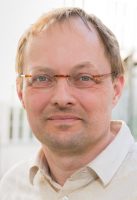
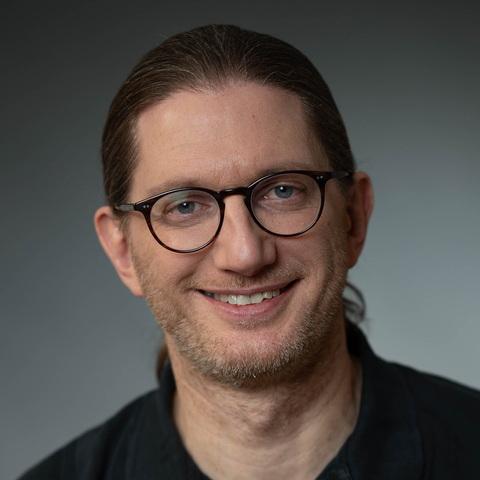
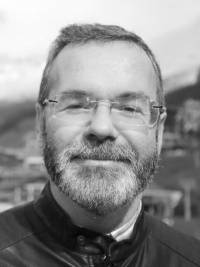
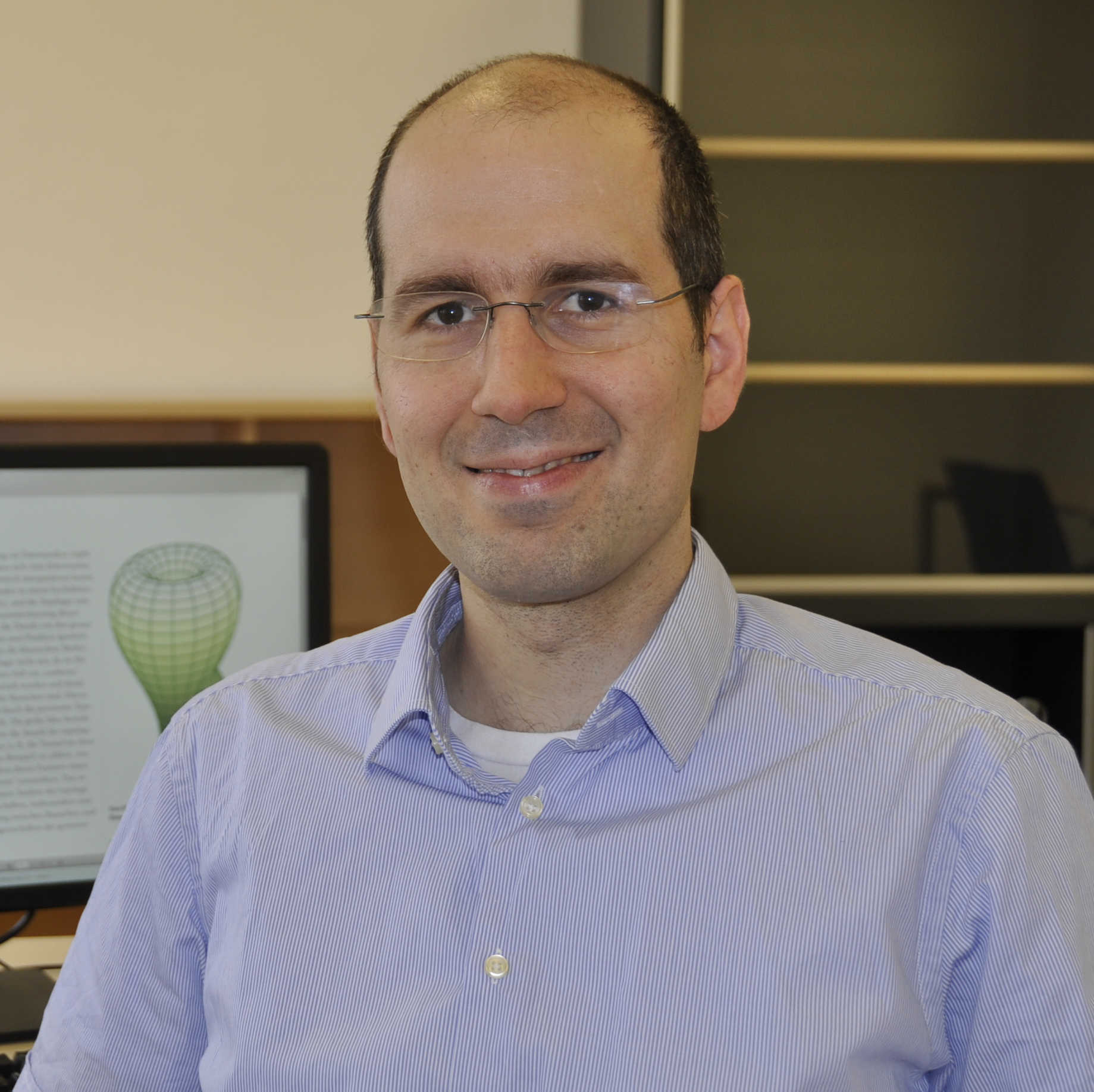
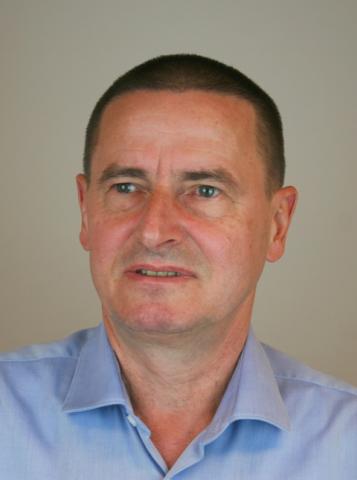
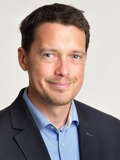
Markus Vincze is an Associate Professor at the Institute of Automation and Control Engineering (ACIN) at Vienna University of Technology (TU Wien). He founded the Vision for Robotics (V4R) group in 1996 to advance robotic perception, particularly in real-world environments and homes. His work focuses on cognitive computer vision techniques for robotics. Education: Diplom in Mechanical Engineering (1988) and PhD (1993) from TU Wien; M.Sc. (1990) from Rensselaer Polytechnic Institute. V4R coordinates EU projects like ActIPret, robots@home, HOBBIT, and national initiatives like vision@home. Markus has edited a book on Robust Vision with Gregory Hager and authored 62 peer-reviewed journal articles and over 400 reviewed publications. His recent research explores zero-shot 6D pose estimation, sim-to-real transfer, and transparent object detection. Markus has served as program chair for ICRA 2013 and organized HRI 2017 in Vienna. He has advised numerous students and secured grants from the Austrian Academy of Sciences for work at HelpMate Robotics and Yale's Vision Laboratory. The V4R group leads innovations in robotic vision, including frameworks for synthetic data generation (Unrealgensyn), depth completion (CAGT), and educational robotics applications for sustainability. Their work spans household robotics (RH3), agricultural robotics (EdgeSoil), and human-robot collaboration.
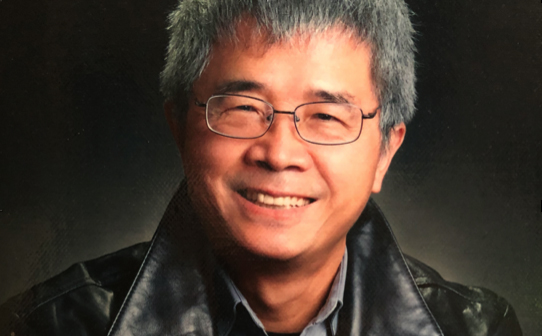
Xiaotie Deng is a distinguished academic and Chair Professor at Peking University (since 2018), with prior roles at Shanghai Jiao Tong University (2013–2017), the University of Liverpool (2010–2013), and City University of Hong Kong (1997–2013). His research focuses on algorithmic game theory, internet economics, and parallel computing. He holds prestigious fellowships including ACM Fellow (2008) and IEEE Fellow (2019). Deng has led significant grants, including a RMB 5M project on algorithmic game theory at Peking University (2018–2020) and NNSFC-funded research on market competitiveness and fairness (2018–2020). Education: PhD in Computer Science from Stanford University (1989), MSc from Chinese Academy of Sciences (1984), BSc from Tsinghua University (1982). Research interests span computational game theory, equilibrium analysis, and blockchain applications. Notable contributions include foundational work on Nash equilibrium complexity and mechanism design for resource allocation. He has advised numerous PhD students and serves on editorial boards of top journals like SIAM Journal on Computing and IEEE Transactions on Cloud Computing. Key awards: ACM and IEEE Fellowships, JSPS Invitation Fellowships (2005, 1996), and NSERC International Fellowship (1991). Active in conference organizing, including PC chairs for WINE 2020 and SAGT 2018. Consultancy includes work with Cryptape, Ant Financial, and Microsoft Research Asia, reflecting his industry engagement in algorithmic solutions and blockchain technologies.
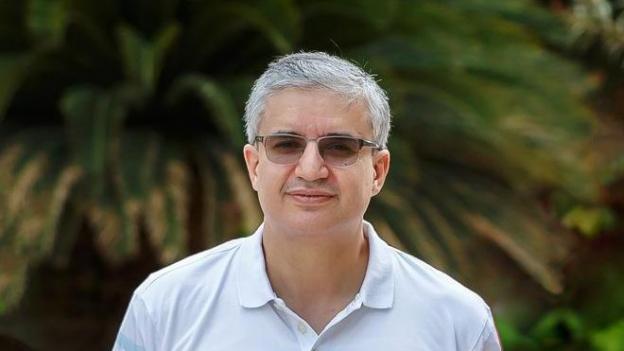
Mohamed-Slim Alouini is a Professor of Electrical Engineering and Associate Dean of the Computer, Electrical and Mathematical Science and Engineering (CEMSE) Division at King Abdullah University of Science and Technology (KAUST) in Saudi Arabia. He also serves as the Associate Vice President for Research and holds the UNESCO Chair in Education to Connect the Unconnected. With over 500 journal publications and more than 46,000 citations, he is a world-renowned expert in wireless communications who was elected IEEE Fellow in 2009 at the age of 39. Education: PhD in Electrical Engineering, California Institute of Technology (Caltech), 1998 MS in Electrical Engineering, Georgia Institute of Technology (Georgia Tech), 1995 Diplôme d'Etudes Approfondies (DEA) in Electronics, Université Pierre & Marie Curie (Sorbonne University), 1993 Diplôme d'Ingénieur, École Nationale Supérieure des Télécommunications (Télécom Paris Tech), 1993 Habilitation, Université Pierre & Marie Curie (Sorbonne University), 2003 Dr. Alouini is a world-renowned expert in wireless communication and networking with research interests spanning diversity combining techniques, MIMO systems, multi-hop/cooperative communications, optical wireless systems, cognitive radio, UAV communications, and advanced modulation schemes. His current focus addresses the technical challenges of uneven information and communication technology distribution, particularly targeting rural, low-income, disaster-prone, and hard-to-reach areas through integrated ground-airborne-space networks. His work bridges theoretical foundations with practical implementations to solve real-world connectivity problems. His recent publications (2020-2024) demonstrate a clear research trajectory toward integrated communication networks combining terrestrial, aerial, and space components. There's growing emphasis on UAV communications, satellite systems, optical wireless technologies, and rural connectivity solutions, with increasing integration of machine learning techniques for network optimization. His work shows consistent focus on addressing the digital divide, with several publications specifically targeting 6G challenges for connecting underserved populations and recycling existing infrastructure for enhanced rural connectivity. Scientific Awards: Member of the European Academy of Sciences and Arts (2019) Fellow of the African Academy of Sciences (2018) IEEE Fellow (2009) Abdul Hameed Shoman Award for Arab Researchers (2016) OIC Science & Technology Achievement Award (2017) Multiple recognitions as Highly Cited Researcher NSF CAREER Award (1999) Dr. Alouini has mentored numerous successful students and post-doctoral fellows who have secured positions at top institutions worldwide including Harvard, Caltech, Imperial College, and faculty positions at Korea University, Hanyang University, and universities across the Middle East. His December 2018 PhD graduate Qurrat-Ul-Ain Nadeem received the prestigious Marconi Society Paul Baran Young Scholars award, while post-doctoral fellows have won IEEE ComSoc Young Professionals Best Innovation Award and attended the Lindau Nobel Meeting. His Communication Theory Lab at KAUST drives significant research in wireless communications with funding supporting extensive publication output and innovative projects. Dr. Alouini leads the Communication Theory Lab at KAUST and holds the UNESCO Chair in Education to Connect the Unconnected, focusing specifically on technical solutions for connecting underserved communities. His lab works on integrated ground-airborne-space networks to bridge the digital divide, with particular emphasis on rural, low-income, and hard-to-reach areas. The team develops practical solutions using UAVs, satellite communications, and recycled infrastructure to provide cost-effective connectivity where traditional approaches fail.
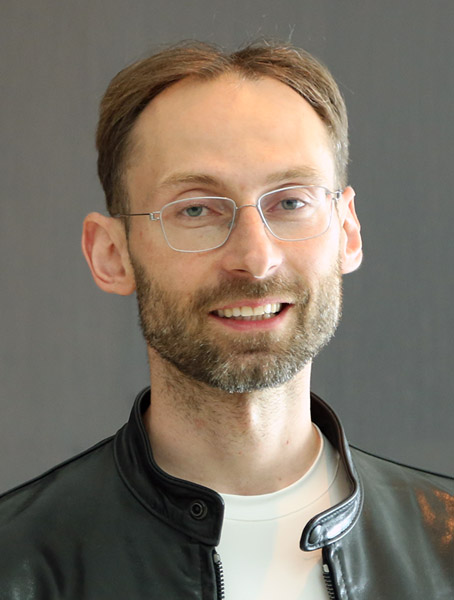
Tobias Ofner-Graff is a researcher at the Institute of Forest Growth within the Department of Ecosystem Management, Climate and Biodiversity at the University of Natural Resources and Life Sciences, Vienna (BOKU). Based at Peter-Jordan-Straße 82, 1190 Wien, his work focuses on advanced forest monitoring technologies. His research interests include: LiDAR and remote sensing applications in forestry Automated forest inventory systems Forest regeneration quantification Airborne Laser Scanning (ALS) data analysis Sustainable forest harvesting planning Recent project contributions include: Leading lidar-based forest monitoring systems development Developing spatial forest growth models Implementing digital inventory workflows His publications demonstrate expertise in: Quantifying forest resources through 3D point clouds Advanced timber stack measurement techniques ALS data integration for forest modeling Mobile laser scanning applications Forest climate adaptation strategies
Prof. Hermann Hellwagner is a Full Professor at the Department of Information Technology, University of Klagenfurt. He has held roles such as Vice President (Natural and Technical Sciences) at the Austrian Science Fund (FWF) and Vice Dean of the Faculty of Technical Sciences. His research focuses on multimedia communication, network engineering, and future internet architectures. Notable projects include work on adaptive streaming, edge computing, and drone networks. He holds a Ph.D. in Systolic Architectures from the University of Linz (1988). Research interests span distributed multimedia systems, information-centric networking (ICN), and optimizing video streaming quality-of-experience (QoE). Recent work emphasizes edge computing solutions for low-latency streaming and dynamic codec adaptation. His contributions include frameworks like ALPHAS and MEDUSA for bitrate optimization, and studies on point cloud streaming in augmented reality. Publications (2021–2025) highlight advancements in edge-assisted streaming, hybrid P2P-CDN architectures, and transcoding techniques. His work often bridges theoretical models with real-world implementations, addressing challenges in latency, cost, and device adaptability. Current projects involve 6DoF video streaming and multi-robot system optimization. Labs/Teams: Part of the Institute of Information Technology (ITEC), Klagenfurt. Collaborates on EU-funded projects and industry partnerships in 5G edge computing and drone networks. Active in standards groups for HTTP adaptive streaming protocols.
Michael Bronstein is a Professor & Chair in Machine Learning and Pattern Recognition at the Department of Computing, Imperial College London (2018–present). He previously held academic roles including Professor at the University of Lugano, Switzerland (2010–present, on leave since 2019), Visiting Associate Professor at Tel Aviv University (2015–2017), and Visiting Lecturer at Stanford University (2008–2009). His research focuses on geometric methods for data analysis, with applications in machine learning, computer vision, and social networks. PhD in Computer Science (2007), Technion – Israel Institute of Technology His expertise spans geometric machine learning , deep learning on graphs, manifolds, and point clouds , 3D shape analysis , and geometry processing . His work bridges theoretical and computational approaches to solving problems in computer vision , pattern recognition , and 3D depth sensors . 2020 Royal Academy of Engineering Silver Medal 2018 Fellow, IEEE and IAPR 2016 ERC Consolidator Grant 2014 Young Scientist, World Economic Forum He has led high-impact industrial projects, including the development of Intel RealSense 3D camera technology, and founded startups like Fabula AI (acquired by Twitter in 2019). His academic and entrepreneurial career includes over 150 publications, 30 patents, and leadership roles in both academia and industry.
Diana Marin is a PostDoc Researcher at TU Wien's Institute of Visual Computing & Human-Centered Technology. She holds a BSc, MEng, and Dr.techn. (PhD) in technical fields. Her research focuses on computational geometry, point cloud processing, and distributed computing for large-scale datasets. She has contributed to projects like Distributed Surface Reconstruction and RE:STOCK INDUSTRY. Education: BSc, MEng, Dr.techn. (PhD) Her work emphasizes curve and surface reconstruction from unorganized point clouds, leveraging proximity graphs and distributed computational methods. Key projects include optimizing surface reconstruction for massive datasets and developing parameter-free algorithms for connectivity analysis. Her publications span topics like SING neighborhood graphs, Riemannian manifold curve reconstruction, and distributed processing techniques. She collaborates on projects such as PostDisaster and Mixed Reality Lab.
Michael Wimmer is a Full Professor at TU Wien, leading the Rendering and Modeling Group and directing the Center for Geometry and Computational Design. He holds a M.Sc. (1997) and Ph.D. (2001) from TU Wien. His research focuses on real-time rendering, procedural modeling, computational design, and point-based graphics. He has co-authored over 200 papers and the book *Real-Time Shadows*. He serves as Co-Editor-in-Chief of Computer Graphics Forum , chairs SIGGRAPH Asia 2025, and received the Eurographics Outstanding Technical Contributions Award (2023). Education: M.Sc. in Computer Science (1997), TU Wien Ph.D. in Computer Science (2001), TU Wien Research Interests: Real-time rendering and visualization Procedural modeling and computational design Point-based graphics and neural rendering Applications in computer games and urban environments Awards: Eurographics Outstanding Technical Contributions Award (2023) Wolfgang Straßer Award (Best Paper, 2022) Eurographics Fellow (2018) Outstanding Service Award (2012) Advising & Grants: Coordinator of the Special Research Programme Advanced Computational Design Key researcher at VRVis Research Center Labs & Teams: Rendering and Modeling Group Center for Geometry and Computational Design
Antonio Rodríguez-Sánchez is an Associate Professor in the Intelligent and Interactive Systems group at the Department of Computer Science, Universität Innsbruck (since 2019). He holds a PhD from York University (2010) and has held academic roles in Austria, Canada, and Spain. His research focuses on Explainable AI, computational neuroscience, deep learning, computer vision, robotics, and medical imaging. Education: PhD in Computer Science, York University (Canada), 2010 M.Sc. in Computer Science, Universidade da Coruña (Spain), 1998 B.Sc. in Computer Science, Universidad de Córdoba (Spain), 1996 3-year Bachelor in Biology, Autonomous University of Madrid (Spain), 1998–2001 Research Interests: His work bridges AI and neuroscience, emphasizing explainable systems, medical imaging analysis, robotics, and deep learning applications. Recent trends in publications highlight advancements in healthcare AI (REM sleep disorder prediction), robotic recycling, and computer vision for environmental monitoring. Teaching & Advising: Teaches courses like Deep Learning, Computer Vision, and Algorithms. Supervises PhD/MSc students (e.g., Safoura Rezapour-Lakani, Sebastian Stabinger). Active in EU-funded projects like PaCMan (FP7-ICT) and IntellAct. Labs & Projects: Leads research in the Intelligent and Interactive Systems group, focusing on interdisciplinary AI applications. Projects include automated avalanche detection and robotic recycling systems.
Stefan Lengauer is a Senior Researcher at the Institute of Visual Computing (IVC), Graz University of Technology. His work bridges cultural heritage analysis and health informatics through advanced visualization techniques. PhD in Computer Science (2022), Graz University of Technology MSc in Space Sciences (2018), TU Graz BSc in Computer Science (2014-2022) and Aviation (2015), FH JOANNEUM Research focuses on visual analytics , 3D object retrieval , and cross-modal search , with applications in: Medical domains (diabetes care, health information systems) Cultural heritage (pottery analysis, fragment matching, digital restoration) Pattern recognition (geometric motifs, surface textures) Recent publications highlight trends in adaptive visualization (2024-2025) and 3D cultural heritage analysis (2021-2023). Key projects include: HEREDITARY (2024-present): HORIZON Europe project on gut-brain interaction A+CHIS (2020-present): FWF research group on adaptive health information systems CrossSAVE-CH (2019-2022): Cross-modal search in cultural heritage Scientific recognition includes: Best Challenge Entry (2024) Honorable Mention (2020) PhD distinction (2022) Mentored 12+ students in topics ranging from medical chatbots to 3D pottery analysis . Reviewing activities span journals like Springer Nature and conferences including WSCG.
Michael Kerber is a Professor at Graz University of Technology, Institute of Geometry, specializing in computational topology and geometry. His research bridges mathematical theory with applications in data analysis, focusing on persistent homology and geometric algorithms. PhD from Max Planck Institute for Informatics (2009) Postdoc positions: Max Planck Institute, Stanford University, IST Austria His work centers on designing efficient algorithms for topological data analysis, particularly: Persistent Homology 2-Parameter Persistence Geometric Filtrations Algebraic Curve Analysis High-Dimensional Sphere Packing Recent publications emphasize: Improved Delaunay bifiltration methods NP-hardness of interleaving distance computation Sparse Čech filtrations for big data Integration with graph neural networks He has co-developed key software tools: PHAT DIPHA HERA SOPHIA
Univ.Prof. Michael Wimmer is a Professor in the Department of Computer Graphics and Visualization at TU Wien's Faculty of Informatics. His research focuses on real-time rendering, point cloud processing, GPU computing, and computational design. He leads projects involving architectural visualization, thermal simulation, and integrative design frameworks combining 4D sketching with material modeling. His work bridges computer graphics with applications in architecture and engineering. ORCID: 0000-0002-9370-2663 Research Group: Network Lab Recent research emphasizes GPU-accelerated algorithms (e.g., LOD generation for 2 billion points), real-time rendering techniques, and deep learning approaches for surface reconstruction. Collaborations span thermal simulation with civil engineers and 4D design tools for architects. Notable contributions include: Developing PPSurf for detailed surface reconstruction using point convolutions Advancing Vulkan-based rendering pipelines in academic settings Integrating light polarization for HDR imaging His lab explores applications in architectural design metaphors, computational material assessment via GeoRadar, and thermal simulation using precomputed radiative transport. Students under his supervision focus on GPU optimization, 3D reconstruction, and VR ergonomics.
Nives Doneus is a researcher at the Vienna Institute for Archaeological Science , University of Vienna, specializing in archaeological prospection and Roman landscape studies . Her work focuses on remote sensing, geoarchaeology, and 3D documentation of Mediterranean and Central European sites. Expert in airborne laser scanning (LiDAR) for submerged/coastal sites Key contributor to LBI ArchPro Research Initiative (2010-2015) Specializes in Roman-era field systems and dry stone wall analysis Her research integrates geophysical prospection with historical GIS to reconstruct Roman urban and rural landscapes. She has pioneered applications of airborne laser bathymetry for documenting submerged archaeological sites in Croatia's archipelagos. Recent publications emphasize interdisciplinary approaches to Mediterranean coastal archaeology, Roman surveying practices, and paleoenvironmental reconstructions. Key methodological themes include non-destructive excavation techniques and digital heritage modeling . Collaborates with teams at the Vienna Institute for Archaeological Science and contributes to the development of systemic archaeological prospection frameworks. Her work spans case studies in Austria, Croatia, and Bulgaria.
Eduard Gröller is a Full Professor of Visualization at the Vienna University of Technology (TU Wien), leading the Research Unit of Computer Graphics and the Visualization Group within the Institute of Visual Computing & Human-Centered Technology (VC&HCT). He holds adjunct professorships at the University of Bergen, Norway, and chairs several academic committees. His academic journey began with a PhD in 1993 from TU Wien, followed by extensive contributions to visualization research. His research focuses on visual computing, scientific visualization, and medical imaging, with applications in energy modeling, climate analysis, and molecular biology. Gröller has pioneered methods like BEMTrace for BIM-based energy models and HORA 3D for flood risk visualization. He co-authored over 300 publications, including foundational work in IEEE Transactions on Visualization and Computer Graphics and Computer Graphics Forum . Gröller's awards include the IEEE VGTC Technical Achievement Award (2019), Eurographics 2015 Outstanding Technical Contributions Award, and Fellow of the Eurographics Association (2009). He actively contributes to conferences like EuroVis and IEEE Visualization as program chair and reviewer. His educational efforts span courses in visual computing, graphics, and data analysis, with a focus on immersive tools like ImNDT for material data exploration. Current projects include Climate-Sensitive Adaptive Planning for Resilient Cities, Visual Analytics in Radiation Therapy, and scalable web-based visualization techniques. He leads teams in VRVis, a research center for applied visualization, and collaborates internationally on medical imaging and environmental data challenges.
Stefan Rass is a full Professor at Alpen-Adria-Universität Klagenfurt (AAU), with additional affiliation at Johannes Kepler University Linz (JKU). He holds the academic title Univ.-Prof. (Universitätsprofessor) and possesses advanced degrees including PD (Privatdozent), Dipl.-Ing. (Diplom-Ingenieur), and Dr. (Doctor). His research spans multiple institutions and projects, with a focus on security and risk management through game theory applications. Professor Rass's research interests center around Security and Risk Management, Decision and Game Theory for Security, Security Infrastructures (including Key Distribution and Management, PKI, and Authentication), Unconditional and network security, Applied Quantum Cryptography, and Complexity Theory and Statistics in Security. His work bridges theoretical computer science with practical security applications, particularly in quantum networks and critical infrastructure protection. His recent publications demonstrate a strong trend toward interdisciplinary security research, combining game theory with quantum cryptography, robotics security, and AI-powered penetration testing. The articles reveal increasing focus on practical applications of theoretical security concepts, with notable work in quantum networks, deniable encryption techniques, robotics security benchmarking, and AI-assisted security testing. His research shows consistent evolution from theoretical foundations toward real-world implementation challenges. Professor Rass leads multiple ongoing research projects including Machine Learning for Risk Management, Safe and Secure Robotic Systems Engineering (SEEROSE), Simulation and analysis of critical network infrastructures in cities (ODYSSEUS), and security for cyber-physical value networks Exploiting smaRt Grid systems (synERGY). These projects, primarily funded by FFG (Austrian Research Promotion Agency), demonstrate his leadership in securing critical infrastructure and developing next-generation security frameworks.