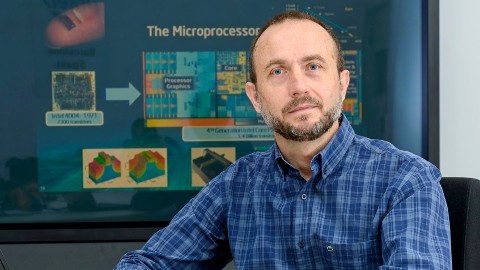
Deva Kannan Ramanan is a Professor at the Robotics Institute of Carnegie Mellon University , focusing on computer vision , machine learning , and human-centered robotics . His work bridges neurorobotics and visual perception , with applications in autonomous driving and 4D reconstruction . Research Topics Computer Vision 3-D Vision and Recognition Visual Servoing Neurorobotics Human-Centered Robotics Graphics & Creative Tools His recent publications in CVPR , ICRA , and ICCV emphasize 4D human reconstruction , neural rendering , and vision-language models for autonomous systems. He serves as General Chair of CVPR 2027 and Program Chair of CVPR 2018 , with IARPA funding for aerial-ground rendering (2023-2027). Current students include PhD candidates Sally Chen, Kangle Deng, and Zhiqiu Lin, while past advisees like Arun Vasudevan and Olga Russakovsky now hold positions at Amazon and Meta respectively.
University of Illinois Urbana-ChampaignUnited States
Derek W Hoiem is a Professor in the Siebel School for Computing and Data Science at the University of Illinois Urbana-Champaign, where he has been a faculty member since 2009. His research focuses on computer vision and related areas, and he is also the co-founder and Chief Science Officer of Reconstruct, an AI-based construction technology company. His educational background includes: PhD in Robotics, Carnegie Mellon University (2007) Beckman Postdoctoral Fellowship (2008) Prof. Hoiem's research spans computer vision, with a focus on object recognition, scene understanding, and graphics. His work also extends to mobile robotics and 3D scene reconstruction. He has made significant contributions in areas such as visual recognition, 3D modeling, and the application of computer vision in construction monitoring. His recent publications (2023-2025) demonstrate a strong focus on advancing multimodal understanding, particularly in region-based representations, 3D vision, and neural radiance fields. There is a clear trend towards integrating language and vision, improving efficiency in neural networks, and applying computer vision to real-world problems such as construction progress monitoring. His scientific awards and honors are extensive and include: IEEE Fellow (2022) University Scholar (2022) Koendrink Prize (2022) Dean's Award for Excellence in Research, Associate Professor (2021) Campus Distinguished Promotion Award (2015) Best Paper Award: IEEE Winter Conference on Applications in Computer Vision (WACV) (2015) CW Gear Junior Faculty Award (2014) IEEE PAMI Young Researcher Award (2014) Dean's Award for Excellence in Research, Assistant Professor (2014) Sloan Research Fellowship (2013) Intel Early Career Faculty Honor Program Award (2012) NSF CAREER Award (2011) ACM Doctoral Dissertation Award, Honorable Mention (2008) Carnegie Mellon University SCS Distinguished Dissertation Award (2008) Best Paper Award: IEEE Computer Vision and Pattern Recognition (CVPR) (2006) Prof. Hoiem has secured significant research funding, including an NSF CAREER award and an Intel Early Career Faculty award. He is also actively involved in technology transfer, having co-founded Reconstruct where he serves as Chief Science Officer. His teaching excellence is reflected in multiple "List of Teachers Ranked as Excellent" awards spanning from 2010 to 2021. Prof. Hoiem leads a research group at UIUC focused on computer vision and 3D scene understanding. Additionally, he co-founded and serves as Chief Science Officer at Reconstruct, which develops AI-based solutions for construction monitoring.
Jianguo Wang is an Assistant Professor in the Department of Computer Science at Purdue University, joining in Spring 2021. His research focuses on database systems for the cloud and large language models, including disaggregated databases and vector databases. He holds a PhD from the University of California, San Diego, and has worked at Zilliz (Milvus) and Amazon Web Services (AWS). Education: PhD in Computer Science (UC San Diego, 2019), MPhil (Hong Kong Polytechnic University), BSc (Zhengzhou University) Research interests include Disaggregated Databases, Vector Databases for Large Language Models, and cloud-native systems. Notable work includes OpenAurora (an open-source Amazon Aurora prototype) and contributions to Milvus. He has received grants like the NSF CAREER Award and honors such as the IEEE TCDE Rising Star Award. Advising a team of students in database systems and teaching courses like CS592 (Disaggregated Database Systems) and CS440 (Large-scale Data Analytics). Serves on program committees for SIGMOD, VLDB, and ICDE.
Dr. Arno Solin is a tenured Associate Professor in Machine Learning at Aalto University's Department of Computer Science and an Academy of Finland Research Fellow . He leads the Aalto machine learning research group and serves as Director of the Finnish Doctoral Program Network in AI (AI-DOC) . His work bridges probabilistic modeling with practical applications in sensor fusion and real-time inference. ELLIS Scholar (European Laboratory for Learning and Intelligent Systems) Adjunct Professor at Tampere University Member of Young Academy Finland (2021–2025) Research Interests focus on data-efficient machine learning with probabilistic methods for real-time inference and sensor fusion. Key areas include Gaussian processes, diffusion models, stochastic differential equations, and uncertainty quantification in deep learning. His group develops methods that combine structural constraints with adaptive learning for deployment on resource-limited hardware. Publication Trends show consistent output in top venues (NeurIPS, ICML, ICLR, AISTATS) with emphasis on diffusion models , 3D scene reconstruction , and real-time probabilistic modeling . Recent works explore physics-informed learning, heterophily-aware graph models, and compressed representations for world models in reinforcement learning. Scientific Recognition : Awarded AI Researcher of the Year 2024 by AI Finland Teacher of the Year 2023 at Aalto CS ISIF Jean-Pierre Le Cadre Best Paper Award (2018) MLSP Schizophrenia Classification Challenge Winner (2014) NeurIPS/ICML Reviewer Awards Research Leadership includes coordinating Finland's AI Center of Excellence program and directing the Finnish Doctoral Program Network in AI (AI-DOC). He supervises 15+ doctoral/postdoctoral researchers and has spun off Spectacular AI , a company commercializing sensor fusion technology.
California Institute of Technology (Caltech)United States
Georgia Gkioxari is an Assistant Professor in the Division of Computing and Mathematical Sciences at Caltech , with a part-time affiliation at Meta AI . Her work focuses on extending visual perception models through advanced 2D and 3D representation learning, spatial reasoning, and generative models. Education: Not explicitly mentioned in the text Research interests span 3D perception , spatial reasoning , and vision-language integration , with projects like Visual Agentic AI for Spatial Reasoning and Token-by-Token Multimodal Alignment . Her publications emphasize 3D object detection , reconstruction , and generative modeling techniques including diffusion models and transformers . Scientific recognition includes the Meta LLM Evaluation Research Grant , Okawa Research Grant , Google Faculty Scholar Award 2024 , and Amazon Research Award . She teaches courses like Large Language & Vision Models (EE/CS 148) and Learning & 3D (CS 101) at Caltech. Labs & Teams: Leads Glab with members including Ilona Demler, Ziqi Ma, and Damiano Marsili
University of Illinois Urbana-ChampaignUnited States
Andrea Tagliasacchi is an Associate Professor at Simon Fraser University's School of Computing Science, holding the Visual Computing Research Chair. He is also a part-time (20%) staff research scientist at Google DeepMind (Toronto) and an associate professor (status-only) at the University of Toronto's computer science department. His research focuses on 3D visual perception at the intersection of computer vision, graphics, and machine learning. Education: EPFL – Postdoc Simon Fraser University – PhD (NSERC Alexander Graham Bell Fellow) Politecnico di Milano – MSc (Gold Medalist) Research Interests: His work emphasizes 3D reconstruction, neural fields, and applications in robotics, autonomous systems, and augmented reality. Recent advancements include scalable 3D Gaussian splatting, robust neural rendering techniques, and diffusion models for 4D generation. Notable Articles: Recent work spans real-time differentiable ray tracing, stochastic rasterization for 3D Gaussian splats, and generative image composition using neural fields. His publications often blend theoretical contributions with practical applications in CVPR, SIGGRAPH, and NeurIPS. Awards: 2015 SGP Best Paper Award 2020 CVPR Best Student Paper Award 2024 CVPR Best Paper Honorable Mention Advising & Grants: Advised 14+ PhD/MSc students (e.g., Baptiste Angles, Sara Sabour) and co-advised with notable figures like Geoffrey Hinton. Active in grants involving neural field compression, robotic perception, and generative AI. Labs & Teams: Leads a lab at SFU focused on 3D vision and neural fields, collaborating with industry partners like Google Brain and Samsung Research.
Antonio González is a full Professor at the Barcelona School of Informatics (FIB), Universitat Politècnica de Catalunya (UPC), where he is affiliated with the Department of Computer Architecture. He leads the Microarchitecture and Compilers (ARCO) research group, focusing on robust and energy-efficient computing systems, including general-purpose processors, GPUs, and cognitive computing architectures. His research spans computer architecture, microarchitecture, compilers, GPU design, and deep learning acceleration, with a strong emphasis on energy efficiency and memory optimization. His work integrates hardware and compiler techniques to enhance performance in modern computing systems. The recent publications highlight a strong trend in energy-efficient DNN acceleration, GPU microarchitecture, memory systems, and near-data processing. His team explores novel quantization methods, adaptive caching, and architectural extensions for vision and AI workloads, published in top-tier venues such as MICRO, ISCA, and IEEE/ACM journals. ACM Fellow (2020) ICREA Academia Award (2014, 2019, 2024) UPC Duran Farell Award (2008) HiPEAC 2024 Paper Award (twice) González has supervised several PhD students and leads competitive R&D+i projects, including those funded by ICREA and the European Research Council. His research group collaborates extensively within UPC and with international institutions. He is actively involved in advancing computer architecture through innovation in simulation, hardware design, and AI acceleration. He is a member of IEEE and ACM, and his work continues to influence both academic and industrial developments in high-performance and energy-efficient computing.
Dr. Baijian "Justin" Yang serves as the Associate Dean for Research at Purdue Polytechnic Institute and is a Professor in the Department of Computer and Information Technology at Purdue University. He earned his Ph.D. in Computer Science from Michigan State University, with Master's and Bachelor's degrees in Automation (EECS) from Tsinghua University. Dr. Yang has established himself as a leader in multiple interdisciplinary research domains. Dr. Yang's educational background includes: PhD in Computer Science, Michigan State University (2002) MS in Automation (EECS), Tsinghua University (1998) BS in Automation (EECS), Tsinghua University (1995) His research interests span multiple cutting-edge domains with practical applications: Cybersecurity : Developing novel approaches for threat intelligence, security education, and network defense Big Data : Creating innovative algorithms for dimension reduction, regression with categorical variables, and tensor decomposition Applied Machine Learning : Implementing AI solutions in healthcare, manufacturing, and forestry applications Digital Forestry : Using UAV imagery and remote sensing for forest management and tree species classification Dr. Yang's publication record demonstrates significant impact across multiple disciplines, with recent work focusing on spatial transcriptomics analysis (SiGra), delirium detection using limited-lead EEG, and visual localization technologies. His research bridges theoretical advances with practical applications in healthcare, manufacturing quality control, and environmental monitoring. The interdisciplinary nature of his work is evident in collaborations spanning computer science, healthcare, forestry, and manufacturing domains. His scientific achievements have been recognized with numerous awards: 2023 HRSA Building Bridges to Better Health Competition Winner (Phase 1) and 2nd place ($100,000 prize) in Phase 3 2023 Outstanding Faculty Award in Engagement, Department of Computer and Information Technology, Purdue University 2021 Leadership in Manufacturing Award, Manufacturing Times Digital (MxD) 2021 Good to Great Award, Purdue Polytechnic 2020 Outstanding Faculty Award in Discovery, Department of Computer and Information Technology 2019 University Faculty Scholars, Purdue University As an educator and mentor, Dr. Yang has advised numerous graduate students through their PhD and Master's research. His leadership extends to significant service roles including serving as Faculty Champion for the Holistic Safety and Security research impact area at Purdue Polytechnic from 2018 to 2021, board membership with ATMAE (2014-2016), and participation in the IEEE Cybersecurity Initiative Steering Committee (2015-2017). He holds valuable industry certifications including CISSP, MCSE, and Six Sigma Black Belt, demonstrating his commitment to bridging academic research with industry practice. Dr. Yang leads multiple research projects including "Digital Forestry" for developing tools to quantify forest function, "CHEESE" (Cyber Human Ecosystem of Engaged Security Education), and "CICI" (Supporting Controlled Unclassified Information with a Campus Awareness and Risk Management Framework). His work on "Applied Machine Learning" focuses on solving real-world problems, while his "Dimension Reduction and Memory Amnestic Big Data Regression" project innovates computational algorithms for large-scale data analysis.
Dr. Iro Armeni is Assistant Professor of Civil and Environmental Engineering at Stanford University, leading the Gradient Spaces research group. Her interdisciplinary research bridges architecture, civil engineering, and computer vision to develop data-driven methods for sustainable and adaptive built environments. Professor Armeni's work focuses on creating gradient environments that blend physical and digital realities through mixed reality technologies. She develops computational methods for 3D scene understanding, generative design, and adaptive spaces that respond to human needs. Her research integrates AI with architectural design to improve sustainability, inclusivity, and reusability of built spaces. Current projects include 3D scene graph representations, automated BIM modeling from visual data, and neuro-symbolic approaches for design optimization. She has developed tools like HoloLabel (AR semantic labeling) and SemSpray (VR annotation) for construction information management. Professor Armeni holds a PhD from Stanford University, supported by a Google PhD Fellowship, and completed postdoctoral research at ETH Zurich with an ETH Fellowship. She teaches courses on Computer Vision for the Built Environment and Mixed Reality applications.
Jan Dirk Wegner is an Associate Professor at the University of Zurich, holding the chair in 'Data Science for Sciences' and leading the EcoVision Lab. He previously served as a Postdoc (2012–2016) and senior scientist (2017–2020) at ETH Zurich's Photogrammetry and Remote Sensing Group, following his PhD (with distinction) from Leibniz University Hannover (2011). His research bridges machine learning, computer vision, and remote sensing to address environmental and geoscience challenges, focusing on large-scale environmental data analysis, vegetation monitoring, and climate change mitigation. Education: PhD (with distinction) in Geodesy, Leibniz University Hannover (2011) Postdoc, ETH Zurich (2012–2016) Senior Scientist, ETH Zurich (2017–2020) Research Interests: Machine Learning, Computer Vision, Remote Sensing, Environmental Science, Climate Science, Geosciences, Explainable AI, Uncertainty Quantification, and Applications in Sustainability. The EcoVision Lab develops data-driven methods for global-scale environmental monitoring, including vegetation parameter mapping, flood prediction, forest degradation detection, and AI-driven ecological modeling. Awards: ETH Postdoctoral Fellowship (2012–2016) Science Prize of the German Geodetic Commission WEF Young Scientist Class 2020 (Top 25 globally under 40) Advising & Leadership: Director of the University of Zurich's Doctoral School in Data Science, leading the EcoVision Lab, and coordinating the CVPR EarthVision Workshops. His roles include Vice President of ISPRS Technical Commission II, member of the ETH AI Center, ELLIS, and UN-ETH Partnership. Labs/Teams: EcoVision Lab focuses on interdisciplinary AI applications for environmental challenges, collaborating with NGOs, governments, and industry to translate research into societal impact.
Jiro Katto is a Professor at Waseda University's School of Fundamental Science and Engineering, where he has been conducting research and teaching since 1999. He received his Ph.D. from the University of Tokyo and has established himself as a leading researcher in multimedia signal processing and computer networks. His academic journey includes positions as Associate Professor (1999-2004), Professor (2004-present), and Director at NEDO (2004-2008), along with research experience at NEC C&C Laboratories (1992-1999) and a Visiting Scholar position at Princeton University (1996-1997). Professor Katto's research interests focus on Multimedia Signal Processing and Computer Networks, with particular expertise in video compression, 5G network performance, and learned image compression techniques. His work bridges theoretical advancements with practical implementations, as evidenced by his extensive publications in top-tier conferences and journals. His research group has made significant contributions to point cloud compression, latency compensation in remote systems, and hardware-accelerated video encoding for UHD streaming. His publication record is impressive, with 276 papers cited 3,323 times in Scopus and 6,169 times in Google Scholar, reflecting his substantial impact in the field. His recent work shows a strong trend toward applying deep learning techniques to traditional signal processing problems, particularly in the areas of image and video compression, where his team has developed novel approaches to improve compression efficiency while reducing computational complexity. Electric Telecommunications Promotion Foundation Telecommunications System Technology Award (2023) Takayanagi Kenjiro Foundation Takayanagi Kenjiro Achievement Award (2020) Institute of Image Information and Television Engineers Fellow (2020) Institute of Electronics, Information and Communication Engineers Fellow (2015) IEICE Communications Society Activity Contribution Award (2006) IEICE Academic Encouragement Award (1995) SPIE VCIP 1991, Best Student Paper Award (1991) Professor Katto has served on numerous prestigious committees including IEEE ComSoC Tech News Editorial Board, IEEE Technical Program Committees for major conferences (Globecom, ICC, ICIP), and editorial boards for several academic journals. His leadership in the academic community extends to chairing conferences like IWAIT 2011 and serving as Editor-in-Chief for journals in his field. His research has practical applications in commercial 5G networks, video streaming services, and remote monitoring systems, demonstrating the real-world impact of his work.
Yaoqing Yang is an Assistant Professor at the Department of Computer Science, Dartmouth College. He earned his PhD in Electrical and Computer Engineering (ECE) from Carnegie Mellon University (CMU) and completed postdoctoral research at UC Berkeley's RISE Lab. His work focuses on robustness in machine learning systems, spectral analysis of neural networks, and algorithm design for structured data like graphs and point clouds. PhD in ECE, Carnegie Mellon University Postdoc, RISE Lab, UC Berkeley BS in Electrical Engineering, Tsinghua University Research interests include diagnosing and mitigating model failures through heavy-tailed spectral analysis, decision boundary studies, and loss landscape visualization. He develops methods such as AlphaPruning and SharpBalance to enhance large language models and ensemble learning. Recent work spans 2025 publications on spectral evolution of neural networks, agentic AI for science, and LLM safety. Key collaborations include Michael W. Mahoney and other researchers. Burke Research Initiation Award, Dartmouth (2024) DOE grant for scientific foundation models (2024) DARPA grant for AI robustness (2024) He serves as Area Chair at NeurIPS 2025 and ICLR 2026, and has presented at Google Research, Lawrence Berkeley National Laboratory, and leading universities worldwide. His lab at Dartmouth engages in theoretical and applied research, with connections to UC Berkeley's RISE Lab and collaborations across institutions like CMU and Tsinghua University.
Dr. Frederick Li is an Associate Professor in the Department of Computer Science at Durham University, UK. He holds editorial roles as Associate Editor of Frontiers in Education (Digital Education) and Editorial Board Member of Virtual Reality & Intelligent Hardware. His research focuses on Computer Graphics, Machine Learning, Geometric Modelling, Collaborative Virtual Environments, Visual Aesthetics, and Educational Technologies. He earned his B.A. (Hons) and M.Phil. from The Hong Kong Polytechnic University and his Ph.D. in Computer Graphics from City University of Hong Kong. Prior roles include Assistant Professor at HK PolyU and project manager of a Hong Kong Government ITF-funded project. **Education**: B.A. (Computing Studies) and M.Phil. from HK PolyU; Ph.D. in Computer Graphics (CityU Hong Kong). **Research Interests**: His work spans mesh saliency detection, human-object interaction recognition, cloud modeling, face beautification, and educational technology. Recent achievements include awards for papers (e.g., Best Paper at ITiCSE 2014) and recognition such as EPSRC Peer Review College membership. He leads Durham's Undergraduate Board of Examiners and has been an external examiner at Northumbria University. **Awards**: Best Paper (ACM ITiCSE 2014), Outstanding Paper (ICALT 2013), EPSRC Peer Review College (2024), Outstanding BMVC 2024 Reviewer. **Grants & Labs**: His research is supported by grants from EPSRC and others. He collaborates with the Centre for Vision and Visual Cognition, VIViD, and AIHS group at Durham.
Swiss Federal Institute of Technology in LausanneSwitzerland
Sabine Süsstrunk is a Full Professor and Director of the Images and Visual Representation Laboratory (IVRL) at EPFL's School of Computer and Communication Sciences. She holds a BS in Scientific Photography from ETH Zürich, MS from Rochester Institute of Technology, and PhD from University of East Anglia. Her career includes positions at Hewlett-Packard Labs and Corbis Corporation. Her research explores computational imaging, computational photography, color processing, computer vision, and image quality. Key interests include near-infrared applications, multispectral imaging, and computational aesthetics. Her work bridges hardware and software solutions for imaging challenges. Publications demonstrate consistent focus on advancing generative models (diffusion models, neural cellular automata), 3D reconstruction (NeRF variants), and media integrity (DeepFake detection). Recent trends show increased emphasis on 3D vision, robustness in generative AI, and video analysis. Awards & Honors: IS&T/SPIE Electronic Imaging Scientist of the Year (2013) Raymond C. Bowman Teaching Award (2018) EPFL AGEPoly IC Polysphere Award (2020) 8 Best Paper/Demo Awards Fellowships: IEEE, IS&T, ELLIS, AIIA She leads the IVRL lab and advises PhD candidates while serving as President of the Swiss Science Council. Research is supported through competitive grants and industry collaborations.
Lu Shijian is an Associate Professor (tenured) at the School of Computer Science and Engineering , Nanyang Technological University (NTU) , Singapore. He holds a PhD in Electrical and Computer Engineering from the National University of Singapore and leads the Visual Intelligence Lab (VILab) , focusing on humanlike visual perception, understanding, and creation. University: Nanyang Technological University School: School of Computer Science and Engineering Academic Rank: Associate Professor (tenured) Email: Shijian.Lu@ntu.edu.sg Office: N4-02C-101, NTU, Singapore His research spans computer vision, deep learning, image and video analytics, visual intelligence, and machine learning , with key topics including scene text detection, unsupervised domain adaptation, image synthesis, satellite image analytics, and facial expression recognition. His work integrates supervised, semi-supervised, and self-supervised learning across 2D images, 3D point clouds, and multi-spectral data. The recent publications highlight a strong trend in domain adaptation, generative modeling, 3D vision, and multimodal AI . His lab produces high-impact work accepted at top venues like CVPR, ICCV, ECCV, NeurIPS, and TPAMI, with applications in autonomous systems, image editing, and robust AI. Top winner of ICFHR2014 Competition on Word Recognition from Historical Documents Top winner of ICDAR 2013 Robust Reading Competition (scene text segmentation) Top winner of ICDAR 2013 Document Image Binarization Contest (DIBCO 2013) Top winner of H-DIBCO 2010 – Handwritten Document Image Binarization Competition Top winner of ICDAR 2009 Document Image Binarization Contest (DIBCO 2009) Lu advises several PhD students and serves as an Associate Editor for Pattern Recognition and Neurocomputing . He has held leadership roles in top conferences as Senior Program Committee member (IJCAI, AAAI) and Area Chair (ICDAR, WACV). His lab, the Visual Intelligence Lab , is actively recruiting PhD students and conducting cutting-edge research in visual intelligence, with recent work on 3D Gaussian splatting, backdoor attacks, and vision-language models.