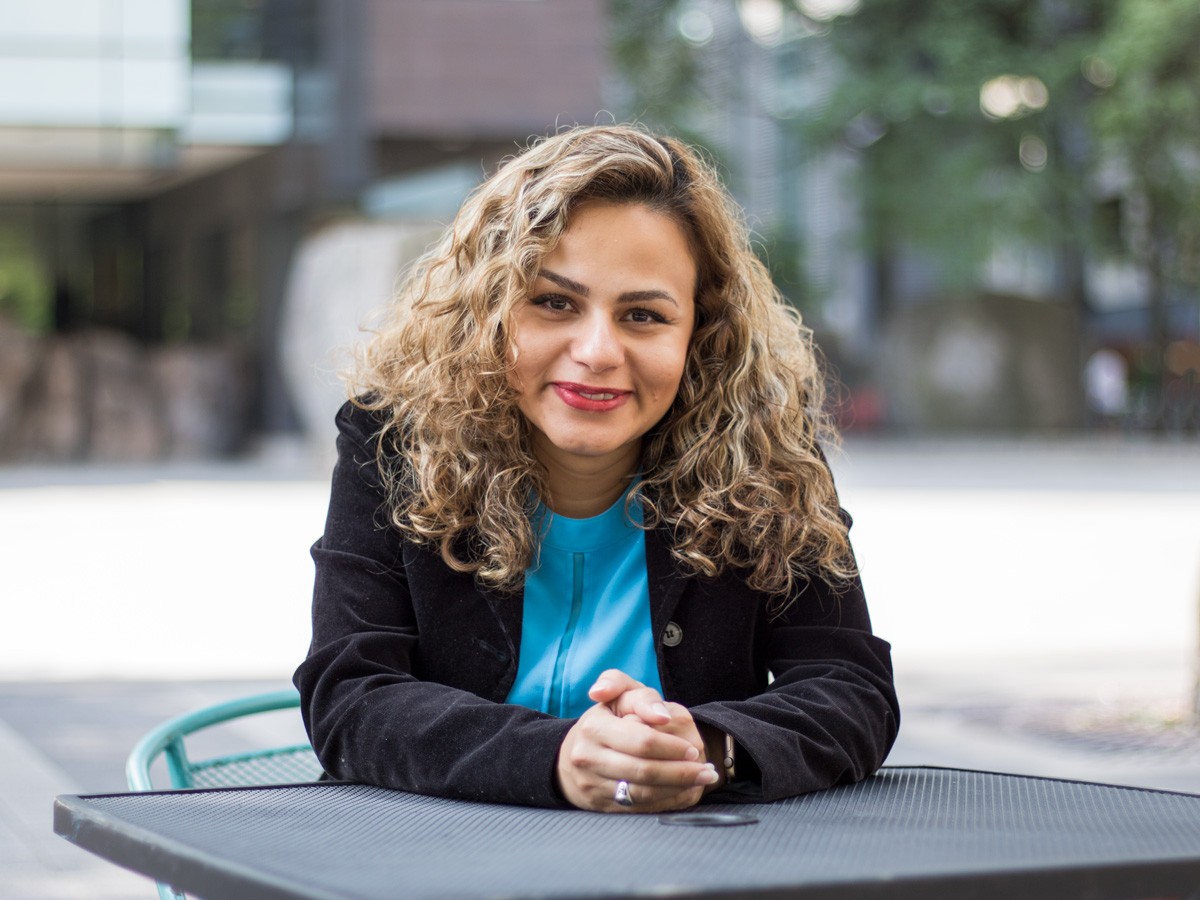
Dr. Hadis Zarrin is an Associate Professor in the Department of Chemical Engineering at Toronto Metropolitan University. Her research focuses on multifunctional nanoengineered materials for clean energy storage, environmental remediation, and wearable biosensors. PhD, University of Waterloo (2014) MSc, Iran University of Science and Technology (2008) BSc, Azad University (2004) Dr. Zarrin’s research spans Clean Energy Storage and Conversion , leveraging 2D nanomaterials (e.g., MXene, hBN, rGO) to advance Hydrogen Production , Fuel Cells , Supercapacitors , and Water Treatment . Her work integrates Nanotechnology with Electrochemistry to develop Smart Coatings and Flexible Electronics . Her recent publications (2024–2025) highlight innovations in MXene-hBN composites for energy devices, self-healing coatings , and environmental remediation via nanofibers. These studies emphasize scalable solutions for hydrogen generation , thermal management , and biomedical sensors . NSERC Alexander Graham Bell Canada Graduate Scholarship (2012–2014) Waterloo Institute of Nanotechnology Fellowship (2012–2014) Waterloo President Graduate Scholarship (2012–2014) As a mentor, Dr. Zarrin encourages students to embrace creativity and risk in problem-solving. She leads the Nano-Engineering Laboratory for Energy and Environmental Technologies , fostering interdisciplinary innovation.
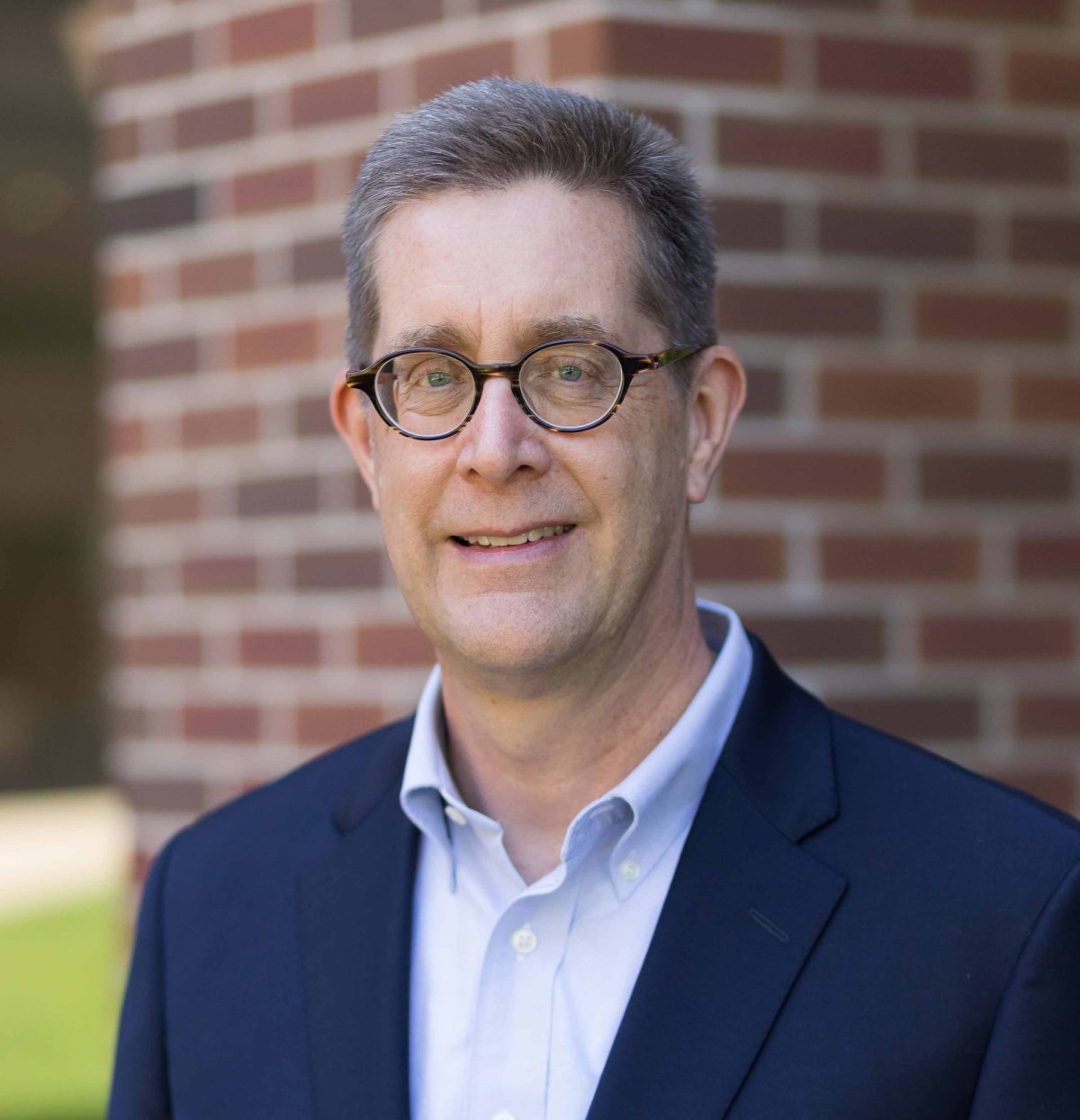
Jeff Derby is a Professor at the University of Minnesota within the College of Science and Engineering , affiliated with the Department of Chemical Engineering and Materials Science . He leads the Derby Group , focusing on computational modeling of materials processing. His research integrates transport phenomena , phase change , and reaction dynamics to advance crystalline material growth techniques. Contact: derby@umn.edu | 612/625-8881 | 239 Amundson Hall, 421 Washington Avenue SE, Minneapolis, MN 55455 Research Interests span nonlinear phenomena in crystal growth , microstructure evolution , defect formation , and high-pressure growth processes for semiconductors (e.g., II-VI crystals), silicon, sapphire, and diamond substrates. His group develops open-source computational tools to model incompressible fluid dynamics , heat/mass transfer , and radiation heat transfer . Scientific Awards : Distinguished McKnight University Professor Labs & Collaborations : The Derby Group collaborates with experimental teams to validate simulations and optimize materials processing across applications in semiconductors , photovoltaics , and optical systems .
Professor M. Grae Worster is a renowned academic in fluid dynamics and geophysics, affiliated with the University of Cambridge's Department of Applied Mathematics and Theoretical Physics (DAMTP) within the Faculty of Mathematics. He holds the title of Professor and specializes in fluid mechanics, solidification processes, and geophysical flows. His research focuses on buoyancy-driven flows, magma dynamics, sea ice evolution, and phase-change phenomena in porous media. Worster earned his Ph.D. in 1983 from Cambridge University with a thesis on "Convective Flow Problems in Geological Fluid Mechanics." His work bridges theoretical and experimental approaches, addressing complex fluid dynamics in natural systems like magma chambers, lava lakes, and sea ice formation. Key areas of expertise include mushy-layer convection, premelting dynamics, and viscous gravity currents. His research interests span fluid mechanics, solidification physics, and environmental fluid dynamics, with a strong emphasis on geophysical applications. Recent studies explore hydrogel mechanics, grounding-line dynamics in ice sheets, and thermal regelation in colloidal systems. He has authored over 140 peer-reviewed articles and co-edited influential works like Perspectives in Fluid Dynamics and Understanding Fluid Flow . Worster's contributions to fluid dynamics include groundbreaking studies on sea ice dynamics, where he developed models for brine drainage and ice growth mechanisms. His work on solidification processes in alloys and colloidal suspensions has advanced materials science and geophysics. Collaborations with experimentalists ensure his theoretical models are grounded in empirical validation.
Henner Busch is an Associate Professor at LUCSUS (Lund University Centre for Sustainability Studies), part of Lund University's Faculty of Social Sciences. His academic journey includes a background in Governmental Studies from Erfurt, Germany, an MSc in Environmental Studies and Sustainability Science (LUMES) from Lund University (2010), and a PhD in Sustainability Science from Lund University (2016). Before his current position, he worked at the Department of Human Geography at Lund University from February 2018 to November 2020, and as a researcher at LUCSUS from 2016 to 2017. His previous professional experience includes work at the Leibniz Institute for Agricultural Engineering in Potsdam-Bornim, Germany. Busch's research primarily focuses on the intersection between energy systems, climate policies, and society, with particular emphasis on questions of justice within energy transitions. His work examines who benefits from energy projects and who bears the burden, whose interests are served by different energy developments, and who has power to shape debates on future energy systems. He approaches these questions through multiple ongoing projects including JUSTIT (Just Swedish Transport Industry Transitions), Workers as Agents of a Green and Just Transition, Burying problems? Imaginaries of Carbon Capture and Storage in Scandinavia, and Of People, PV, Power Lines: Energy Islands in the Nordics. His research spans theoretical frameworks including energy justice, community energy development, urban climate governance, and the social dimensions of carbon capture and storage. Analysis of Busch's recent publications reveals a strong focus on energy justice frameworks across multiple contexts - from coal phase-outs to community energy initiatives and carbon capture technologies. His work consistently examines the distributional, procedural, and recognition dimensions of justice within energy transitions, with particular attention to Scandinavian and European contexts. The publications demonstrate interdisciplinary approaches combining political science, environmental sociology, and sustainability science to address complex questions of power, representation, and equity in energy systems. Researcher at LUCSUS (Lund University Centre for Sustainability Studies) Associate Professor at Lund University Member of LUCID research school (Lund University Centre of Excellence for Integration of Social and Natural Dimensions of Sustainability) Busch actively engages in teaching at undergraduate, master's, and PhD levels, with supervisory experience spanning approximately 40 master's theses on topics ranging from community energy to urban development and climate change depictions in video games. His educational approach integrates methodology-oriented content such as systems thinking and energy justice with empirical examinations of energy systems and globalization. His work contributes to multiple United Nations Sustainable Development Goals, particularly those related to sustainable cities and communities, affordable and clean energy, and climate action.
Roland N. Horne is the Thomas Davies Barrow Professor of Earth Sciences at Stanford University and Senior Fellow at the Precourt Institute for Energy. He holds positions in the Department of Energy Science & Engineering and is an Affiliate at the Stanford Woods Institute for the Environment. With degrees from the University of Auckland (BE, PhD, DSc), Horne has established himself as a leading expert in geothermal reservoir engineering and energy production optimization. His research focuses on inverse problems in reservoir modeling, including tracer analysis of fractures, computer-aided well test analysis, production schedule optimization, and automated history matching. Horne has made significant contributions to understanding geothermal reservoir engineering and multiphase flow of boiling fluids through porous materials and fractures. The analysis of his recent publications (2023-2025) reveals a strong emphasis on enhanced geothermal systems (EGS), with particular focus on flexible operations, economic modeling, and advanced characterization techniques. His work increasingly incorporates machine learning approaches for reservoir analysis and has expanded into microbial tracing methods for interwell connectivity assessment. There's also significant attention to US geothermal resource potential and integration into the broader energy transition. Honorary Member of the Society of Petroleum Engineers Member of the US National Academy of Engineering Multiple SPE Distinguished Lecturer appointments (1998, 2009, 2020) John Franklin Carl Award recipient Five Best Paper awards from Geothermal Resources Council Patricius Medal from German Geothermal Society Core Values Award from Women in Geothermal (2023) Horne has supervised 60 PhD and 135 MS students throughout his career. His current teaching includes undergraduate and graduate courses in Fundamentals of Energy Processes, Geothermal Reservoir Engineering, Mass and Energy Transport in Porous Media, and Well Test Analysis. He previously served as President of the International Geothermal Association (2010-2013) and Technical Program Chair for multiple World Geothermal Congress events. Horne maintains active research collaborations worldwide, including with the University of Tokyo (where he was a Fellow of the School of Engineering in 2016) and China University of Petroleum. His current research group focuses on advancing EGS technologies and developing more accurate reservoir characterization methods for geothermal applications.
Xifan Wu is a Professor of Physics at Temple University, specializing in computational methods and materials science. His research focuses on first-principles computational approaches, particularly exploring the locality of Wannier orbitals to address physical problems in solids and liquids. Key interests include superlattice design and applications of order-N exact exchange functionals like PBE0 and GW quasi-particle approximations. He has authored numerous high-impact publications in journals such as Physical Review Letters and Physical Review B , covering topics like ferroelectric superlattices, X-ray absorption spectroscopy, and the dielectric properties of electrolyte solutions. His work bridges quantum mechanical models with machine learning potentials, advancing large-scale simulations of complex materials. Education/Background: Not explicitly detailed in the provided text. Grants/Awards: No specific awards listed, but his research is supported by Temple University’s Center for the Computational Design of Functional Layered Materials (CCDM). Labs/Teams: Collaborates with teams focused on computational design and materials modeling, possibly through Temple’s physics department and affiliated research centers. His recent work explores molecular-scale insights into electrical double layers at oxide-electrolyte interfaces and the impact of ions on X-ray spectra, demonstrating expertise in linking theoretical models with experimental phenomena.
James Dixon is a Professor and Director of Ecological Psychology at the University of Connecticut, where he leads the Department of Psychological Sciences and directs the Center for the Ecological Study of Perception & Action (CESPA). CESPA fosters interdisciplinary research across optics, acoustics, movement science, and nonlinear dynamics, establishing UConn as a pioneer in ecological psychology. Research Focus Dr. Dixon investigates the self-organizing principles underlying perception, action, and cognition, with emphasis on thermodynamic foundations of behavior. His work bridges psychology, physics, and complex systems theory: Self-organization in biological and non-living dissipative systems Fractal dynamics in cognitive processes Inter-entity coordination across scales End-directed evolution in complex systems Publication Trends His publications (2009-2016) converge on emergent phenomena in complex systems, with recurring themes of self-organization, entropy, and coordination dynamics. Recent work emphasizes thermodynamic principles in behavioral emergence, while earlier studies explore representational change and insight through nonlinear models. Leadership & Academic Environment As CESPA Director, he oversees collaborative research spanning 10+ specialties. The center’s ethos integrates ecological principles with physics and development, maintaining UConn’s legacy in perception-action science since its founding by J.J. Gibson.
Gregory J. Wagner is an Associate Professor of Mechanical Engineering and Director of Graduate Studies at Northwestern University's McCormick School of Engineering. His research focuses on developing computational methods for multi-scale and multi-physics problems in additive manufacturing, fluid dynamics, and heat transfer. He leads the Wagner Research Group, which specializes in high-performance computing tools for complex engineering simulations. Education includes a Ph.D., M.S., and B.S. in Mechanical Engineering from Northwestern University and Boston University. His work integrates machine learning with traditional computational methods to model material behavior, microstructure evolution, and process-structure-property relationships in advanced manufacturing. Notable contributions include the GO-MELT framework for thermal simulations and the C-HiDeNN neural network approach for large-scale systems. Research interests span additive manufacturing process modeling, multiphysics coupling, and data-driven approaches for material design. Awards include the Bette and Neison Harris Chair in Teaching Excellence. Publications emphasize thermal modeling, phase change phenomena, and computational fluid dynamics innovations. His lab's work bridges mesoscopic and multiscale modeling, with applications in energy systems, biomedical devices, and environmental engineering. Collaborations focus on experimental validation and industrial-scale simulation challenges.
John Dolbow is a Professor in the Thomas Lord Department of Mechanical Engineering and Materials Science at Duke University, with secondary appointments in Civil and Environmental Engineering and Mathematics. He is a Bass Fellow and holds leadership roles as Associate Vice President for Research & Innovation since 2024. Education: B.S.M.E. (University of New Hampshire, 1995), M.S. (Northwestern, 1998), Ph.D. (Northwestern, 1999) Research Focus: Computational fracture mechanics, phase-field modeling, hydrogels, and multiphysics problems in geomechanics and biomedical engineering His recent work advances phase-field methods for fracture nucleation, hydraulic fracturing in geothermal systems, and laser lithotripsy simulations. Dolbow leads Duke's Computational Mechanics Laboratory, integrating civil, mechanical, and materials science approaches. Key contributions include: Erratum corrections for computational mechanics frameworks Nitsche-stabilized methods for interface constraints Phase-field models for surfactant-driven particle raft fracture Multi-resolution approaches for hydraulic fracture simulation Embedded FEM techniques for moving boundary problems Scientific Recognition: R. H. Gallagher Young Investigator Award (2005) Robert J. Melosh Medal for Finite Element Analysis (1999) DOE Computational Science Graduate Fellowship (1997) DOE CSGF Steering Committee Chair
Professor Cynthia H.Y. Fu is a leading researcher in the Department of Psychology & Human Development at the University of East London's School of Childhood and Social Care. She serves as an Honorary Consultant Psychiatrist at the South London and Maudsley NHS Foundation Trust and holds a Visiting Professor position at the Centre for Affective Disorders, King's College London. Her research focuses on identifying brain regions affected by depression and how they change with various treatments including talking therapies, antidepressant medication, and neurostimulation techniques like transcranial direct current stimulation (tDCS). Professor Fu pioneered work demonstrating that neural activation patterns during sad facial processing can accurately diagnose depression in individual patients and predict treatment response. Her research has direct translational potential in developing biomarkers for diagnosis and prognosis based on brain imaging. Professor Fu's work spans multiple disciplines including affective neuroscience, computational psychiatry, and neuromodulation. Her recent publications reveal strong trends in applying machine learning to neuroimaging data for depression classification, investigating home-based tDCS treatment protocols, and exploring the relationship between physiological markers and psychological states in real-world contexts like driving and commuting. British Association for Psychopharmacology Award National Alliance for Research in Schizophrenia and Depression (Brain & Behavior Research Foundation) Award Professor Fu has secured significant research funding from major organizations including the Medical Research Council, Wellcome Trust, GlaxoSmithKline, and Eli Lilly. Her work regularly appears in top-tier journals and is consistently cited among the most influential publications in psychiatry. She leads research investigating how brain responses can predict individual treatment responses, potentially enabling personalized depression treatment approaches. Her laboratory focuses on multimodal neuroimaging approaches combined with machine learning to identify neural signatures of depression and treatment response. Current projects include home-based tDCS treatment protocols with remote supervision, biomarker development for predicting antidepressant response, and computational approaches to understanding stress responses in everyday contexts.
Dr. John Kounios is Professor of Psychology at Drexel University and author of the bestselling book The Eureka Factor: Aha Moments, Creative Insight, and the Brain . A Fellow of the Association for Psychological Science and Psychonomic Society, he researches the cognitive neuroscience of insight, creativity, and problem solving. Research Focus: Kounios investigates neural predictors of insight solutions, cognitive differences between analytic and insight problem solving, and reward mechanisms in creative breakthroughs. His work identifies pre-problem neural activity patterns that predict solution approaches. Key Discoveries: Demonstrated that insight solutions are more likely correct than analytic solutions; identified neural precursors to 'aha' moments; revealed reward system activation during insight; showed positive mood facilitates insight while negative mood promotes analytical thinking. Publications: Recent work examines EEG predictors of problem-solving outcomes, flow states in creativity, individual differences in insight phenomenology, and brain-age estimation methods. Research featured in BBC documentaries, The New York Times, and Chicago's Museum of Science and Industry.
Romain Bordes is a Researcher in Applied Chemistry at Chalmers University of Technology, specializing in colloid and interface science with applications spanning sustainable materials development, art conservation science, and environmental remediation technologies. His work bridges fundamental chemical research with practical applications addressing contemporary challenges in cultural heritage preservation and green chemistry. Dr. Bordes' research interests focus on several interconnected domains: Development and application of amino acid-based surfactants and green chemistry solutions for sustainable applications Nanocellulose and biomaterials for art conservation, packaging, and textile applications Surface chemistry and interfacial phenomena in complex colloidal systems Novel separation techniques for environmental remediation, particularly heavy metal removal Sustainable materials development for cultural heritage preservation Analysis of Dr. Bordes' extensive publication record reveals a consistent trajectory toward increasingly sophisticated applications of colloid science. His recent work demonstrates a growing integration of advanced characterization techniques like acoustic levitation with traditional colloid chemistry approaches, enabling non-contact analysis of delicate materials. A significant portion of his research addresses practical challenges in art conservation, with particular emphasis on developing sustainable alternatives to traditional conservation methods. His work on beeswax nanoemulsions and nanocellulose-based consolidants represents innovative approaches to longstanding challenges in cultural heritage preservation. Dr. Bordes has secured substantial research funding from multiple prestigious sources including VINNOVA, the European Commission (EC), the Swedish Research Council (VR), and the Swedish Foundation for Strategic Research (SSF). His collaborative projects demonstrate strong interdisciplinary connections across chemistry, materials science, conservation science, and environmental engineering. The GREENART project (2022-2025) and NANORESTART project (2015-2018) particularly highlight his leadership in applying advanced materials science to cultural heritage challenges. His research group appears to focus on developing sustainable chemical solutions that address real-world problems at the intersection of environmental science, cultural preservation, and materials innovation, with particular emphasis on replacing hazardous chemicals with bio-based alternatives in conservation practices and industrial applications.
Dr. Yi-Yuan Tang is a Professor at Arizona State University’s College of Health Solutions and Director of the Health Neuroscience Collaboratory . He is also a Presence Fellow at Stanford University’s Center for Advanced Study in the Behavioral Sciences. Top 2% Most Cited Scientist Author of >360 peer-reviewed articles Editorial roles in SCAN, Frontiers in Neuroimaging, PloS One Research Focus: Health neuroscience integrating neuroimaging , physiological monitoring , and interventional methods to study self-control, emotion regulation, and brain-body interactions. Key projects include NIH-funded studies on polysubstance use reduction and effortless attention control . Scientific Achievements: NIH Cutting-Edge Basic Research Award NIH Phased Innovation Award American Congress of Rehabilitation Medicine Award Stanford Presence Fellow Mentoring: Supervised >70 graduate students/postdocs across psychology, neuroscience, health sciences, and data science. Serves on federal grant panels for NIH, DoD, NASA, and NSF.
Maja Elmgren is a Senior Lecturer in Physical Chemistry and Educational Developer at Uppsala University's Department of Chemistry and Faculty of Science and Technology. Since 2009, she has directed the Council for Educational Development (TUR), focusing on academic leadership, chemistry education, and scholarly teaching. Her research spans physical chemistry, chemistry/physics education, and higher education development. Research Interests: Leadership in higher education and doctoral assessment Educational expertise in academia Student learning in thermodynamics and kinetics Chemistry education through international cooperation Quantum mechanics conceptualization Thermal phenomena visualization via infrared cameras Article Trends: Recent publications highlight interdisciplinary learning (chemistry-mathematics), assessment reform in doctoral education, student-centered pedagogy, and technological tools in science education. Subfields include mathematical modeling, entropy understanding, and VR-funded projects on science teacher roles. Scientific Awards: Medal for Merit from Uppsala Science and Technology Student Union (2011) Distinguished Teaching Award from Uppsala University (2001) Academic Roles: Director, Council for Educational Development (TUR) since 2009 Author of "Academic Teaching" (2018) and "Universitetspedagogik" (2016) International collaborations with IUPAC and VR-funded projects Specializes in entropy/thermodynamics education and infrared camera applications
Professor Georg Gottwald is a distinguished academic in the School of Mathematics and Statistics at the University of Sydney, where he has been a faculty member since 2002, progressing from Lecturer to his current position as Professor since 2013. He also holds a Visiting Professor position at the University of Surrey in the UK since 2013. His extensive research career spans dynamical systems theory, geophysical fluid dynamics, and the intersection of machine learning with complex systems. Professor Gottwald's research focuses on dynamical systems theory as an abstract formalism for studying systems evolving in time and space. His work has significant applications across diverse fields including climate modeling, biological systems, and complex networks. He is particularly known for developing methods for model reduction of complex dynamical systems, stochastic modeling approaches, and the application of machine learning techniques to dynamical systems. His research aligns with the Faculty of Science Research Strengths in Understanding the Universe, Fundamental Laws of Nature, Complex Systems, Climate and Environmental Change, Data and Decisions, and National Security. His most recent publications demonstrate a strong trajectory toward integrating machine learning with dynamical systems theory, particularly in developing stable generative models, learning dynamical systems with random feature maps, and combining data assimilation with machine learning for forecasting. His work spans pure mathematical theory to practical applications in climate science, finance, and biological systems, showing remarkable breadth while maintaining deep mathematical rigor. Future Fellowship, 'Stochastic methods in mathematical geophysical fluid dynamics', Australian Research Council, 2010-2014 Australian Research Fellowship, 'Stochastic methods in mathematical geophysical fluid dynamics', Australian Research Council, 2010-2015 (declined) Australian Research Fellowship, 'Geometric methods in geophysical fluid dynamics', Australian Research Council, 2004-2009 Professor Gottwald has successfully supervised numerous PhD and Master's students who have gone on to academic and industry positions worldwide. His current research group includes postdocs and PhD students working on machine learning for dynamical systems, stochastic model reduction, physics-informed machine intelligence, and tensor methods for scientific machine learning. He has secured multiple ARC Discovery Project grants and has been involved in significant international collaborative research projects. He is actively involved with the Sydney Dynamics Group, which he co-founded in 2007, fostering collaboration between the University of Sydney and UNSW. Professor Gottwald maintains strong editorial commitments as Associate Editor for Geophysical and Astrophysical Fluid Dynamics, SIAM Journal of Applied Dynamical Systems, and Journal of Computational Dynamics, and serves on the Editorial Advisory Board for Chaos and the Editorial Board for Physical Review E. His professional activities demonstrate leadership in the dynamical systems community through organizing workshops, seminars, and special journal issues.