Mirco Raffetto is a Full Professor in the Department of Naval, Electrical, Electronic, and Telecommunications Engineering (DITEN) at the University of Genoa under the Polytechnic School. He actively participates in academic governance as a member of the Department Board, Scientific Council of the Interuniversity Center for Electromagnetic Fields and Biosystems (ICEMB), and School Council. Research Focus: His work spans Electromagnetic field analysis for moving media Computational electromagnetics with finite element methods Metamaterial modeling and inverse scattering Photobiomodulation effects on mitochondrial function Microwave imaging for biomedical applications Waveguide and cavity analysis for industrial systems His research combines theoretical rigor with numerical simulations to solve complex problems in electromagnetics and interdisciplinary biosystems. Teaching: He teaches graduate courses on Electromagnetic Fields in multiple degree programs including Computer Engineering, Electronics Engineering, and Biomedical Engineering. His teaching emphasizes both fundamental theory and practical applications.
Robert Adams is an Associate Professor in the Department of Electrical & Computer Engineering at the University of Kentucky. He holds a Ph.D., M.S., and B.S. in Electrical Engineering from Virginia Tech and Michigan Technological University, respectively. His academic career spans roles as Research Assistant Professor at Virginia Tech and EM Research Scientist at Science Applications International Corp. Ph.D., Virginia Tech, Electrical & Computer Engineering, 1998 M.S., Virginia Tech, Electrical Engineering, 1995 B.S., Michigan Technological University, Electrical Engineering, 1993 His research focuses on computational electromagnetics, with expertise in applied and theoretical electromagnetics, numerical methods for integral equations, and finite element analysis. His work addresses challenges in wave scattering, eddy current modeling, and nonlinear magnetic material simulations. Dr. Adams' recent publications emphasize advancements in the Nyström method for solving augmented integral equations, Helmholtz decomposition techniques for stability, and sparse matrix factorizations. These studies highlight applications in electromagnetic scattering, hysteresis modeling, and efficient computational algorithms. Teachers Who Made a Difference (2007) ECE Department Outstanding Teaching Award (2006) NSF CAREER Award (2006-2011) R.W.P. King Paper Award (2005) Bradley Postdoctoral Fellowship (1999-2001) Bradley Fellowship (1995-1998) His awards include prestigious NSF funding and multiple Bradley Fellowships, alongside recognition for teaching excellence. Research grants and collaborations further underscore his contributions to computational electromagnetics.
Dr. Miklos Bartha is a Professor in the Department of Computer Science at Memorial University of Newfoundland, located within the Faculty of Science. He holds a M.Sc. and Ph.D. from József Attila University in Hungary. His research focuses on programming language semantics, algebra and category theory applied to computer science, automata theory, and graph theory. Dr. Bartha's work bridges formal methods with computational models, emphasizing theoretical foundations and their applications in discrete systems. His academic career includes significant contributions to automata equivalence, synchronous system modeling, and graph-based algorithms. Notable areas of exploration include quantum automata, soliton graphs, and the monoidal structure of Turing machines. His research often intersects category theory, providing novel frameworks for understanding computational processes. Dr. Bartha has published extensively in international conferences and journals, with recent work addressing graph reduction algorithms, deterministic properties of soliton graphs, and the theoretical underpinnings of molecular switching using automata models. His publications span topics from formal verification of circuits to algorithmic graph theory, reflecting a deep engagement with both foundational and applied aspects of computer science. His contact information includes an office at Memorial University and can be reached via email at bartha@mun.ca or phone at (709) 864-2193.
Leung Tsang is a Professor of Electrical Engineering and Computer Science at the University of Michigan, Ann Arbor, holding the Robert J. Hiller Professorship of Engineering. He received his SB, SM, EE, and Ph.D. from MIT. His academic career includes positions at Texas A&M University (1980-1983), University of Washington (1983-2014) as Professor and Department Chair (2006-2011), and a visiting Professorship at City University of Hong Kong (2001-2004). He has served as Editor-in-Chief of IEEE Transactions on Geoscience and Remote Sensing and President of the Electromagnetics Academy and IEEE Geoscience and Remote Sensing Society. His research focuses on microwave remote sensing , multiple scattering theory , electromagnetic wave propagation in random media , photonic crystals , and signal integrity . His work spans theoretical advancements (e.g., radiative transfer theory, UV multi-level methods) and practical applications (e.g., snow parameter retrieval, ocean foam modeling, via coupling analysis). Key trends include Development of computational techniques for large-scale scattering problems Integration of neural networks for inversion in remote sensing Investigation of backscattering enhancement and polarimetric signatures Notable awards include Fellow of IEEE and Optical Society of America William T Pecora Award (2012) Van De Hulst Light Scattering Award (2018) Membership in the National Academy of Engineering (2020) His group utilizes high-performance computing resources, including the Flux HPC cluster at the University of Michigan and XSEDE allocations, with specialized nodes for electromagnetic modeling. Current students include Ruoxing Gao (electromagnetic theory), Firoz Borah (snow remote sensing), Jongwoo Jeong (forest scattering), and Zhenming Huang (snow modeling).
Professor Mark Strong is the Dean of the School of Medicine and Population Health at the University of Sheffield, where he also holds the title of Professor of Public Health. He maintains an honorary clinical consultant role with the Office for Health Improvement and Disparities at the Department of Health and Social Care. His research focuses on Uncertainty Quantification in health economic models, particularly methods for computing Expected Value of Sample Information (EVSI) and Partial Expected Value of Perfect Information (EVPI) . Key Contributions : Developed the SAVI web calculator for efficient value-of-information calculations Co-investigator on NIH-funded SIPHER Consortium projects Expertise : Bayesian statistical methods Model discrepancy analysis Health policy decision modeling Systems science applications in public health Research Trends Analysis of his 20+ recent publications reveals concentrated activity in: Health Economic Evaluation (8 articles) Uncertainty Quantification (6 articles) Public Health Policy (7 articles) Systems Science Applications (4 articles) Alcohol Consumption Modeling (3 articles) Clinical Decision Support (5 articles)
Christino Tamon is a Professor of Computer Science at Clarkson University's Coulter School of Engineering & Applied Sciences. He holds a Ph.D. from the University of Calgary (1993-1996), an M.S. from the University of Toronto (1990-1992), and a B.Sc. in Computer Science and Applied Mathematics from the University of Calgary (1986-1990). His research focuses on theoretical computer science, quantum computing, graph theory, and machine learning, with notable contributions to quantum state transfer and quantum walks on graphs. Recipient of the Clarkson University Distinguished Teaching Award (2009) and New Teacher Award (2000). Principal Investigator on multiple NSF grants, including quantum computing and REU mathematics programs. Visiting appointments at institutions like the Institut Henri Poincaré and the University of Waterloo. Research interests include quantum algorithms, graph spectral theory, and the application of algebraic methods to discrete systems. His work on quantum walks explores perfect state transfer, fractional revival, and spatial search optimization. Recent grants support quantum advantage in algorithm design and interdisciplinary research in quantum dynamics. Advised numerous graduate students and mentors undergraduate research through REU programs. Active in professional service, including organizing workshops on quantum mathematics and algebraic graph theory.
Santiago Badia is a Professor of Computational Mathematics at Monash University's School of Mathematics since 2019. Previously, he held roles at UPC (Universitat Politècnica de Catalunya) as Professor of Computational Science and Engineering (2009–2019) and was an adjunct researcher at CIMNE (Barcelona), leading the Large Scale Scientific Computing Department. He earned his PhD in 2006 from UPC, with prior work at Politecnico di Milano (2006) and Sandia National Labs (2007–2008). His research focuses on numerical approximation of PDEs using finite element methods, with applications in fluid/solid mechanics, electromagnetics, and multiphysics problems. He leads high-performance computing projects like FEMPAR (scalable PDE solvers) and Gridap (Julia-based PDE framework). His work includes perfect weak scalability on supercomputers and solving PDEs with up to 60 billion unknowns. Research interests span computational science, numerical analysis, parallel computing, and numerical linear algebra. Projects address challenges in fusion energy, additive manufacturing, and nuclear waste repositories. He actively supervises PhD students through funded projects, emphasizing computational modeling and simulation. Collaborations include international teams in geophysical fluid dynamics and stochastic inverse problems. His software frameworks (FEMPAR, Gridap) are widely used for industrial and academic research, emphasizing scalability and usability.
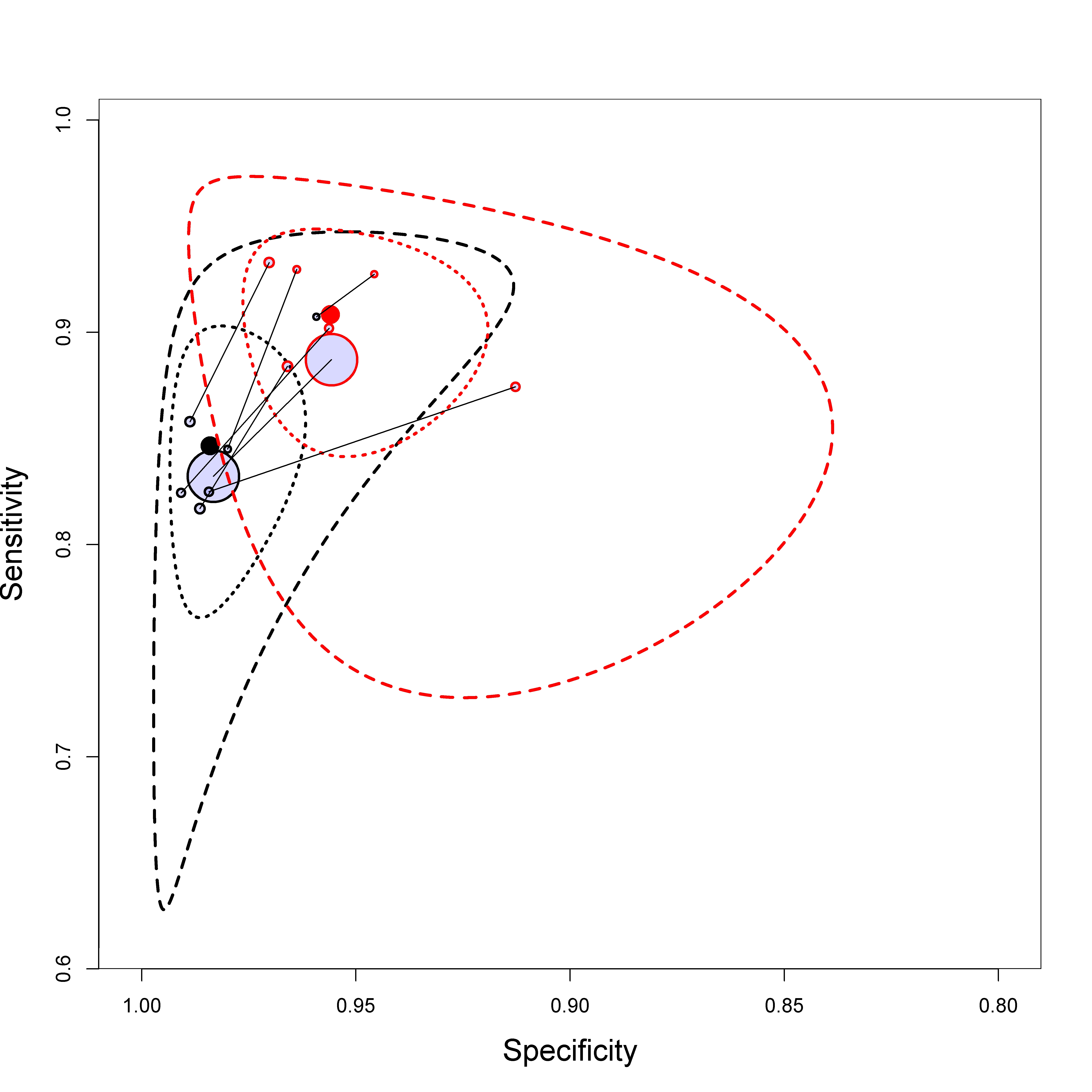
Nandini Dendukuri, PhD is a Scientist at the Research Institute of the McGill University Health Centre (RI-MUHC) at the 5252 de Maisonneuve site. She holds dual affiliations with the Infectious Diseases and Immunity in Global Health Program and the Centre for Outcomes Research and Evaluation (CORE). Academically, she serves as an Associate Professor in the Department of Medicine, Faculty of Medicine and Health Sciences at McGill University, specifically within the Division of Clinical Epidemiology at the MUHC. Dr. Dendukuri's research program centers on the development of advanced statistical methodologies for diagnostic test accuracy evaluation in the absence of perfect reference standards. Her work spans Bayesian inference, latent class modeling, and meta-analysis techniques specifically designed for diagnostic accuracy studies. She has made seminal contributions to addressing methodological challenges such as conditional dependence between diagnostic tests, verification bias, and limitations of composite reference standards. Her research bridges theoretical statistical methodology with practical applications in infectious disease diagnostics, particularly tuberculosis where perfect reference tests are often unavailable. An analysis of Dr. Dendukuri's extensive publication record reveals consistent innovation in diagnostic test methodology with increasing sophistication in statistical modeling approaches. Her recent work (2024-2025) demonstrates expansion into diverse application areas including cardiovascular disease, emerging infectious diseases like COVID-19, and novel diagnostic technologies, while maintaining her core methodological focus. Her publications show particular strength in applying latent class models to complex diagnostic scenarios across multiple disease domains. Dr. Dendukuri actively collaborates with researchers across multiple disciplines, particularly in epidemiology, infectious diseases, and technology assessment. Her work with hospital-based technology assessment units has directly contributed to translating scientific evidence into healthcare policy. She maintains strong connections between statistical theory and practical healthcare applications, frequently developing software implementations (particularly rjags programs) of her methodological innovations to facilitate adoption by the research community.
Kristof Cools is a Full Professor at Ghent University's Faculty of Engineering and Architecture , affiliated with the Department of Information Technology and the Internet Technology and Data Science Lab . His research spans computational electromagnetics, integral equations, and finite element methods, focusing on electromagnetic scattering and wave propagation. Research Interests include: Computational Electromagnetics Integral Equations and Boundary Element Methods Domain Decomposition and Preconditioning Antennas, Propagation, and Modeling of Composite Systems His Publications emphasize stable time-domain solvers, multi-trace formulations, and advanced discretization techniques for electromagnetic problems. Notable trends include resonance-free equations, quasi-Helmholtz projectors, and nonlinear surface scattering models. Advisory Roles include supervising doctoral researchers: Cedric Münger Paul Olyslager Quang Huy Nguyen Alessandro Zuccotti Prakash Jay
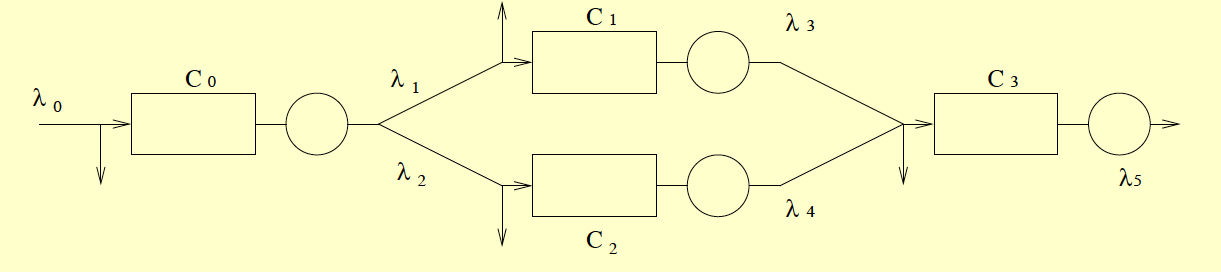
Jean-Marc Vincent is an Associate Professor at Grenoble Alpes University's UFR IMAG school, with a focus on performance evaluation and stochastic models. His research spans Markov processes, perfect simulation, and analysis of large-scale distributed systems. He has contributed extensively to trace visualization, resource modeling, and algorithm design for parallel computing environments. Key research areas: Performance evaluation, Stochastic models, Markov processes, Perfect simulation Recent work trends: IoT resilience in fog computing, stochastic automata networks, trace analysis Teaching: Algorithms, complexity analysis, distributed systems at L3 and Master's levels His 15 most recent publications highlight interdisciplinary approaches combining computer science, statistics, and education. Collaborations include Inria, LIG, and international institutions like PUCRS. Students under his supervision have worked on trace visualization, stochastic modeling, and system performance optimization.
Jean-Philippe Groby is a Research Director at CNRS working at the Laboratory of Acoustics of the University of Le Mans (LAUM), UMR6613 CNRS. He leads the "Acoustic Materials" research team, one of three research teams at LAUM, and chairs the Technical Committee "Acoustic Materials" of the European Acoustics Association (EAA). He also serves as an associate editor for npj Acoustics. Education: Habilitation à Diriger des Recherches (2017): "Acoustic wave propagation in lossy, structured and periodic media" at Université du Maine PhD (2005): "Modélisation de la propagation des ondes élastiques générées par un séisme proche ou éloigné à l'intérieur d'une ville" at Université de la Méditerranée - Aix-Marseille II Research Interests: Jean-Philippe Groby specializes in acoustic wave propagation through various media, with particular focus on metamaterials and porous media . His research spans theoretical modeling, experimental characterization, and practical applications of acoustic materials. His work has significant implications for noise control in urban environments, automotive and aerospace industries. He has pioneered techniques for designing materials that can manipulate sound waves with unprecedented precision, including perfect absorbers and diffusers that operate at subwavelength scales. Publication Trends: Groby's recent publications (2023-2025) demonstrate a strong focus on dual-function acoustic metamaterials that can simultaneously absorb and diffuse sound, Willis coupling phenomena in complex materials, and advanced characterization methods for anisotropic porous media. His work increasingly bridges theoretical acoustics with practical engineering applications, particularly in room acoustics, aerospace noise control, and architectural sound design. A notable trend is the development of causality-driven designs that optimize acoustic performance while minimizing material usage. Professional Activities: Associate Editor, npj Acoustics Chair, Technical Committee "Acoustic Materials" of the European Acoustics Association Editor of the book "Acoustic Waves in Periodic Structures, Metamaterials, and Porous Media: From Fundamentals to Industrial Applications" (Springer, 2021) Research Leadership: As leader of the "Acoustic Materials" team at LAUM, Groby oversees a vibrant research group focused on developing innovative acoustic solutions. His team has established strong collaborations with international research institutions and industry partners, particularly in the automotive and aerospace sectors. They have developed several patented technologies for sound absorption and control, including metaporous materials and acoustic meta-lenses.
Aurélien Garivier is a Professor at Ecole Normale Supérieure de Lyon , affiliated with the UMPA and LIP laboratories. He serves as Deputy Director of UMPA and leads the Master 2 Fundamental Computer Science program at ENS Lyon. His research and academic activities span multiple domains within Machine Learning , Statistics , and Sequential Decision Problems . Local chair of COLT 2025 in Lyon Co-organizer of workshops on Graph Representation Learning and Reinforcement Learning Former director of the Department of Mathematics at the Faculty of Science and Engineering (2016-2018) He has contributed to comparative studies of programming languages for statistical tasks, such as the Baum-Welch algorithm speed analysis in R/Python/Matlab, and co-authored the Perfect Simulation of Processes with Long Memory (2015), which introduced CIAFTP algorithms for stationary processes with transition kernels. His leadership extends to organizing educational initiatives like the UT3-INSA-UT1 Big Data Challenges and Enter the World of AI exhibition. He is also co-host of the SciDoLySE group (Data Science in Lyon and Saint-Etienne).
Prof. Viktor Beneš is a distinguished academic at the Department of Probability and Mathematical Statistics , Faculty of Mathematics and Physics, Charles University, Prague. His work bridges stochastic geometry and point process theory with applications in neurophysiology , materials science , and public administration . Key research themes include space-time modeling , nonlinear filtering , and statistical inference for complex systems. His recent publications focus on spatio-temporal dynamics in biological and physical systems, unions of interacting discs for spatial modeling, and stochastic microstructure analysis in polycrystalline materials. Collaborative projects span Bayesian geostatistics , survival analysis , and neuronal signal processing . Key contributions to stochastic modeling of neurophysiological experiments Developed nonlinear filtering methods for doubly stochastic processes Led international research on Markov point processes with perfect simulation
Prof. Dr. Funda Akleman Yapar is a faculty member at the Department of Electronics and Communication Engineering , Istanbul Technical University , holding the Professor rank. She currently serves as Vice Dean (2023–2026) and previously held administrative roles including Deputy Head of Department (2020–2023). Her academic career spans 25 years at the same institution, starting as a Research Assistant in 1997. PhD in Electronics and Communication Engineering (1998–2002), Istanbul Technical University Her research focuses on electromagnetic engineering , microwave technologies , and antenna systems , with recent work on: 6G high-altitude platform antenna design Microwave metamaterials for solar cells Waveguide filter synthesis via inverse problems Radio propagation analysis in solar-affected stratospheric channels She has 50+ research outputs, including journal articles and conference papers, and leads projects like Three-Dimensional Radio Wave Propagation Analysis on Perfect Conductor Rough and Smooth Terrain (2014–2020). Her methodological expertise includes finite-difference time-domain (FDTD), parabolic equation (PE) modeling, and generalized scattering matrix techniques.
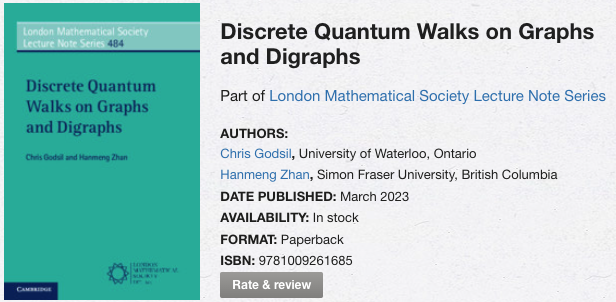
Hanmeng Zhan is an Assistant Professor in the Computer Science Department at Worcester Polytechnic Institute (WPI), where he conducts research at the intersection of algebraic graph theory, quantum information, and quantum computation. His work focuses on discrete and continuous quantum walks, graph spectra, association schemes, and their applications to quantum algorithms and communication. Ph.D. in Combinatorics and Optimization, University of Waterloo (Supervisor: Chris Godsil) Postdoctoral Fellow, Simon Fraser University (with Bojan Mohar) York Science Fellow, York University (with Ada Chan) Postdoctoral Fellow, Université de Montréal (Centre de Recherches Mathématiques, with Luc Vinet) His research lies in the theoretical foundations of quantum walks, including perfect and fractional state transfer, uniform mixing, and spectral analysis of graphs. He has co-authored a book, Discrete Quantum Walks on Graphs and Digraphs (Cambridge University Press, 2023), and published in leading journals such as Linear Algebra and its Applications , Electronic Journal of Combinatorics , Quantum Information Processing , and Journal of Physics A . The most recent articles highlight a sustained focus on quantum walk dynamics, particularly on state transfer phenomena, Laplacian-based walks, and spectral characterizations in structured graphs like circulants, Johnson schemes, and distance-regular graphs. His work often combines deep algebraic techniques with quantum information applications. Organizer, QIT Thinking Seminar, WPI Session Organizer, CMS and AMS Meetings (2023–2025) Mini-course on Discrete Quantum Walks, CMS Winter Meeting 2022 He has supervised undergraduate research through the Fields Undergraduate Summer Research Program and teaches core computer science courses such as Foundations of Computer Science and Theory of Computation at WPI. Previously, he taught courses in discrete mathematics, linear algebra, and quantum walks at Simon Fraser University, York University, and the University of Waterloo. He is actively involved in the combinatorics and quantum information communities, regularly presenting at international conferences including the Joint Mathematics Meetings, CMS meetings, CanaDAM, and specialized workshops on quantum simulation and walks.