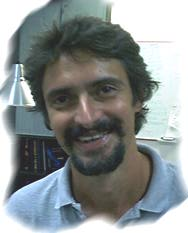
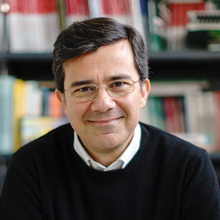
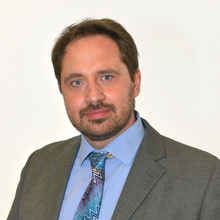
Lorenzo Colace is an Associate Professor in the Department of Engineering at the University of Rome "Roma Tre", where he has been a faculty member since 2012. He received his MS in Electronic Engineering from "La Sapienza" in 1992 and his PhD from Roma Tre in 1997. He began as a researcher in 2005 and advanced to Associate Professor in December 2012. He teaches core courses including Electronics I and Photovoltaic Devices and Systems, and has also taught Solid State Electronics, Precision Analog Electronics, and Optoelectronics. His research spans optoelectronic devices compatible with silicon technology, with applications in optical communications, sensing, imaging, and photovoltaics. He specializes in Germanium-on-Silicon photodetectors, PbS colloidal quantum dots, CIGS solar cells, and near-infrared imaging systems. His work integrates materials synthesis, device fabrication, and characterization, aiming at high-performance, CMOS-compatible solutions. The recent publications highlight a strong trend in near-infrared optoelectronics, particularly using Ge/Si and colloidal quantum dots for photodetection in safety, security, and energy applications. There is also a significant focus on photovoltaic device modeling and fire detection systems, reflecting interdisciplinary innovation bridging materials science, electronics, and environmental monitoring. Institute of Electrical and Electronics Engineers (IEEE) European Technology Platform for Photonics (Photonics21) Materials Research Society (MRS) Istituto Nazionale di Fisica Nucleare (INFN) Consorzio Nazionale Interuniversitario per le Telecomunicazioni (CNIT) Prof. Colace has supervised numerous research projects and established key collaborations with institutions such as MIT, the University of Central Florida, CNR-IMM, CNR-IMEM, and companies like Agilent Technologies and Pirelli Labs. He serves on scientific and organizing committees for major conferences and acts as a referee for several international journals. He has authored over 200 publications, including 81 journal articles, 4 international patents, 10 book chapters, and numerous conference papers, with an h-index of 21 and over 1,500 citations (Scopus, 2017). His lab focuses on integrated optoelectronic systems, particularly for sensing and energy applications, and he leads a research team advancing silicon-compatible infrared technologies.