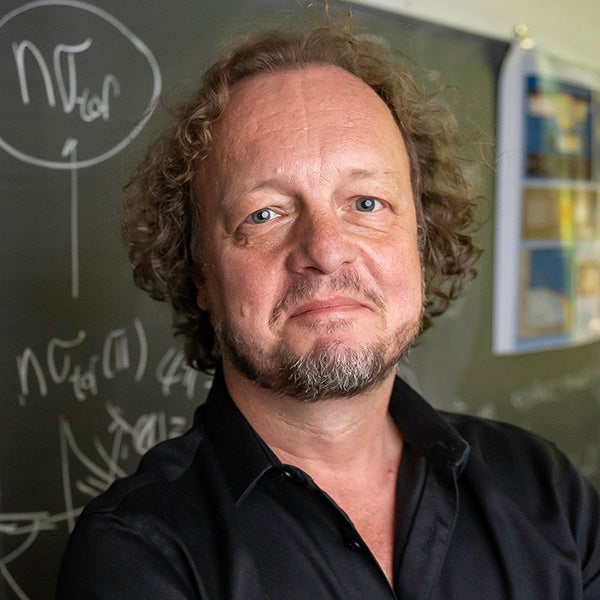
Frank Geurts is a Professor of Physics & Astronomy at Rice University. He received his Ph.D. from Utrecht University in 1998 for work on light meson production in heavy-ion collisions at CERN. His research focuses on relativistic heavy-ion physics, studying quark-gluon plasma formation and QCD matter properties using experiments at RHIC and LHC. He leads the Experimental Relativistic Heavy Group and has held leadership roles including STAR Collaboration co-Spokesperson and CMS subsystem manager. Education: 1992 MS Physics (Utrecht), 1998 PhD Experimental Physics (Utrecht) Research interests center on probing extreme states of nuclear matter through heavy-ion collisions, with emphasis on quark flavor studies, symmetry properties, and electromagnetic probes. Recent publications demonstrate focus on precision Standard Model measurements, exotic particle searches, and detector development for future colliders. His group maintains active involvement in STAR and CMS collaborations, with research spanning femtoscopy, flow measurements, heavy flavor production, and luminosity calibration techniques.
Alfred H. Mueller is the Enrico Fermi Professor of Physics in the Department of Physics at Columbia University. He has established himself as a leading theoretical physicist specializing in high-energy nuclear and particle physics, particularly in Quantum Chromodynamics at high densities. Dr. Mueller received his Ph.D. from MIT in 1965 and has maintained a distinguished career at Columbia University. His academic journey reflects deep commitment to advancing our understanding of fundamental particle interactions under extreme conditions. Dr. Mueller's research focuses on the properties of QCD systems at very high density, which occur in high-energy heavy ion collisions and high-energy (small x ) deep inelastic lepton-proton scattering. His specific interests include: the relationship between unitarity limits and parton density limits (saturation); maximal allowed occupation numbers for quarks and gluons in hadronic wavefunctions; first principles calculation of approach to equilibration using Boltzmann equations; the relationship between factorial divergence of the QCD perturbation series and high field strength configurations; and connections between saturation phenomena in QCD and reaction-diffusion processes in statistical physics. Analysis of Dr. Mueller's publication record reveals a sustained focus on jet physics, diffractive processes, and saturation phenomena in QCD. His work bridges theoretical developments with experimental applications, particularly relevant for facilities like the Electron-Ion Collider. His research spans both perturbative and non-perturbative aspects of QCD, with significant contributions to understanding heavy ion collisions and deep inelastic scattering phenomena. Dr. Mueller has established extensive collaborations with researchers worldwide, including Edmond Iancu, Dionysis N. Triantafyllopoulos, and Stéphane Munier. His work has been highly influential in shaping theoretical frameworks for high-density QCD systems. While specific details about his mentoring activities are not explicitly documented in the available information, his extensive publication record spanning decades suggests active guidance of graduate students and postdoctoral researchers. His research program has likely been supported by major funding agencies in high-energy physics, contributing to Columbia University's strong presence in theoretical nuclear and particle physics.
Thomas Dent is a Distinguished Researcher at the University of Santiago de Compostela, affiliated with the Research Group on Theory and Phenomenology of Particles, Astroparticles, Fields and Strings . He teaches Advanced Computational Physics and Advanced Gravitation and Cosmology in the Master in Physics program across multiple academic years. His research focuses on theoretical particle physics, cosmological models, gravitational wave detection, and quantum field theory applications in high-energy phenomena. Key interests include Higgs boson properties, black hole mergers observed via LIGO-Virgo data, and fundamental interactions in collider experiments. Recent work highlights include studies on Higgs boson decay channels, binary black hole population analysis, and exploration of exotic particle decay pathways. His contributions span both observational astrophysics (e.g., gravitational wave alerts) and theoretical frameworks in quantum chromodynamics. No scientific awards are explicitly listed in the provided materials. Teaching responsibilities include curriculum design for advanced physics courses and student tutoring. Research activities are centered on LHC data analysis, with publications addressing topics like leptoquark searches, neutrino behavior in B meson decays, and jet substructure measurements. Collaboration with international teams such as CMS and PyCBC underscores his involvement in large-scale experimental physics endeavors.
Gavin Niendorf is a researcher in the Physics department, specializing in high-energy particle physics and experimental collider studies. His work focuses on dark matter detection, Higgs boson properties, and beyond-Standard Model phenomena through experiments at the CERN Large Hadron Collider (LHC). His research interests include: Dark matter searches via experiments like LDMX Supersymmetric particle detection Higgs boson decay channel analysis Jet substructure and quenching phenomena Effective Field Theory parameterization Advanced tracking algorithms for HL-LHC Recent publications demonstrate expertise in detector technology, collision data analysis, and machine learning applications in particle physics. His collaborations involve CMS experiment upgrades, LDMX development, and precision cross-section measurements.
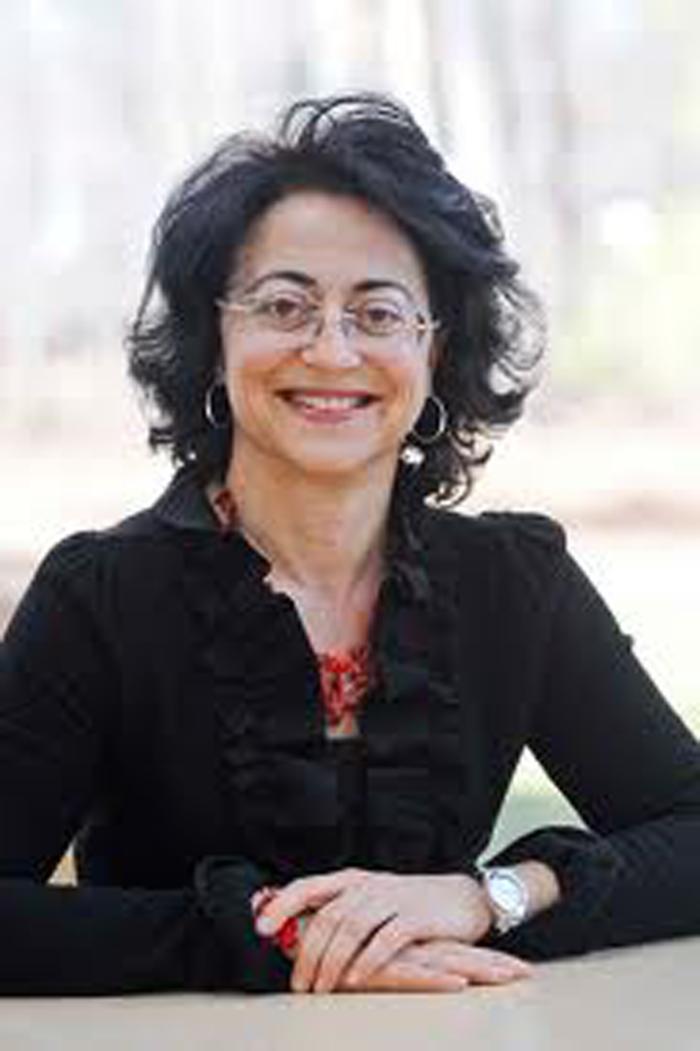
Lola Smaragda is a Professor at the Department of Theoretical and Mathematical Physics, Astronomy and Astrophysics within the School of Sciences at the University of Patras. She has served as faculty since 2004, advancing to full Professor in 2009, and maintains active Visiting Professor roles across global institutions. Education: 1979-1985: Middle/High School at Barvakeio Model School 1985-1989: Physics Degree with Honors, University of Athens 1989-1993: PhD in Physics, University of Oxford (Thesis: Cosmological Implications of Unification Theories) Research Focus: Her work bridges Elementary Particle Physics and Cosmology , specializing in neutrino physics using data from Super-Kamiokande and SNO experiments, supersymmetric extensions of the Standard Model, and searches for new particles at CERN facilities. Her cosmological research tackles dark matter, inflationary models, and baryogenesis through theoretical frameworks. Publication Impact: With 94 publications and 5,700+ SPIRES citations (h-index 35), her highly influential work spans collider phenomenology (HERA, LHC), neutrino mass mechanisms, and future facility physics (ILC, Neutrino Factories), demonstrating consistent leadership in high-energy theory from 1997-2009. Awards: Marie Curie Excellence Grant (EXT) for establishing Elementary Particle Physics research group (2005-2009) Mentorship & Grants: She has supervised three doctoral students while securing major European network roles: UNIVERSENET Representative (2006-2010) for particle-cosmology research and HEPTOOLS Representative (2006-2010) for LHC computational physics. Collaborations: Her CERN and Heidelberg University background fuels ongoing partnerships with LHC experimental teams and international consortia developing next-generation colliders and neutrino facilities.
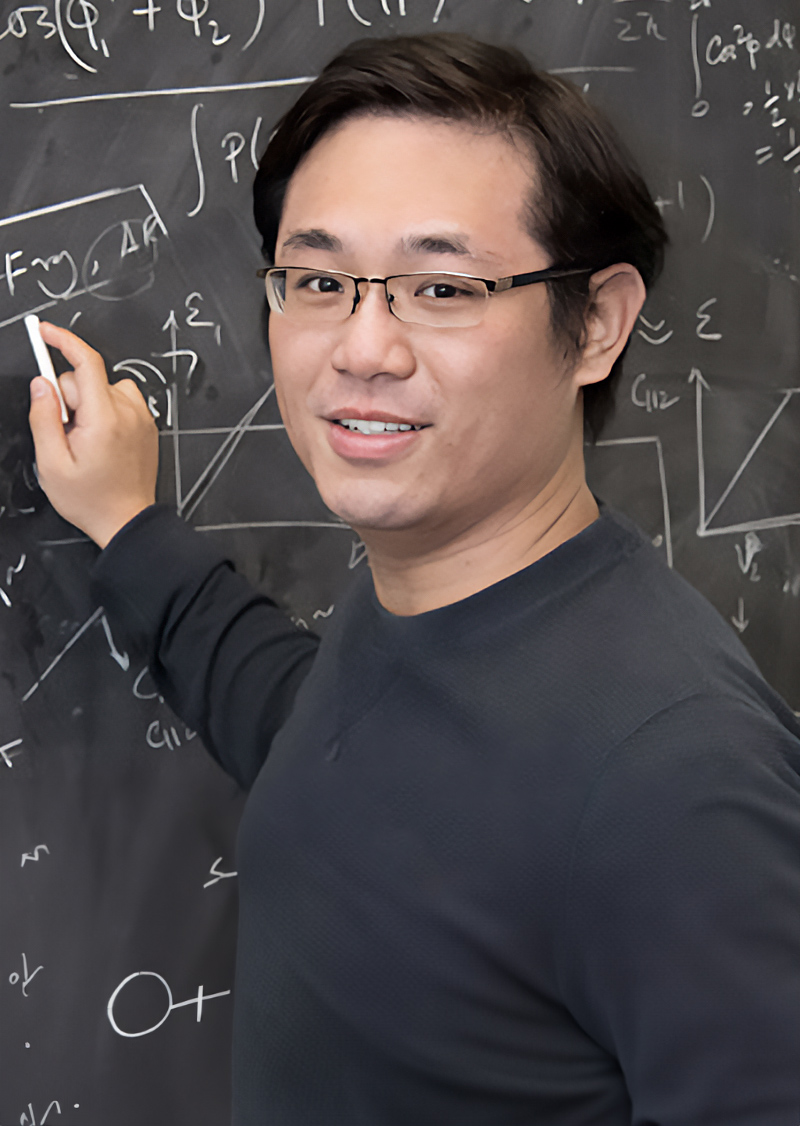
Chun Shen is an Associate Professor in the Department of Physics and Astronomy at Wayne State University's College of Liberal Arts and Sciences. His research focuses on understanding strongly interacting many-body systems, particularly the properties of nuclear matter under extreme hot and dense conditions created in relativistic heavy-ion collisions. Dr. Shen's research interests include precision fluid dynamical modelling of quark-gluon plasma at finite baryon density, electromagnetic tomography in strongly-coupled systems, rapid thermalization and out-of-equilibrium physics of many-body QCD, and multi-scale imaging of proton and nucleus at high energy. He develops comprehensive integrated frameworks to model the dynamical evolution of heavy-ion collisions event-by-event, combining these with modern statistical Bayesian analysis to extract quantitative transport properties of the Quark-Gluon Plasma. His 15 most recent publications (2025) demonstrate a strong focus on Bayesian analysis techniques applied to heavy-ion collision data, hydrodynamic modeling of quark-gluon plasma, jet physics in nuclear environments, and nuclear structure imaging. These works span from theoretical developments to experimental data analysis, with particular emphasis on uncertainty quantification and model selection. Notable Awards and Recognition: DOE Early Career Award (2021-2026) for "Quantitative Characterization of Quark-Gluon Plasma Properties" DOE AI/ML Grant as Co-PI (2024-2026) for "New approaches to Bayesian uncertainty quantification" IUPAP Young Scientist Prize in Nuclear Physics (2019) Goldhaber Fellow at Brookhaven National Lab (2016) APS Dissertation Award in Nuclear Physics (2016) Dr. Shen has secured significant research funding including multiple NSF and DOE grants. He teaches graduate and undergraduate physics courses including Thermodynamics and Statistical Physics, University Physics for Scientists, and University Physics for Engineers. His work connects theoretical nuclear physics with advanced computational methods and experimental data from major facilities like RHIC and LHC.
Krzysztof Poźniak is a Professor at the Institute of Electronic Systems within the Faculty of Electronics and Information Technology at Warsaw University of Technology. He holds a PhD and DSc (habilitation), specializing in experimental high energy physics with a focus on collider-based particle physics. His research is deeply integrated with the CMS Experiment at CERN's Large Hadron Collider (LHC), contributing to studies of Higgs boson properties, heavy ion collisions, and searches for beyond the Standard Model physics. University: Warsaw University of Technology Faculty: Faculty of Electronics and Information Technology Department: Institute of Electronic Systems Research interests include: Higgs boson self-coupling and production mechanisms Jet substructure and quark/gluon discrimination Heavy flavor physics in proton-proton and heavy ion collisions Detector development for high-luminosity LHC conditions Electroweak precision measurements Prominent recent work focuses on: Analysis of ttH production in b-bbar decay channels Studies of bottom quark energy loss in Pb-Pb collisions Searches for fractionally charged particles Measurement of WW and WZ cross sections at 13.6 TeV His group collaborates extensively with the CMS Collaboration, contributing to detector upgrades and data analysis frameworks. Over 740 documented publications reflect his leadership in experimental particle physics, with a particular emphasis on precision measurements and new physics searches.
Prof. Toyoko Orimoto is a Professor of Physics at Northeastern University's College of Science, specializing in experimental particle physics. She leads research at the CMS Experiment at CERN's Large Hadron Collider (LHC), focusing on Higgs boson physics, beyond the Standard Model (BSM) searches, and detector development. Her work includes studies of Higgs boson interactions, dark matter signatures, and the CMS electromagnetic calorimeter upgrade. Prof. Orimoto also advocates for diversity, equity, and inclusion in science. Education: PhD in Physics from UC Berkeley (2006), followed by postdoctoral roles at Caltech (2006-2009) and CERN (2009-2012). She has been at Northeastern since 2012. Research interests span experimental particle physics, including Higgs boson decay mechanisms, BSM physics (supersymmetry, extra dimensions), and future colliders like the muon collider. Her group contributes to CMS detector improvements, such as the MIP timing layer and electromagnetic calorimeter readout electronics. Notable achievements include co-winning the 2025 Breakthrough Prize in Fundamental Physics for LHC research and organizing the 2024 Large Hadron Collider Physics Conference at Northeastern. Her work bridges cutting-edge physics with detector technology and accelerator R&D.
Patrizia Rossi is a Research Professor of Physics at George Washington University and holds roles as Deputy Associate Director for Nuclear Physics at Jefferson Lab (JLab), Research Director at Frascati National Laboratories of INFN-Italy (on leave), and Adjunct Researcher. She earned her PhD in Physics from the University of Rome (Italy) in 1986. Her research focuses on hadron and nuclear physics, studying nucleon structure and the strong interaction through QCD. Recent work includes transverse momentum parton distribution functions and experimental collaborations at JLab, DESY, ESRF, and Frascati. She contributed to detector advancements like the CLAS12 RICH detector and electromagnetic calorimeters. Prof. Rossi has authored over 200 journal papers and presented at ~100 conferences. She serves on committees including the US Nuclear Science Advisory Committee (NSAC), European Physical Journal A (EPJA) editorial board, and GSI-FAIR Strategy Board. She has advised numerous undergraduate, PhD, and postdoctoral researchers.
Professor Constantia Alexandrou is a distinguished physicist at the Department of Physics, School of Natural and Applied Sciences, University of Cyprus. She leads state-of-the-art research in Lattice Quantum Chromodynamics and hadron structure, heading the Lattice QCD Computational Lab at the university. Professor Alexandrou serves as Chair of the Council of PRACE (Partnership of Advanced Computing in Europe), is a member of multiple prestigious scientific councils including the National Council for Research in Greece and the Helmholtz-Institute Mainz, and represents Cyprus at IUPAP. B.A. in Physics with First Class Honors from University of Oxford (1980) Ph.D. in Theoretical Strong Interactions Physics from MIT (1985) Research positions at Paul Scherer Institute, Switzerland and Erlangen University, Germany Professor Alexandrou's research focuses on Lattice Quantum Chromodynamics, hadron structure, and high-performance computing applications in theoretical physics. Her work bridges fundamental particle physics with advanced computational techniques, particularly in studying nucleon properties and quantum chromodynamics from first principles. She has pioneered methods for calculating parton distribution functions, hadronic vacuum polarization, and nucleon spin decomposition using lattice techniques, contributing significantly to our understanding of strong interaction physics. Her recent work has expanded into quantum computing applications for high-energy physics problems. Analysis of Professor Alexandrou's recent publications reveals a consistent focus on advancing lattice QCD methodologies for calculating fundamental properties of hadrons and nucleons. Her work spans both traditional lattice calculations and emerging quantum computing applications, demonstrating leadership in adapting computational physics to new technological frontiers. The publications show particular emphasis on precision calculations of nucleon structure, hadronic contributions to fundamental constants, and developing non-perturbative methods for quantum field theory. Fellow of the American Physical Society Principal Investigator of three European Joint Doctorates (approximately €3.7 million each) Principal Investigator of Excellence Center Quantum Computing for Science and Technology (QSciTec) under Teaming action (€35 million) Professor Alexandrou has secured approximately €15 million in competitive funding for the Computational-based Science and Technology Research Center of the Cyprus Institute, including two ERA Chair projects of €2.5 million each. She has served as the first Head of the Department of Physics at the University of Cyprus and held leadership positions at the Cyprus Institute from 2004-2022. With over 300 scientific publications and numerous invited talks at international meetings, she has organized several workshops in Cyprus and abroad, significantly contributing to the international lattice QCD community through the Extended Twisted Mass Collaboration (ETMC). She heads the Lattice QCD Computational Lab at the University of Cyprus, which operates dedicated computing clusters for lattice QCD calculations. As a member of the Extended Twisted Mass Collaboration (ETMC) - comprising major European and US research groups - she plays a key role in advancing international collaboration in computational particle physics. Her leadership extends to multiple scientific advisory bodies where she influences research directions in high-performance computing and theoretical physics across Europe.
Ewa Rondio is a distinguished Professor at the National Centre for Nuclear Research in Poland, where she also serves as Deputy Director for Science. With a career spanning over four decades, she has made significant contributions to experimental particle physics, particularly in neutrino physics and nucleon structure. Education: Professor Title in Physics (granted by President of Poland, 2006) Habilitation (physics), Institute for Nuclear Studies, Warsaw (1995) PhD (physics), Institute for Nuclear Studies, Warsaw (1982) MSc (physics), Warsaw University, Warsaw (1978) Ewa Rondio's research focuses on two main areas: nucleon structure and neutrino physics. Her work on nucleon spin structure has been instrumental in advancing our understanding of quantum chromodynamics, while her contributions to neutrino physics, particularly through the T2K experiment, have been pivotal in measuring neutrino oscillation parameters. She has led multiple international collaborations and has been at the forefront of experimental particle physics for decades. Her publication record shows consistent productivity with 239 papers total, including 39 published since 2015 and 5 in 2019 alone. The research demonstrates strong continuity in neutrino oscillation studies, nucleon structure investigations, and hadron production measurements essential for neutrino beam simulations, reflecting her leadership in major international collaborations. Scientific Awards: Breakthrough Prize in Fundamental Physics (2016) for progress in understanding neutrino oscillations Golden Cross of Merit (2015) for scientific achievements Andrzej Soltan Award (2002, 1998, 1994) Award of Rector of Warsaw University (1978) Throughout her career, Professor Rondio has played a significant role in mentoring through her position as Coordinator of PhD Studies in Soltan Institute for Nuclear Studies (2007-2009) and as team leader for multiple research groups. She has secured substantial research funding through international collaborations including T2K, ICARUS, and NA61 experiments, with particular focus on neutrino beam simulations and detector development. Currently, Professor Rondio leads the T2K group at the National Centre for Nuclear Research and serves as deputy-leader of the Polish neutrino group. Her laboratory work focuses on neutrino oscillations, nucleon structure, and hadron production measurements essential for neutrino beam simulations, maintaining active participation in CERN-based experiments.
Prof. Dr. Martin Beneke holds the Chair of Theoretical Elementary Particle Physics at the Technical University of Munich (TUM) , affiliated with the TUM School of Natural Sciences and Department of Physics. He is a leading expert in theoretical particle physics and cosmology. Academic Appointments : TUM (2012–Present), RWTH Aachen University (1999–2012), CERN (1996–1999) Education : PhD in Physics (TUM, 1993), studies at Konstanz, Cambridge (UK), and Heidelberg His research interests span theoretical elementary particle physics, focusing on: Phenomenology of high-energy collider collisions Higher-order perturbation theory and renormalons Effective field theory applications Heavy quark physics (bottom/top) and CP violation Dark matter and cosmology, including cosmic background radiation polarization His key publications demonstrate expertise in precision QCD calculations, B meson decays, and effective field theory techniques, with applications to Standard Model extensions and collider phenomenology. Scientific recognition includes: DFG Gottfried Wilhelm Leibniz Prize (2008) Humboldt Foundation Feodor Lynen Fellowship (1995) Max Planck Society Otto Hahn Medal (1994) He teaches courses like Theoretical Physics 2 (Electrodynamics), advanced seminars on precision calculations, and supervises weekly arXiv paper discussions with colleagues.
Lluis Ametller Congost is a faculty member at the Universitat Politècnica de Catalunya (UPC), affiliated with the School of Engineering of Barcelona Est (EEBE) under the Department of Physics. His research spans particle physics, quantum chromodynamics, and condensed matter physics, with a focus on lepton flavor phenomena, 2D material characterization, and theoretical models beyond the Standard Model. His recent work includes Optoelectronic characterization of graphene-based heterostructures (2023) Lepton flavor-changing Higgs decays in T-parity models (2017) QCD resonance analysis and low-energy data interpretation (2014) He has contributed to experimental and theoretical studies in high-energy physics and materials science, often collaborating with Pedro Talavera and Francisco del Aguila. Academic output includes 26 indexed journal articles, 6 competitive R+D+i projects, and 5 conference presentations. Email: lluis.ametller@upc.edu | ORCID: 0000-0002-2756-8216
Dr. Dan Pitonyak is an Associate Professor of Physics at Lebanon Valley College , where he co-chairs the Chemistry and Physics department. His research focuses on computational nuclear physics , particularly the 3D structure of protons using Python-based simulations. B.S. from Lebanon Valley College Ph.D. from Temple University Dr. Pitonyak’s work spans Quantum Chromodynamics (QCD) , Transversity PDFs , Transverse Momentum Dependent (TMD) distributions , and Spin Observables . He leads NSF-funded projects on hadronic structure and collaborates with institutions like Jefferson Lab. Recent publications highlight his global QCD analyses of transversity and dihadron fragmentation functions, with applications to the Electron-Ion Collider . His 2015 APS Dissertation Award underscores his impact on hadronic physics. NSF Grant (PHY-2308567) : Principal Investigator DOE Grant : Senior Personnel Students like Penn Smith '25 and Jacob Marsh '25 actively participate in his research. Dr. Pitonyak provides interactive tools via Google Colab for exploring QCD models and experimental configurations.
Professor Muammer Altan Çakır is a Full Professor at the Department of Physics Engineering, Istanbul Technical University. His primary affiliation is with the CMS experiment at CERN, focusing on high-energy physics and particle physics research. He has held significant roles in collaborative projects involving international teams analyzing proton-proton collisions and heavy ion collisions. Research Interests: Proton-proton collisions, Higgs boson physics, top quark dynamics, lepton physics, and detector development for CMS. Key Projects: Includes studies on big data processing for CMS experiment visualization, scalable distributed computing platforms, and new physics searches using deep learning. He has been awarded multiple research fellowships and performance awards, notably the Landes Baden-Württemberg Doctoral Fellowship and LPC Guest Visiting Faculty roles.