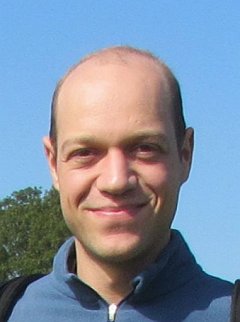
David Chisnall is a researcher affiliated with the University of Cambridge and active in systems programming, compiler design, and cross-language interoperability. He contributes to conferences like POPL, PLDI, ISMM, and SPLASH, with particular focus on secure compilation and memory management.
Magnus Madsen is an Associate Professor at Aarhus University, Department of Computer Science. He leads the development of the Flix programming language, a declarative tool integrating logic, functional, and imperative features with Java interoperability. His work spans type and effect systems, program analysis, and JavaScript bug-finding tools, particularly for asynchronous applications. Academic Affiliation: Aarhus University (Denmark) Leadership: Flix Programming Language Magnus's research focuses on programming language design, type systems, and static/dynamic analysis. This includes Datalog constraints, polymorphic effects, and nullability frameworks. His contributions to JavaScript analysis address asynchrony and concurrency challenges. Key trends in his work include declarative program analysis, effect system design, and Datalog-based frameworks like IFDS/IDE. Recent papers explore rank-polymorphic function inference, purity reflection, and stratification in logic programming. Scientific awards include: Sapere Aude grant (2023) Dahl-Nygaard Junior Prize (2022) STEM Grant (2022) Amazon Research Award (2021) DFF Project One (2020) ECOOP 2023 Distinguished Paper ICSE 2016 Distinguished Paper Current PhD students advised: Jonathan Lindegaard Starup, Matthew Lutze, Andreas Stenbæk Larsen (co-advised with Aslan Askarov), Caroline Palma Berger (co-advised with Clemens Nylandsted Klokmose).
Quentin Stiévenart is a researcher at Université du Québec à Montréal, focusing on abstract interpretation, concurrency, and static analysis. His work spans programming language design, software verification, and tool development for WebAssembly and functional languages like Racket and Scheme. Active in organizing and reviewing for conferences including SPLASH, ICFP, ECOOP, and SAS Developed tools such as Wassail for WebAssembly static analysis and RacketLogger for educational purposes Contributions include theoretical work on effect-driven flow analysis and practical advancements in concolic execution abstraction His research addresses challenges in concurrency verification, cyclic reinforcement in incremental analysis, and security-focused taint tracking across multiple language paradigms.
Luca DE'MEDICI is a Professor at the Laboratoire de Physique et Etudes des Matériaux (LPEM) at ESPCI-PSL in Paris. His research focuses on condensed matter theory, particularly strongly correlated materials, unconventional superconductors, and theoretical methods for quantum materials. He leads a research group funded by an ERC Consolidator Grant (2016-2022) exploring correlated materials and their applications in superconductors and thermoelectrics. His work includes groundbreaking studies on Hund’s metals, Mott transitions, and electronic compressibility in FeSe. He has organized international conferences like 'Cutting-Edge Topics in Quantum Materials' and contributed to the development of the EDIpack computational package for quantum impurity problems. DE'MEDICI has been recognized for his contributions to understanding electronic correlations in superconductors and correlated systems.
Guillaume Huard is an Associate Professor at Grenoble Alpes University, affiliated with the LIG Laboratory and the POLARIS Research Team . His research focuses on high-performance computing (HPC), particularly in tracing, performance analysis, and optimization of parallel applications, compiler optimization, and architecture. PhD in 2002 from École Normale Supérieure de Lyon under Alain Darte His research interests span applications tracing, monitoring and visualization of runtime data, application deployment, scheduling, performance evaluation, resource utilization, and cache/memory footprint optimization. His work often addresses challenges in NUMA architectures and large-scale trace analysis. Guillaume's publications highlight trends in memory trace collection (e.g., Moca system), spatiotemporal data aggregation, NUMA-aware visualization tools (e.g., TABARNAC), and cache utilization control. Key subfields include performance debugging, compiler transformations, runtime environments, and multidimensional data aggregation techniques. Guillaume is actively involved in the POLARIS Bootcamp and DATAMOVE/POLARIS events , contributing to collaborative research and educational initiatives in HPC.
Mostafa BAMHA is an Associate Professor (Maître de Conférences) at the University of Orleans, affiliated with the LIFO Laboratory (Laboratoire d'Informatique Fondamentale d'Orléans). He leads research in parallel and distributed computing, focusing on MapReduce optimization , data skew handling , and scalable graph processing . Member of the PRV team (Parallelism, Virtual Reality, System Verification) Active in projects: HPIAF (High Performance computing for AI in Finance) INEx (Cloud Computing experiments) Girafon (Graph & BigData processing) Research Trends His publications from 2018–2024 show focus on: MapReduce optimizations for join operations and LSH similarity joins Graph processing challenges in Pregel with high-degree vertices Skew-insensitive algorithms across distributed architectures Academic Contributions Co-author in 15+ peer-reviewed publications (2000–2024) including International Journal of Parallel Programming , DEXA , and HLPP conferences. Key collaborators: Sébastien Rivault , Mohamad Al Hajj Hassan , Sophie Robert .
Mamadou Kaba Traore is a Professor at the University of Bordeaux , affiliated with the Production Engineering research group and the MEI team at the Integration, Material to System (IMS) Laboratory. His work focuses on Modeling and Simulation (M&S), Digital Twins , and Multi-Perspective Modeling . Research Interests: Traore's research spans Discrete Event System Specification (DEVS) , HiLLS (High-Level Language for System Specification), Process Mining , and System Inference . He develops frameworks like DMFDT (Data Management Framework for Digital Twin) and contributes to Model-Driven Systems Engineering and Verification & Validation methodologies. Recent Publications: Traore co-authored works on Digital Twin verification, DEVS standardization, and applications of simulation to healthcare and urban systems. His 2023 chapter in the Body of Knowledge for Modeling and Simulation outlines core areas of M&S theory. Earlier studies explore Fuzzy Clustering and Parallel Simulation techniques.
Denis Jeandel is a Researcher at the Laboratory of Fluid Mechanics and Acoustics (LMFA), University Claude Bernard Lyon 1, France. He specializes in turbulence modeling, flow instability analysis, and fluid dynamics. His work encompasses a wide range of applications, including electric arc dynamics, combustion chamber aerodynamics, and numerical methods for multiphysics problems. He is part of the Turbulence & Instabilities research team and contributes to advancements in computational fluid dynamics (CFD), finite element methods, and boundary layer studies. Research Interests: Turbulence Modeling and Simulation Electric Arc Behavior in Circuit Breakers Internal Aerodynamics of Combustion Chambers Thermal-Hydraulic Phenomena Lagrangian Stochastic Modeling for Atmospheric Dispersion Shock-Wave and Multiphase Flow Dynamics Publications Highlight Key Contributions: His work spans numerical methods for second-order turbulence closures, coupled electromagnetic-aerothermal simulations, and boundary layer stability analysis. Recent publications focus on improving accuracy in high-speed flow simulations and electric arc initiation modeling. Awards and Recognition: No specific awards mentioned in the provided texts, though his sustained research output indicates active recognition in the field. Lab and Team Involvement: He collaborates with the Turbulence & Instabilities team at LMFA to address complex fluid dynamics challenges, leveraging state-of-the-art experimental and numerical tools.
Tony Lelièvre is a Professor of Applied Mathematics at the Ecole Nationale des Ponts et Chaussées, part of the Institut Polytechnique de Paris. He holds a PhD (2004) and Habilitation (2009), specializing in multiscale modeling, molecular simulation, and stochastic processes. His research focuses on free energy computations, numerical analysis of complex fluids, and computational statistical physics. He co-authored two books and over 100 papers, receiving significant awards like the ERC Consolidator Grant (2013-2019) and the Grand prix Alcan. Lelièvre has organized numerous international workshops and serves on editorial boards of journals like ESAIM:M2AN and SIAM/ASA Journal of Uncertainty Quantification. His work bridges applied mathematics, numerical analysis, and computational science with applications in materials science and industrial fluid dynamics. Education: PhD in Applied Mathematics, 2004 Habilitation à Diriger des Recherches, 2009 Research Interests: Multiscale modeling of complex fluids Molecular dynamics and free energy calculations Stochastic methods for metastable systems Numerical analysis of PDEs and SDEs Computational statistical physics Recent Contributions: His work on adaptive biasing force methods and hybrid Monte Carlo techniques has advanced the simulation of rare events and free energy landscapes. He contributed to variance reduction techniques in molecular simulations and mathematical analysis of parallel replica algorithms. Awards: ERC Consolidator Grant (2013-2019), Prix CS 2002, Grand prix Alcan (2010), Ordway Visiting Professorship (2012-2013), and several teaching awards. Professional Activities: Organized major conferences like CEMRACS 2013 and IPAM Long Program on Energy Landscapes (2017). Co-edits journals and authored influential textbooks on magnetohydrodynamics and free energy computations.
François Chaumette is a Senior Research Scientist (Directeur de recherche) at Inria, affiliated with IRISA and the Centre Inria de l'Université de Rennes. He has been a key researcher in robotics and computer vision since 1990 and led the Lagadic research team from 2004 to 2017. His research interests are centered on robot vision, particularly visual servoing and active perception . He has made foundational contributions to image-based and position-based visual servoing, and his work integrates control theory, computer vision, and robotics. His research spans applications in mobile robotics, aerial systems, medical robotics, space robotics, and soft object manipulation. The recent publications highlight a consistent focus on visual servoing under complex constraints—such as motion blur, occlusions, and deformations—applied to drones, cable-driven robots, and space systems. There is a strong emphasis on robustness , stability analysis , and hybrid sensing (e.g., vision + proximity, vision + force). His work with the RemoveDebris mission demonstrates real-world impact in space robotics. AFCET/CNRS Prize for best Ph.D. in Automatic Control Best paper awards at RFIA 1996 & 2004 Best paper in IEEE T-RA (2002) Best paper in IEEE RA-L (2019) Best paper in IEEE RAM (2020) IEEE Fellow (2013) He has advised over 30 Ph.D. students, many of whom have become active researchers in robotics. He has served in editorial roles for top journals including IEEE Transactions on Robotics , IEEE Robotics and Automation Letters , and the International Journal of Robotics Research . He was elected to the IEEE RAS Administrative Committee (2016–2018) and served on ERC grant panels for robotics. Chaumette is the main developer of ViSP (Visual Servoing Platform), a widely used C++ library for visual tracking and servoing. His leadership in both theoretical advances and software tools has significantly shaped the visual servoing community.
Laure Gonnord is a Full Professor in Computer Science at Grenoble INP , affiliated with the Esisar Engineer School in Valence, France, since September 2021. She is a member of the CTSYS research team at the LCIS laboratory and an external member of the CASH team at the University of Lyon / CNRS / LIP / Inria. Her research focuses on compilation , static analysis , and applications to safety , security in high-performance and embedded systems . Fields of Interest : Compiler Design Static Analysis for Safety & Security Abstract Interpretation Embedded Systems High-Performance Programming Hardware Security Engineering Research Trends (from recent publications): Her work explores modular verification through monadic abstract interpreters, complexity bounds in term rewriting , and educational tools for theorem proving . Notable contributions include compiler hardening schemes for hardware security and memory layout optimizations for algebraic data types. Academic Leadership : Scientific Director of the Summer School EJCP (École Jeune Compilation et Programmation) Board Member of the French national research group GDR GPL Teaching Responsibilities at Grenoble INP include courses in architecture , compilation , programming languages , algorithms , and databases . She has also taught at University of Lyon, ENS Lyon, Polytech'Lille, and INSA.
Beatrice Markhoff is a Professor of Computer Science (CNU 27) at the University of Tours , affiliated with the Faculty of Science and Technology (Blois site) and the Computer Science Department . She is a member of the UMR CNRS 7324 - CITERES - Archaeology and Territories Laboratory (CITERES-LAT) and the Maison des Sciences de l'Homme Val de Loire (MSH VdL) . Her research focuses on semantic interoperability , Web of data , knowledge representation , and knowledge extraction , with significant collaborations in cultural heritage disciplines . Doctorate in Computer Science, University of Franche-Comté (1995) HDR (Habilitation to Direct Research), François Rabelais University of Tours (2013) Her research themes include semantic interoperability, knowledge engineering, and data mining, with applications in cultural heritage. She co-created the International Workshop on Semantic Web for Cultural Heritage and co-edited special issues for the Semantic Web Journal and JOCCH . She leads projects like ANR SESAMES (2018-2023), H2020 ARIADNEplus (2019-2022), and H2020 4CH (2021-2023). Her academic contributions span XML data management, semantic web technologies, and functional programming. Key projects include carto4CH for cultural heritage mapping and OpenArchaeo for knowledge graph profiling. She has co-supervised PhD theses on topics like LOD querying and knowledge extraction from Wikidata .
Anne BENOIT is an Associate Professor of Computer Science at École normale supérieure de Lyon (ENS de Lyon), affiliated with the Parallel Computation Laboratory (LIP) and the ROMA project. She holds leadership roles, including Chair of the IEEE Technical Community on Parallel Processing (2020–2024) and IUF Senior Membership (2023–2028). Her research focuses on multi-criteria scheduling algorithms for HPC, addressing performance, cost, energy, and reliability challenges. She earned a PhD in Systems and Communications from INPG Grenoble (2003) and an HDR (2009). Research Interests : Her work integrates scheduling optimization, fault tolerance, and energy efficiency in HPC systems. She designs resilient protocols to manage failures and uncertainties, particularly in heterogeneous environments. Key topics include checkpointing strategies, workflow scheduling on edge platforms, and balancing conflicting optimization criteria. Awards & Roles : Senior Member of the Institut Universitaire de France (2023) Guest Professor at Georgia Tech (2017–2018) Associate Editor-in-Chief of Elsevier JPDC and ParCo IEEE Senior Member Professional Contributions : Chair of major conferences like IPDPS and HiPC. Authored A Guide to Algorithm Design (CRC Press, 2013). Leads the Computer Science Department at ENS Lyon since 2022. Labs & Projects : Active in the ROMA project (Resource Optimization) and the LIP laboratory, focusing on parallel computation and algorithmic efficiency.
Arthur Charguéraud is a senior researcher (Directeur de Recherche) at Inria, based in Strasbourg within the Camus team, affiliated with the iCube laboratory at Université de Strasbourg. His research spans program verification, program optimization, and mechanized semantics of programming languages, with a strong focus on separation logic and interactive theorem proving using Coq. Affiliation: Inria, Camus team, iCube Laboratory, Université de Strasbourg Position: Senior Researcher (Directeur de Recherche) Research Focus: Formal verification, separation logic, source-to-source transformations, high-performance computing His research interests center on developing formal methods to ensure correctness and efficiency in software systems. He works extensively on separation logic to verify both time and space complexity of programs, especially in the presence of garbage collection. His work bridges theoretical foundations with practical tools, such as the CFML framework and the OptiTrust optimization framework, which enables trustworthy source-to-source transformations with formal guarantees. His publications reveal a consistent focus on interactive verification, formal semantics, and performance optimization. Key themes include granularity control in parallelism, mechanized semantics (e.g., for JavaScript), and verified compilation. He has made significant contributions to separation logic, including extensions for time and space credits, big-O reasoning, and higher-order representation predicates. Arthur Charguéraud has received notable recognition for his work, including: Distinguished Paper Award at CPP 2022 SIGPLAN Research Highlight at PPoPP 2019 He has advised several PhD students and postdoctoral researchers, including Guillaume Bertholon, Alexandre Moine, and Armaël Guéneau. He leads the ANR-funded OptiTrust project (2022–2027), which aims to build a framework for verified source-to-source optimizations. He has also been involved in other major projects such as ANR VOCAL, ANR AJACS, and ERC DeepSea. His work is supported by both national (ANR, Inria) and institutional (CEA, ENS) grants. He is actively involved in the programming languages research community, serving on the program committees of top conferences including POPL, ICFP, PLDI, CPP, and CoqPL, and has chaired several workshops. He is also engaged in education and outreach, co-authoring the book Separation Logic Foundations in the Software Foundations series and designing challenges for the Concours Castor Informatique to promote computer science among young students.
Stéphane MAAG is a Professor at Telecom SudParis, associated with the SAMOVAR research laboratory. His work focuses on formal methods for protocol validation, network security, and distributed systems monitoring. He has contributed to advancing testing methodologies for mobile ad-hoc networks (MANETs), IoT protocols, and wireless communication systems. His research integrates machine learning techniques for automation and has been applied to web testing frameworks and ERP systems. Key research areas include protocol performance evaluation, trust management in networks, and curriculum design for computer science ethics. His work spans both academic surveys (e.g., European ethics education studies) and technical innovations (e.g., proactive interoperability solutions for wireless routing). Publications emphasize practical applications of formal methods, with over 50 peer-reviewed articles in journals like International Journal of Ethics Education , Computer Communications , and IEEE Transactions . His work bridges theoretical foundations with real-world systems like ODOO ERP and SIP protocols.