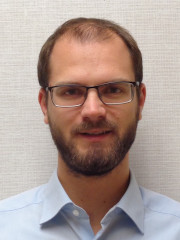
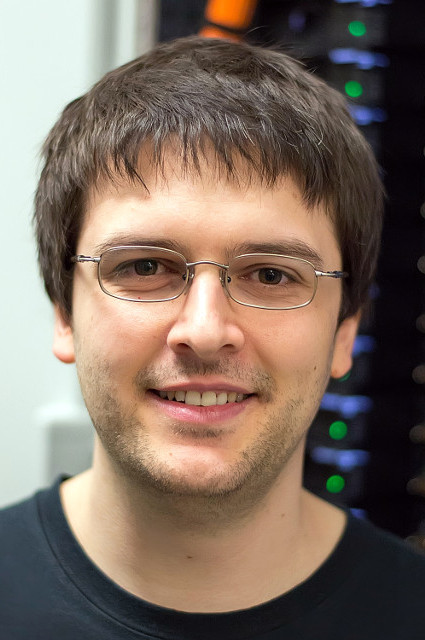
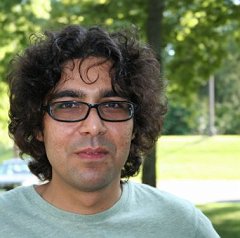
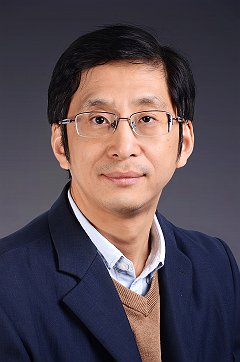
Dr. Philipp Grete is a postdoctoral research associate at the Hamburg Observatory (University of Hamburg), previously holding a Marie Skłodowska-Curie Fellowship at the same institution and a postdoctoral position at the Department of Physics & Astronomy, Michigan State University . His interdisciplinary research bridges astrophysics and computational methods , focusing on: Magnetohydrodynamic turbulence in astrophysical systems Performance-portable exascale simulation frameworks (Parthenon, AthenaPK) Cosmic ray transport mechanisms Anisotropic transport processes in weakly collisional plasmas Supercomputer-driven AGN feedback analysis He leads the XMAGNET project using DOE INCITE allocations on exascale systems and recently secured DFG funding for three years. His work has been recognized with the Postdoctoral Excellence in Research Award (MSU), SC23 Best Paper nomination, and CUG23 Best Paper Runner-up award.
Antonio Filieri is a Senior Applied Scientist at Amazon Web Services (AWS) and holds a Visiting Associate Professor position at the Department of Computing, Imperial College London. Previously, he was a tenured Associate Professor at Imperial College London (2022-2024) and Assistant Professor (2016-2022), and served as Assistant Professor at the University of Stuttgart between 2013 and 2015. His academic career spans over a decade with significant contributions to software engineering research. Dr. Filieri's research focuses on formal mathematical methods for software design, verification, self-adaptation, and security. His primary research areas include static analysis, privacy, and automated test generation for security; exact and approximate methods for probabilistic program analysis; control theory for adaptive software; quantitative verification and model checking; and runtime-efficient and incremental verification. His work bridges theoretical foundations with practical applications in industry settings, particularly in cloud computing and security domains. His recent publications demonstrate a strong focus on probabilistic methods for software analysis, security testing, and performance modeling. The research trends show increasing integration of formal methods with machine learning techniques, particularly in test oracle generation and neural network analysis. There's also a clear emphasis on scalability and practical applicability of verification techniques to real-world systems like serverless computing and microservices architectures. Dr. Filieri has received numerous prestigious awards for his contributions: Best Student Paper Award (2025) for 'Robust Probabilistic Model Checking with Continuous Reward Domains' ACM Distinguished Paper Award (2023) for 'Sibyl: Improving Software Engineering Tools with SMT Selection' Best Paper Award (2022) for 'Enhancing Performance Modeling of Serverless Functions via Static Analysis' Best Artifact Award (2017) for 'Self-adaptive video encoder: comparison of multiple adaptation strategies made simple' Most Influential Paper Award (awarded at SEAMS 2025) for 'Software Engineering Meets Control Theory' ACM SigSoft Distinguished Paper Award (2011) for 'Run-time Efficient Probabilistic Model Checking' Dr. Filieri has advised several PhD students including Donato Clun (2024), Runan Wang (2024), and Xiaotong Ji (expected 2025). His advising focuses on probabilistic program analysis, automated testing, and security verification. His research has been supported by significant grants from both academic and industry sources, enabling collaborations across multiple institutions and contributing to advancements in software engineering practices. While specific lab information isn't prominently featured in the provided materials, Dr. Filieri's work suggests strong connections with research groups focused on formal methods, software verification, and adaptive systems at both Imperial College London and AWS. His research often involves interdisciplinary collaboration between theoretical computer science and practical software engineering challenges.
Bernd Fischer is a Professor and the current Head of Division in the Division of Computer Science at Stellenbosch University, South Africa. Previously, he held positions at TU Braunschweig, NASA Ames Research Center, and University of Southampton, establishing a strong international academic background in software engineering and formal methods. Professor Fischer's research focuses on automated software engineering, particularly logic-based techniques. His work spans specification-based component reuse, program synthesis, and program verification, with current emphasis on annotation inference, software model checking, and human-oriented presentation of verification results. His research bridges theoretical foundations with practical applications, particularly in concurrent program verification, grammar-based testing, and fault localization techniques. His work has significant implications for improving software reliability and developer productivity. Analysis of his recent publications reveals a strong focus on concurrent program verification through lazy sequentialization techniques, with substantial contributions to tools like CSeq and ESBMC. His research demonstrates consistent innovation in software verification, particularly in addressing the challenges of concurrency, bounded model checking, and fault localization. The interdisciplinary nature of his work connects theoretical computer science with practical software engineering challenges. ASE 2012 Most Influential Paper Award ACM Distinguished Paper Award Best Presentation Award Professor Fischer has successfully advised PhD students including Gillian Greene, who defended her thesis on "Concept-Based Exploration of Rich Semi-Structured Data Collections," and Geoff Birch, who completed work on "Fast, Fully-Automated, Model-Based Fault Localisation and Repair with Test Suites as Specification." His mentoring approach integrates theoretical rigor with practical tool development. His research has been supported through various academic grants enabling the development of multiple software verification tools. Professor Fischer leads development of several important software engineering tools including AutoBayes for statistical program synthesis, ConceptCloud for interactive visualization of software repositories, CSeq for concurrent program verification, and ESBMC for software model checking. These tools represent significant contributions to the software engineering research community and have been recognized in international verification competitions.
Prof. Dr. Michael Kuhn is a Professor in the Faculty of Computer Science at Otto von Guericke University Magdeburg since 2020, leading the Parallel Computing and I/O Group. His work bridges theoretical parallel computing concepts with practical high-performance computing implementations. His academic journey includes: Bachelor's degree in Computer Science from Heidelberg University (2007) Master's degree in Computer Science from Heidelberg University (2009) Doctorate from Hamburg University (2015) with dissertation on "Dynamically Adaptable I/O Semantics for High Performance Computing" Prof. Kuhn's research tackles critical challenges in modern computing infrastructure where systems scale to millions of processor cores. He investigates fundamental improvements to storage architectures, I/O interfaces, and programming models that enable efficient data processing at exascale levels. His development of the JULEA storage framework provides dynamically adaptable solutions for high-performance computing environments, addressing the growing mismatch between computational power and data movement capabilities. As faculty public relations officer, he maintains the Faculty of Computer Science's digital presence while actively teaching courses that equip students with practical parallel programming skills. His group's work demonstrates how breaking computational problems into parallelizable components—like the matrix processing example reducing runtime to a quarter—enables scientific breakthroughs requiring massive computational resources. The Parallel Computing and I/O Group serves as a hub for advancing storage technologies and parallel processing methodologies, with applications spanning scientific computing, big data analytics, and next-generation supercomputer architectures.
Mehdi Bagherzadeh is an Assistant Professor in the Department of Computer Science and Engineering at Oakland University. His professional profile shows consistent involvement in major software engineering conferences including ASE, SPLASH, and ICSE, where he has served in various leadership roles such as Workshops Co-Chair for SPLASH (2021-2023) and Late Breaking Results Co-Chair for ASE (2022). Dr. Bagherzadeh's research focuses on the correct construction of concurrent and big data software, situated at the intersection of Software Engineering and Programming Languages. His work particularly addresses challenges in deep learning program optimization, actor concurrency models, and automated refactoring techniques. His research trajectory shows a clear evolution from foundational work on concurrent programming models (Panini, Capsule) to current applications in deep learning systems. Analysis of his publication history reveals a strong focus on practical software engineering challenges in concurrent systems, with recent work concentrating on the migration and optimization of deep learning programs. His research combines empirical studies with formal methods, addressing both theoretical foundations and practical implementation concerns in modern software systems. Through his committee service across multiple top-tier conferences including ASE, SPLASH, ICSE, and ESEC/FSE, Dr. Bagherzadeh has established himself as an active contributor to the software engineering research community. His service roles have ranged from program committee membership to organizational leadership positions.
Luciano Baresi is a Full Professor at the Polytechnic University of Milan (Politecnico di Milano), Italy, affiliated with the Department of Electronics, Information and Bioengineering. He earned his laurea (MSc) and PhD in Computer Science from the same institution and has held visiting positions at the University of Oregon (USA), Tongji University (China), and the University of Paderborn (Germany). His research spans software engineering, with current focuses on self-adaptive systems, edge computing, and AI/ML-based software. His work integrates formal methods with practical applications, emphasizing autonomous systems, cloud-edge continuum, and federated learning. Recent publications highlight AI-driven advancements in software testing, resource optimization, and educational tools. Key research themes include: AI/ML for autonomous driving testing and data augmentation Serverless computing at the edge Federated learning system architectures Containerization and cloud resource management Awarded for impactful contributions: RE 2020 Most Influential Paper ICSOC 2020 Best Paper SEAMS 2022 Best Paper He advises 14+ PhD students and leads projects like Ketonet (health app), WHO's Essential Items Estimator, and dynaSpark. As Editor-in-Chief of Proceedings of the ACM on Software Engineering and senior editor for multiple journals, he shapes academic discourse in adaptive systems and software engineering.
Hongyu Zhang is a Professor and Dean of the School of Big Data and Software Engineering at Chongqing University, China, and an Honorary Professor at The University of Newcastle, Australia. Previously, he served as a Lead Researcher at Microsoft Research Asia and an Associate Professor at Tsinghua University, China. He received his PhD from the National University of Singapore in 2003. His academic journey spans prestigious institutions, combining industry research experience with academic leadership. Dr. Zhang's research interests focus on intelligent software engineering, software analytics, data-driven software engineering, software fault management, testing and debugging, and software maintenance and reuse. His work centers on improving software quality and productivity by mining and analyzing vast amounts of software data. Over the years, he has developed innovative methods that apply data mining, machine learning (including deep learning), and information retrieval techniques to extract knowledge from software data and solve complex software engineering problems. His research spans three major areas: intelligent programming (code search, code summarization, code generation), intelligent quality prediction (defect prediction, cloud failure prediction, performance prediction), and intelligent fault detection and diagnosis (log-based fault detection, crash-based fault localization, bug report analytics). His recent publications demonstrate a clear trend toward integrating large language models and deep learning techniques with traditional software engineering practices. The research spans intelligent programming assistance, code security, UI automation, distributed systems optimization, and performance analysis. His work increasingly focuses on practical applications of AI in software engineering, with emphasis on real-world impact in industrial settings, particularly in microservices, cloud systems, and large-scale software development environments. 8 ACM Distinguished Paper Awards Best Paper Award: How Long Will it Take to Mitigate this Incident for Online Service Systems? David Lorge Parnis Fellowship Senior Member of IEEE Distinguished Member of ACM Distinguished Member of CCF Fellow of Engineers Australia (FIEAust) Recognized in The Australian's Top Researchers special edition as leading researcher in Software Systems World's Top 2% Scientists (career-long) Dr. Zhang has successfully advised numerous PhD and Master's students who have gone on to prominent positions at leading technology companies and academic institutions worldwide. His research has been supported by significant grants including Australian Research Council Discovery Projects (as Lead CI) and multiple National Science Foundation of China projects. His work has made tangible impacts in industry, most notably through the Microsoft Developer Assistant project which received over 450K downloads in 2016. He leads research groups focused on intelligent software engineering and software analytics, with strong collaborations between Chongqing University, The University of Newcastle, and Microsoft Research. His teams develop practical tools for code intelligence, log analysis, and fault diagnosis that are deployed in real-world online service systems.