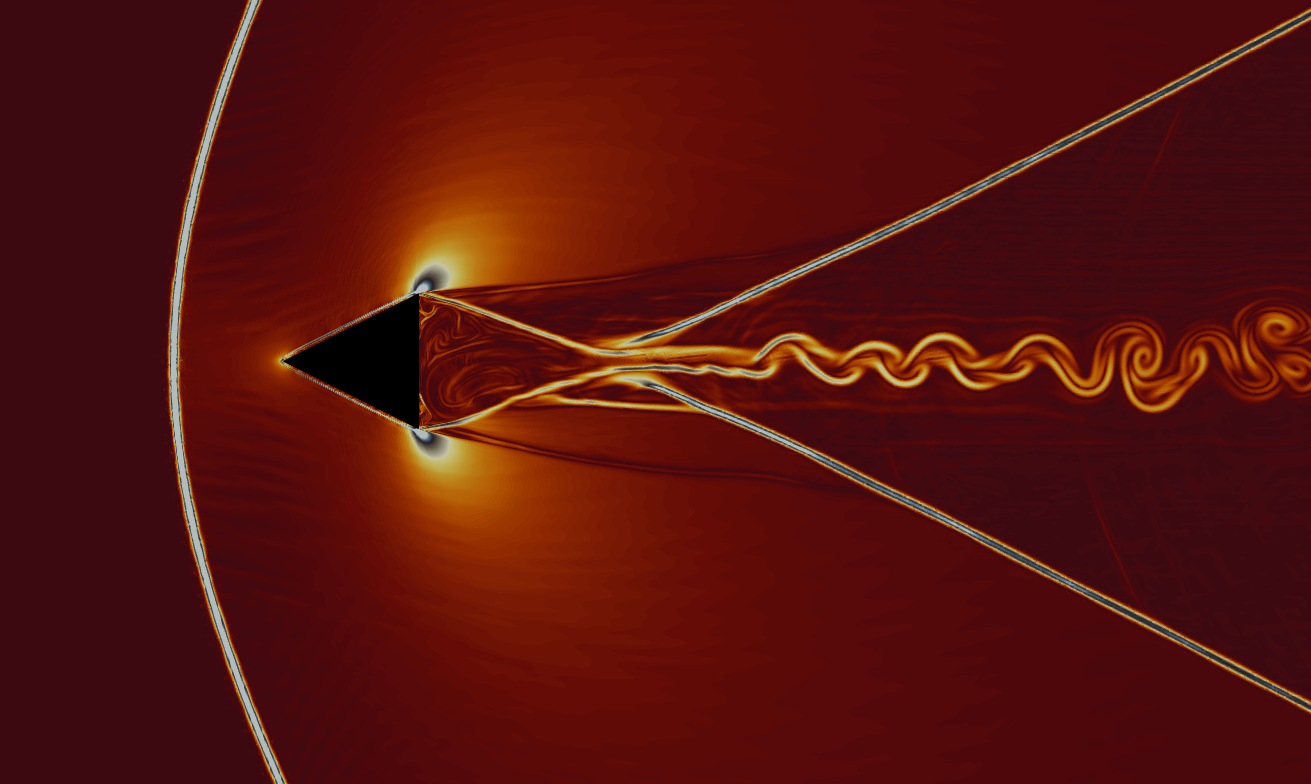
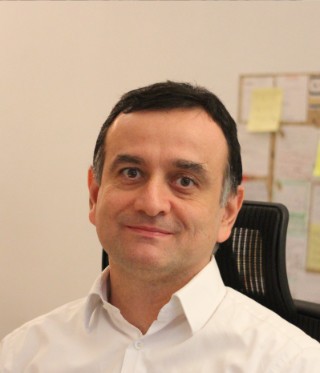
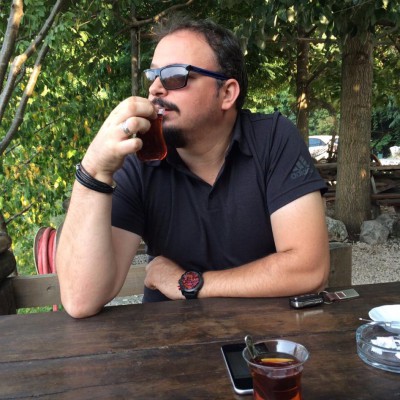
Ali Karakus is an Associate Professor at Middle East Technical University (METU) and Deputy Head of Department. He obtained his Bachelor's degree (2005), Master's degree (2009), and PhD (2015) from METU. His research focuses on computational fluid dynamics, high-order numerical algorithms, and GPU-accelerated solvers for multiphysics problems. Specializes in high-performance scientific computing and finite element methods. Develops GPU-optimized solvers for compressible/incompressible flows, level-set reinitialization, and physics-informed neural networks. The Accelerated Multiphysics (AMiP) research group, led by Dr. Karakus, emphasizes discontinuous Galerkin approaches, adaptive mesh refinement , and Jacobian-free Newton-Krylov methods . His recent work integrates data-driven modeling with traditional fluid dynamics solvers. Notable scientific achievements include: 2024 Lecturer of the Year award from METU Parlar Foundation Collaborative publications on NekRS , a GPU-accelerated Navier-Stokes solver Selected as a groundbreaking paper in Parallel Computing journal Dr. Karakus has supervised multiple M.Sc. theses on topics including: High-order Boltzmann solutions for low Mach aerodynamics Physics-informed neural networks in CFD GPU-accelerated level-set reinitialization His publications demonstrate expertise in GPU parallelization , mesh deformation , and weakly compressible flow modeling .
Ali Emre Turgut is an Associate Professor at Middle East Technical University (METU) in Ankara, Turkey. His research intersects robotics, control systems, and bio-inspired design, with a focus on swarm robotics, UAVs, and complex systems. He maintains a formal email address ( aturgut@metu.edu.tr ) and an online presence at users.metu.edu.tr/aturgut . Education B.Sc. in Electrical Engineering, METU (1996) M.Sc. in Electrical Engineering, METU (1999) Ph.D. in Electrical Engineering, METU (2008) Research Interests center on swarm robotics , mechatronics , and unmanned aerial vehicles (UAVs) . His work explores self-organization in robotic swarms, bio-inspired control mechanisms, and adaptive systems for complex environments. Key themes include: Swarm intelligence for collective motion and task specialization Design and control of aerial and legged robots Applications in environmental monitoring, manufacturing, and biological interaction Publication Trends highlight his leadership in swarm robotics, with recent works addressing predictive flocking algorithms, biohybrid platforms, and exoskeleton-assisted motor learning. His studies often integrate hardware design with computational models. Advising and Grants information is unavailable in the provided texts, though his active research role since 2008 suggests significant contributions to graduate training and funded projects in robotics.
Assistant Professor Sukru Kitis is a dedicated academic at Kütahya Dumlupınar University's Simav Faculty of Technology, Department of Electrical-Electronics Engineering. With over 15 years of academic experience, he has progressed from Instructor (2009-2019) to Doctor Lecturer (2019-present), currently serving as Deputy Head of Department since 2022. His academic journey includes a Bachelor's and Master's in Electrical-Electronics Engineering from Niğde University, followed by a PhD from Sakarya University. His educational background includes: 1999-2004: Bachelor's in Electrical-Electronics Engineering, Niğde University 2004-2007: Master's in Electrical-Electronics Engineering, Niğde University 2008-2019: PhD in Electrical-Electronics Engineering, Sakarya University Professor Kitis's research spans two primary domains with significant interdisciplinary connections: biomedical engineering and renewable energy systems. His biomedical work focuses on advanced signal processing techniques for EEG and ECG analysis, novel filter design for medical applications, and increasingly, machine learning approaches to medical diagnostics including thyroid cancer examination, obesity stage detection, and neurological disorder assessment. His energy research centers on geothermal heating system automation, solar energy applications, and innovative vehicle design using alternative energy sources. These research strands converge in his recent work on providing energy for biomedical devices using renewable resources. His publication record demonstrates strategic evolution from circuit design and biomedical instrumentation (2012-2017) toward data-driven healthcare solutions (2018-2025), while maintaining parallel expertise in sustainable energy systems. This dual focus creates unique opportunities for students interested in the intersection of healthcare technology and sustainable engineering. Professor Kitis has received recognition for his scholarly contributions, most notably the Best Paper award in 2017. His research impact extends through: 93 publications including journal articles and conference proceedings 3 major research projects related to forest fire monitoring, electric vehicle design, and geothermal system automation 2 scientific awards including Best Paper 2017 As an educator and mentor, Professor Kitis supervises numerous graduate students working on cutting-edge projects at the intersection of electrical engineering, biomedical applications, and renewable energy. His administrative roles as Department Head (2019-2021) and current Deputy Head of Department demonstrate leadership within his academic community while maintaining active research and teaching responsibilities. His lab environment emphasizes practical application of theoretical concepts, with students working on real-world problems in medical device development, energy system optimization, and data-driven healthcare solutions. The interdisciplinary nature of his research creates a dynamic environment where electrical engineering principles meet medical and environmental challenges.
Mustafa AKSU is a Lecturer at Ahi Evran University, Faculty of Engineering and Architecture, Department of Computer Engineering. He holds a Doctorate (2016) from İnönü University in Computer Hardware, a Master's (2004) in Electrical and Electronics Engineering from Kahramanmaraş Sütçü İmam University, and a BSc (1998) in Computer Science Engineering from Kocaeli University. Current Position: Doctor Öğretim Üyesi (Lecturer) since 2022 Previous Role: Full-time Teaching Staff at Kahramanmaraş Sütçü İmam University (2001-2022) His research focuses on Data Structures and Algorithms , with significant contributions to skip ring/skip list innovations and their applications in robotics, artificial intelligence, and image processing. Key interests include: Algorithm optimization Machine learning applications Image segmentation techniques Mobile system development Renewable energy simulations Publications showcase expertise in data structures, robotics, and energy systems, with a recent 2024 paper on COVID-19 prediction algorithms and a 2023 book chapter on robotic simulation importance . Collaborations span institutions including İnönü University, University of Turku, and Gaziantep University. As a thesis advisor, he has guided three Master's students in 2024. Professional experience includes department chairmanship (2011-2014) and extensive teaching roles since 2001.
Mustafa ULAŞ is an Assistant Professor in the Software Engineering Department at Fırat University, Turkey. He also serves as a University Advisor and Coordinator of the Digital Transformation and Software Office at Fırat University since October 2020. With academic roots entirely at Fırat University, he has established himself as a prominent researcher in data science and software engineering. Born in November 1981 in Elazığ, Turkey PhD in Electrical-Electronics Engineering (2011) Master's in Computer Engineering (2006) Bachelor's in Electrical-Electronics Engineering (2003) Dr. ULAŞ's research spans multiple domains of computer science and engineering with particular emphasis on practical applications. His work bridges theoretical computer science with real-world problems in healthcare, finance, and industrial systems. Recent publications reveal a strong focus on machine learning applications, especially in medical diagnostics and explainable AI, while maintaining his longstanding interest in VLF signal analysis for earthquake prediction. His publication record shows a clear evolution from foundational work in database systems and medical imaging to cutting-edge research in deep learning and explainable AI. The most recent articles (2024-2025) predominantly focus on healthcare applications of machine learning, particularly diabetes and cancer diagnosis, while maintaining parallel research streams in industrial applications, financial analytics, and drone network optimization. This multidisciplinary approach demonstrates his ability to adapt core computational techniques to diverse problem domains. Dr. ULAŞ has been actively involved in numerous research projects, including TÜBİTAK-funded initiatives such as the 'Enriched Virtual Laboratory' and 'A New Approach in Teacher Education: Effective Blended Learning.' His project portfolio spans infrastructure development, educational technology, and advanced research applications. As an educator, he teaches courses including C Programming and Algorithms, Internet-Based Programming, Server Operating Systems, and Web Project Management. His administrative roles include serving as University Advisor and Coordinator of the Digital Transformation and Software Office at Fırat University since 2020.