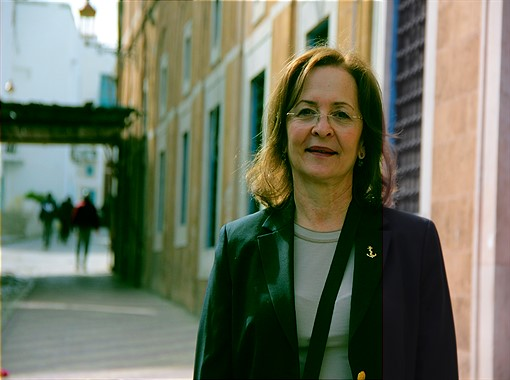
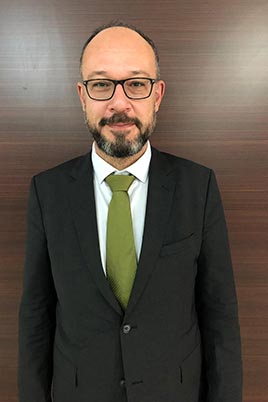
Assistant Professor Tusan Derya is affiliated with Başkent University in the College of Engineering , Industrial Engineering Department . Their research focuses on Operations Research Fuzzy Logic Modeling and Optimization with applications in routing problems and logistics. Their recent publications address variations of the Traveling Salesman Problem (2020-2024), Team Orienteering (2016), and Vehicle Routing (2011) using Mixed-Integer Programming and Fuzzy Logic approaches. They have contributed to Portfolio Optimization models (2024) and Autonomous Distribution Systems (2024).
Osman Darcan is an Associate Professor at Bogazici University in Istanbul, Turkey, with a verified institutional email osman.darcan@boun.edu.tr. His academic career spans over two decades with consistent research output in computational fields. Education Background: Undergraduate: Boğazici University, Computer Engineering Masters: Boğaziçi University, Computer Engineering Ph.D.: Boğaziçi University, Industrial Engineering His research focuses on practical applications of computational techniques across multiple domains. Darcan's work in Programming Techniques emphasizes object-oriented development frameworks and visualization tools for educational purposes. His Simulation research includes distributed systems and load balancing algorithms, while Artificial Intelligence applications target data mining for student profiling and e-commerce. The E-Learning strand features innovative tools for linear programming, geometric problem-solving, and programming education, demonstrating a strong commitment to pedagogical innovation through technology. Publication trends (2000-2012) reveal an evolution from foundational work in distributed simulation (2000-2006) toward applied data mining in education and e-commerce (2009-2012). His research consistently bridges theoretical computer science with practical educational and business applications, particularly in cluster analysis for student performance and agent-based modeling for market simulations. No scientific awards were documented in the source material. While specific advising records and grant details weren't provided, Darcan's publication pattern indicates supervision of students in data mining and simulation projects. His international conference presence (IBIMA, PICMET, World Conference on E-Learning) suggests active participation in global academic networks. The absence of lab/team mentions implies independent or small-group research operations focused on software tool development.
Belgin Ergenç Bostanoğlu is an Associate Professor in the Computer Engineering Department at Izmir Institute of Technology (Turkey). Her research focuses on query optimization in distributed databases, association rule mining, privacy-preserving data mining, and graph-based algorithms. She leads the Dworld research laboratory and has held academic and industry roles since the 1980s. Education: B.Sc. in Computer Engineering, Middle East Technical University (1983) M.Sc. in Computer Engineering, Izmir Institute of Technology (2002) Ph.D. in Computer Engineering, Paul Sabatier University, France (2008) Research Interests: Dynamic frequent itemset mining and hiding under multiple support thresholds Subgraph mining in evolving graphs Federated query processing over linked data Privacy-preserving techniques in distributed databases Medical NLP applications (e.g., TurkMedNLI dataset) Her recent work emphasizes large-scale graph analysis, medical NLP dataset development, and adaptive join operators for federated SPARQL queries. She has contributed to over 30 peer-reviewed publications and led projects like the TÜBİTAK ARDEB 3501 platform for dynamic frequent itemset mining. Teaching: Courses include Advanced Database Management Systems, Knowledge Discovery, and Privacy-Preserving Data Mining. Labs & Projects: Manages Dworld lab and coordinates projects such as 'Turkish Medical NLP Model Development' (BAP-funded) and the Behavioral Next Generation Wireless Networks COST Action.
Ethem Alpaydin is a Professor of Computer Science at Özyeğin University in Istanbul, Turkey. He is a prominent researcher in machine learning and artificial intelligence, with affiliations including membership in The Science Academy, Turkey, and Academia Europaea. He also holds a fellowship with the Asia-Pacific Artificial Intelligence Association. His research focuses on foundational aspects of machine learning, including statistical methods, neural networks, and deep learning. He has contributed to areas such as generative adversarial networks (GANs), decision pathways in neural networks, and distributed decision trees. His work bridges theoretical advancements with practical applications in domains like natural language processing and computer vision. Alpaydin has authored influential textbooks such as Introduction to Machine Learning and Maschinelles Lernen , which are widely used in academic curricula. His publications emphasize model interpretability, regularization techniques, and cross-lingual learning for languages like Turkish. Awards include recognition from leading scientific institutions for his contributions to AI and data science.
Cláudio Maia is a Lecturer and Integrated PhD Researcher at the Faculty of Engineering of the University of Porto, Portugal. He holds a B.Sc. and M.Sc. in Computer Engineering from the Polytechnic Institute of Porto and a Ph.D. in Electrical and Computer Engineering from the University of Porto (2018). His research focuses on real-time systems, including real-time operating systems, hypervisors, multiprocessor architectures, and scheduling theory. He has contributed to advancements in task scheduling for multiprocessor platforms, resource contention analysis, and WCRT (Worst-Case Response Time) methodologies. His work has been published in venues such as RTCSA, RTNS, and DATE, and includes a Best Paper award at ICESS 2021. He is affiliated with the CISTER Research Centre, where he collaborates on projects involving embedded systems, real-time critical CPS, and automotive systems integration. His recent research explores memory and bus contention analysis in real-time task models, with applications to multiprocessor systems and industrial automation. Education: Bachelor’s Degree (B.Sc.) in Computer Engineering, School of Engineering, Polytechnic Institute of Porto Master’s Degree (M.Sc.) in Computer Engineering, School of Engineering, Polytechnic Institute of Porto Ph.D. in Electrical and Computer Engineering, University of Porto (2018) Research Interests: Real-Time Scheduling (WCRT Analysis, Partitioned/Global Scheduling) Multiprocessor Architectures and Resource Contention Real-Time Operating Systems and Hypervisors Parallel Task Models (Fork-Join, 3-Phase Tasks) Embedded Systems and Cyber-Physical Systems (CPS) Awards: Best Paper Award at ICESS 2021 for 'Bus-Contention Aware WCRT Analysis' Key Contributions: Developed contention-aware scheduling models for real-time multiprocessor systems Advanced WCRT analysis techniques for 3-Phase Task Models Contributed to frameworks for automotive systems integration and CPS emulation Labs/Teams: Active member of the CISTER Research Centre, collaborating on industrial and academic projects in real-time systems and embedded computing.
Professor Ahmet Duran at Istanbul Technical University's Department of Mathematics specializes in applied mathematics with interdisciplinary applications in renewable energy systems, financial mathematics, and computational modeling. His research focuses on differential equations, numerical methods, and optimization techniques. Current projects involve EU collaborations on supercomputing (GPGPU for bio-fluid applications) and sparse direct solvers for linear equations. Recent publications emphasize wind/solar energy prediction, climate resilience, and financial portfolio optimization via principal component analysis. Technical expertise spans spectral analysis, fuzzy logic modeling, and high-performance computing using frameworks like SuperLU.
Mustafa Altun is a Professor at Istanbul Technical University in the Department of Electronics and Communication Engineering. With an h-index of 11 and 78 research outputs, he has established himself as a prominent researcher in electronics engineering and neural network hardware implementations. His research focuses on key areas including: Nano-crossbar Arrays and Switching Lattices Logic Synthesis and Boolean Function Realization Neural Network Hardware Implementation Low-voltage Circuit Design Fault Tolerant Computing Electrodeposition for Li-ion Battery Anodes Dr. Altun's recent work demonstrates a strong emphasis on energy-efficient hardware implementations of artificial neural networks using approximate arithmetic blocks to reduce power consumption while maintaining acceptable accuracy levels. His research on silicon anode electrodeposition has explored how artificial light-induced processes can increase silicon loading for improved battery performance. These dual research directions reflect his commitment to advancing both computing hardware and energy storage technologies. His scientific achievements have been recognized with prestigious awards including the ODTÜ Mustafa N. Parlar Research Incentive Award (2022), EU H2020 Success Award (2015), and the Young Scientist Award (2020). His work has been supported by multiple projects funded by TUBITAK and SRP. Dr. Altun has supervised 16 students according to available data and has led numerous research projects focusing on novel circuit architectures for efficient computing, particularly in neural networks and fault-tolerant systems. His laboratory work continues to push the boundaries of nano-crossbar array computing and its practical applications.
Ramazan Çağlar is an Associate Professor in the Department of Electrical Engineering at Istanbul Technical University, College of Engineering. His research focuses on modern power systems, including microgrids, renewable energy integration, reliability assessment, and intelligent control of distributed energy resources. He actively publishes in high-impact journals and leads research initiatives in smart grid technologies. Research Interests: His work spans electric power distribution, system reliability, microgrid dynamics, induction motors, and power transmission. He integrates advanced computational methods such as machine learning, Bayesian inference, and optimization algorithms to solve complex problems in energy systems. His recent focus includes fault prediction using drones, energy forecasting with neural networks, and optimal allocation of distributed generators. Recent Research Trends: Analysis of his latest publications (2022–2024) reveals a strong trend toward data-driven and AI-enhanced modeling in microgrids and renewable integration. He combines physical models with machine learning (e.g., neural ODEs, autoencoders, LSTMs) and applies multi-objective optimization techniques like multiverse optimization. His work increasingly emphasizes uncertainty quantification, real-time control, and sustainable energy solutions. Scientific Projects: Completed: Reliability Evaluation of Power Station Designed for DC-Fed Traction Systems in Light Rail Transit (2011–2021). Advising and Grants: He is currently supervising 14 theses in progress, indicating an active role in mentoring graduate students. While specific grant details are limited, his long-running project funded by ITU's BAP (Scientific Research Projects) suggests sustained research funding. His collaborations include international researchers, particularly in Africa and the Middle East. Labs and Research Teams: Though not explicitly named, his research activities suggest leadership in a power systems and smart grid laboratory at ITU, focusing on reliability, optimization, and AI applications in energy infrastructure.
Dr. Tolga Berber is an Assistant Professor at the Faculty of Science, Karadeniz Technical University . With a PhD in Computer Engineering from Dokuz Eylül University, his academic career spans over 20 years, including roles as Deputy Head of Department (2013–2023) and extensive research in Computer Sciences, Artificial Intelligence, and Medical Informatics .
Elvin Çoban serves as Associate Professor and Chair of the Industrial Engineering Department within Ozyegin University's Faculty of Engineering, specializing in optimization applications for healthcare systems, humanitarian logistics, and service operations. Her research bridges theoretical operations research with real-world implementation in critical infrastructure domains. Education Background: PhD in Operations Management and Manufacturing, Carnegie Mellon University (2012) MS in Operations Management and Manufacturing, Carnegie Mellon University (2010) MS in Industrial Engineering, Sabanci University (2008) BS in Manufacturing Systems Engineering, Sabanci University (2006) Dr. Çoban's research program focuses on developing mathematical models for complex decision-making under uncertainty, with significant contributions to disaster response logistics using drone technology and healthcare operations management. Her work integrates machine learning with combinatorial optimization to solve scheduling problems in medical facilities and vaccine distribution networks, while also exploring energy systems through electric vehicle charging infrastructure modeling. Current projects emphasize predictive analytics for post-disaster damage assessment and resource allocation during pandemics. Analysis of her 15 most recent publications (2019-2024) reveals three dominant research thrusts: (1) humanitarian logistics (35% of output), particularly drone routing for disaster assessment; (2) healthcare operations (50%), including operating room scheduling and vaccine distribution; and (3) energy systems (15%), focused on electric vehicle infrastructure optimization. Methodologically, her work combines stochastic programming, metaheuristics, and machine learning to address data-scarce environments. Research Funding and Advisory: Principal Investigator for TUBITAK 1001 project (2021-2024): Information Gathering and Damage Prediction for Post-Disaster Drone Assessment Researcher for TUBITAK 3501 project (2013-2016): Blood Supply Chain Optimization Consultant for TEA Networks (2018-2021) and TUBITAK 1507 workforce management project (2014-2016) Advises three graduate students: Kian Farajkhah (PhD candidate), Birce Adsanver (MSc 2020), and Gulsah Alper (MSc 2015) on optimization applications in disaster response and healthcare She leads an active research group at Ozyegin University that collaborates with government agencies and industry partners on projects involving real-time decision support systems. Current initiatives focus on integrating real-world constraints into optimization models for medical logistics and developing scalable algorithms for drone-based disaster assessment networks, with ongoing recruitment for TUBITAK-funded humanitarian logistics research positions.
Sümeyye KAYNAK serves as an Assistant Professor in the Department of Computer Engineering at Sakarya University's Faculty of Computer and Information Sciences. Her academic profile demonstrates interdisciplinary expertise bridging computer science with environmental sustainability and educational technology through computational modeling and data-driven solutions. Her educational foundation includes: Doctorate (2019) from Sakarya University Institute of Science/Computer and Information Engineering with thesis on solar energy potential modeling using 3D data Master's degree (2014) from same institution focusing on AI-based student counseling infrastructure Bachelor's degree (2012) in Computer Engineering from Sakarya University Faculty of Engineering Dr. KAYNAK's research integrates advanced computational methodologies across multiple domains. Her primary focus areas include Artificial Intelligence applications for resource allocation in cloud manufacturing (utilizing genetic algorithms and AHP), Environmental Informatics for flood modeling and hydrological analysis, and Sustainable Energy systems through solar potential estimation tools. Recent work demonstrates significant expansion into geospatial web components for earth science agencies and digital twin frameworks for urban infrastructure resilience, reflecting growing emphasis on climate change adaptation technologies. Publication analysis from 2012-2025 reveals a clear research evolution: early work (2012-2018) concentrated on educational AI systems and solar energy tools, while current output (2023-2025) prioritizes environmental applications with city-scale flood impact modeling, hydroinformatics, and open data frameworks. This trajectory shows increasing sophistication in real-time data analytics and cross-domain integration, particularly between manufacturing systems and environmental monitoring. No scientific awards were documented in the source materials. Regarding academic mentoring, the available documentation contains no references to graduate student supervision or grant-funded research projects. No laboratory affiliations or research team leadership roles were specified in the provided information.
Mete Özgür Falcıoğlu is a Professor at Beykent University's Faculty of Law, Department of Private Law, specializing in commercial and corporate law. His academic trajectory includes progression from Lecturer (1999) to Associate Professor (2019) and full Professor (2024) across institutions including İstanbul Bilgi University and Bahçeşehir University. Research Focus: Primary interests span commercial law frameworks, electronic commerce regulations, AI-legality interfaces, and intellectual property rights. Recent works critically examine AI governance, digital contract fairness, and corporate compliance in technology-driven markets. Teaching Portfolio (Selected): Corporate Law (1999-2025) Electronic Commerce Law (2003-2025) Negotiable Instruments Law (2018-2024) Intellectual Property Law (2018-2021) Professional Engagements: Member of Istanbul Bar Association (1998-present) with parallel roles as legal expert witness (2008-2019) and practicing advocate. Advising: Supervised 18 graduate theses (2011-2025) covering topics like shareholder rights, e-commerce contracts, and corporate governance.
Cihan Topal is an Associate Professor in the Department of Artificial Intelligence and Data Engineering at Istanbul Technical University, Faculty of Computer and Informatics. He has previously held academic positions at Eskişehir Technical University and Anadolu University in the Department of Electrical and Electronics Engineering. He also served as a Research Fellow at the University of Surrey's Centre for Vision, Speech and Signal Processing (CVSSP) from 2019 to 2020. His research interests span a wide range of topics in computer science and artificial intelligence, including Computer Vision , Image Processing , Deep Learning , Semantic Segmentation , Edge Detection , and Human-Computer Interaction . His work emphasizes both theoretical innovation and practical applications in industrial and medical imaging. His recent publications demonstrate a strong focus on semantic segmentation , defect detection , domain adaptation , and deepfake detection , often leveraging attention mechanisms and spectral methods. He has led research on GPU-accelerated image filtering and developed novel edge detection algorithms such as Edge Drawing. IEEE Member (2005–2017) Former R&D Director and Co-founder at Visea Innovative IT Technologies Industry experience at Siemens Corporate Research Dr. Topal has advised numerous graduate students on topics related to AI and image analysis. He is currently leading a research project on 3D semantic segmentation of medical images using a novel 2D convolution-based ESA architecture. His scholarly output includes over 60 publications with significant citations, reflecting an active and impactful research trajectory.
Assoc. Prof. Fulya Gökalp Yavuz is a faculty member at the Department of Statistics within the College of Science at Middle East Technical University (METU), Ankara, Turkey. Her academic career spans roles as a Research Assistant at Yildiz Technical University (2010-2019), Statistical Consultant at Purdue University (2008-2009), and Post-Doc Researcher in Statistics at Purdue University (2016-2017). Education: PhD in Statistics (Yildiz Technical University, 2015), M.S. in Statistics (Purdue University, 2010), B.S. in Statistics (Hacettepe University, 2006) Her research focuses intersect statistical theory and computational methods, including Linear Mixed Models, Robust Distributions, Parallel Programming, and Machine Learning. She also contributes to statistical applications in big data, cognitive neuroscience, and environmental science, with a strong emphasis on R programming and reproducible research practices. Her recent publications highlight advancements in parallel computing for kernel regression, hybrid modeling of neuroimaging data, and robust estimation techniques in multivariate regression. These works align with keywords in statistical computing, neuroscience, and data science. Scientific Awards: International Post Doctoral Research Fellowship (TUBITAK), Best Presentation awards at ICS 2017 and IC-SMHD-2016, Course Honorarium at ASA 2018 She actively engages in academic leadership as Project Coordinator for METU's Data Science Ecosystem (2019-2021) and collaborates on TUBITAK-funded research, including pandemic data modeling and cultural heritage regeneration projects.
Prof. Dr. Ece Olcay Gunes is a Professor at the Department of Electronics and Communication Engineering, Faculty of Electrical and Electronics, Istanbul Technical University. She specializes in analog circuit design, embedded systems, and biometric applications. Her research emphasizes signal flow diagrams, sensitivity analysis, and VHDL-based design methodologies. Her work spans multiple domains including stochastic computing optimization, embedded system implementations, and fault detection in electrical systems. Recent projects include AI-driven visual odometry for robotics and post-quantum cryptography algorithms for RISC-V processors. Prof. Gunes has advised over 20 graduate students, focusing on topics like multiple constant multiplications optimization, biometric gender classification, and FPGA-based elliptic curve cryptography. She leads research in agricultural robotics and IoT integration for smart farming, including autonomous robots for crop monitoring and seed classification.