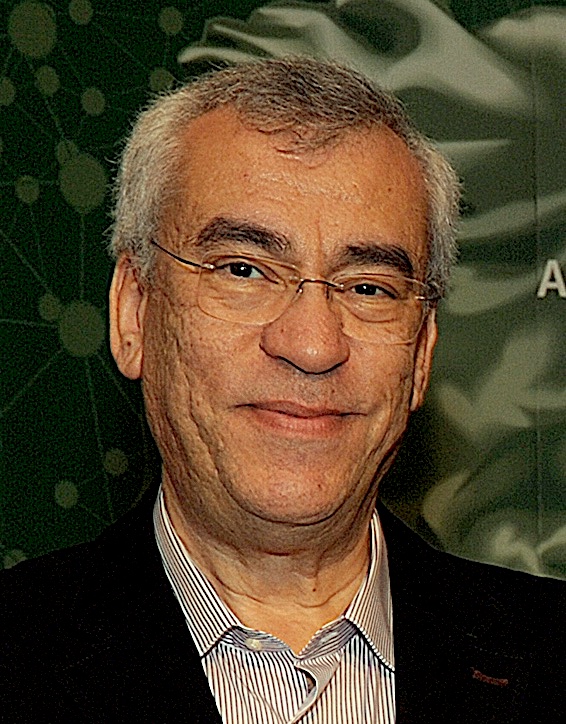
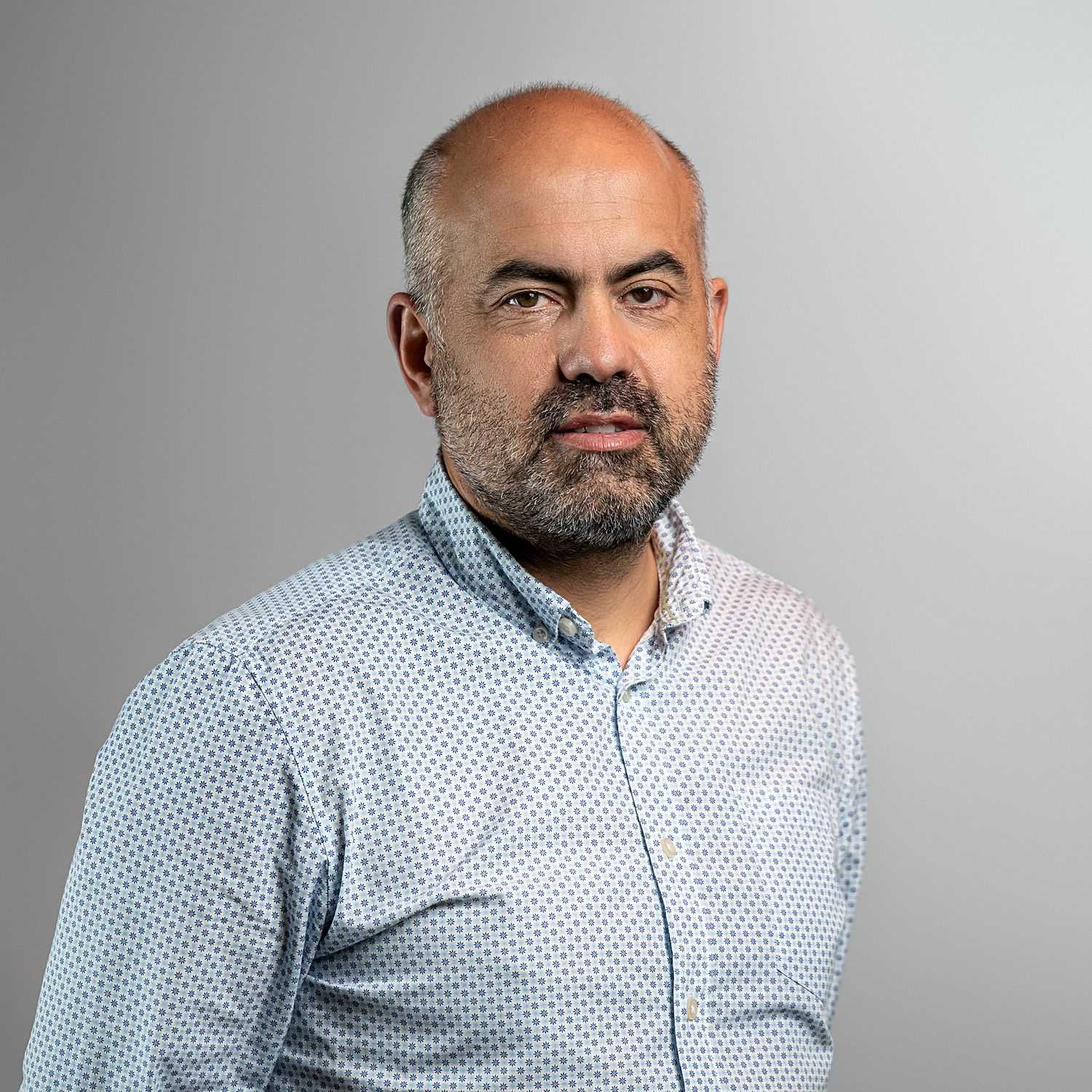
Juan Luis Aragón is a Full Professor of Computer Architecture at the University of Murcia. His research focuses on heterogeneous parallel systems, GPU architectures, and energy-efficient designs. He has been a visiting researcher at Princeton University multiple times and has advised 7 PhD theses. Research areas include GPU memory hierarchy optimization, warp scheduling techniques, and hardware-software co-design for efficient computing. Recent work explores tile rendering optimization and OS-level memory management improvements.
Carlos Molina Clemente is an Associate Professor of Computer Architecture at Rovira i Virgili University in Tarragona, Spain. He holds a M.Sc. in Computer Engineering (Universitat Politècnica de Catalunya, 1996) and a Ph.D. in Computer Science (UPC, 2005). His research focuses on Computer Architecture, Mobile/Sensor Networks, and Cloud Computing. He leads the Cloudlab research group and coordinates initiatives like GTDAWIN and BIOGEI. Key research areas include multicore scheduling, LoRaWAN protocols, LIDAR data analysis, and serverless computing. He has published over 50 articles in top-tier conferences/journals and supervised three doctoral theses. His work spans projects on cache architectures, real-time systems, and educational multicomputing solutions. Affiliations include the Department of Computer Engineering and Mathematics (DEIM) at URV, with offices at Campus Sescelades (Avinguda Països Catalans 26, Tarragona). Research highlights include contributions to non-uniform cache policies, predictive mobile network algorithms, and energy-efficient sensor networks.
Eliseo García García is a Professor at the University of Alcalá, affiliated with the Department of Automatic Control and Systems Engineering. He holds a Ph.D. from the University of Alcalá, awarded in 2005 for his thesis on computational electromagnetics. His primary research focuses on computational methods for electromagnetic analysis, including the development of efficient algorithms like the Characteristic Basis Function Method (CBFM) and hybrid techniques with the Multilevel Fast Multipole Algorithm (MLFMA). He is a core member of the GEC (Computational Electromagnetic Group), where he explores geophysical applications, antenna design, and high-frequency electromagnetic problems. His research interests bridge theoretical and applied electromagnetics, with particular emphasis on reducing computational costs in solving large-scale EM problems. Notable contributions include advancements in radar cross-section (RCS) computation, radome structure analysis, and geothermal exploration frameworks using hydrogeophysical methods. He has also published extensively on numerical techniques for antenna trajectory simulations and sparse matrix preconditioning. Eliseo’s work spans multiple disciplines, including aerospace engineering, environmental science, and software development, as evidenced by his contributions to Altair Feko 2023 updates. Despite no listed awards, his prolific publication record (over 70 articles from 2013–2024) underscores his active role in advancing computational electromagnetics and its interdisciplinary applications. His advising and grants section remains unreported, but his involvement in collaborative projects is implied through frequent co-authorships and institutional affiliations. He leads the GEC lab, focusing on cutting-edge computational tools and their practical deployment in real-world engineering challenges.
Max Rossmannek is a Researcher at IBM Research Europe - Zurich, specializing in the integration of quantum computing and high-performance computing (HPC) systems. His work focuses on developing hybrid quantum-classical algorithms that surpass the capabilities of individual paradigms. Education: Master of Science from ETH Zürich (2020), Dr. sc. nat. from University of Zürich and IBM Research Zürich Research Interests: Quantum Algorithms, Quantum Chemistry, HPC Integration, Computational Materials Science Notable Collaborations: Ivano Tavernelli (Quantum Computing), Antonio Córcoles (Quantum + HPC), Antonio Mezzacapo (Quantum-Centric Supercomputing)
Alvaro Ordoñez Iglesias is an Assistant Professor at the University of Santiago de Compostela, affiliated with the Higher Technical School of Engineering and the Department of Electronics and Computing. He is a member of the ARQCOMP research group (Computer Architecture) and the CiTIUS research center. His research focuses on high-performance computing techniques for processing multi/hyperspectral remote sensing images, leveraging GPUs, multi-core CPUs, and cluster systems. He holds a PhD in 'Research in Information Technologies' (2021) from the University of Santiago de Compostela, with a thesis titled Efficient Registration of Multi and Hyperspectral Remote Sensing Images on GPU , supervised by Dra. Dora Blanco Heras and Dr. Francisco Argüello Pedreira. Prior to his current role, he was a Juan de la Cierva postdoctoral researcher at the University of A Coruña. His work emphasizes developing accurate image registration algorithms through spectral information exploitation and parallel/distributed computing. Key contributions include the HSI-MSER and HSI-KAZE algorithms, GPU-accelerated registration frameworks, and open-source tools like HypeRvieW for hyperspectral data processing. His publications span topics such as real-time registration on heterogeneous platforms, feature-based vs. area-based methods, and anomaly detection in river basins. Research collaborations involve multi-device algorithm implementations and benchmarking across diverse hardware architectures.
Juan Carlos Pichel is an Associate Professor at the Center for Research in Intelligent Technologies (CITIUS) within the University of Santiago de Compostela (Spain). He holds a B.Sc. in Physics and a Ph.D. in Computer Science from the same university (2006). His research focuses on parallel and distributed computing, Big Data technologies, quantum computing, and optimization for emerging architectures. He has held visiting positions at University Carlos III de Madrid and University of Illinois at Urbana-Champaign, and worked at the Galicia Supercomputing Center. Education: B.Sc. Physics (USC, Spain), Ph.D. Computer Science (USC, 2006). Research interests include: HPC frameworks (IgnisHPC), quantum computing tools (NetQIR), bioinformatics software (BigSeqKit/VeryFastTree), and misinformation detection systems. His work emphasizes interdisciplinary applications of parallel computing in genomics, health informatics, and social media analysis. Notable contributions: MPI4All (universal MPI bindings), IgnisHPC (HPC-Big Data framework), and VeryFastTree (phylogeny tool). Active in projects like C3HS (health search systems) and HYBRIDS (AI for democratic practices). Labs/Teams: Leads the ARQCOMP research group in Computer Architecture. Collaborates with multidisciplinary teams in bioinformatics, quantum computing, and social media analytics.
Gregorio Bernabe Garcia is an Associate Professor in the Department of Computer Engineering and Technology at the University of Murcia's Faculty of Informatics. His research focuses on computer architecture, parallel systems, and medical video encoding optimization. He holds a PhD from the University of Murcia, awarded in 2004 for his thesis on Wavelet Transform optimization for medical video compression in single-processor architectures. Education: PhD in Computer Science (2004), Universidad de Murcia Research Interests: Specializes in computer architecture design, parallel computing systems, and signal processing techniques for multimedia applications. His work emphasizes efficient implementation of Wavelet Transform algorithms in constrained computational environments. Contact: gbernabe@um.es
Dominique Ginhac is a Professor of Electrical Engineering at the Laboratory of Electronics, Informatics and Image (Le2i UMR 6306) at the University of Burgundy in Dijon, France. He joined Le2i as an assistant professor in 2000 and was promoted to professor in 2009, also becoming head of the Sensors & Hardware Architectures team. In 2010, he became head of the Electronic department of Le2i, and in 2011, he was appointed Deputy Director of Le2i, overseeing approximately 200 people across three scientific departments: Computer Sciences, Vision, and Electronic. Ginhac holds a Master's Degree in Engineering from Polytech Clermont-Fd (1995) and a PhD in Computer Vision from Blaise Pascal University (1999). In 2008, he received his Habilitation qualification (Accreditation to supervise research) from the University of Burgundy. From 2007 to 2009, he was a visiting professor at Université Libre de Bruxelles in the Consciousness, Cognition & Computation lab, expanding his expertise into cognitive science applications for imaging systems. His research focuses on the development of smart imaging technology where sensing and processing are integrated as closely as possible to achieve low cost, low power, and high processing capabilities. His work spans hardware design of smart vision systems, implementation of real-time image processing applications, VLSI CMOS imaging technology, and embedded image processing on DSP/FPGA platforms. His research activities represent the crossroads between algorithmic and hardware solutions dedicated to real-time embedded image processing applications. An analysis of Ginhac's recent publications reveals a strong focus on smart camera and sensor development, particularly in high dynamic range imaging, single-photon detection, and configurable hardware accelerators. His work shows a clear trajectory from fundamental VLSI image sensor design toward increasingly sophisticated integrated systems combining sensing, processing, and specialized applications in medical imaging and real-time vision. His interdisciplinary approach bridges electronics, computer vision, and application-specific system design. Throughout his career, Ginhac has supervised 8 PhD students and published 20 papers in international peer-reviewed journals, 3 book chapters, and more than 50 conference papers. His research has resulted in several significant projects including VerIDIS (Vertically Integrated Digital Image Sensor), CAPTIvA (Asynchronous Photon-counTing Image sensor Architecture), HDR-ARtiSt (High Dynamic Range Adaptive Real-time Smart camera), and ASTICO (Assistance Textile Cognitive). Ginhac leads the Electronic department at Le2i, which is part of a research laboratory under the supervision of the University of Burgundy and the CNRS. His work involves close collaboration with industry partners and has resulted in practical implementations of smart imaging systems for applications ranging from medical monitoring to automotive vision systems. His current research continues to push the boundaries of integrated vision systems, with particular emphasis on 3D-stacked image sensors and photon-counting technologies.
Constantino Vázquez Blanco is a Researcher in Grid & Virtualization Technology at the Distributed Systems Architecture Group, affiliated with the Department of Computer Architecture and Automatic Control at Universidad Complutense de Madrid. He holds a PhD in Distributed Computing Architecture and has extensive experience in Grid computing, cloud infrastructure, and open-source projects like OpenNebula and GridWay. His work focuses on distributed systems, virtualization, and resource management. He has contributed to major EU projects such as RESERVOIR and BEinGRID, advancing cloud and grid technologies. Education: M.E. in Computer Science (2002, UCM), MSc in Computing & Internet Systems (2003, King's College London), PhD in Distributed Computing Architecture (2012, UCM). Professional experience includes roles at Altien Solutions, British Telecom, and leadership in academic research projects. Research interests include Grid federation, cloud computing, utility computing, and distributed virtualization management. He has published on grid benchmarking, workflow execution, and middleware integration. His work emphasizes scalable resource provisioning and interoperability in distributed systems. Grants and Projects: Involved in EU-funded initiatives like RESERVOIR (cloud computing), BEinGRID (Grid experiments), and OpenNebula development. His contributions span academic-industry collaborations and open-source tool development. Contact: Located at the Facultad de Informática in Madrid, reachable via email tinova@fdi.ucm.es.
Álvaro Hernández Alonso is a Full Professor in the Department of Electronics at the University of Alcalá (UAH). He previously served as Secretary of the Electronics Department and coordinated the GEINTRA research group (2021–2023), which includes 24 researchers and over 25 active projects. His research focuses on mobile robotics, multisensor integration, ultrasonic systems, NILM techniques, FPGA implementations, and electronic technologies for transport. Education: PhD in Electronics and Systems (University Blaise Pascal & UAH) Electronics Engineering Degree (UAH) Research interests include positioning systems (infrared, ultrasonic, visible light), energy monitoring for assisted living, and embedded hardware architectures. He has secured €1.9M in funding (public and private) over the past decade, leading 4 projects as Principal Investigator. His work has produced 41 indexed journal papers (25 Q1), 6 patents, and 65 conference contributions. Awards: Best Thesis Awards at UAH for two doctoral students under his supervision. He has advised 30+ student theses and 9 doctoral dissertations, many in international co-supervision programs. Funding highlights: 19 public projects (€900k total) and 10 private projects (€1.1M total). His research has achieved 4 consecutive positive evaluations (1997–2020) from Spain's National Research Evaluation Commission.
Jose Enrique Adsuara Fuster is a Researcher at the Department of Computer Science and Artificial Intelligence within the School of Engineering at Universitat de Valencia. He earned his PhD in 2017 with the thesis 'Improved numerical methods for elliptic problems in astrophysics' supervised by Dr. Miguel-Ángel Aloy Toras and Dr. Pablo Cerdá-Durán. He belongs to the ERI Image Processing Laboratory (IPL) and focuses on numerical methods for astrophysical simulations. His research bridges computational mathematics and astrophysics, specializing in iterative solvers like the Scheduled Relaxation Jacobi method and their equivalence to classical algorithms. His work emphasizes improving convergence rates for elliptic PDEs relevant to astrophysical phenomena. No scientific awards or student supervision details are listed in available sources. The three articles since 2016 show a consistent focus on numerical analysis for astrophysical applications, particularly elliptic PDEs and iterative methods. His publications appear in computational physics journals, with collaborations within the IPL group.
Fernando Rafael Pardo Seco is a Professor at the Department of Electronics and Computing, affiliated with the Higher Technical School of Engineering at the University of Santiago de Compostela. He earned his PhD in 2008 with a thesis titled Software-hardware FPGA-Based System for the solution of the 3D heat equation applications on the non-destructive evaluation of minefields , supervised by Dr. Diego Cabello Ferrer and Dr. Marco Balsi. His research focuses on FPGA-based systems, CMOS architectures, thermal modeling, image processing, and non-destructive evaluation techniques. His academic contributions span engineering education innovation, including methodologies like cooperative learning and e-learning integration. His technological work emphasizes embedded systems, hardware acceleration for numerical simulations, and safety-critical applications such as landmine detection through thermal analysis. Recent publications highlight advancements in hyperdimensional computing architectures, 3D image processing, and thermal simulation tools. His work bridges hardware-software co-design principles with real-world applications in geophysics, security systems, and industrial engineering education.
Ahmed Bouajjani is a Professor at Paris Diderot University (Univ. Paris 7) and a Senior member of the Institut Universitaire de France . He leads the Automata, Structures, and Verification (ASV) pole of the IRIF laboratory and is a member of the Modeling and Verification team. His work focuses on formal methods, program verification, and automata theory, particularly for concurrent and infinite-state systems. Research Interests : Formal specification and verification, program verification, concurrency, model-checking algorithms, verification of infinite-state systems, automata, and logics. Teaching : He teaches courses such as Introduction to Artificial Intelligence and Game Theory , Formal Methods for Verifying Systems , and Algorithmic Program Verification at the university. Scientific Contributions : His recent articles address weak memory models, robustness in distributed systems, and inter-procedural analysis of list-manipulating programs. Keywords include Computer Science , Formal Verification , and Concurrency . Awards : He is a Senior member of the Institut Universitaire de France , a prestigious academic recognition. Labs and Teams : He is affiliated with the IRIF laboratory and its Modeling and Verification team, contributing to collaborative research in automata and verification.
Adeline De Montlaur is an Associate Professor at the Universitat Politècnica de Catalunya (UPC) within the School of Telecommunications and Aerospace Engineering of Castelldefels (EETAC), affiliated with the Department of Physics. She leads research in numerical methods for fluid dynamics and their applications in renewable energy systems and air traffic management. Her academic career includes a PhD in Aerospace Science and Technology (UPC, 2009), an M.S. in Mechanical and Aerospace Engineering (SUNY Buffalo, 2003), and an Engineering degree from ENSICA (France, 2002). Roles: Academic Staff, Researcher at LACÀN Center for Numerical Methods. Research Interests: High-order CFD methods, wind energy optimization, multiphase flows, air traffic flow management, and planetary atmospheric dynamics. Her work bridges computational methodologies with practical applications, such as optimizing wind turbine efficiency using flow control techniques and analyzing thermally-driven winds on Mars. She has contributed to over 50 publications and projects like the European-funded WOW-CONTROL initiative for turbine optimization. Awards include the 2023 Best Paper Award in Atmospheric Sciences. Key projects include wind resource assessment near hydroelectric dams, delay management strategies in air traffic control, and analytical models for aviation emissions. Adeline collaborates with global institutions and industry partners to advance sustainable energy and transport systems.
Antonio García Loureiro is a Full Professor in the Department of Electronics at the University of Santiago de Compostela (USC), Spain. His research focuses on high-performance computing applications in semiconductor device simulation, photovoltaics, and wireless power transmission. He leads multiple research projects including rePowerSiC and HiPerHC2DA, and has extensive collaborations with international institutions. Dr. García Loureiro received his MSc in Electronic Physics and PhD in Electronics and Computer Science from the University of Santiago de Compostela in 1994 and 1999, respectively. He has been a visiting researcher at the Edinburgh Parallel Computing Centre (UK) and the Device Modeling Group at the University of Glasgow (UK). His primary research interests span high-performance computing for semiconductor device simulation, photovoltaic systems, and wireless power transmission technologies. He specializes in parallelization and optimization of numerical simulators for semiconductor devices, transistors, and solar cells. His work bridges the gap between computational methods and practical electronic device design, with applications in energy harvesting and conversion systems. Recent publications reveal a strong trend toward machine learning applications in semiconductor device modeling and optimization of laser power converters. His research group has made significant contributions to III-V nitride-based optical photovoltaic converters, silicon carbide systems for space applications, and high-efficiency photovoltaic technologies. The work spans from fundamental semiconductor physics to practical engineering applications in wireless power transmission. Dr. García Loureiro has received support for numerous research projects including: rePowerSiC: High-Efficiency High-Power Laser Beaming In-Space Systems Based On Sic (2024-2028) HiPerHC2DA: High Performance, Heterogeneous and Cloud Computing for Demanding Applications (2023-2026) Ultra-Efficient Micro-Scale New Generation Hybrid Concentrator Photovoltaic Systems (2020-2023) Network on variability in Nanoelectronics (2014-2016) He leads a research team focused on semiconductor device simulation and photovoltaic technologies, with strong connections to international research groups working on high-performance computing applications in electronics. His laboratory utilizes advanced computational resources for semiconductor device modeling and optimization.