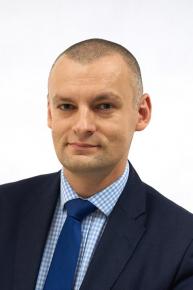
Łukasz Machura is a Professor at the University of Silesia, specializing in statistical physics and nonlinear dynamics. His research focuses on stochastic processes, quantum systems, and mesoscopic phenomena, particularly in Brownian motors and molecular motors. He investigates transport phenomena in mesoscopic systems, quantum open systems, and signal processing in complex systems. His work often employs advanced computational methods like GPU-accelerated Monte Carlo simulations. Key research areas include: Stochastic transport in mesoscopic devices Nonlinear dynamics in Josephson junctions Quantum fluctuations in nanoscale systems Signal analysis for biomedical applications His publications demonstrate expertise in quantum Smoluchowski regimes, absolute negative mobility, and energy conversion in superconducting systems. Recent studies address biharmonic-driven systems and multifractal analysis of biological signals. He contributes to both theoretical and computational physics, bridging fundamental research with applications in nanoelectronics and medical diagnostics.
Paweł Malczyk is an Associate Professor and Head of the Department of Theory of Machines and Robots at the Faculty of Power and Aeronautical Engineering, Warsaw University of Technology. He holds a D.Sc. (habilitation), Ph.D., and M.Eng. His research focuses on multibody systems, optimal control, data-driven modeling, and high-performance computing. He leads the division and oversees research in kinematics, dynamics, and control of complex systems. Key research interests include multibody dynamics simulation, optimal control methods, parallel computing, and applications of machine learning in system modeling. His work emphasizes algorithm development for efficient dynamics simulations and real-time control. Selected articles span topics like neural-network-based inverse dynamics, divide-and-conquer algorithms, and FPGA acceleration. His contributions address both theoretical advancements and practical implementations in robotics and mechanical systems. Malczyk teaches courses on automation, control systems, and multibody dynamics. His lab focuses on computational mechanics and real-time systems, with ongoing projects in parallel algorithms and data-driven control strategies.
Prof. Olgierd Unold is a faculty member at the Faculty of Information and Communication Technology at Wrocław University of Science and Technology, where he is affiliated with the Department of Computer Engineering. He holds the academic rank of Professor and conducts research in machine learning, computational intelligence, and bioinformatics. Research Interests: Machine Learning, particularly Grammatical Inference Computational Intelligence: Evolutionary Algorithms, Learning Classifier Systems, Fuzzy Rule Systems Bioinformatics and DNA Computing Natural Language Processing and Pattern Recognition His recent publications demonstrate a strong focus on applying AI techniques to bioinformatics, log analysis, formal language inference, and optimization problems. The work spans from theoretical algorithm development to practical applications in software reliability and biological data classification. Scientific Awards: No awards listed in the provided text. Advising and Grants: Prof. Unold has supervised or collaborated with numerous researchers and students, including Wojciech Wieczorek, Norbert Kozłowski, and Łukasz Śmierzchała, on projects involving classifier systems, grammatical inference, and bioinformatics. While specific grants are not mentioned, his consistent publication output suggests active research funding. Labs and Research Teams: He is part of the research ecosystem within the Department of Computer Engineering, contributing to projects in AI, machine learning, and computational intelligence, likely involving student-led and collaborative research initiatives.
Maciej Walczyński, PhD, is an academic staff member at the Faculty of Information and Communication Technology at Wrocław University of Science and Technology. He is affiliated with the Department of Applied Informatics, where he contributes to research and teaching. His office is located in building C-5, room 702, and he holds regular office hours on Wednesdays from 11:00 to 15:00. His research interests lie at the intersection of applied informatics and computer engineering, with a strong focus on optimization algorithms, signal processing, and parallel computing. Specific areas include drone path planning, echo cancellation in communication systems, and adaptive algorithms for real-time applications. The recent publications highlight a consistent trend in solving practical engineering problems using computational intelligence. His work involves the application of the Traveling Salesman Problem to UAV navigation under wind variability, parallel optimization for drone inspections in construction, and the development of parallel LMS-based algorithms for echo cancellation—showcasing expertise in algorithm design and high-performance computing. While no scientific awards are listed in the provided text, his collaborative research output indicates active participation in academic projects. There is no public information available about students he may have advised or any grants he has led. Similarly, details about formal education or professional development are not included in the source material. Maciej Walczyński is involved in research activities within the Department of Applied Informatics, likely collaborating with colleagues such as W. Bożejko and A. Dobrucki. Although no named laboratory or research group is mentioned, his work suggests engagement in applied algorithm development for industrial and telecommunications applications.
Professor Mieczysław Wodecki is affiliated with the Faculty of Information and Communication Technology at Wrocław University of Science and Technology, where he is a member of the Department of Telecommunications and Teleinformatics. He holds a DSc and PhD and is actively engaged in research and teaching. Research Interests: His work centers on discrete optimization, scheduling problems, and methods for solving NP-hard problems. He applies parallel computing and probabilistic models to challenges in project management and automation in construction. His research bridges theoretical computer science with industrial engineering applications, particularly in manufacturing and production systems. The recent publications highlight a strong focus on cyclic job shop and flow shop scheduling, with an emphasis on parallel algorithms and metaheuristics. These works contribute to the optimization of manufacturing processes, especially in cyclic and flexible production environments. Scientific Contributions: While no specific awards are listed, his extensive publication record in reputable journals such as Computers & Industrial Engineering and Bulletin of the Polish Academy of Sciences: Technical Sciences reflects sustained scholarly impact. Advising and Grants: Information on students advised or research grants received is not available in the provided text. Laboratories and Teams: He collaborates closely with researchers including W. Bożejko, J. Pempera, and A. Gnatowski, contributing to a research group focused on discrete systems and scheduling optimization. His work appears in special issues dedicated to discrete systems, indicating active participation in thematic research initiatives.
Beata Agnieszka Dmitruk is an Assistant Professor in the Department of Software Systems Informatics at the Faculty of Mathematics, Physics and Computer Science, Maria Curie-Skłodowska University. Her research focuses on computer and information sciences, with a strong emphasis on parallel computing and algorithm optimization. Research Areas: OpenMP, Vectorization, Computer Systems, Parallel Computing, Accuracy, Parallel Algorithms, Tridiagonal, OpenACC, Summation, Portability, SIMD Intrinsics, Hybrid Systems, Signal Processing, SIMD Extensions Her academic achievements include 5 publications, with a Google Scholar h-index of 3, Scopus h-index of 1, and Web of Science h-index of 2. Additionally, she has accumulated a total impact factor (IF) of 1.5, a total SNIP of 2.664, and a total CiteScore of 13.5. Dr. Dmitruk offers consultations every Wednesday from 11:00 to 13:00 at Building D, Room 306 of the Institute of Computer Science, and can be reached via her email at beata.dmitruk@mail.umcs.pl.
Dominik Żelazny is a researcher at the Faculty of Information and Communication Technology, Department of Computer Engineering, Wrocław University of Science and Technology. He focuses on scheduling algorithms and multi-objective optimization using evolutionary computation methods. Current position: Researcher Primary affiliation: Department of Computer Engineering Research interests include: Development of evolutionary algorithms for scheduling problems Multi-criteria and multi-objective optimization GPU-accelerated computing using CUDA Parallel and distributed algorithm design Industrial applications of operational research
Tadeusz Tomczak is a faculty member at the Faculty of Information and Communication Technology , Wrocław University of Science and Technology , within the Department of Computer Engineering . His academic rank is Professor . Research Focus: Fast computational hardware, massively-parallel computing, and residue number systems. Expertise: GPU acceleration, fluid dynamics simulations, sparse geometries, and numerical methods. Recent publications highlight his work on Navier-Stokes solvers , Lattice-Boltzmann methods , and residue number systems , with applications in fluid dynamics, biomedical engineering, and high-performance computing. His research spans hardware acceleration, algorithm optimization, and computational modeling on GPUs.
Mariusz Fraś is a researcher affiliated with the Faculty of Information and Communication Technology at Wrocław University of Science and Technology. He works within the Department of Computer Science and Systems Engineering , focusing on computational systems' performance and cloud-based architectures. His research spans database optimization, parallel processing, and mobile application frameworks. Research interests include: Computational cloud scalability and cost optimization Database application performance analysis Parallel processing frameworks Mobile sensor data processing Web content delivery efficiency His publications demonstrate expertise in cloud computing trends, with 10 peer-reviewed works since 2014. Notable collaborations include researchers like Piotr Karwaczyński and Bogdan Marczuk. Current research likely continues exploring hybrid cloud environments and software performance metrics. Contact: mariusz.fras@pwr.edu.pl , Room 301, Building C-3, Wrocław University of Science and Technology.
Dr. Kateryna Czerniachowska is a Lecturer at the Department of Process Management, Wrocław University of Economics. She specializes in logistics optimization, heuristic algorithms, and supply chain management. Her work focuses on solving complex problems such as order-picking efficiency, shelf space allocation, and inventory distribution in retail and warehouse systems. She is fluent in English, Polish, Russian, and Ukrainian. Her research emphasizes mathematical modeling for retail networks and warehouse layouts, incorporating innovative heuristics like Flower Cutting and Mushroom Picking algorithms. Recent studies address sequence-dependent constraints in conveyor systems and multi-axial product categorization. She actively collaborates with industry to apply these methods in practical settings. Her publications span optimization frameworks for space allocation, scheduling TV advertisements via genetic algorithms, and predicting public transportation delays using machine learning. She maintains active profiles on ResearchGate and ORCID. Consultations are available via Microsoft Teams upon prior arrangement via email. She contributes to pedagogical activities focused on operational research and logistics systems design.
Bartosz Wiland is an Associate Professor at the Faculty of English, Adam Mickiewicz University in Poznań, Poland, where he is affiliated with the Department of English-Polish Comparative Linguistics. He is actively engaged in research and teaching in theoretical linguistics, with a specialization in comparative syntax and morphology of Slavic languages and nanosyntax. Education: B.A. in English Linguistics, Adam Mickiewicz University Poznań, 2003 M.A. in English Linguistics, Adam Mickiewicz University Poznań, 2005 Ph.D. in Linguistics (cum laude), Adam Mickiewicz University Poznań, 2009 Habilitation in Linguistics (cum laude), Adam Mickiewicz University Poznań, 2020 His research interests lie at the intersection of syntactic theory and morphological structure, particularly focusing on Slavic languages through the lens of nanosyntax. He investigates phenomena such as prefix stacking, remnant movement, complementizer syncretism, and the syntax-semantics interface, contributing to theoretical debates on lexicalization and functional hierarchy. His teaching portfolio includes graduate and undergraduate courses in generative linguistics, syntax, morphology, and academic writing. The recent publications reflect a sustained focus on nanosyntax and Slavic linguistic structures, with recurring themes including syntactic movement, morphological decomposition, and cross-linguistic comparison. His work frequently appears in top-tier journals and edited volumes, demonstrating consistent scholarly output and international recognition. Scientific Awards and Honors: Fulbright Junior Grant at MIT, 2007–2008 Władysław Kuraszkiewicz Scholarship, 2008–2009 Prime Minister's Award for Outstanding Ph.D. Dissertation, 2010 Start Stipend, Foundation for Polish Science, 2011 Fellow, Young Academy of Europe, elected 2015 Bartosz Wiland has supervised B.A. and M.A. students and welcomes prospective M.A. and Ph.D. candidates in syntax, morphology, and nanosyntax. He has served on the scientific advisory board of the Van Riemsdijk Foundation since 2022 and has organized major conferences such as the 41st Poznań Linguistic Meeting and the Workshop on Prefixes and Suffixes at the 21st International Congress of Linguists. He is also the organizer of several student and specialist workshops, reflecting strong academic leadership and mentorship. His research has been presented at leading international venues including NELS, WCCFL, FASL, and SLE.
Krzysztof Walkowiak is a Professor at the Faculty of Computer Science and Telecommunications, Wrocław University of Science and Technology (PWr), where he also serves as the Dean of the Doctoral School. He leads the Computer Networks Team (ZSK) and is actively involved in multiple research projects, including Dark-Box Optimization and evolutionary methods for multi-criteria network design. A Senior Member of IEEE and IEEE ComSoc, he contributes to academic governance as a member of the Polish Academy of Sciences’ Committee on Electronics and Telecommunications. PhD in Computer Science (2000, with distinction) Habilitation in Computer Science (2008) Professor of Technical Sciences (2017) Dean of the Doctoral School, PWr (since 2020) Senior Member, IEEE and IEEE Communications Society Member, Committee on Electronics and Telecommunications, Polish Academy of Sciences His research spans computer network optimization, machine learning in networks, evolutionary algorithms, survivable optical networks, and intelligent computational techniques . He has pioneered the integration of AI methods in teleinformatics and leads initiatives in intent-based and cognitive networking. His work emphasizes multi-layer, application-aware network design and distributed processing systems. The 15 most recent publications reflect a strong trend in optimization under uncertainty, AI-driven networking, and metaheuristic algorithm development . There is a clear focus on survivability, scalability, and automation in modern network architectures, with increasing attention to edge intelligence via TinyML and cognitive systems. His recent work also addresses internationalization and pedagogical innovation in doctoral education. Fabio Neri Best Paper Award 2014 (Elsevier Journal of Optical Switching and Networking) Best Paper Award, DRCN2009 (Washington, USA) Best Paper Award, RNDM2015 (Munich, Germany) Medal of the National Education Commission (2011) Scientific Scholarship, Wrocław University of Science and Technology (2017) Star of Internationalization 2024 – Teaching Star Professor Walkowiak has supervised 10 completed PhD theses and currently mentors 5 doctoral students. He has led or managed 13 research projects funded by NCN (including 4 OPUS grants), EU, NAWA, and national agencies. His grant leadership includes the NAWA InterDocSchool project (2021–2023) and the Unite! Doctoral School curriculum development. He has reviewed over 300 journal submissions and served as session chair at 22 international conferences. He leads several research teams: Computer Networks Team (ZSK), Machine Learning Team, Advanced Data Analysis Methods Team, Metaheuristics Team, and Teaching Team . He has developed innovative educational programs such as the Research Skills course and Recent Research Trends , promoting international collaboration and doctoral training. He championed the transition to English-language instruction in the Doctoral School and promotes internationalization as a 'team sport' across institutional levels.
Maciej Smołka, PhD hab., serves as a University Professor at the Institute of Computer Science within the Faculty of Computer Science at AGH University of Science and Technology in Kraków, Poland. His office is located at D-17, Kawiory 21, room 2.25, and he actively contributes to academic governance through the Computer Science Discipline Council and College of the Faculty of Computer Science. His research centers on computational optimization, specializing in metaheuristics, evolutionary algorithms, and inverse problems. He addresses complex challenges in non-convex optimization, time-delay systems, and stabilization of forward solvers, with significant contributions to hierarchical memetic strategies including the pyHMS Python library. His interdisciplinary work extends to Music Informatics, where he investigates urban soundscapes as carriers of local identity and applies computational methods to musical harmonization. Recent publications (2022-2025) demonstrate advancements in auto-configured metaheuristics for engineering optimization, socio-cognitive approaches to time-delay control, and LLM-generated algorithm design. His work bridges computational intelligence with practical applications in thermal systems and Gaussian mixture modeling, while maintaining a parallel research thread on musicology and urban acoustic ecology.
Dr. Aleksander Smywiński-Pohl is an Assistant Professor at the Institute of Computer Science , Faculty of Computer Science, AGH University of Science and Technology in Kraków, Poland. He holds a PhD in Computer Science from AGH (2015) for his thesis "Automatic Information Extraction from Polish Texts" and a parallel degree in Philosophy from Jagiellonian University. His academic career includes teaching at Jagiellonian University (2007-2016) and AGH (since 2008), where he currently instructs courses in Artificial Intelligence and Natural Language Processing. His research focuses on Natural Language Processing with specialization in Polish language technologies, formal ontologies , legal text analysis, and cognitive science. Key areas include: Machine learning for low-resource languages Legal document processing (amendments, argument retrieval) Neural models for translation and classification Semantic web technologies He has supervised over 30 student theses in NLP/ML applications and contributes to national NLP evaluations (PolEval).
Maciej Woźniak serves as a university professor at the Institute of Computer Science within the Faculty of Computer Science at AGH University of Science and Technology in Kraków, actively contributing to research and teaching staff while participating in the Computer Science Discipline Council and College of the Faculty. His office is located at D-17, ul. Kawiory 21, III, 4.58, with primary contact via macwozni@agh.edu.pl. His research spans computational mathematics and high-performance computing, specializing in parallel algorithms for numerical simulations including isogeometric analysis, finite element methods, and multi-frontal solvers. Key applications address environmental challenges like hail suppression and urban smog reduction, alongside biomedical modeling of tumor growth and airborne pathogen dispersion. Methodological innovations focus on GPU acceleration, shared-memory architectures, and efficient integration techniques for partial differential equations. Analysis of his 2019-2024 publications reveals consistent advancement in parallel computational frameworks for environmental and biomedical applications, demonstrating interdisciplinary impact through experimental validation of hail cannons, smog reduction technologies, and pathogen dispersion modeling during the COVID-19 pandemic. His work bridges theoretical algorithm development with real-world problem solving across physics, engineering, and life sciences. Scientific Awards: No specific awards were documented in the provided sources. Student advising, research grants, laboratory affiliations, and educational background details beyond his PhD, DSc, and Eng. titles remain unspecified in the available materials, though his extensive publication record suggests active mentorship and collaborative research leadership.