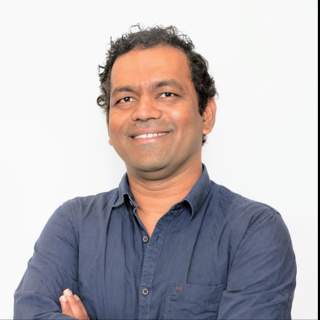
Ravindra Shinde is a Research Scientist at the University of Twente , Netherlands, affiliated with the Computational Chemical Physics group under the Faculty of Science and Technology . He is also the founder of The Science Dev , a tech and research blog. Education : Ph.D. in Physics (2014) and M.Sc. in Physics (2009) from IIT Bombay, India. His research spans Exascale Scientific Computing , Quantum Chemistry , Time-Dependent DFT , and Topological Materials . He specializes in method development for quantum mechanical simulations and code modernization for high-performance computing . Recent publications focus on Exascale Computing challenges , Quantum Monte Carlo accuracy, and machine learning integration in force field modeling. Notable awards include SERB Postdoctoral Fellowship and multiple Best Presentation Awards . Scientific Awards : Best Poster Award, UC Riverside (2019) Best Presentation Awards, SERB 2018 & IISc 2018 National Postdoctoral Fellowship, India (2016-2018) All India GATE Physics Rank 73 (2009)
Martin Dijkstra is a Professor at the Computer Vision & Data Science professorship & knowledge centre at NHL Stenden University of Applied Sciences. His research focuses on autonomous control of UAVs, software architecture for autonomous systems, and accelerating computer vision algorithms using multi-threading and GPGPU techniques. He graduated from the same institution with a degree in Information Technology, where his internship and graduation project led to foundational work on the Twirre architecture for autonomous drones. His professional career began immediately after graduation as a project engineer at the Computer Vision knowledge centre, where he contributed to the development of UAV software systems. Current efforts emphasize refining the Twirre architecture while exploring parallel computing methods for computer vision acceleration, though the latter is temporarily paused due to resource constraints. Martin’s work bridges theoretical research and practical implementation, with a focus on real-world applications of autonomous systems. His affiliation with the Computer Vision knowledge centre underscores his role in both academic and applied research within the field.
Prof. Derek Karssenberg is a Professor of Computational Geography at Utrecht University's Department of Physical Geography within the Faculty of Geosciences. His research focuses on spatio-temporal modeling of Earth surface systems, including hydrology, geomorphology, ecology, and environmental health. He develops software frameworks like PCRaster, LUE, and Campo to enhance model scalability and usability. Current roles include coordinating the Computational Geography group and leading the AI & Sustainability Lab. His work integrates geocomputation with applied data science, addressing sustainability challenges and health-environment linkages. Research interests emphasize model development for complex systems, such as air pollution exposure assessment, land-use change impacts, and global hydrological modeling. Collaborations span environmental epidemiology, remote sensing, and machine learning. He co-initiated the Applied Data Science Master's program and innovates teaching methods using blended learning. Publications (2024–2020) highlight advancements in air pollution modeling, streamflow prediction via machine learning, and scalable hydrological frameworks. Activities include editorial roles for Environmental Modelling & Software and steering committees for Utrecht's Applied Data Science initiatives.
Andreas W. Reimer is a University Researcher at Eindhoven University of Technology's School of Mathematics and Computer Science, Department of Applied Geometric Algorithms. His work spans geometric algorithms, cartographic generalization, and biomedical data analysis. Institution: Eindhoven University of Technology School: Mathematics and Computer Science Department: Applied Geometric Algorithms Role: Researcher Research Interests : Dr. Reimer focuses on harmonious simplification of isolines, geometric similarity metrics, and scalable topographic modeling. His work bridges computational geometry, geographic information systems, and biomedical applications for stem cell research. Key themes include spatial data optimization, parallel algorithm implementation, and feature labeling in maps. Publications : Recent work includes isoline processing algorithms (2024), stem cell topography studies (2016), and cartographic generalization techniques (2015-2021). Research outputs show interdisciplinary applications in computer science, geospatial engineering, and biomedical sciences. Collaborations : Maintains active partnerships in geometric algorithms research and has contributed to 1 patent. His work has been cited over 80 times, with significant Mendeley readership (89).
Francesc Verdugo Rojano is an Assistant Professor at the Faculty of Science (Computer Systems) at Vrije Universiteit Amsterdam, with additional affiliations at the Network Institute and Distributed Computer Systems. His research focuses on scientific computing, parallel algorithms, and numerical methods for partial differential equations, particularly leveraging finite element methods. He actively contributes to open-source software like Gridap, an extensible finite element toolbox in Julia. His work spans computational physics, structural engineering, and materials science, emphasizing scalable numerical techniques for complex systems. Notable research includes fusion technology simulations, hydroelastic analysis of floating structures, and optimization of surface-enhanced Raman spectroscopy substrates. Collaborations involve international teams and interdisciplinary applications. Teaching responsibilities include courses on parallel programming and large-scale parallel systems. His research outputs highlight contributions to unfitted finite element methods, geometric discretization, and computational mechanics, with a strong emphasis on practical software implementations.
Dr. Wesley Roozing is an Assistant Professor at the Robotics and Mechatronics (RaM) group and Robotics Centre of the University of Twente, Netherlands. He holds a PhD from the Italian Institute of Technology (2018) and was a visiting student at the Australian Centre for Field Robotics. His research focuses on compliant actuation, mechatronic co-design, energy-efficient systems, bio-inspired mechanisms, and control methodologies. He actively contributes to the robotics community through roles such as chair of the euRobotics Mechatronics Topic Group, associate editor for IROS and BioRob, and organizer of ICRA events. His work emphasizes high-performance robotics for applications like jumping, grasping, and athletic feats, with publications in top journals and conferences like IJRR, T-MECH, and ICRA. Education: PhD in Robotics, Italian Institute of Technology (2018) Visiting Student, Australian Centre for Field Robotics Research interests include advanced actuation systems, motor-gearing integration, and safety-critical control strategies. He leads national/international projects and teaches courses on energy-based modeling. His research bridges electric motor innovations with mechanical design to achieve dynamic robot capabilities. Notable awards include an honorable mention for the RA-L Best Paper Award (2021). His work contributes to UN Sustainable Development Goals related to Industry, Innovation, and Infrastructure (Goal 9) through advancements in energy-efficient robotics. Advising and Grants: Coordinates research projects, advises on robotics program development, and serves on examination boards. His grants fund collaborative efforts in mechatronics and robotics education. Labs/Teams: Part of the Robotics and Mechatronics group at University of Twente, contributing to the Robotics Centre’s interdisciplinary initiatives.
Renata Sotirov is a Full Professor at Tilburg University's Department of Econometrics & Operations Research within the Tilburg School of Economics and Management. She holds a PhD in Mathematics and has held academic positions including Associate Professor (2009–2014) and Assistant Professor (2007–2009). Her research focuses on optimization, operations research, and semidefinite programming with applications in combinatorial optimization and discrete mathematics. She has supervised PhD students such as Dr. Ning Ma and Dr. Uwe Truetsch and collaborates internationally, including with institutions like the University of Melbourne and McMaster University. Her work includes pioneering contributions to semidefinite relaxation techniques, integer SDPs, and algorithmic optimization. Recent projects involve the Chvátal-Gomory procedure for integer SDPs and complex cut polytopes. She has served as a research coordinator, director of graduate studies, and treasurer for her department. Her expertise spans teaching operations research methods, combinatorial optimization, and quantitative business analytics.
Sajid Mohamed is a guest researcher in the Electronic Systems group at the Department of Electrical Engineering, Eindhoven University of Technology. His work focuses on model-based design of image-based control systems tailored for resource-constrained domains like semiconductor manufacturing and automotive industries. PhD, M.Tech, and B.Tech degrees from TU/e, IIT Kharagpur, and NIT Calicut respectively His research combines expertise in Multiprocessor Systems , Deep Neural Networks , and Motion Control to address challenges in real-time performance and optimization. Key contributions include the IMOCO4.E reference framework and methodologies for vision-based DNN deployment on legacy hardware . Recent publications highlight advancements in Motion Control through multi-rate sensor fusion , DNN-driven visual perception , and predictable multi-core implementations . His work aligns with the UN Sustainable Development Goals, particularly in technological innovation for industrial efficiency. Best Paper Award at ECYPS (2019) Professionally, he serves as a Principal Software Engineer at ITEC B.V., integrating academic research with industry applications. Collaborations include projects like FitOptiVis and oCPS , emphasizing cyber-physical systems and edge computing.
Dr. Roel van den Broek is a PhD candidate and researcher in the Department of Computer Science at Utrecht University , focusing on algorithms and complexity within railway operations. His work bridges theoretical scheduling models with real-world transportation challenges. Current affiliation: Utrecht University Research group: Algorithms and Complexity Roel's research centers on stochastic scheduling and robustness measures in transportation systems. He has developed hybrid evolutionary algorithms and local search methods to optimize train unit shunting, personnel scheduling, and infrastructure capacity. Recent publications highlight his contributions to: Robustness metrics for parallel machine scheduling Computational approaches to railway yard capacity Integrated planning of train shunting and servicing His workday spans multiple locations, including the Buys Ballot Building and Dutch Railways (NS) offices, where he applies algorithms to large-scale logistical problems.
Kuan-Hsun Chen is an Assistant Professor specializing in Computer Architecture Design for Embedded Systems Real-Time Systems Non-Volatile Memory (NVM) Optimization Machine Learning and Edge AI His research focuses on bridging hardware-software gaps in real-time embedded applications through innovative architectural solutions. Research highlights include: Decision Tree Optimization for Real-Time Inference Wear-Leveling Techniques in NVM Probabilistic Timing Guarantees GPU-Accelerated Graph Algorithms Security-Enhanced NVM Designs He explores theoretical foundations while emphasizing practical implementations in autonomous systems and cyber-physical platforms. Scientific achievements: Best Paper Award (2023) Outstanding Paper Award (2023) Outstanding Reviewer Award (2024) His work spans algorithm design, hardware-software co-optimization, and rigorous system validation through fault injection and simulation frameworks.
Dirk Beyer is a Full Professor and Head of Research Chair at the Department of Computer Science, Ludwig-Maximilians-Universität München (LMU Munich), where he leads the Software and Computational Systems Lab. His research focuses on developing models, algorithms, and tools for constructing and analyzing reliable software systems, with emphasis on software verification, model checking, and static analysis. Professor Beyer's research spans multiple critical areas in software engineering and formal methods. He has made significant contributions to software model checking through tools like CPAchecker and BLAST, structure analysis of large systems using CrocoPat and CCVisu, and formal verification of real-time systems with Rabbit. His work on interfaces for component-based design (Chic) has advanced modular software development approaches. Beyer has pioneered methodologies in benchmarking and reliable experimental evaluation through BenchExec, which has become a standard in tool competitions. Analysis of his recent publications reveals a strong focus on advancing software verification techniques, particularly in transferring knowledge between hardware and software verification domains, decomposing verification tasks for parallel processing, and improving the effectiveness of verification witnesses. His work consistently bridges theoretical foundations with practical tool implementations, with a growing emphasis on comparative evaluation and competition frameworks that drive the field forward. ACM SIGSOFT Distinguished Paper Award (FSE 2024) ACM SIGSOFT Best Artifact Award (FSE 2024) As a principal investigator of the DFG Research Training Group ConVeY, Beyer has secured significant funding for advancing verification techniques. He has played leadership roles in numerous software verification competitions including SV-COMP and Test-Comp, serving as PC Chair for major conferences like TACAS 2018 and VMCAI 2020. His service contributions extend to chairing ETAPS 2022 and organizing multiple workshops on CPAchecker. Professor Beyer leads the Software and Computational Systems Lab at LMU Munich, which has developed numerous influential verification tools including CPAchecker (configurable software verification), BenchExec (reliable benchmarking), and CCVisu (software structure visualization). The lab maintains active collaborations with research groups worldwide and contributes significantly to the international verification community through competitions, benchmarks, and open-source tool development.
Prof. A.D. Pimentel holds a full professorship at the Informatics Institute of the University of Amsterdam, leading the Parallel Computing Systems (PCS) group within the Systems and Networking Lab. His research focuses on multi-core and multi-processor systems, emphasizing performance, energy efficiency, dependability, and productivity in system design and runtime management. He earned his PhD and MSc in Computer Science from the University of Amsterdam in 1998 and 1993, respectively. Current roles: Chair of PCS group, Board member of Advanced School for Computing and Imaging (ASCI), and ICT Research Platform Nederland (IPN) Teaching: Courses on Multi-core Processor Systems, Embedded Software, and Architecture Research interests span edge AI, sustainable computing, and system-level modeling. Recent work includes innovations in energy-efficient scheduling, thermal management in 3D-stacked systems, and adaptive CNN inference at the edge. Over 25 years of contributions to embedded systems design space exploration and hardware/software co-design have been recognized through awards like the IEEE CEDA Outstanding Service Award (2025). Awards: IEEE DATE Fellow (2025), NWO Knowledge & Innovation Covenant grant lead Active in conference organization, serving as General Chair for Embedded Systems Week (2026) and Design Automation and Test in Europe (DATE 2024). Engages in cross-disciplinary projects like improved secure semiconductor evaluation (ISSE) and energy labeling for digital services.
Erika Covi is an Assistant Professor at the University of Groningen, affiliated with the Faculty of Science and Engineering and the Bio-inspired Circuits & Systems group within the Zernike Institute for Advanced Materials. Her research focuses on neuromorphic engineering, leveraging emerging materials like ferroelectric and memristive devices to design bio-inspired circuits and systems. Key areas include ferroelectric tunnel junctions (FTJs), spiking neurons, and neuromorphic edge computing. She collaborates on compact modeling for efficient circuit simulations and explores applications in energy-efficient neural networks. Her work integrates interdisciplinary approaches from materials science, electrical engineering, and computational neuroscience. Research interests span device physics of ferroelectric materials, analog neuromorphic hardware, and neuromorphic computing architectures. She has contributed to studies on coincidence detection in spiking neurons using ferroelectric polarization and tunable synaptic working memory with memristive devices. Current projects emphasize bridging device-level innovations with system-level neuromorphic applications, aiming to advance bio-inspired computing technologies.
H. (Hans) Philippi is an Assistant Professor at Utrecht University, affiliated with the Department of Algorithmic Data Analysis under the Faculty of Science. His research focuses on database systems, bioinformatics, distributed systems, and algorithms. He can be reached at h.philippi@uu.nl and is located in Room BBL464 of the Buys Ballot building in Utrecht. Philippi's work spans multiple areas, including leveraging database technology for bioinformatics challenges like sequence alignment (e.g., BLAST emulation) and exploring distributed database architectures. His earlier research also involved object-oriented systems evaluation, reflecting a longstanding interest in software design and systems optimization. His publications highlight contributions to both theoretical and applied database systems, with a strong emphasis on algorithmic approaches to data analysis. No notable scientific awards have been mentioned in the records. Philippi has not listed any current or past advisees or grants in the provided information. His work is primarily conducted within the Algorithmic Data Analysis group, part of Utrecht University's broader AI & Data Science initiative.
Tjark Vredeveld is a University Researcher in the Department of Mathematics and Computer Science at Eindhoven University of Technology (TU/e), specializing in Combinatorial Optimization. His research focuses on algorithmic design and analysis, particularly in scheduling, approximation algorithms, and discrete optimization problems. His research interests span Combinatorial Optimization , Approximation Algorithms , Scheduling Theory , Local Search Algorithms , Real-Time Scheduling , and Vector Scheduling . These areas are central to theoretical computer science and operations research, aiming to develop efficient algorithms with provable performance guarantees for complex computational problems. The recent articles reflect a strong trend in designing and analyzing approximation algorithms for scheduling and optimization under constraints, including real-time and multidimensional settings. His work often involves proving tight bounds on algorithmic performance and exploring structural properties of combinatorial problems such as equitable Hamiltonian cycles and dynamic pricing models. While no specific scientific awards are listed in the provided text, his publications in high-quality venues like Algorithmica and Discrete Applied Mathematics indicate recognition within the academic community. Vredeveld has been involved in funded research projects, including one receiving over €7 million via Domain Science-KLEIN, highlighting his role in innovative and urgent research. Although no formal students are listed, his collaborations on Ph.D.-level work suggest advisory or mentoring roles. He has co-authored works with prominent researchers such as Nikhil Bansal and Frits Spieksma. He is active within a collaborative research network at TU/e and contributes to both journal and conference publications in theoretical computer science and optimization.