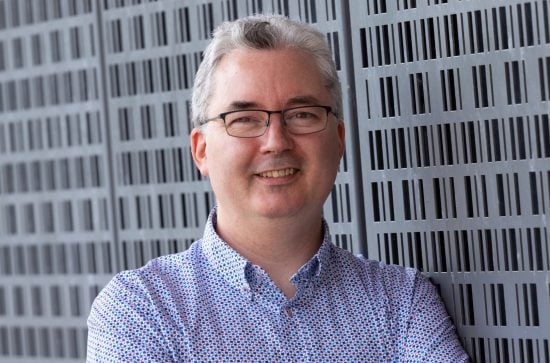
Professor Damien Woods is a faculty member at Maynooth University's Faculty of Science & Engineering, specifically affiliated with the Department of Computer Science and the Hamilton Institute. He leads groundbreaking research in DNA computing, molecular programming, and optical computing, focusing on self-assembly, algorithmic design, and computational complexity. ERC Consolidator Grant: 'Computationally Active DNA Nanostructures' SFI ERC Support Award EIC Pathfinder Challenge Grant: 'DISCO - DNA Infrastructure for Storage and Computation' His research projects explore programmable DNA storage, molecular robotics, and robust self-assembly systems. Recent publications span diverse topics like algorithmic DNA tile assembly, thermodynamic stability, and computational universality in nanosystems. Awards include ERC and SFI grants, with a focus on bridging theoretical computer science and experimental molecular biology. Scientific Contributions include: 2022: 'Turning Machines' - Molecular Robotics 2019: 'Diverse Molecular Algorithms' in Nature 2017: 'A Cargo-Sorting DNA Robot' in Science
Dr. Muhammad Intizar Ali is an Assistant Professor in the School of Electronic Engineering at Dublin City University (DCU). He holds a PhD (with distinction) from Vienna University of Technology, Austria (2011) and has held roles including Adjunct Lecturer and Research Fellow at the Insight Centre for Data Analytics, NUI Galway. His primary research focuses on IoT, Data Analytics, Machine Learning, and Knowledge Graphs with applications in Smart Cities, Manufacturing, Farming, and Healthcare. Education: PhD in Computer Science, Vienna University of Technology (2007-2011) Research Interests: IoT and Edge Analytics Federated and Distributed Machine Learning Semantic Web and Knowledge Graphs Smart Manufacturing and Industry 4.0 Stream Processing and Real-Time Systems Recent Work Trends: His publications emphasize federated learning frameworks, IoT-enabled adaptive intelligence, and knowledge graph applications in industrial contexts. Recent projects include digital twin systems for predictive maintenance and ontology-driven manufacturing solutions. Grants & Projects: Lead Investigator in SFI-funded projects like MultiRoof (2025-2029) and Neuro-Symbolic AI for Building Management EU/Industry collaborations including Terrain-AI and Bentley-funded initiatives Labs & Teams: Active in DCU's Data Analysis and Machine Learning research groups, leading projects like Smart DCU Digital Twin for campus optimization.
Dr. Sabin Tabirca is a Senior Lecturer at the School of Computer Science and Information Technology, University College Cork (UCC). He holds a BSc from Bucharest University and a PhD from Brunel University. His research focuses on Artificial Intelligence, Data Analytics, Algorithmics, Interactive Media, and HCI, with applications in computational cancer modeling, mobile health (mHealth), and parallel computing. He coordinates MPT Activities and is affiliated with the CRR Group and BCRI Centre. Notable awards include UCC's President Award for Innovation in Teaching (2007), IT@Cork Leader Award (2008), and UCC Staff Recognition Award (2013). His teaching includes modules like Parallel and Grid Computing, Mobile Application Design, and Graphics for Interactive Media. Dr. Tabirca has supervised over 70 MSc students and numerous PhD candidates, many of whom now hold academic and industry roles globally. His research includes developing mHealth apps for cystic fibrosis patients, 3D cancer visualization tools, and frameworks for mobile parallel computing. Publications span mHealth design pipelines, cancer prediction models, and mobile gaming for health education. He actively engages in interdisciplinary projects, blending computer science with medical and biological applications.
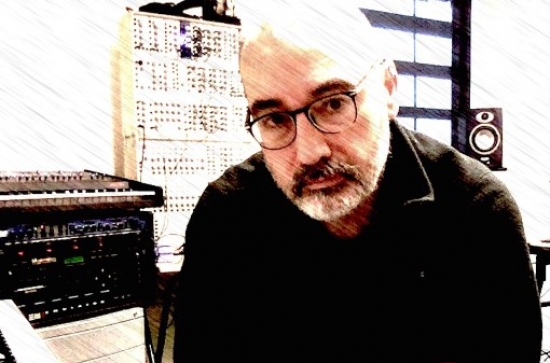
Victor Lazzarini is a Professor of Music at Maynooth University, Ireland, specializing in computer music and audio signal processing. He holds a BMus from Universidade Estadual de Campinas (UNICAMP), Brazil, and an AMusD from the University of Nottingham, UK. His research spans electroacoustic music, digital signal processing, and music technology. He leads the Csound project, a widely used sound and music computing system, and authored libraries like Aulib and Aurora. Education: Bachelor of Music (BMus), UNICAMP, Brazil Advanced Music Degree (AMusD), University of Nottingham, UK His research interests include sound synthesis, computer music languages, and the intersection of music with technology. He has authored over 150 peer-reviewed publications and books such as Spectral Music Design: A Computational Approach (Oxford UP, 2021) and co-edited volumes like Ubiquitous Music Ecologies (Routledge, 2020). His work bridges academic and industrial sectors through projects like the Enterprise-Ireland-funded commercialization initiative. Prof. Lazzarini’s contributions to music technology include pioneering tools like Csound, which enable real-time audio synthesis and processing. His articles span topics from digital filter design to historical computer music archaeology, reflecting his expertise in both theoretical and applied domains. Awards: AIC/IMRO International Composition Prize (2006) He advises on interdisciplinary projects such as the BeatHealth initiative, integrating ubiquitous computing and music. His creative output includes electroacoustic compositions performed globally and released on labels like FarPoint Recordings. Lazzarini actively collaborates with international teams, contributing to conferences like DAFx and ICMC, and leads initiatives like the Ubimus (Ubiquitous Music) research network.
Anthony Kelly serves as a Postdoctoral Research Fellow in the Department of Electronic and Computer Engineering within the Faculty of Science and Engineering at the University of Limerick, Ireland, with his office located in E2-006. His affiliation spans both engineering and healthcare domains through interdisciplinary research initiatives. His research demonstrates dual expertise in artificial intelligence applications for healthcare and advanced power electronics. In healthcare AI, he develops interpretable mental health models, diabetes management chatbots, and comorbid condition interventions with emphasis on clinician trust and safety evaluation. In power systems, he pioneers digital control techniques for DC-DC converters, FPGA power management, and machine learning-integrated circuit designs. This bifurcated focus reveals a strategic transition from hardware-centric research (2005-2019) toward AI-health convergence (2024-2025). Analysis of his 15 most recent publications shows a pronounced shift toward healthcare AI since 2024, with 80% of current work addressing mental health modeling, diabetes chatbots, and comorbid condition management. Earlier publications (2009-2019) consistently focused on power electronics innovations including current-sharing algorithms, adaptive controllers, and FPGA-based systems, establishing foundational expertise later applied to healthcare technology development.
John Herbert is a Senior Lecturer in Computer Science at University College Cork (UCC), Ireland. His research focuses on pervasive computing, wireless sensor networks, and healthcare informatics, with notable projects like the CARA framework for falls assessment in the elderly. He holds a PhD in Computer Science from Cambridge University and has held visiting roles at institutions including SRI International and the University of Cambridge. Education: BSc (Experimental Physics), MSc (Experimental Physics), Postgraduate Diploma (Computer Science) from UCC; PhD (Computer Science) from Cambridge University. Research Grants: Led projects funded by Science Foundation Ireland (163,726) and the Irish Research Council (71,250), focusing on cloud computing and healthcare applications. His work emphasizes context-aware systems, data quality in medical environments, and real-time analysis. Selected awards include an International Fellowship from Digital Systems Research Center (1989) and visiting fellowships at Cambridge (2008-2009). Teaching: Courses include Advanced Software Engineering, Formal Methods, and Model-Based Software Development. Outreach: Advisor to award-winning student teams (e.g., IEEE mobile app contest) and collaborator with industry partners in China and Europe.
Lai Ma is Associate Professor at the School of Information and Communication Studies, University College Dublin (UCD), where she also serves as Director of Research (2022–2025) and previously directed the MLIS and GradDipLIS programmes. She holds a PhD in Information Science from Indiana University Bloomington and a BSc(Econ) from The Chinese University of Hong Kong. Her work bridges philosophy, information science, and science policy. PhD, Information Science, Indiana University Bloomington MLIS, Indiana University Bloomington BSc(Econ), The Chinese University of Hong Kong Her research centers on the epistemology of information and knowledge production, with a focus on open research, scholarly communication, research evaluation, and research infrastructure. Influenced by critical social theory, philosophy of language, and STS, she investigates issues of epistemic injustice, bibliodiversity, and the political economy of academic publishing. A major theme is the critique of metrics and platformisation in research. Her recent publications reveal a strong trend toward analyzing the structural inequalities in global knowledge production, especially through the lens of open access models, citation practices, and research assessment. She critically examines how commercial interests and dominant platforms shape what counts as knowledge, often marginalizing voices from the global periphery. Best Paper Meta Reviewer Award Teaching Excellence Award Best Paper Reviewer Award Lai Ma leads the ERC Consolidator Grant project Sustainable and Collaborative Research Information for Bibliodiverse Ecosystems (SCRiBe) (2025–2030) and has secured other grants on open research culture. She actively mentors PhD students and has coordinated key modules such as Digital Libraries , Scholarly Communication , and Research and Practice in LIS . She serves on editorial boards and review panels for major journals and funding bodies, and has held leadership roles in ASIS&T and the Library Association of Ireland. She is affiliated with the UCD Geary Institute for Public Policy and contributes to policy discussions on research evaluation, ethics, and open science. Her work emphasizes the need for community-governed, equitable, and sustainable research infrastructures.
Hadi Tabatabaee is an Assistant Professor at the School of Computer Science, University College Dublin (UCD), leading the Sustainable Orchestration in Computing Continuum (SOC² Lab). His research focuses on sustainable orchestration of services across edge-cloud environments, emphasizing energy efficiency, carbon-aware systems, and AI-driven applications like large language models (LLMs). Key roles include Associate Editor for IEEE Access and Management Committee member of COST Action CA22151 (CYPHER). He holds a PhD in Computer Engineering from the University of Isfahan and has held academic positions at Maynooth University, Shahid Beheshti University, and Trinity College Dublin's CONNECT research program. Education: PhD (Computer Engineering, University of Isfahan), MSc (Computer Engineering), with a research visit at TU Delft (2010-2011). Certifications include Epigeum's Research Leadership and Research Integrity courses. Languages: Persian (fluent), Azerbaijani (spoken). Research Interests: Edge-cloud continuum, dynamic service placement, distributed AI workloads, LLM optimization, and sustainable resource management. Recent work includes zero-trust vehicular networks, parallel algorithms for recommender systems, and geospatial event processing. Awards: None explicitly listed, though his contributions include over 20 journal articles in IEEE/Elsevier/Springer venues. Professional Activities: IEEE Senior Member, TPC member for IEEE conferences, and reviewer for multiple journals. Teaching: Coordinates/teaches Cloud Computing, Computer Networks, and Principles of Computer Organization at UCD.
Ravi Reddy Manumachu is an Assistant Professor in the School of Computer Science at University College Dublin (UCD), Ireland. He holds a B.Tech from IIT Madras (1997) and a PhD in Computer Science from UCD (2005), specializing in high-performance heterogeneous computing and energy-efficient systems. His research focuses on optimizing performance and energy efficiency in modern heterogeneous platforms like clouds, grids, and supercomputers through novel models and algorithms. Key contributions include functional performance/energy models, energy-prediction frameworks, and extensions like Heterogeneous MPI and ScaLAPACK for heterogeneous clusters. He has published over 69 articles in top journals/conferences, with recent works addressing data transfer energy measurement, scalable allreduce algorithms (SUARA), and portable programming models (OpenH). Professional roles include Assistant Professor at UCD (2023–present), SEAI Research Fellow (2022–2023), and prior industrial experience at Ansys, Siemens, and IONA Technologies. He has certifications in university teaching, GDPR, and research integrity. Languages include English (fluent), Telugu, and Hindi. Research trends emphasize bi-objective optimization (performance-energy), hardware heterogeneity challenges, and scalable communication algorithms for deep learning. His work addresses energy non-proportionality in CPUs and GPU-CPU interactions, with practical solutions for real-world applications like matrix operations and gene sequencing.
Professor John Morrison is the founder and director of the Centre for Unified Computing and co-founder of the Boole Centre for Research in Informatics at University College Cork. With qualifications including BSc, MSc, PhD, and DipTLHE, his research focuses on parallel distributed computing, grid technologies, and cloud architectures. His primary research explores: Self-organizing cloud management systems Heterogeneous computing environments Energy-efficient cloud infrastructure Grid computing middleware Professor Morrison's publications demonstrate strong focus on cloud computing optimization, distributed systems, and virtual reality applications in healthcare and education. Recent work emphasizes scalable resource management and trust systems in cloud environments. Honors include: Senior Member of ACM Senior Member of IEEE He has secured significant research funding including: €883,226 from Horizon 2020 for CloudLightning Project €379,111 from Enterprise Ireland for Cloud Computing Centre €646,604 from Higher Education Authority for Biophotonics Platform He leads the MAVRIC Research Lab focusing on immersive computing technologies and serves on editorial boards for multiple journals including Journal of SuperComputing.
John Murphy is a Full Professor at the School of Computer Science, University College Dublin. He holds academic positions as an IBM Faculty Fellow and Fellow of multiple professional organizations, including the Institution of Engineering and Technology and Engineers Ireland. His research focuses on Performance Engineering, Telecommunication Systems, and Middleware, with a strong emphasis on cloud computing, distributed systems, and network optimization. Education: B.E. (Electronic Engineering) from University College Dublin (1988), M.Sc. (Electrical Engineering) from California Institute of Technology (1990), and Ph.D. (Electronic Engineering) from Dublin City University (1996). Research Interests: His work spans Performance Engineering, Telecommunication Systems, Enterprise Software, Middleware, Mobile Networks, and Queueing Theory. Notable contributions include energy-efficient cloud resource management and network-aware scheduling in data centers. Publications: Over 200 peer-reviewed articles, including recent work on intelligent computing in IoT, energy-efficient VM mapping, and load balancing in wireless networks. His research trends emphasize cloud optimization, distributed systems performance, and smart city infrastructure. Awards: Recognitions include the Real Time Correlation Engine award and prestigious fellowships. He has supervised 24 PhD students and secured over €9.5M in research grants. Teaching: Coordinates modules on Computer Networking, Databases, and Programming. He advocates for foundational learning to foster adaptability in students. Grants: Includes Horizon 2020 projects like NEO-QE and PRTLI grants for SimSci. Collaborates with industry partners for applied research. Labs: Leads the Performance Engineering Laboratory, advancing research in distributed systems and network performance.
Dr. Helard Becerra is an Assistant Professor in the School of Computer Science at University College Dublin (UCD). He holds a PhD from the University of Brasília and has held postdoctoral roles at UCD's Insight Centre for Data Analytics and Samsung R&D Institute Brazil. His research focuses on multimedia quality assessment (audio/video/speech) and AI-driven healthcare solutions for stroke rehabilitation. Key contributions include developing NAViDAd (a deep learning-based quality metric) and predictive models for stroke recovery outcomes. Education: B.Sc. (UNSAAC, Peru, 2010); M.Sc. & Ph.D. (UnB, Brazil, 2013/2019). Professional experience includes roles at Samsung (2019), DIT (2017-2018), and leadership in EU projects like Precise4Q (Horizon 2020). Research interests span: 1) Perceived quality in multimedia systems, 2) Explainable AI for healthcare, 3) Predictive modeling in stroke rehabilitation. Notable work includes gradient boosting models for social risk prediction and Elo rating systems for personalized therapy. Teaching responsibilities include coordinating modules on Software Engineering, Parallel Computing, and Programming. He actively supervises graduate students and serves on UCD's Equality, Diversity & Inclusion Committee. Awards include the 2019 Best Student Paper Award at International Symposium on Electronic Imaging. He reviews for top conferences (ACM MMSys, IEEE ICIP) and journals (IEEE Access, IEEE Signal Processing Letters).
Professor Barak Pearlmutter is affiliated with Maynooth University in the Faculty of Science & Engineering . His research spans multiple domains including automatic differentiation , neural networks , machine learning , and neuroscience . He has contributed significantly to adaptive systems , brain imaging , and programming language design . Research Interests include: Adaptive systems, automatic differentiation, theoretical neurobiology, neural networks, machine learning, acoustic source separation/localization, neuroscience, brain imaging, programming language design, and computational neuroscience. Publications focus on applying algorithmic differentiation to machine learning, developing neural ODE models for biomedical signals, advancing sparse NMF techniques, and integrating functional programming with numerical methods. Collaborations span institutions like MIT, Oxford, and IEEE societies, with work in brain-computer interfaces , MEG source localization , and neuromodulation for tinnitus treatment. Technical Contributions include the DiffSharp AD library for .NET languages and foundational work on reverse-mode automatic differentiation in functional frameworks. His 2018 Journal of Machine Learning Research survey on AD remains a seminal reference in the field. Application Areas cover biomedical signal processing , optical brain-computer interfaces , cognitive modeling , and neural code optimization . His work intersects computer science, neuroscience, and mathematical computing through sparse decomposition and probabilistic modeling .
Aisling O'Driscoll is a Senior Lecturer at the School of Computer Science and Information Technology (CSIT), University College Cork (UCC), Ireland since 2017. She previously held roles at Cork Institute of Technology (CIT) from 2005 to 2017, including a PhD in Location Management and Hybrid Geo-Routing (2014). Her research focuses on communication protocols for wireless systems, particularly in vehicular networks, IoT, and bioinformatics. She leads the Connected Autonomous Vehicles (CAV) working group in the SFI CONNECT Centre and chairs UCC's Athena Swan committee. Education: PhD (CIT, 2014), MEng (Research, 2006), BSc (2004) Grants: Over €3M in funding from SFI, EU, and industry, including the SFI Blended Autonomous Vehicle (BAV) Spoke and AWS grants Research interests include decentralized network solutions for autonomous systems, parallelized bioinformatics algorithms, and vehicular communication protocols. Awards include the 2021 National Teaching Hero Award and recognition at Áras an Uachtaráin for women in science. Labs/Teams: Leads CAV initiatives in CONNECT, collaborates with Jaguar Land Rover and Teagasc Outreach: Founded IWish Campus Day to promote STEM for girls, and chairs IT@Cork's Tech Talk Committee
Professor Barry O'Sullivan is a leading academic and industry expert in artificial intelligence at University College Cork , where he serves as a full professor in the School of Computer Science & IT . He directs the Insight Centre for Data Analytics and the SFI Centre for Research Training in AI, and holds influential advisory roles at Europol's GRACE project, Leuven.ai institute, and the Computational Sustainability Network. His €300m+ R&D funding achievements and 15+ recent publications highlight his technical and societal impact. Co-founder and Chief AI Officer, Stimul.ai Member of University College Cork Governing Body Vice Chair, European Commission High-Level Expert Group on AI Former President, European AI Association His research spans AI ethics , machine learning , and computational sustainability , with recent work focusing on explainable AI for medical diagnostics, energy-efficient scheduling in manufacturing, and human-AI collaboration mechanisms. His publications reveal expertise in constraint programming, anomaly detection, and multilingual reasoning systems. Notable awards include fellowships from AAAI, EurAI, and the Royal Irish Academy, alongside leadership roles in AI policy committees for the European Commission and Irish health research ethics. He leads a team of PhD researchers at UCC, including Marco Dalla and Sharmi Dev Gupta, while directing major European AI initiatives like the ALTAI assessment framework.