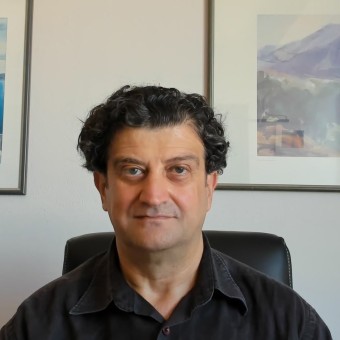
Dr. Christos Antonopoulos is an Associate Professor at the Department of Electrical and Computer Engineering, University of Patras. He holds a Diploma and PhD in Electrical Engineering from the University of Patras (2002, 2008) and has participated in over 16 European research projects (FP5, FP6, FP7, Horizon 2020) and 6 national projects. Research Interests: Wireless Networks Cyberphysical Systems Embedded Software Architecture Internet of Things Cross-Layer Protocols Sensor Networks Technical Expertise: His work involves network simulation, power optimization, and reconfigurable computing. He has published >100 journal/conference papers and 13 book chapters with over 1000 citations.
Dimitrios Tsoumakos serves as an Associate Professor of Big Data Management Systems at the School of Electrical and Computer Engineering of the National Technical University of Athens (NTUA) where he also directs DBLab, the Knowledge and Database Systems Laboratory. His academic career spans over two decades with significant contributions to large-scale data management and distributed systems. Diploma in Electrical and Computer Engineering from NTUA (1999) M.Sc. in Computer Sciences from University of Maryland (2002) Ph.D. in Computer Sciences from University of Maryland (2006) Professor Tsoumakos' research focuses on the intersection of big data management, cloud computing, and distributed systems. His work addresses fundamental challenges in large-scale data processing, including wavelet synopses for data summarization, vector embedding frameworks for analytics operators, multi-engine analytics systems, and cloud application deployment with failure recovery mechanisms. His research consistently bridges theoretical algorithms with practical implementations for real-world data challenges. His publication record demonstrates consistent innovation from early work on P2P data management systems through to current research on vector embeddings and deep reinforcement learning for cloud autoscaling. Recent work shows a clear progression toward content-based analytics, multi-dataset integration, and intelligent resource management in heterogeneous environments. Best Paper Runner Up Award at SSDBM 2019 Best Paper Award at CCGrid 2013 Professor Tsoumakos has secured substantial research funding through multiple European projects including RELAX (2023-2027), HiDALGO2 (2023-2026), DAPHNE (2021-2024), and previous initiatives like HiDALGO, TraMOOC, ASAP, CELAR, ARCOMEM, and GREDIA. These projects reflect his leadership in big data analytics, cloud computing, and distributed systems research. As director of DBLab, Professor Tsoumakos oversees research on the Knowledge and Database Systems Laboratory, which has produced significant work on analytics operators, multi-engine resource scheduling (IReS platform), cloud elasticity (TIRAMOLA), and RDF data management (H2RDF+). The lab maintains strong industry connections and has developed multiple open-source tools for big data analytics.
Michael D. Bond is a Professor in the Department of Computer Science & Engineering at Ohio State University's College of Engineering. He leads the Programming Languages and Software Systems (PLaSS) Research Group, which focuses on designing program analyses and software and hardware systems that enhance computing reliability, scalability, and security. His academic service includes general chair for PLDI 2027, program committee membership for multiple top conferences, and committee roles in SIGPLAN Research Highlights (2024-2027). Professor Bond's research spans programming languages, systems, and security, with particular expertise in memory management, concurrency, hardware transactional memory, information flow control, and predictive race detection. His work bridges theoretical foundations with practical implementations, as evidenced by numerous open-source projects accompanying his publications. The PLaSS group has made significant contributions to understanding and improving memory models, developing efficient garbage collection techniques for modern architectures, and creating novel approaches to secure programming in languages like Rust. Analysis of his recent publications reveals a clear trajectory toward addressing security and reliability challenges in modern computing systems, particularly through language-based approaches. His work increasingly focuses on Rust programming language security mechanisms, memory disaggregation for datacenters, and advanced techniques for detecting and preventing concurrency bugs. The research demonstrates strong continuity in exploring memory models and concurrency while adapting to emerging hardware trends and security challenges. Outstanding Teaching Award, Department of Computer Science and Engineering, Ohio State University (2018) Lumley Research Award, College of Engineering, Ohio State University (2016) OOPSLA 2015 Distinguished Paper and Artifact Awards NSF CAREER Award ACM SIGPLAN Outstanding Doctoral Dissertation Award Intel PhD Fellowship Professor Bond actively mentors several PhD students including Chujun Geng, Vincent Beardsley, Chris Xiong, Victor Chen, and Noah Charlton, with external co-advisee Zixian Cai at Australian National University. His research is currently supported by multiple NSF grants including SaTC-2348754 (2024-2027), CyberCorps-2336531 (2024-2029), and CSR-2106117 (2021-2025), reflecting sustained funding for his work in information flow control, security, and systems research. The PLaSS Research Group maintains a strong presence in both academic and industrial communities, with graduated PhD students securing positions at major technology companies like Google, Amazon Web Services, and Huawei, as well as academic positions at institutions like UIUC and IIT Kanpur. The group's work combines theoretical rigor with practical implementation, consistently producing open-source artifacts that enable reproducibility and further research in the systems and programming languages community.
Ruzica Piskac is a Professor of Computer Science at Yale University, where she leads the Rigorous Software Engineering (ROSE) group. She has made significant contributions to the fields of software verification, security, automated reasoning, and code synthesis, focusing on improving software reliability and trustworthiness through formal techniques. Dr. Piskac received her PhD from the Swiss Federal Institute of Technology (EPFL) in 2011, where her dissertation won the Patrick Denantes Prize. Prior to joining Yale, she led an independent research group at the Max Planck Institute for Software Systems in Germany (2012-2013). Her research spans several key areas: symbolic execution for Haskell (G2), privacy-preserving formal methods (PPFM), functional reactive synthesis, verification of configuration files, and analysis of software updates. Her work consistently bridges theoretical formal methods with practical applications in real-world systems. Dr. Piskac's recent publications demonstrate a strong trend toward applying formal verification techniques to emerging challenges including large language models, quantum computing security, legal accountability of automated systems, and cyber-physical systems. Her research increasingly intersects with AI, cryptography, and legal domains while maintaining strong foundations in formal methods. Her scientific achievements have been recognized with numerous prestigious awards: Multiple Amazon Research Awards Yale University's Ackerman Award for Teaching and Mentoring Facebook Communications and Networking Award Microsoft Research Award for the Software Engineering Innovation Foundation (SEIF) Patrick Denantes Prize for her PhD dissertation Dr. Piskac has graduated five PhD students, four of whom have gone on to become assistant professors of computer science. She has served as Program Chair of the 37th International Conference on Computer Aided Verification and is on the Steering Committee of the Formal Methods in Computer-Aided Design conference. She leads the Rigorous Software Engineering (ROSE) group at Yale, which focuses on several key projects including: Symbolic Execution Engine for Haskell (G2) Privacy Preserving Formal Methods (PPFM) Functional Reactive Synthesis Verifications for Configuration Files Analysis of Software Updates and Configuration Files
Zhenjiang Hu is a Chair Professor and Dean of the School of Computer Science at Peking University. He serves as Director of the Programming Languages Laboratory and has held significant academic positions including Professor at the National Institute of Informatics and University of Tokyo. BS and MS from Shanghai Jiaotong University (1988, 1991) PhD from University of Tokyo (1996) Lecturer/Assistant Professor at University of Tokyo (1997) Associate Professor at University of Tokyo (2000) Full Professor at National Institute of Informatics (2008) Full Professor at University of Tokyo (2018-2019) Professor Hu's research primarily focuses on programming languages and software engineering, with special emphasis on functional programming, bidirectional transformation, and software adaptation. His work explores transformational programming approaches for automatic program optimization, systematic parallelization of sequential programs, efficient manipulation of structured documents, and bidirectional model transformation for software development. His research has significantly advanced the field of bidirectional programming, developing foundational theories and practical applications that enable more reliable and maintainable software systems. His recent publications demonstrate a strong trajectory in bidirectional programming, program synthesis, and graph processing. The research shows increasing sophistication in handling program transformations, with growing emphasis on practical applications in software engineering contexts. His work increasingly integrates formal methods with practical programming language design, creating systems that maintain theoretical soundness while addressing real-world software development challenges. The research spans multiple venues including top conferences like PLDI, POPL, ICFP, and OOPSLA, reflecting its broad impact across programming language research. Fellow of JFES (Japan Federation of Engineering Society, 2016) ACM Distinguished Scientist (2016) Member of Academia Europaea (2019) IEEE Fellow (2020) Member of Engineering Academy of Japan (2020) Professor Hu actively mentors students and has welcomed excellent candidates to join his group through Peking University's International Elite PhD Program and Boya Postdoctoral Fellowship Program. He serves on numerous program committees for major conferences including PLDI, POPL, ICFP, and OOPSLA, and holds editorial positions for prestigious journals such as Journal of Functional Programming and Science of Computer Programming. His leadership extends to conference organization, having served as PC Chair for CNCC 2024 and General Co-Chair for SoICT 2019. As Director of the Programming Languages Laboratory at Peking University, Professor Hu leads a research team focused on advancing programming language theory and practice. His lab has developed influential frameworks like BiGUL for bidirectional programming and Fregel for graph processing. The laboratory maintains strong international collaborations and contributes to both theoretical foundations and practical implementations in programming languages and software engineering.
Andy D. Pimentel is a Full Professor at the University of Amsterdam, where he chairs the Parallel Computing Systems (PCS) group within the Systems and Networking Lab at the Informatics Institute. His work focuses on the design, programming, and run-time management of multi-core and multi-processor computer systems, with particular attention to performance, power/energy consumption, system dependability, and design productivity. His academic background includes: PhD in Computer Science, 1998, University of Amsterdam MSc in Computer Science, 1993, University of Amsterdam Professor Pimentel's research spans multiple critical areas in modern computing systems. His primary interests include multi-core embedded systems, system-level design and simulation, design space exploration, performance and power analysis, system dependability, hardware/software co-design, run-time resource management, and Edge AI. His work addresses the growing challenges of making computer systems faster, more sustainable, energy efficient, reliable, and secure in an era of increasing computational demands and climate concerns. The PCS group he leads performs research on the modeling, analysis and optimization of extra-functional aspects of computing systems, which play a pivotal role in their work. An analysis of Professor Pimentel's recent publications reveals a strong focus on edge computing, distributed AI, and energy-efficient system design. His work bridges theoretical computer architecture with practical implementation challenges, particularly in the context of resource-constrained environments. Key trends include the adaptation of AI models for edge devices, thermal management in advanced architectures, and optimization of multi-core systems for both performance and energy efficiency. His research increasingly addresses sustainability concerns in computing, reflecting broader industry and academic priorities. His notable scientific achievements include: IEEE CEDA Outstanding Service Recognition Award DATE Fellow Award Professor Pimentel has served in numerous leadership roles in the academic community, including as General Chair of Design Automation and Test in Europe (DATE) 2024, Vice General Chair of IEEE/ACM Embedded Systems Week 2025, and General Chair of IEEE/ACM Embedded Systems Week 2026. He has secured significant research funding for projects related to sustainable computing, edge AI, and multi-core system design. His professional service includes board membership with the ICT Research Platform Nederland (IPN) since 2020 and leadership roles in major conferences such as DATE, Embedded Systems Week, and SAMOS. The Parallel Computing Systems group he chairs is a vibrant research team within the Systems and Networking Lab at the Informatics Institute. The PCS group focuses on the challenges of modern computing systems, particularly addressing the extra-functional aspects like performance, power consumption, and system dependability. Their work is highly relevant to current technological challenges in edge computing, sustainable systems design, and the integration of AI into resource-constrained environments.
Nikolaos Samaras is a Full Professor at the Department of Applied Informatics, School of Information Sciences, University of Macedonia in Thessaloniki, Greece. He has been serving as director of the Computational Methodologies & Operations Research (CMOR) Laboratory since April 2016. His academic career includes positions as Assistant Professor (2007-2012) and Lecturer (2003-2007) at the same institution, and earlier as an adjacent Lecturer at the Technological Institute of Western Macedonia (1998-2000). Dr. Samaras earned his Diploma in Applied Informatics from the University of Macedonia in 1996 and his Ph.D. in Applied Informatics from the same university in 2001. His educational background forms the foundation for his extensive research in computational optimization and operations research. Professor Samaras's research focuses on the interface between computer science and operations research, with particular expertise in linear and nonlinear optimization, network optimization, integer optimization, and scientific computing including HPC and GPU programming. His work has resulted in the development of new algorithmic families for optimization problems, efficient GPU implementations of the revised simplex algorithm, and novel algorithms and software for operations research. His research spans theoretical algorithm development, practical implementation, and real-world applications across various engineering and scientific domains. His extensive publication record includes over 35 journal papers in prestigious venues such as Computers and Operations Research, European Journal of Operational Research, and Journal of Artificial Intelligence Research, more than 85 conference papers, and four textbooks (two in English and two in Greek). His work has been recognized through citations and the Thomson ISI/ASIS&T Citation Analysis Research Grant in 2005. ACM Senior Member (2016) Thomson ISI/ASIS&T Citation Analysis Research Grant (2005) Editorial board member of Operations Research: An International Journal Reviewer for numerous top journals including Mathematical Programming Computation and European Journal of Operational Research Professor Samaras has supervised four current Ph.D. students working on hybrid simplex algorithms, large-scale optimization using Apache Hadoop, algorithmic procedures in matrix theory, and smoothed complexity analysis. He has successfully guided five Ph.D. students to completion, including Nikolaos Ploskas who won the 2014 HELORS Doctoral Dissertation Award. Additionally, he has supervised 45 master's theses and 84 bachelor's theses. His research group has secured funding from diverse sources including the European Union, Greek Secretariat of Research and Technology, and industry partners like Veltio Greece LTD. The Computational Methodologies & Operations Research (CMOR) Laboratory, which he directs, focuses on developing and implementing optimization algorithms with applications in transportation, energy systems, and business process design. The lab has produced notable software tools including Euclides and Visual LinProg, which have educational applications in linear programming.
Michael Carbin is an Associate Professor at MIT in the Department of Electrical Engineering and Computer Science (EECS), where he leads the Programming Systems Group at the Computer Science and Artificial Intelligence Laboratory (CSAIL). His research centers on developing programming systems that handle uncertainty through probabilistic programming, quantum computing, and neural networks. Carbin's work spans programming languages, systems, and machine learning, with themes including uncertainty management, efficiency optimization, and formal verification. His publications demonstrate a strong focus on probabilistic inference methods, neural network optimization, and quantum programming frameworks. Awards and Honors: Sloan Research Fellowship (2020) Multiple Best Paper Awards (OOPSLA 2013, 2014; ICLR 2019) NSF CAREER Award (2018) Google Faculty Research Award (2018) As the head of the Programming Systems Group, he advises 10+ graduate students and postdocs, focusing on cutting-edge systems research. He has secured grants including Facebook Research Awards and NSF funding.
Michael Eichberg is a Professor at Technische Universität Darmstadt, Germany, where his work centers on software engineering, static analysis, programming languages, and secure software development tools. He is the principal architect of the OPAL framework for Java bytecode analysis and has an extensive publication record spanning PLDI, ICSE, ESEC/FSE, ISSTA, ASE, FSE, SOAP, and other premier venues. Research Interests: Static program analysis and its scalability to real-world code bases Software security, particularly cryptographic API misuse and Android app repackaging detection Concurrent and parallel programming models, including deterministic concurrency in Scala Software architecture conformance, drift and erosion detection, and rule reuse Development of open extensible tools and frameworks (OPAL, LectureDoc, QScope, Sextant, XIRC, IRC) Publication Trends: His recent work (2015-2022) demonstrates a strong focus on empirical evaluation of static analysis techniques, modular composition of analyses, and security-related program understanding. Key themes include unsoundness in call graph construction, purity and immutability analyses, parallelization of static analyses, and large-scale studies of cryptographic API misuse. Tools & Frameworks: OPAL – A flexible Java bytecode analysis and manipulation framework (core developer until 2019) LectureDoc 2 – Web-based lecture material authoring and presentation system QScope – Open extensible metrics framework for modern software projects Sextant – Eclipse-integrated software exploration tool XIRC/IRC – Frameworks for enforcing system-wide properties and architectural constraints
Ioannis Milis is a Professor at the Department of Informatics, Athens University of Economics and Business (AUEB), part of the School of Information Sciences and Technology. He holds a BS in Electrical Engineering from Democritus University of Thrace (1983) and a PhD in Computer Science from AUEB (1989). His research focuses on algorithms, computational complexity, and optimization for computer/communication networks, combinatorial optimization, graph theory, and game theory. He has conducted postdoctoral research at LRI (1992-94), INRIA-Sophia Antipolis (1994-95), and NTUA as a Marie Curie fellow (1995-96). His teaching includes courses on Algorithms, Advanced Algorithms, and Topics in Algorithms at both undergraduate and graduate levels. He co-authored a textbook on Distributed Systems with Java (2005). His conference involvement includes organizing the Athens Colloquium on Algorithms and Complexity (ACAC) since 2006, the Euro-Par 2012 conference, and the ISCO 2012 symposium. His research has addressed scheduling algorithms, energy-efficient computing, and combinatorial optimization problems in networks.
Dr. Sotirios Kontogiannis is a Researcher and Director of the Distributed MicroComputer Systems Laboratory (MCSL) at the Department of Mathematics, University of Ioannina. He holds a PhD in Software Engineering from Democritus University of Thrace (2012), with a focus on load balancing algorithms for distributed systems. His career spans academic and private sector roles, including software development, research in FP7 projects, and technical leadership at TEKMON Geomatics. He currently teaches courses on Database Systems, Parallel Algorithms, and Educational Technologies at the University of Ioannina. Education: 5-year Engineering Diploma (DUTH, 2003), MSc in Microelectronics and Information Systems (DUTH, 2006), PhD in Load Balancing Algorithms (DUTH, 2012). Research Focus: Distributed systems, IoT protocols, sensor networks, big data, and smart agriculture technologies (e.g., beekeeping monitoring systems, wine fermentation frameworks). His work integrates IoT, AI, and edge computing to address challenges in agriculture, accessibility, and environmental monitoring. Notable inventions include patented smart beehive systems and tactile navigation tools for visually impaired individuals.
Georgios Keramidas is an Assistant Professor in Computer Architecture at the Department of Informatics, Aristotle University of Thessaloniki . He also holds an Adjunct Professor position at the Hellenic Open University and collaborates with institutions like the University of Peloponnese and University of Patras . Research Interests : Computer Architecture, Memory Systems, Multicore/GPU Design, Low-Power Techniques, Fault-Tolerant Systems His work focuses on cache optimization , energy-efficient computing , and security-aware memory design . Key contributions include DVFS frameworks , reuse-distance prediction , and non-deterministic cache mechanisms . Recent article trends highlight innovations in computation-in-memory , IoT platform components , and security/low-power co-design . Patents on image compression and GPU optimization reflect practical applications of his research. Academic Network : Collaborates with institutions including University of Patras , University of Manchester , and TU Dresden
Professor Chatziantoniou Damianos holds a position at the Athens University of Economics and Business (AUEB) within the Department of Management Science and Technology (DMST), School of Business. He earned a B.Sc. in Applied Mathematics from the National & Kapodistrian University of Athens (1991), M.Sc. from New York University's Courant Institute of Mathematical Sciences, and a Ph.D. from Columbia University. His research focuses on big data systems, business intelligence, query processing, and real-time data analysis, with contributions influencing commercial database systems like Microsoft SQL Server and Oracle. As Director of AUEB's Master’s program in Business Analytics and Big Data, he previously served as an Assistant Professor at Stevens Institute of Technology (1997–1999). His industry collaborations include co-founding Panakea Software and VoiceWeb SA, and consulting roles at Aster Data Systems (now Teradata). He leads big data projects for companies like Cosmote, Piraeus Bank, and HEDNO. His research has been published in top venues including VLDB, ICDE, and SIGMOD, emphasizing practical applications in large-scale analytics and OLAP systems. He advises on strategic partnerships for the MSc program and maintains an active role in academic administration, including steering committees and quality assurance initiatives.
Minos Garofalakis is a Professor of Computer Science at the School of Electrical and Computer Engineering (ECE) of the Technical University of Crete (TUC), where he directs the Software Technology and Network Applications Laboratory (SoftNet). He is also the Director of the Information Management Systems Institute (IMSI) at the Athena Research and Innovation Centre in Athens. Previously, he held roles at Yahoo! Research, Intel Research Berkeley, and Bell Laboratories, and was an Adjunct Associate Professor at UC Berkeley. Education: He earned a BSc in Computer Engineering from the University of Patras (1992), followed by MSc (1994) and PhD (1998) in Computer Science from the University of Wisconsin-Madison. Research Interests: His work focuses on Big Data analytics , including database systems, data streams, approximate query processing, probabilistic databases, and secure/private data analytics. Key areas include distributed stream processing, data synopses, and machine learning applications. He has authored over 150 papers and holds 29 patents, with an h-index of 63 and 13,500+ citations. Recent Work Trends: His recent articles emphasize scalable stream analytics (e.g., OmniSketch), privacy-preserving techniques, and distributed event processing. He explores challenges in handling high-velocity data streams, uncertainty in databases, and real-world applications like healthcare analytics. Scientific Awards: ACM Fellow (2018), IEEE Fellow (2017), TUC Excellence Award (2015), and multiple patents from Bell Labs/Yahoo/AT&T. Advising & Grants: He led EU projects such as FERARI, LEADS, and The Human Brain Project. His lab, SoftNet, develops tools for extreme-scale analytics and declarative networking. Current work includes interactive cross-platform analytics (Infore) and AI-driven medical data systems. Labs/Teams: Director of SoftNet Lab and IMSI. Collaborates with industry partners on distributed systems and privacy-preserving technologies.
Stefanos Papadakis serves as a Research Staff Scientist at the Telecommunications and Networks Laboratory (TNL) of the Institute of Computer Science at Foundation for Research and Technology-Hellas (FORTH) and holds an Adjunct Lecturer position in the Department of Computer Science at the University of Crete. Since 2001, he has pioneered hardware and software prototyping at TNL-FORTH, currently leading the Software Defined Radio (SDR) group he established to drive vertical integration from physical layer design to application development. His educational foundation includes a Physics degree (2001) and M.Sc. (2004) and Ph.D. (2009) in Computer Science, all earned at the University of Crete. Teaching responsibilities encompass core courses CS-330: Introduction to Telecommunication Systems Theory and CS-435: Network Technology & Programming. Papadakis' research spans wireless innovation frontiers including software-defined/cognitive radios, spectrum sharing, heterogeneous networking, position location, radio propagation modeling, and emergency communications. His work emphasizes practical implementation, yielding functional prototypes across the entire communications stack. Notable contributions include GPU-accelerated SDR frameworks, robust spectrum virtualization techniques, and emergency response communication systems validated through international competitions. Analysis of his 15 most recent publications (2010-2016) reveals dominant themes in SDR optimization for IoT and critical communications, with significant focus on GPU parallelization, interference management in dense networks, and real-time spectrum sharing mechanisms. His experimental approach consistently bridges theoretical models with hardware validation, particularly in emergency response and heterogeneous network scenarios. Key recognitions include: Ericsson Award of Excellence in Telecommunications for position location research First place in PENED doctoral proposal competition Fourth place in IEEE DySPAN 2015 5G Spectrum Challenge Second place in Virginia Tech ShaRC 2016 with the 'Skynet' cognitive radio system Mentorship spans 16 undergraduate projects (11 completed), 8 M.Sc. students (3 completed theses), and 1 Ph.D. candidate. His research is sustained through major EU and national projects including REDComm (emergency communications), EU-MESH (metropolitan networks), RERUM (IoT security), and Heraklion smart city initiatives. The SDR group maintains critical infrastructure like the Heraklion metropolitan wireless network, FORTH campus network, and specialized mobile emergency nodes equipped with multi-radio SDR platforms, satellite transceivers, and high-performance computing resources.