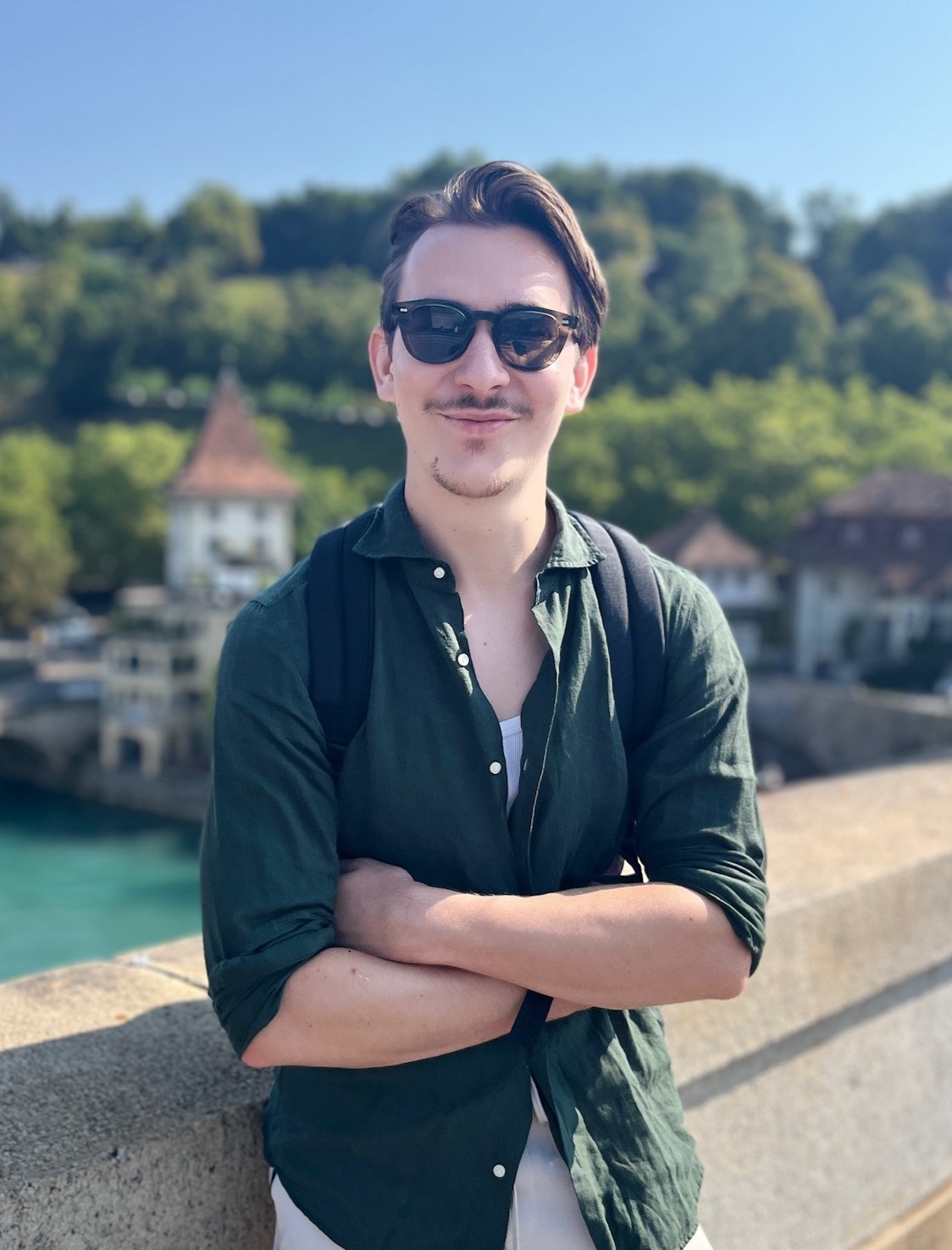
Bernhard Kerbl is a Researcher and Teaching Assistant at the Institute of Computer Graphics and Vision, Technical University of Graz (TU Graz). He holds a Master’s degree in Software Engineering and Economics. His research focuses on parallel and distributed processing, with special emphasis on adaptive rendering and GPU optimization under Prof. Dieter Schmalstieg and Dr. Markus Steinberger. His interests include real-time graphics, high-performance rendering, and Virtual Reality (VR). He contributes to teaching by organizing lectures on computer graphics. His recent work involves publications in areas like adaptive radiance caching and distributed rendering systems. Collaborations include projects with industry and academic partners, though specific grants or lab affiliations are not detailed in the provided texts.
Jens Knoop is a Full Professor at TU Wien, leading the Department of Information Systems Engineering (E194) and the Research Unit Compilers and Languages (E194-05). His roles include Head of Institute for Information Systems Engineering and membership in the Curriculum Commission for Informatics. He specializes in compiler design, program analysis, and embedded systems, with a focus on worst-case execution time (WCET) analysis and formal methods. His research interests span optimizing compilers, programming languages, and real-time computing. Notable contributions include the Platin tool suite for WCET analysis and contributions to the T-CREST project on time-predictable multi-core architectures. He has authored and edited multiple influential publications, including proceedings of international conferences such as Code Generation and Optimization (CGO) and ARCS. Professor Knoop has supervised numerous theses, including works on effect systems in Haskell, mutation testing in Rust, and robotic systems. He has received the Most Influential PLDI Paper Award (2002) for foundational work in compiler optimization.
Matthias Paul Lanzinger is an Assistant Professor at the Technische Universität Wien's Faculty of Informatics, Department of Database and Artificial Intelligence. His research focuses on algorithms, graph neural networks, hypergraph decomposition techniques, parameterized complexity, and computational logic. He leads projects like 'DeConquer' (Vienna Science Fund) and 'HyperTrac', exploring efficient query processing and hypergraph-based algorithms. Research interests include theoretical computer science, database systems, and applying logical frameworks to solve complex computational problems. Recent work emphasizes hypertree decompositions, fuzzy Datalog, and graph motif analysis via the Weisfeiler-Leman test. He co-edited the 2024 Datalog-2.0 workshop proceedings and has supervised students on topics like column-store performance and graph query languages. His publications span venues like ACM Transactions on Database Systems, ICLR, and IJCAI, highlighting contributions to algorithmic efficiency, database theory, and logical reasoning systems. Active in academic service, he teaches courses on database systems, scientific research, and advanced topics in informatics.
Minos Garofalakis is a Professor at the School of Electrical and Computer Engineering , Technical University of Crete, and serves as Director of the Information Management Systems Institute at the Athena Research & Innovation Center in Athens. He has held senior research roles at Bell Labs, Intel Research, Yahoo! Research, and academic positions at UC Berkeley as an Adjunct Associate Professor. Currently, he is a Senior Research Consultant at Huawei Edinburgh Research Center and co-founder of Agora Labs , focusing on medical data privacy. Research Interests His work centers on Big Data Analytics , encompassing private data analytics , machine learning , federated analytics , and blockchain systems . He has pioneered advancements in data stream management , query optimization , and approximation algorithms , with applications in distributed systems and privacy-preserving technologies. Scientific Awards ACM Fellow (2018) IEEE Fellow (2017) Excellence in Research Award, Technical University of Crete (2015) FP7 Marie-Curie International Reintegration Fellowship (2010-2014) Bell Labs President’s Gold Award (2004) Central Bell Labs Teamwork Award (2003) Patents and Citations Garofalakis holds 29 issued US patents (36 filed) with applications in data management and analytics. His research has garnered over 16,000 citations on Google Scholar and an h-index of 69.
Michał Karoński is a Professor of Mathematics at the Faculty of Mathematics and Computer Science, Adam Mickiewicz University, Poznań, Poland, and serves as head of the Department of Discrete Mathematics. He has held visiting professorships at Emory University, The Johns Hopkins University, Purdue University, and Southern Methodist University since 1975, with ongoing engagements at Emory University since 1992. Research Focus: Discrete mathematics, random discrete structures, graph theory, and theoretical computer science. Leadership Roles: Editor-in-Chief of Random Structures & Algorithms (since 1990), Chairman of the Council of National Science Centre (2010–2016), and organizer of 17 bi-annual conferences on random structures. His research group in random structures gained international recognition in the 1970s. He has authored 60 publications, delivered over 30 plenary lectures, and collaborated globally at institutions like Microsoft Research, Bellcore, and BRICS. Scientific Awards: 2016 Medal 'Homini Vere Academico' (AMU Rector) 2013 Polonia Restituta Officer Cross (President of Poland) 1990 Minister of Science and Higher Education Prize His work spans probabilistic combinatorics, algorithm theory, and graph irregularity, with influential publications on stochastic Kronecker graphs, random intersection graphs, and distributed complexity in matchings.
Sean Douglas Willett is a Full Professor at ETH Zurich, Switzerland (since 2006), specializing in Earth surface processes and tectonic geomorphology. Previously, he held positions as Assistant/Associate Professor at the University of Washington (1998-2006), Assistant Professor at Pennsylvania State University (1994-1998), and completed postdoctoral research at Dalhousie University. He was also a Visiting Professor at the University of Bologna (2004-2005). Education: Ph.D. in Geophysics, University of Utah (1988) B.S. in Geology and Geophysics, University of Utah (1982, cum laude) Research Focus: Integrates numerical modeling with field observations to study landscape evolution, mountain-building processes, fluvial/glacial erosion dynamics, low-temperature thermochronology, and orogenic wedge mechanics. His work bridges tectonics, climate science, and surface processes. Publications: His recent articles (2012-2015) demonstrate advanced computational methods for landscape modeling and focus on Alpine/European tectonic evolution, river basin reorganization, and exhumation mechanisms. Earlier foundational work established mechanical models for mountain belts. Awards/Honors: Fellow, Canadian Institute for Advanced Research (1995-2014) Elected Member, Academia Europaea (2015) Professional Service: Extensive editorial contributions including Associate Editor for American Journal of Science and Terra Nova , organizer of TOPO-Europe conferences, and committee roles for European Science Foundation programs. His scholarly impact includes 5,700+ citations and h-index of 36 (2015).
Kin K. Leung is the Tanaka Chair Professor in the Electrical and Electronic Engineering and Computing Departments at Imperial College London. He serves as the Head of the Communications & Signal Processing Group (2009-2024) and Deputy Director of the University Defence Research Centre in Signal Processing. Previously, he held senior technical roles at AT&T Bell Labs and Lucent Technologies. Education: B.S. from Chinese University of Hong Kong (1980), M.S. and Ph.D. from University of California, Los Angeles (1982, 1985). Research Interests: Focuses on wireless technologies, communication networks, stochastic modeling, machine learning, optimization, and emerging quantum computing applications. His work integrates theoretical frameworks with practical implementations in multi-antenna systems, cross-layer network designs, and distributed quantum architectures. Publication Trends: Recent works (2021-2025) demonstrate a strong focus on quantum computing integration with networking systems, federated learning optimizations for edge devices, and reinforcement learning solutions for resource allocation in wireless environments. Awards and Honors: Fellow of Royal Academy of Engineering (2022) IEEE Fellow (2001) IET Fellow (2021) Royal Society Wolfson Research Merit Award (2004-2009) IEEE Communications Society Leonard G. Abraham Prize (2021) IEEE Best Survey Paper Award (2022) Grants and Leadership: Principal Investigator for EPSRC TITAN/HASC Com Hubs, DCIT Centre, and DQC & App (distributed quantum computing). Leads the Communications & Signal Processing Group and co-directs the School of Convergence Science in Space, Security and Telecoms.
Veljko Milutinovic is a Full Professor at the School of Electrical Engineering, University of Belgrade since 1990. He has also held academic positions at Purdue University (1982-1989) and consulted globally for institutions like IEEE and ACM. Current role: Computer Area Director, teaching VLSI, Data Mining, and E-Business Previous roles: Tenure Track Assistant Professor at Purdue University International collaborations: EU FP7 projects, Raiffeisen Bank, Wall Street Journal His research spans microprocessor architecture , VLSI design , data mining , and semantic web , focusing on energy-efficient architectures and e-business infrastructure. He pioneered DARPA's 200MHz GaAs RISC microprocessor and 4096-node systolic arrays. Recent work trends include: Technical and semantic interoperability in e-government Customer satisfaction accelerators in e-commerce 3D semantic web visualization Data mining for inverse engineering Academic-industry co-design methods Global university collaboration frameworks Scientific awards include: IEEE Life Fellow (2003) Foreign Member, Montenegrin Academy (2018) IPSI Awards (2007-2010) for eGov projects Best Method papers ranked #1 in Google search Supervised PhD students at Purdue, Belgrade, and Valencia Universities, with significant contributions to cache coherence, GaAs processors, and mobile network security. His publications (over 100 SCI papers) have been cited over 4000 times on Google Scholar.
Onur Mutlu is a Full Professor of Computer Science at ETH Zurich (since 2015), with adjunct professor positions at Carnegie Mellon University (since 2016) and Bilkent University (since 2015). His academic career spans prestigious institutions including Carnegie Mellon University where he served as Assistant Professor (2009-2013) and Strecker Early Career Endowed Professor (2013-2016). His research focuses on computer architecture, particularly memory systems, with expertise in: Computer memory systems and DRAM architecture Multi-core processor design Fault tolerance and reliability Hardware/software interactions Systems security related to hardware Emerging memory technologies Dr. Mutlu's work has significantly impacted both academic research and industry practices. His discovery of the RowHammer problem created a new field at the intersection of hardware reliability and systems security. His research on memory controllers, flash memory reliability, and emerging memory technologies has been adopted by major technology companies including Samsung, Intel, IBM, and Microsoft. His numerous scientific awards include the IEEE Computer Society Harry H. Goode Memorial Award (2025), IFIP Jean-Claude Laprie Award (2024), Huawei OlympusMons Award (2023), IEEE Computer Society Edward J. McCluskey Technical Achievement Award (2020), and ACM SIGARCH Maurice Wilkes Award (2019). He is an IEEE Fellow (2018), ACM Fellow (2017), and member of Academia Europaea (2018). Dr. Mutlu has received significant industry recognition with Faculty Awards from Google, Facebook, HP, Huawei, IBM, Intel, Microsoft, NSF, and VMware. His work has earned over 20 Best Paper awards and 12 papers selected for IEEE Micro's Top Picks as some of the most influential papers in computer architecture. He maintains strong industry connections, having worked at Microsoft Research (2006-2009), Intel (multiple summers), AMD (multiple summers), VMware (2016), and Google (2016), enabling direct technology transfer of his research ideas into commercial products.
Camille Schreck is a researcher in Computer Graphics currently holding an Inria Starting Faculty Position (ISFP) at Inria Nancy within the MFX Team. She has been actively contributing to the field of computer graphics with a focus on physics-based simulation and geometric modeling since completing her PhD in 2016. Her educational background includes an engineering degree from ENSIMAG (Grenoble INP) in 2013, followed by a PhD at the University of Grenoble-Alpes supervised by Stefanie Hahmann and Damien Rohmer. Between 2016 and 2020, she conducted postdoctoral research at IST Austria in Chris Wojtan's group. Dr. Schreck's research spans physics-based simulation of natural phenomena, geometric modeling, and computational fabrication techniques. Her work demonstrates particular expertise in simulating deformable materials like paper, water dynamics, and developing novel methods for 3D printing and shape manipulation. She has successfully bridged theoretical computer graphics with practical applications in digital fabrication. Her publication record shows consistent high-impact contributions to top computer graphics venues including SIGGRAPH, Eurographics, and Computer Graphics Forum, with recent work focusing on star-shaped particle simulation, self-shaping 3D printed structures, and efficient mesh processing techniques. The progression of her research demonstrates a clear trajectory from fundamental paper simulation to increasingly complex physical phenomena and fabrication methods. Young Research Fellow of Eurographics France (YFR EGFR) - 2024 Dr. Schreck serves on numerous program committees including SIGGRAPH, Eurographics, and Shape Modeling International. She teaches courses in computer graphics and parallelism at ENSG-GeoRessources and Telecom Nancy, both part of Université de Lorraine. Her teaching spans from 2020 to the current 2024-2025 academic year. As a member of the MFX research team at LORIA (Inria Nancy), she collaborates on advancing the state of the art in physics-based animation and geometric modeling, with her StarDEM project representing a significant contribution to particle simulation methods.
Univ.-Prof. Dr. Wolfgang Lechner is a Professor at the Institute of Theoretical Physics at the University of Innsbruck, leading the Quantum Computing research group. His work focuses on theoretical and applied aspects of quantum computing, including quantum algorithms, quantum annealing, and error correction using Rydberg atoms. He holds a prominent role in advancing parity-based quantum architectures and their implementation in scalable quantum systems. Research interests include developing novel quantum algorithms for optimization problems, fault-tolerant quantum computing frameworks, and hardware-aware design of quantum circuits. His contributions span theoretical physics, computer science, and engineering, addressing both fundamental principles and practical implementations of quantum technologies. Key trends in his recent articles emphasize parity-based architectures, multi-qubit gate operations, and applications in solving industrially relevant optimization challenges. The body of work highlights innovation in quantum error mitigation, algorithm parallelization, and scalable hardware implementations. While no specific awards are listed, his active research output reflects significant contributions to the field. He advises students and collaborates on grants related to quantum computing fundamentals and applications, though explicit details are not provided in the text. Lechner's research group actively explores quantum annealing, variational methods, and the interplay between quantum systems and classical control mechanisms, positioning his work at the forefront of modern quantum computing research.
Michael Quell is a Researcher at the Microelectronics Research Department (E360-01) at TU Wien. His work focuses on numerical methods for semiconductor process simulation, including level-set techniques, hierarchical mesh processing, and high-performance computing. He holds a Dipl.-Ing. (Master's equivalent) and a Dr.techn. (PhD) in technical sciences. His research emphasizes parallel algorithms for material flow simulation, adaptive mesh refinement, and TCAD applications. Education: Dipl.-Ing. and Dr.techn. in Technical Sciences Research interests span computational engineering, numerical analysis, and semiconductor fabrication modeling. Key contributions include shared-memory parallel implementations of the Fast Marching Method, hierarchical re-distancing algorithms, and feature detection for topography simulations. His work often addresses challenges in nanoscale fabrication processes and multi-material wet etching. Collaborations involve projects on parallel mesh adaptation frameworks and quantum transport simulations. He has contributed to advancing computational tools for semiconductor process design and manufacturing optimization.
Stefan Haeussler is an Associate Professor at the Department of Information Systems, Production and Logistics Management within the University of Innsbruck , Austria. His academic career spans since 2009, starting as a University assistant while completing his PhD in Management. He holds dual diplomas in Business Administration (2009) and Political Science (2010) from the same university. Specializing in production and logistics management, Häussler combines optimization techniques with machine learning approaches to address complex manufacturing challenges. His research focuses on Workload control systems Order release mechanisms Lead time management Reinforcement learning applications Semiconductor manufacturing optimization Behavioral operations in supply chains Recent publications highlight his work on integrated production planning , explainable AI for powertrain control , and dynamic workload allocation . He actively presents at major conferences like Winter Simulation Conference, EURO, and International Working Seminar on Production Economics. Häussler also teaches master's level courses and supervises thesis work in production economics, while serving as a guest lecturer on topics at the intersection of AI and manufacturing.
Martin Feda is an Associated Researcher at the Institute of Computer Graphics, Vienna University of Technology, where he previously served as Assistant Professor. His research focuses on advancing radiosity methods for photorealistic image synthesis, with significant contributions to algorithmic efficiency and visual quality in global illumination rendering. Feda's primary research interests include radiosity, photorealistic image synthesis, and parallel graphics algorithms. He has pioneered techniques for stochastic radiosity, progressive refinement, and parallel implementations to accelerate computation. Key innovations involve hierarchical subdivision algorithms, methods for reducing shadow leaks without explicit meshing, improvements to intermediate radiosity images through directional light, and overshooting techniques to speed up progressive radiosity. His work consistently bridges theoretical advancements with practical applications for handling highly complex scenes. Analysis of his 1991-1997 publication record reveals a clear evolution in radiosity research: early work established parallel implementations on transputers and foundational radiosity algorithms, while later contributions developed sophisticated stochastic and hierarchical methods. The trajectory shows increasing emphasis on Monte Carlo techniques and computational optimizations to achieve greater efficiency and visual fidelity in global illumination, with consistent publication in top-tier graphics venues like Eurographics and Computer Graphics Forum.
Lukas Radl is a University Assistant and PhD Student at the Institute of Visual Computing, Graz University of Technology, where he works on 3D Scene Representations for View Synthesis under the supervision of Markus Steinberger. His research focuses on advancing real-time rendering techniques, particularly in Neural Radiance Fields (NeRF) and Gaussian Splatting, to bridge digital and physical world representation. Education: Master of Science in Computer Science (with distinction), Graz University of Technology, 2018-2023 Bachelor of Science in Software Engineering, Graz University of Technology, 2018-2023 Research Focus: Radl's work intersects Computer Graphics, Computer Vision, Machine Learning, and Parallel Processing. He pioneers practical implementations of Radiance Field Representations, addressing critical challenges in view consistency, anti-aliasing, and real-time performance for interactive applications. His innovations enable robust rendering in virtual reality and complex lighting scenarios through novel geometric and neural approaches. Publication Impact: Recent publications (2024-2025) demonstrate a cohesive trajectory toward production-ready radiance field systems. Key advances include sorting algorithms for view consistency (StopThePop), anti-aliasing frameworks for Gaussian Splatting (AAA-Gaussians), and VR-optimized pipelines (VRSplat). These contributions establish new standards for real-time performance while maintaining visual fidelity across diverse hardware platforms. Scientific Recognition: Dean's List (top 5% of students) at Graz University of Technology (2019, 2020) Mentorship & Service: Radl actively shapes academic discourse as a reviewer for premier venues (CGF, ICCV, TVCG) and mentors students through open projects in real-time rendering. His teaching portfolio spans exercise coordination for core visual computing courses since 2020, with current leadership in Real-Time Graphics and Computer Graphics instruction. He fosters talent through student projects advancing Gaussian Splatting implementations. Research Ecosystem: Embedded in Graz University of Technology's Institute of Visual Computing, Radl collaborates within a specialized team focused on radiance field optimization. The group maintains active pipelines for NeRF and Gaussian Splatting research, with strong industry connections evidenced by his upcoming Meta Reality Labs internship. Current projects target foveated rendering, geometric consistency, and editing capabilities for next-generation AR/VR systems.