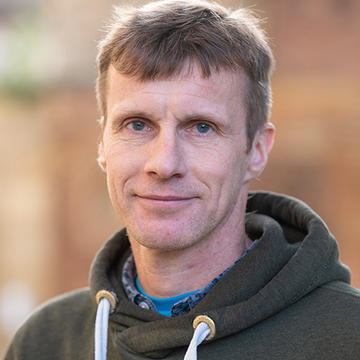
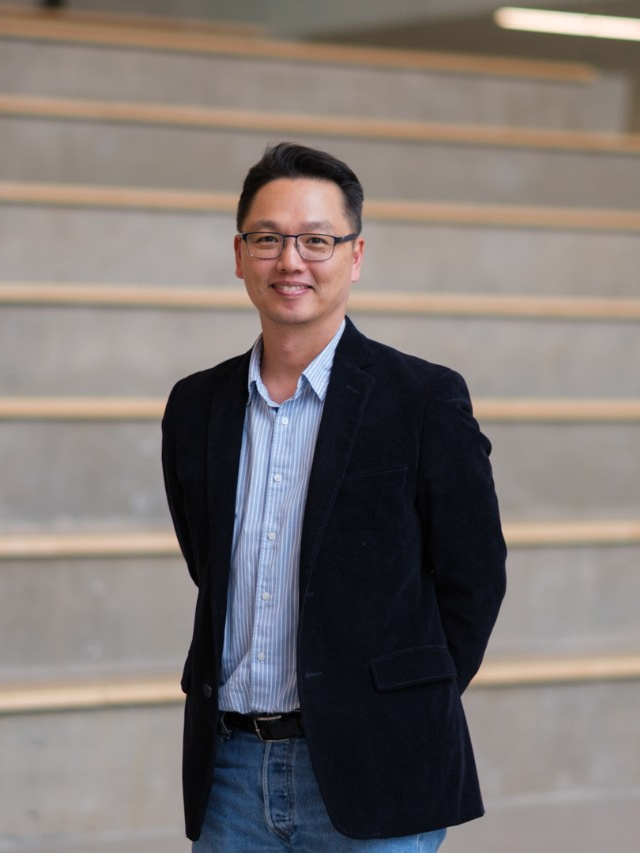
Jonathan Doye is a Professor of Theoretical Chemistry at the University of Oxford, affiliated with Queens College. He holds positions in the Department of Chemistry and collaborates with the Brandeis Bioinspired Soft Materials MRSEC. His research focuses on theoretical and computational studies of soft matter and biomolecular systems, including DNA biophysics, DNA nanotechnology, liquid crystals, and quasicrystals. He co-developed the oxDNA coarse-grained model for DNA simulations, widely used in nanotechnology research. Education: Bachelor’s and PhD in Theoretical Chemistry from the University of Cambridge Postdoctoral research at FOM Institute in Amsterdam (1996–1998) Research Interests: Coarse-grained modeling of DNA and RNA Patchy-particle self-assembly (including quasicrystals) Prokaryotic S-layer structural analysis Liquid crystal phase behavior of DNA origami rods Key Achievements: Discovery of one-component icosahedral quasicrystals via patchy particles Development of oxDNA model for DNA origami simulations Structural elucidation of S-layers across prokaryotes Awards: Royal Society of Chemistry Harrison Memorial Prize (2000) Labs/Teams: Jonathan Doye's Research Group focuses on computational studies of soft matter systems, with experimental collaborations in DNA nanotechnology and materials science.
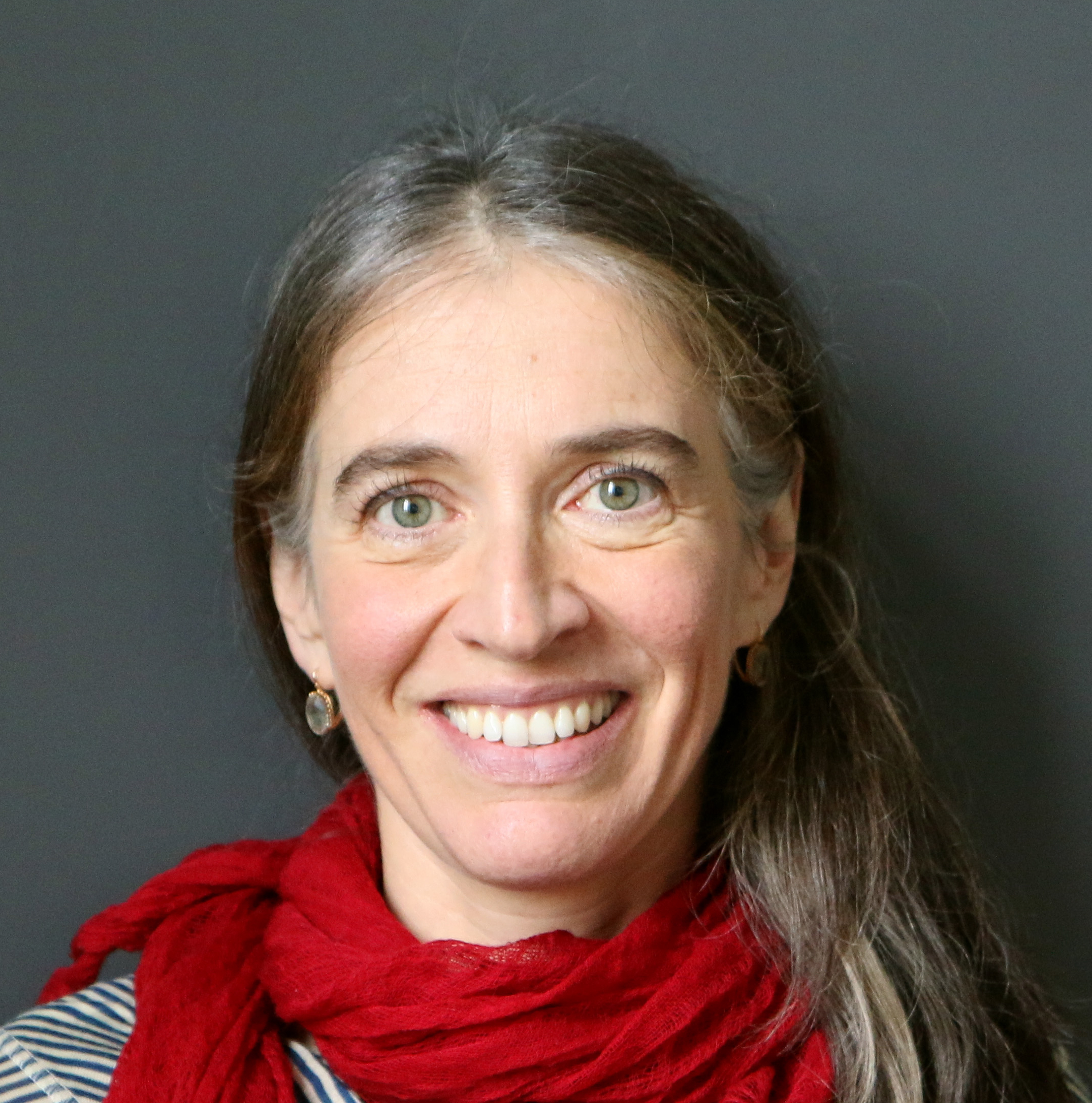
Suresh Venkatesh is an Assistant Professor in the Department of Electrical and Computer Engineering at North Carolina State University. He previously served as a postdoctoral research associate at Princeton University (2018–2022) and earned his Ph.D. in Electrical Engineering from the University of Utah in 2017. His academic journey also includes a Master's degree in Electrical Engineering from NC State in 2010. Education: Ph.D. in Electrical Engineering, University of Utah, 2017 Master's in Electrical Engineering, North Carolina State University, 2010 Research Interests: His work focuses on metamaterials and surfaces at GHz-THz frequencies, millimeter-wave phased arrays, and innovative applications in 5G/6G communication systems. Key areas include antenna design, physical layer security, advanced electromagnetic simulations, and reconfigurable systems using CMOS integration. He explores origami-based platforms for adaptive RF imaging and employs spatio-temporal modulation techniques to enhance wireless security and efficiency. Publications Trends: Recent work emphasizes mmWave and THz communication, with a focus on reconfigurable intelligent surfaces, secure low-latency links, and CMOS-based designs for direct detection receivers and cytometers. His research bridges theoretical concepts with experimental validation, particularly in wavefront manipulation and sparse imaging techniques. Awards and Honors: Mistletoe Research Fellowship (2021) Advising and Grants: Venkatesh contributes to research teams like the NC State 6GNC initiative, which spans 6G technologies. He actively organizes conferences such as the World Microwave Congress 2024 as TPC Co-Chair and participates in IEEE technical committees. His grants and collaborations drive advancements in metamaterials, secure wireless systems, and CMOS-integrated solutions. Labs and Teams: He leads efforts in the NC State ECE Department, focusing on labs involving reconfigurable antennas, computational imaging, and integrated systems. His work intersects with the 6GNC team to develop future communication technologies and secure mmWave/THz systems.
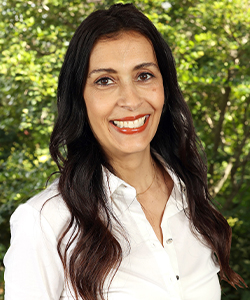
Dr. Helena Verrill is an Assistant Professor at the Department of Mathematics, University of Warwick, focusing on teaching and outreach. Her research interests span Number Theory, Algebraic Geometry, Combinatorial Game Theory, and the Mathematics of Origami, with applications in generative art. She actively mentors students through third-year essays, research projects, and outreach initiatives like the Royal Institute Masterclasses. Her research explores modular forms, computational algebra, and arithmetic geometry, with notable contributions to ℓ-adic representations and noncongruence cuspforms. She bridges pure mathematics with artistic expression through origami tessellations and fractal patterns. Notable works include studies on Fano plane automorphisms and Harter-Heighway dragon curves. Her publications span journals like the *Proceedings of the American Mathematical Society* and *Journal of Number Theory*, alongside creative outputs in *Generative Art* and *Bridges Conferences*. She maintains a personal homepage with resources for mathematical art and education.
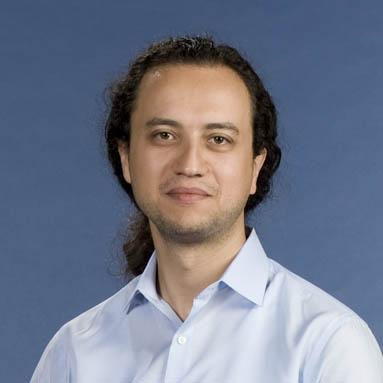
Ana Cannas da Silva is a Lecturer in the Department of Mathematics at ETH Zurich (Switzerland). She specializes in Symplectic Geometry , Geometric Topology , and Geometric Analysis . Her academic work includes research on symplectic toric manifolds, folded symplectic structures, and geometric quantization, with notable publications in journals like Pure and Applied Mathematics Quarterly and Mathematical Research Letters . Research Interests Symplectic Geometry Geometric Topology Geometric Analysis Hamiltonian Group Actions Toric Manifolds Recent Academic Activities Co-organized Symplectic Geometry Seminar (2021-2023) Supervised student theses on topics like contact toric manifolds, Hamiltonian actions, and symplectic linear algebra Authored research on Dedekind sums via Atiyah-Bott-Lefschetz theory (2023) and symplectic origami (2011) Teaching Lecturer for Mathematics I (2024), covering differential calculus and linear algebra Lecturer for Mathematics II (2024), focusing on multivariable calculus and partial differential equations Co-taught seminars on symplectic/contact geometry with Bahar Acu Academic Contributions Advised 20+ MSc/BSc theses at ETH Zurich since 2012 Co-organized conferences like D-Days (2013) and LP-60 (2023) Authored outreach book: Step by Step Symmetry (2016)
Ana Figueroa serves as Assistant Professor in the Department of Education at The University of Tampa, teaching Foundations of American Education and Human Exceptionalities courses. Her academic journey bridges extensive K-12 experience with current scholarly work focused on teacher development. Her educational background includes: 2007: B.S. in Elementary Education, University of Central Florida 2014: Master of Education, University of South Florida 2022: Ed.D., University of the Cumberlands Dr. Figueroa's research centers on teacher mindset dynamics, specifically the relationship between evaluative performance perceptions and learning effort. Her dissertation revealed a critical dichotomy: K-12 teachers maintain fixed mindsets regarding performance evaluation but demonstrate growth mindsets in learning contexts. This insight drives her development of targeted professional learning frameworks that enhance self-efficacy through differentiated strategies and structured self-reflection. Her honors include: Marzano High Reliability Teacher Certification (2018) High Impact Teacher (2015) Polk County Charter School Teacher of the Year (2015) Polk County Teacher of the Year (2012) CEC Outstanding Achievement nomination (2005) Through UT's Teacher Education Advisory Council, she connects academic training with classroom practice. Her community engagement spans dePaul School of Dyslexia partnerships, ESOL/ESE student tutoring, after-school origami programs, and middle school basketball coaching - all informing her research on practical teacher development. While not leading a formal research lab, Dr. Figueroa actively disseminates findings through conference presentations (ICPEL 2023, University of the Cumberlands 2022) and co-authored publications. Her current work focuses on translating mindset research into preservice training and teacher retention initiatives.
Cagdas Onal is an Associate Professor of Robotics Engineering at Worcester Polytechnic Institute (WPI). He holds a BS and MS from Sabanci University (2003, 2005) and a PhD in Robotics from Carnegie Mellon University (2009). His research focuses on soft robotics, bio-inspired systems, and control theory , emphasizing the development of flexible robotic components for healthcare, industry, and sustainable applications. He leads the Soft Robotics Lab and the Future of Robots in the Workplace (FORW-RD) initiative, advancing human-centric robotics solutions. Research interests include designing bio-inspired soft robots (e.g., origami-inspired snake robots), developing modular actuation systems with embedded sensors, and exploring applications in medical devices and assistive technology. His work aligns with UN Sustainable Development Goals, particularly in healthcare access (SDG 3), quality education (SDG 4), and innovation (SDG 9). Recent projects include origami-based robotic arms for wheelchair users , self-contained underwater robots, and haptic interfaces for teleoperation. His lab collaborates on国家级 grants like the NSF-funded NRT Program and has secured patents for actuator designs (e.g., Hydro Muscle). Labs/Teams: Soft Robotics Lab, FORW-RD, NRT Program. Notable media coverage includes Worcester Telegram & Gazette and Spectrum News for innovations in human-friendly robotics.
Prof. Dr. Leonid Ionov is a leading academic at the Faculty of Engineering Science , University of Bayreuth, specializing in Biofabrication and 4D Printing . He has held professorial roles since 2017, with prior positions at the University of Georgia and TU Dresden. Research Priorities: Smart responsive polymers, 3D/4D bioprinting, self-healing electronics, and bioinspired surface engineering. Teaching: Offers advanced courses in 3D Printing of Polymers , Biofabrication , and Polymer Science . His work integrates stimuli-responsive materials with additive manufacturing to create bioinspired actuators, vascular scaffolds, and self-healing conductive systems. Recent articles focus on 4D-printed vascular junctions , multi-responsive cellulose composites , and dynamic bilayer morphing . Scientific Achievements Recipient of the 2022 North Bavaria Business Plan Competition award 2012 Georg Manecke Prize for biopolymer research Developed European patents for Li-S battery cathodes and microfluidic devices Trained over 20 PhD/postdoc alumni now at institutions like Iowa State University and Harvard Medical School . Leads a multidisciplinary lab with advanced equipment for polymer synthesis, electrospinning, and cell culture studies.
Paul Rothemund is a Visiting Associate in Computing and Mathematical Sciences and Computation & Neural Systems at the California Institute of Technology . His research focuses on expanding the toolkit of DNA nanotechnology , particularly through the development of DNA origami and its integration into fields like biological engineering and translational research . He is part of the Biology and Biological Engineering divisions and collaborates with the Winfree and Qian labs. B.S., Caltech (1994) Ph.D., University of Southern California (2001) Research Interests Rothemund’s work centers on programmable molecular systems , with a focus on DNA origami for creating nanoscale shapes, RNA nanostructures , and lipid nanodiscs . His lab develops methods for molecular self-assembly , nanophotonic architectures , and single-molecule assays . Key applications include hybrid nanodevices , precision biomolecular placement , and dynamic DNA/RNA systems . Publication Trends Over 15 recent articles, Rothemund’s research spans DNA/RNA origami , lipid bilayer engineering , nanoarray fabrication , and biomolecular sensing . Themes include modular design , co-transcriptional folding , and programmable nanoscale materials . Scientific Recognition Beckman Senior Research Fellow (2001-04) Bryan R. Coles Prize (2017) Advising & Collaborations Rothemund has advised doctoral students and postdocs such as Anya Mitskovets (now at KLA) and Tyler Ross (MIT/Harvard). His lab forms a DNA nanotechnology supergroup and engages in interdisciplinary collaborations.
Erik Demaine is a Professor in the Department of Electrical Engineering and Computer Science at MIT, affiliated with the Computer Science and Artificial Intelligence Laboratory (CSAIL), the Theory of Computation group, and the Algorithms Group. His research spans algorithms, computational geometry, folding, robotics, complexity theory, and interdisciplinary connections between mathematics and art. He received the MacArthur Fellowship ("genius grant") for his work on folding and computation. Demaine's work includes co-authoring books such as Geometric Folding Algorithms and Games, Puzzles, and Computation . His art collaborations with his father Martin Demaine, including curved-crease sculptures, are in the permanent collections of the Museum of Modern Art (MoMA) and the Renwick Gallery. He is also involved in software projects like Coauthor and Cocreate, supporting collaborative research and education. His research interests include folding and unfolding of geometric structures, computational complexity of games, protein folding, and algorithm design. He has contributed to areas like data structures, robotics, and network computing, with a focus on bridging theoretical computer science and tangible applications. Demaine holds patents and has been recognized with numerous awards, including the NSERC Doctoral Prize and the Gödel Prize. His work often involves supercollaboration, emphasizing open problem-solving and interdisciplinary approaches.
Prof. Amir A. Zadpoor holds dual roles as Antoni van Leeuwenhoek Professor at TU Delft (Department of Biomechanical Engineering) and Professor of Orthopedics at Leiden University Medical Center. He leads the Additive Manufacturing Lab and specializes in biomaterials, tissue biomechanics, and orthopedic implants. His research focuses on 3D/4D printing, meta-biomaterials, and biodegradable metals for clinical applications. Key research interests include: designing function-tailored implants, antimicrobial biofunctionalized materials, and mechanically adaptive meta-implants. He has pioneered projects like 'Metallic clay' and 'Mechanobiology in-silico,' with applications in orthopedics and regenerative medicine. Notable awards include ERC grants, Vidi/Veni awards, and the Jean Leray Award. His lab develops deployable implants, self-folding origami lattices, and smart meta-implants. Ancillary roles include editorial positions at Springer Nature and directorships at Sylvanity/Zagres. Teaching includes courses on biomaterials, regenerative medicine, and computational biomechanics. Research outputs span over 150 peer-reviewed articles. Current priorities include sustainable biomaterials, AI-driven design optimization, and translating additive manufacturing innovations into clinical practice.
Woo Soo Kim is a Professor and Associate Director in the School of Mechatronic Systems Engineering at Simon Fraser University. As a Graduate Student Supervisor, he leads the SFU Additive Manufacturing Laboratory, focusing on advanced 3D printing, sensing robotics, and agritech applications. His research integrates additive manufacturing with smart systems for healthcare, agriculture, and IoT. Education: Ph.D. in Materials Engineering (KAIST, 2006), Postdoc at MIT (2009) Research Themes: 3D printed devices, bio-medical sensors, AI-driven robotics, and sustainable manufacturing His work emphasizes practical applications, such as wireless pressure sensors for helmets, AI-based crop monitoring, and portable health diagnostics. The lab collaborates on projects like the Agritech 4.0 Bootcamp and develops 3D printed neuromorphic systems. Kim’s publications span advanced materials, sensor integration, and robotics, with a focus on solving real-world challenges through additive manufacturing. He supervises graduate students in mechatronic design and teaches courses like MSE220 (Engineering Materials) and MSE812 (Advanced 3D Printing). The lab’s innovations include 3D printed disposable sensors, smart robotic grippers, and flexible electronics. His research bridges academia and industry, addressing sustainability and technological advancement in multiple sectors.
Ramses Martinez is an Assistant Professor in the Department of Industrial Engineering and Biomedical Engineering at Purdue University . He holds a B.A. in Applied Physics from Universidad Autonoma de Madrid (2004) and a Ph.D. in Physics and Materials Science from the Spanish National Research Council (CSIC) in 2009. Prior to joining Purdue, he conducted postdoctoral research in the lab of Prof. George M. Whitesides at Harvard University, focusing on nanofabrication, microfluidics, and soft robotics. Education B.A. in Applied Physics, Universidad Autonoma de Madrid (2004) Ph.D. in Physics and Materials Science, Spanish National Research Council (CSIC) (2009) His research bridges soft robotics , flexible electronics , and nanofabrication , with a focus on creating self-powered e-textiles , omniphobic paper-based devices , and programmable mechanical metamaterials . His work has led to over 25 publications and 9 patents, emphasizing practical applications in health monitoring and industrial automation . Notable projects include waterproof electronic decals for biofluid monitoring, smart bandages for chronic wound detection, and laser nanoforming methods for scalable metallic structures. His research has been recognized through the Fulbright Fellowship and the Marie Curie IOF Grant .
Professor JC Ji is a distinguished academic at the School of Mechanical and Mechatronic Engineering at the University of Technology Sydney (UTS), where he was promoted to Professor on January 3, 2025, after serving as an Associate Professor since January 1, 2016. He serves as the Theme Research Director at the Centre for Audio, Acoustics and Vibration (CAAV) at UTS and is an active member of the Faculty of Engineering and Information Technology. Professor Ji holds a PhD in Mechanical Engineering from Australia and a Graduate Certificate from UTS, along with CPEng NER certification from Engineers Australia since 2018. Professor Ji's research spans multiple interdisciplinary areas with significant practical applications. His primary research interests include Dynamics, Vibration and Vibration Control (focusing on wind turbine dynamics, rotor-bearing systems, and vibration isolation); Machine Condition Monitoring and Asset Management (specializing in fault diagnostics, prognostics, and digital twin-based modeling); Renewable Energy and Sustainability (particularly in vibration-based energy harvesting and battery circular economy); Mechanical and Vehicle Systems; Robotic and Multi-Agent Systems; and Ecological Systems. His work demonstrates a strong integration of theoretical foundations with practical engineering solutions for real-world problems. Analysis of Professor Ji's recent publications reveals a clear research trajectory focused on advanced vibration control systems, condition monitoring techniques, and digital twin applications. His work increasingly integrates machine learning with traditional mechanical engineering approaches, particularly in bearing and gear health management. A significant portion of his recent research focuses on quasi-zero stiffness vibration isolators using innovative structural designs including origami-inspired mechanisms. His publications show strong international impact with numerous high-citation articles in top mechanical engineering journals. Stanford University's World's Top 2% Scientists List for both career-long impact and single-calendar year impact in 2023 and 2024 CPEng NER Chartered Engineers certification from Engineers Australia (2018-present) Professor Ji actively supervises research students and has secured substantial funding for his work, including multiple ARC Discovery and Linkage Projects. He serves as an Associate Editor for Mechanical Systems and Signal Processing (Q1 journal), Journal of Vibration and Control (Q2 journal), and International Journal of Bifurcation and Chaos (Q2 journal). He is also an active assessor for ARC grant applications since 2007 and for international funding bodies including Hong Kong RGC, Belgium FNRS, and New Zealand MBIE. His industry collaborations include projects with Zip Heaters, Alstom Transport, and Coal Services Health and Safety Trust. As Theme Research Director at the Centre for Audio, Acoustics and Vibration (CAAV) at UTS, Professor Ji leads a research team focused on advancing vibration control technologies and their applications. His laboratory work includes developing innovative vibration isolators, condition monitoring systems for industrial machinery, and energy harvesting technologies. The research group maintains strong connections with industry partners to ensure practical implementation of their theoretical advancements.
Peiyi Wang is an Assistant Professor at Peking University's School of Electronics Engineering and Computer Science, Institute for Artificial Intelligence. With strong research output spanning both natural language processing and robotics, Wang maintains significant collaborations with Southern University of Science and Technology and National University of Singapore, particularly in soft robotics research with Professor Cecilia Laschi. Additionally, Wang is actively involved with DeepSeek-AI, contributing to several major language model initiatives including DeepSeek-R1 and DeepSeek-V2. Peking University, School of EECS, Institute for Artificial Intelligence (Primary) Southern University of Science and Technology (Collaborative) National University of Singapore (Collaborative) DeepSeek-AI Research Organization Dr. Wang's research spans two primary domains with significant intersection points. In natural language processing, Wang focuses on large language model reasoning capabilities, mathematical verification, uncertainty estimation, and preference alignment. The robotics work centers on soft robotics, particularly origami-inspired designs, strain-based modeling, and control systems for continuum manipulators. These domains converge in Wang's work on vision-language models, embodied AI, and multimodal reasoning systems. Recent work demonstrates particular innovation in mathematical reasoning verification (Math-Shepherd), soft robotic control systems, and red teaming frameworks for language model safety. Wang's publication record shows remarkable productivity, with over 40 publications between 2021-2025 across top-tier venues including ACL, EMNLP, CVPR, and IEEE Transactions on Robotics. The work demonstrates consistent progression from foundational NLP tasks to increasingly sophisticated multimodal and reasoning systems. The most recent publications (2024-2025) show particular emphasis on mathematical reasoning verification, soft robotics control, and language model safety evaluation. While specific awards aren't documented in the provided materials, Wang's work has clearly gained significant recognition through acceptance at top-tier conferences and collaborations with leading researchers in both NLP and robotics fields. Wang's research demonstrates strong interdisciplinary connections, bridging theoretical NLP work with practical robotics applications. The work with DeepSeek-AI suggests active industry collaboration while maintaining strong academic research output. Current research directions appear focused on improving language model reasoning reliability while developing novel soft robotic systems that can interact safely and effectively with complex environments.
Tom F.A. de Greef is a Full Professor at Eindhoven University of Technology's Biomedical Engineering department, leading pioneering research at the intersection of synthetic biology, molecular computing, and engineered living systems. He founded the Center of Living Technologies and serves as a Core Professor at the Institute for Complex Molecular Systems (ICMS). Key research areas: Biological Computing Devices, DNA-based Data Storage, Engineered Living Materials, Synthetic Cell Engineering, Digital Chemistry, and Protocell Communication. His work has resulted in over 100 publications in Nature , Nature Chemistry , and Nature Nanotechnology , supported by prestigious awards including ERC Consolidator, Starting, and PoC grants, as well as NWO's VICI, VIDI, and VENI grants. He received the Cram-Lehn-Pedersen Prize in 2017 and was named a Groundbreaking TU/e Researcher in 2022. Leadership roles: Founding member of Center of Living Technologies, Principal Investigator at TU/e, and Fellow of the Netherlands Academy of Engineering. He supervises a large research group with >15 PhD students and leads collaborations across international institutions, focusing on programmable molecular systems and sustainable technologies aligned with UN SDGs.