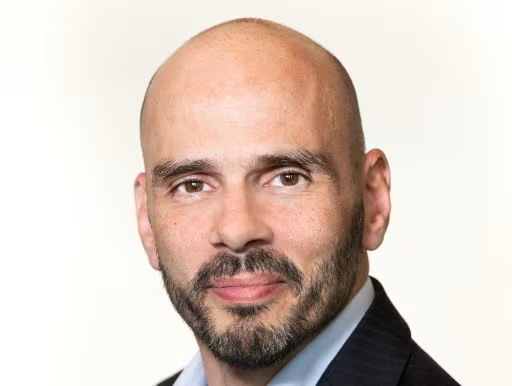
Professor Michael Ben-Gad is a Professor of Economics at City, University of London, where he has served since 2009. He previously held roles as Head of the Department of Economics (2010–2013) and Deputy Head (2008–2010). His research focuses on dynamic macroeconomics, taxation, public debt, immigration economics, and national security, with notable contributions to endogenous growth models and compositional data econometrics. He holds a PhD from the University of Chicago (1996) and has taught at institutions including the University of Houston and University of Haifa. Ben-Gad served on the U.S. National Academy of Sciences panel on immigration's economic and fiscal impacts (2014–2016) and received a 2017 Fellowship from the Royal Society of Arts (FRSA). His work spans academic journals (Economic Modelling, Journal of Economic Dynamics and Control) and media outlets (BBC, CNBC, Al Jazeera), addressing topics like Brexit economics, fiscal policy, and geopolitical challenges. He co-convenes the City Branch of Academics for Academic Freedom and is a founding member of London Universities' Council for Academic Freedom. His research grants include funding from HM Treasury/ESRC on fiscal policy and immigration (2011), the Israel Science Foundation (2007–2008), and the Samuel Ne'eman Foundation (2004). Professional roles include editorial board membership for Economic Affairs and membership of the ESRC Grant Assessment Panel (2021). He is proficient in Hebrew and contributes to policy debates on taxation, macroprudential frameworks, and defense economics.
Mauro Bambi is an Associate Professor at Durham University Business School and an Associate Fellow at the Institute of Advanced Studies. His research focuses on Macroeconomic Theory, Endogenous Growth, Habit Formation, and Behavioral Economics. He earned his PhD from the European University Institute (2007) and held positions at ETH Zurich and the University of York. He directs the Centre for Macroeconomic Policy (CEMAP) and has been recognized with the 2008 Italian Association of Applied Mathematics award for his PhD thesis. Education: PhD in Economics (European University Institute, 2007); Postdoctoral Fellowships at Université Catholique de Louvain (Belgium) and ETH Zurich (Switzerland). Research Interests: Macroeconomic Theory and Policy Design Endogenous Growth and Fluctuations Habit Formation in Economic Models Behavioral Economic Preferences Mathematical Methods in Macroeconomics Key Contributions: His work on habit formation models, time-to-build frameworks, and policy design has influenced macroeconomic theory. Recent studies analyze post-COVID demand shifts and pandemic economic impacts. Awards: 2008 Graduate Prize for Best PhD Thesis (Italian Association of Applied Mathematics). Advising and Leadership: Supervised PhD students like Federico Bertoni and Xinyi Xu. Directed CEMAP from 2019–2022, fostering macroeconomic policy research. Active in interdisciplinary collaborations at the Institute of Advanced Studies. Labs/Teams: Leader of CEMAP, collaborating with global institutions on macroeconomic policy analysis.
Dr Isik Akin is a Senior Lecturer in Accounting and Finance at Bath Spa University and leads the Accounting Pathway. He teaches undergraduate and postgraduate modules including Financial Accounting, Management Accounting, Corporate Financial Management, and Quantitative Research Methods. Education: PhD in Accounting and Finance (Bath Spa University), PhD in Economics and Finance (Istanbul Gelisim University), MSc in Finance (University of the West of England), BSc in Mathematics (Trakya University) Professional Qualifications: Fellowship in Higher Education Academy, Chartered Institute for Securities & Investment (CISI) His research focuses on Behavioral Finance , FinTech , Credit Risk Management , and Sustainable Finance . Recent publications analyze: Enterprise valuation dynamics (FTSE 100) Metaverse asset valuation frameworks Interconnected financial markets (stocks, commodities, crypto) Green investments in real estate He has secured significant international funding including the Connect4Innovation UK-Turkey partnership grant (2021-2022, £50,000) and coordinated EU projects like the Life-Long Learning Programme (2016-2017). Scientific Awards & Roles: Chartered Institute for Securities & Investment (CISI) certified Fellow of the Higher Education Academy Advisory Board Member: Izlek Academic Journal, Metropolitan Business Review Editorial Board Member: International Journal of Economics and Financial Research His career spans multiple institutions including Worcester University and University of Arts London, with expertise in international finance, quantitative methods, and financial globalization.
London School of Economics and Political Science (LSE)United Kingdom
Johannes Spinnewijn is a Professor of Economics at the London School of Economics and Political Science (LSE), affiliated with STICERD and multiple research centers. He holds a PhD in Economics from MIT (2009), following an M.A. from Université Libre de Bruxelles and B.A. from KU Leuven. His research focuses on Public Economics , Behavioral Economics , and Economic Theory , with emphasis on unemployment insurance design, tax compliance, health inequalities, and labor market policies. Notable contributions include analyzing optimal unemployment benefit timing, risk-based selection in insurance, and behavioral nudges in tax systems. Spinnewijn has received prestigious awards such as the ERC Starting Grant (2017-2022) , Wiley Prize (2015) , and Austin Robinson Memorial Prize (2013) . He serves as Director of the CEPR Public Economics Program and co-director of STICERD's Public Economics Program. His editorial roles include the American Economic Review , Review of Economic Studies , and Journal of Public Economics . He has advised over 15 PhD students, including those at top institutions like MIT, Chicago, and Edinburgh. His grants include €1.5 million from the ERC and £200K from the ESRC. Recent work explores health disparities, mental health determinants, and socioeconomic impacts of chronic diseases. Spinnewijn has held visiting roles at Columbia University, UC Berkeley, MIT, and KU Leuven. His teaching spans public economics, contract theory, and microeconomics at both undergraduate and graduate levels.
Adrien Auclert is an Associate Professor in the Department of Economics at Stanford University. He holds prestigious research affiliations including Research Fellow at the Centre for Economic Policy Research (CEPR), Senior Fellow at the Stanford Institute for Economic Policy Research (SIEPR), Research Associate at the National Bureau of Economic Research (NBER), and member of the French Council of Economic Analysis. His research centers on inequality, macroeconomics, and international economics with a focus on heterogeneous-agent models (HANK). He develops computational tools like the Sequence-Space Jacobian to analyze fiscal/monetary policy, debt relief, and global imbalances. His work bridges theoretical macroeconomics with urgent policy questions, particularly examining how distributional heterogeneity shapes aggregate economic dynamics. Recent publications reveal a dominant trend in studying household-level heterogeneity's role in macroeconomic transmission mechanisms. Auclert demonstrates how fiscal stimulus, monetary policy, and trade shocks propagate asymmetrically through income/wealth distributions, with significant implications for inequality dynamics and policy design in open economies. His scientific honors include: Research Fellow, Centre for Economic Policy Research Senior Fellow, Stanford Institute for Economic Policy Research Research Associate, National Bureau of Economic Research Member, French Council of Economic Analysis Auclert actively engages in policy formulation through the French Council of Economic Analysis, co-authoring influential notes on fiscal consolidation and monetary policy. He is co-organizing the upcoming SITE workshop "Macroeconomics in the Sequence Space" at Stanford (September 8-10, 2025), advancing methodological frontiers in heterogeneous-agent modeling.
Professor Francisco Gomes is a Professor of Finance at the London Business School , where he has been a faculty member since 2000. His research focuses on capital markets, asset allocation, household finance, and macroeconomics , with a particular emphasis on life-cycle investing, retirement policy, and risk-sharing mechanisms. BA - Universidade Nova de Lisboa MA/PhD - Harvard University His work has been published in top-tier journals like The Journal of Finance , The Review of Financial Studies , and The American Economic Review . Recent publications analyze automation's impact on wealth dispersion, yield-chasing behavior in household investments, and optimal target-date fund strategies for retirement planning. Professor Gomes is a Research Affiliate of the Centre for Economic Policy Research (CEPR) and co-founded the CEPR Network on Household Finance. His research bridges theoretical models with empirical analysis, often incorporating computational methods (e.g., Fortran/Matlab code for life-cycle models).
London School of Economics and Political Science (LSE)United Kingdom
Camille Landais is a Professor of Economics at the London School of Economics and Political Science (LSE), where she leads the Department of Economics. She serves as Director of STICERD (Suntory and Toyota International Centres for Economics and Related Disciplines) and Co-Director of the LSE-Gates Hub for Equal Representation in the Economy (H.E.R.). Additionally, she is a member of the French Council of Economic Advisers (CAE). Her research expertise spans Public Finance, Labour Economics, Applied Microeconomics, and Microeconometrics, with a focus on gender inequality, taxation policies, and child penalties. Landais holds a PhD in Economics from the Paris School of Economics. Her research interests include optimizing public spending efficiency, analyzing the economic impacts of family policies, and addressing wealth inequality through tax reforms. Recent work emphasizes the 'child penalty' phenomenon, migration responses to wealth taxation, and strategies for achieving full employment. She has contributed to high-impact publications such as the Review of Economic Studies and collaborates internationally on projects like the Child Penalty Atlas. Landais teaches advanced courses in public economics and actively engages in policy advising. She directs research centers that prioritize interdisciplinary approaches to economic challenges and inequality reduction. Her work frequently involves large-scale data analysis, including banking data and microsimulation techniques, to evaluate policy outcomes. Education: PhD in Economics, Paris School of Economics Research Centers: Director of STICERD, Co-Director of H.E.R., International Inequalities Institute Associate Teaching: EC325/EC426/EC534 (Public Economics modules) Professional Roles: Member of French Council of Economic Advisers, Editor of LSE Public Policy Review
Professor Tatiana Damjanovic is a Professor of Economics at the University of Durham's Business School since 2015. She holds a PhD from the Stockholm School of Economics (supervised by Lars Ljungqvist) and prior roles include Associate Professor at the University of Exeter and positions at the University of St. Andrews. Her research focuses on Macroeconomics, Monetary Policy, Banking, and Public Economics. Notable contributions include studies on fiscal policy design, financial intermediation, and gender equality's interplay with economic growth. Affiliations: Business School, Department of Economics, University of Durham. Education: BSc in Functional Analysis (Moscow State University), MSc from New Economic School, PhD (Stockholm School of Economics). Research Interests: Her work bridges macroeconomic policy analysis with institutional frameworks, emphasizing monetary policy's welfare impacts, banking sector dynamics, and fiscal frameworks. Recent studies explore heterogeneous firms, loan-to-collateral ratios, and gender equality's macroeconomic dimensions. Esteem Indicators: 2019: MMF Committee Member (Money Macro and Finance Research Group). 2019: FCT Evaluation Panel Member (Portuguese Science Funding Agency). 2017: Academy of Finland Review Panel Member (Economics). Publications Trends: Over 30 peer-reviewed articles since 2003, with a focus on monetary policy design, banking stability, and fiscal frameworks. Recent work highlights include 2024's analysis of heterogeneous firms in monetary policy, 2021's Ramsey policy contributions, and 2020 studies on financial bailouts and gender equality. Advising & Grants: While specific student names are not listed, her work implies significant academic mentorship. Grant details are not explicitly mentioned in the text. Labs/Teams: No dedicated lab affiliations noted, but collaborative work with institutions like the MMF Group and FCT suggests active network engagement.
Elisa Faraglia is a Professor of Macroeconomics and Finance at the Faculty of Economics, University of Cambridge, and a Research Fellow of CEPR and CERF. She coordinates the Euro Area Business Cycle Network (EABCN) and has published extensively on fiscal policy, debt management, and financial economics. PhD, New York University (2005) Network Coordinator, Euro Area Business Cycle Network (EABCN) Affiliated with King's College and CEPR Her research spans Macroeconomic Theory, focusing on optimal fiscal policy, debt management, asset pricing, and numerical methods. Recent work examines gender dynamics in academic collaboration post-MeToo and the unequal impacts of the pandemic on economists' productivity. Professor Faraglia's publications include analyses of cross-country stock market comovement, government debt strategies, and sovereign default risks. Her work combines theoretical modeling with empirical studies of financial markets and macroeconomic policy. J M Keynes Fellowship (2023) She supervises PhD students including Lennart Niermann (Sovereign Default, Financial Contagion) and Luigi Dante Gaviano (Sovereign Debt, Firm Dynamics). Her affiliations include King's College, CEPR, and EABCN, with contributions to institutions like the Janeway Institute for Economics.
Miguel Leon-Ledesma is a Professor of Economics at the Department of Economics , University of Exeter Business School , joining in September 2024. Previously, he held a Professorship at the University of Kent . A macroeconomist, he specializes in Economic Growth , International Economics , and Business Cycles , with affiliations as Research Fellow at the Centre for Economic Policy Research (CEPR) and Fellow at the National Institute for Economic and Social Research (NIESR). He has advised international organizations like the European Central Bank and Asian Development Bank and serves as a committee member and trustee for the UK's Money Macro and Finance Society (MMF) . Research Interests : His work bridges macroeconomic theory and empirical analysis , focusing on growth volatility, trade dynamics, labor share trends, and structural transformation. He explores how monetary policy interacts with labor markets, the role of technology frontiers in productivity, and the impact of import elasticities and network effects on development. Article Trends : His recent publications and working papers emphasize growth convergence , DSGE model innovations , factor substitution in production, and trade-policy linkages , reflecting a thematic focus on macroeconomic stability, structural change, and globalization's economic implications. Scientific Awards : Research Fellow, Centre for Economic Policy Research (CEPR) Fellow, National Institute for Economic and Social Research (NIESR) Grants & Projects : Funded by the Leverhulme Trust , Nuffield Foundation , and ESRC , his work includes projects on pensions and health economics, oil shocks' network amplification, and UK firm creation during the pandemic. Labs & Teams : Collaborates with international researchers (e.g., Mathan Satchi, Laura Puzzello) and contributes to policy-oriented networks like the Money Macro and Finance Society , integrating academic research with institutional policy advice.
Max Troshkin is an Associate Professor of Economics at the University of Exeter Business School. He holds a Ph.D. in Economics from the University of Minnesota, advised by V.V. Chari and Larry E. Affiliations: University of Exeter Business School, Policy @Exeter Research Network Education: Ph.D. in Economics, University of Minnesota Research Interests: Focuses on macroeconomic and contracting aspects of public policies, including optimal taxation, social insurance, and pension systems. His work bridges micro and macroeconomic frameworks to address policy challenges in fiscal theory, public finance, and economic inequality reduction. Awards: Presidential Merrill Scholar Mentor Award (Cornell University) Edmund S. Muskie Fellowship (U.S. Department of State) Professional Contributions: Organizes research conferences, referees for leading journals (MIT Press, NSF), and contributes to sustainable development goals (SDG 10: Reduced Inequalities; SDG 16: Peace, Justice & Institutions). Engages in policy-related advising and committee memberships. Labs/Teams: Active in Policy @Exeter, a research network addressing public policy challenges through interdisciplinary collaboration.
Dr. Asieh Hosseini Tabaghdehi is a Senior Lecturer in Strategy & Business Economy at Brunel Business School, Brunel University of London. She serves as Programme Lead for the BSc International Business Programme and Trade2Grow Executive Education Programme. Additionally, she is Impact Lead at the Brunel Centre for AI: Social and Digital Innovation, where she leads the capability area in the Future of Work. Dr. Tabaghdehi is also an economist and social impact advisor for the independent NGO, Social Innovation Movement. Dr. Tabaghdehi earned her PhD in Economics and Finance (2008) and MSc in International Money, Finance, and Investment (2015), both from Brunel University London. She also holds a BA in Theoretical Economics from University of Mazandaran. She completed the Postgraduate Certificate in Academic Practice and is a Fellow of the Higher Education Academy. Dr. Tabaghdehi is internationally recognized for her research on digital transformation, with particular expertise in the ethical integration of artificial intelligence and digital technologies. Her work focuses on how emerging technologies shape industries, labor markets, and society, with emphasis on enhancing SME growth through technological innovation. She explores applications across critical sectors including social care, supply chain management, and environmental sustainability. A central theme in her research is smart data governance, ensuring ethical, transparent, and responsible use of data in decision-making processes. Her research portfolio demonstrates a consistent focus on the intersection of technology, ethics, and business strategy. She has developed frameworks like the Digital Business Auditing Framework, which has been adopted internationally for smart city initiatives. Her work connects academic research with practical policy applications, as evidenced by her presentations as oral and written evidence to the House of Commons Select Committee. Her publications span AI ethics, digital footprint implications, fertility economics, and healthcare cost analysis, showing interdisciplinary breadth while maintaining thematic coherence around digital transformation's societal impact. Scientific Awards and Recognition Semi-finalist: Research Impact Award at Brunel University London, 2023 Staff Award: Exceptional in Collegiality and Supportive to Colleagues at Brunel University London, 2022 Exceptional Performance at Regents University London, 2018-19 Staff Award in Teaching, Learning and Assessment at Regents University London, 2016 Best Lecturer Award at London Brunel International College, 2014 Best Lecturer Award at London Brunel International College, 2013 Dr. Tabaghdehi actively supervises PhD students researching areas including Smart Data Governance, Ethical AI Governance, Digital Innovation Impact, Responsible AI Adoption Strategies, Sustainability, and Future of Labour Market. She has secured research funding from multiple sources including the Economic & Social Research Council (ESRC), Brunel University London, and Brunel Business School. Her current projects include research on AI Adoption and Governance, Youth digital addiction, Algorithm Reliability Framework, and SMEs digital footprints. She has also co-designed the "Digital Adoption" module for the UK Government's Help to Grow Management program, demonstrating the practical application of her research. As a member of multiple professional organizations, Dr. Tabaghdehi serves as an associate practitioner at Social Value International, associate member of the Big Innovation Centre, and member of the All-Party Parliamentary Group on AI. She is also a member of the ESRC Review College, British Academy of Management Review College, and Energy Institute UK, contributing to the broader academic and policy communities through these roles.
Professor Stavros A. Zenios is a Professor of Operations Management and Finance at the University of Cyprus on sabbatical leave, affiliated with Durham University (stavros.zenios@durham.ac.uk). He serves as a Member of the National Academy of Sciences, Letters, and Arts of Cyprus, and a Non-resident Fellow of Bruegel in Brussels. His academic leadership roles include Rector of the University of Cyprus (two terms), first Dean of the School of Economics and Management, and President of UNICA-Universities of the European Capitals. He has held governmental advisory roles, including Vice-Chairman of the Cyprus Council of Economic Advisors and Board Member of the Central Bank of Cyprus. Zenios’ research focuses on risk management, financial engineering, and sovereign debt sustainability, particularly integrating climate change impacts and political risk. His work spans 130+ peer-reviewed articles and three influential books, including Practical Financial Optimization and Performance of Financial Institutions . He received the EURO Excellence in Practice Award and INFORMS Computing Prize, alongside two Marie Sklodowska-Curie Fellowships. His consulting engagements include the World Bank, European Stability Mechanism, Union Bank of Switzerland, and governments like Finland’s Ministry of Finance. Recent research emphasizes green bonds, GDP-linked debt instruments, and the climate-sovereign debt nexus. He advocates for financial education spillover effects and robust optimization frameworks under ambiguity.
Professor Vlad Mykhnenko is Professor of Geography and Political Economy in the University of Oxford Department for Continuing Education, and a Research Fellow in Sustainable Urban Development at St. Peter's College, Oxford. He serves as Academic Director for Social Sciences at Oxford Lifelong Learning and has been with the Department since January 2017, initially taking up an Associate Professorship in Sustainable Urban Development. His academic career spans multiple institutions including the University of Birmingham, Al-Farabi Kazakh National University, the University of Nottingham, the University of Glasgow, and the Central European University. Professor Mykhnenko's educational background includes: PhD in Political Economy from Darwin College, the University of Cambridge (2005) MA in International Relations and European Studies from the Central European University (1999) MA (1998) and BA (1996) in International Relations from Taras Shevchenko National University of Kyiv As an economic geographer specializing in geographical political economy, Professor Mykhnenko challenges conventional wisdom about urban and regional development. His research initially focused on transition economies of Eastern Europe (particularly Polish Upper Silesia and the Ukrainian Donbas) before expanding to cities and regions worldwide. He has produced over 140 research outputs and secured £16 million in external research funding, with £2 million as Principal Investigator. His current research initiatives focus on green steel - rebuilding Ukraine's iron and steel sector post-war without fossil fuels - and sustainable urban development in Kazakhstan. His publication record demonstrates significant scholarly impact across diverse areas including urban shrinkage, post-war reconstruction, geopolitical analysis, and future trends in technology and governance. The breadth of his research interests spans from analyzing spatial economic patterns in African cities to examining the implications of the metaverse for future business practices. Professor Mykhnenko has substantial policy impact, with research quoted in at least 79 policy documents by 49 organizations across 21 countries. His work contributes to UN Sustainable Development Goals, with 30% directly attributed to SDG11: Sustainable Cities and Communities. He has advised governments, intergovernmental organizations, and multinational enterprises, including serving on a UN expert group to shape the New Urban Agenda and providing expert evidence to the UK House of Commons on Ukraine's recovery. In early 2025, he was appointed a commissioner for the Lancet Commission on Ukraine. Professor Mykhnenko has taught over 3,100 students across various institutions and currently contributes to Oxford's MSc in Sustainable Urban Development program. He has supervised numerous doctoral students and received recognition for his teaching excellence, including Fellow of the Higher Education Academy status and a Postgraduate Certificate in Academic Practice. His commitment to research-led teaching has resulted in innovative pedagogical approaches documented in peer-reviewed academic publications.
Alex Michaelides is a Professor of Finance at Imperial College Business School since 2013 and a Research Fellow at CEPR (International Macroeconomics and Financial Economics Programmes). He holds affiliations with Imperial's Energy Futures Lab and Language and Communication Intelligence initiatives. Previously, he served at the London School of Economics (LSE) as Lecturer (2001-2006) and Associate Professor (2006-2010), and at the University of Cyprus as Professor of Finance (2010-2014). He earned his PhD in Economics from Princeton University (1997) and BA in Economics from Harvard (1993). His research focuses on household finance (e.g., life-cycle portfolio choice), asset pricing with heterogeneous agents, housing markets, and macro-finance intersections. Notable work includes analyses of pension systems, sovereign debt crises (e.g., Cyprus), and banking system dynamics. He has held visiting roles at the Federal Reserve Bank of New York, ECB, and served on the Central Bank of Cyprus' board (2013-2014). Leadership roles include Head of Finance at Imperial (2014-2021) and Director of Postgraduate Studies (since 2023). His work bridges theoretical models with policy-relevant insights, addressing fiscal procyclicality, central bank independence, and climate regulatory impacts.


-726x726.jpg)