Massachusetts Institute of TechnologyUnited States
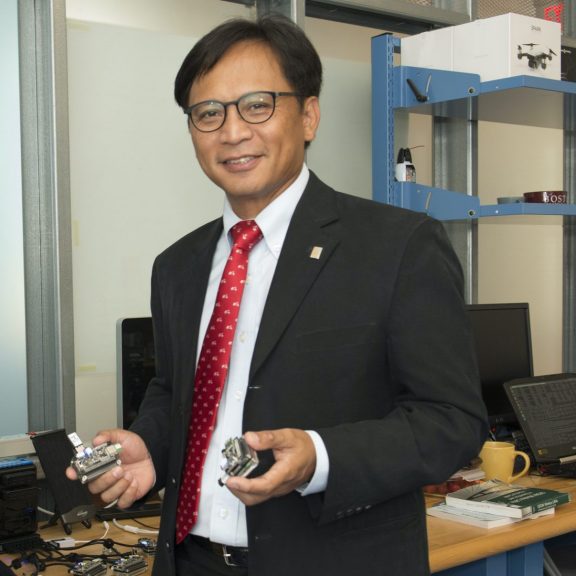
Moe Z. Win is the Robert R. Taylor Professor at the Massachusetts Institute of Technology (MIT), specializing in wireless communications, optical communications, and space communications systems. His research bridges theoretical and applied domains, including quantum sensing, network localization, and signal processing. B.S.E.E., Texas A&M (1987) M.S.E.E. & Ph.D., University of Southern California (1989, 1998) Recent work focuses on quantum-enhanced positioning, machine learning for localization, and next-generation (xG) non-terrestrial networks. He leads research at the Quantum neXus Laboratory (QX Lab), Wireless Information & Network Sciences Lab, and Laboratory for Information and Decision Systems. His career spans the Jet Propulsion Laboratory (1987-1995) and AT&T Research Laboratories (1998-2002). Key methodologies include soft information fusion, variational quantum sensing, and robust beam tracking for terahertz communications.
Aditya K. Jagannatham is a Professor in the Department of Electrical Engineering at the Indian Institute of Technology Kanpur (IIT Kanpur). With expertise in wireless communications and signal processing, he has established himself as a leading researcher in 5G/6G technologies, MIMO systems, and cognitive radio networks. His educational background includes: PhD in Electrical and Computer Engineering from UC San Diego (2007) M.S. in Electrical and Computer Engineering from UC San Diego (2004) B.Tech. in Electrical Engineering from IIT Bombay (2001) Professor Jagannatham's research primarily focuses on next-generation wireless communication systems, with special emphasis on 5G and 6G technologies. His work spans OTFS modulation, Terahertz communications, Visible Light Communication (VLC), Intelligent Reflecting Surface (IRS) technology, Massive MIMO, mmWave MIMO, Non-Orthogonal Multiple Access (NOMA), and Filter-Bank Multi-Carrier (FBMC) systems. His research integrates theoretical analysis with practical implementation challenges, addressing critical issues in modern wireless networks. His recent publications demonstrate a strong trend toward advanced signal processing techniques for next-generation wireless systems, particularly focusing on Sparse Bayesian Learning approaches for channel estimation, cooperative communication systems with energy harvesting capabilities, and millimeter wave MIMO technologies. His work bridges theoretical communication theory with practical implementation challenges in emerging wireless standards. Professor Jagannatham has received numerous prestigious awards and fellowships: Arun Kumar Endowed Chair Professorship (2019) Qualcomm Innovation Fellowship (2018) P.K. Kelkar Young Faculty Research Fellowship for excellence in research (2015-2018) IEEE Signal Processing Society travel grant to attend ICASSP 2015 Gopal Das Bhandari Memorial Distinguished Teacher Award (2012-13) Cal(IT)2 fellowship for graduate study at UC San Diego As an educator, Professor Jagannatham has received commendation letters from the Director of IIT Kanpur for excellence in teaching courses including EE624 Information and Coding Theory, EE670 Wireless Communications, and EE320 Principles of Communication Systems. His research has attracted significant funding, though specific grant details are not provided in the available information. He likely supervises graduate students working on cutting-edge wireless communication research. Professor Jagannatham is based in the Advanced Centre for Electronic Systems (ACES) at IIT Kanpur, where he leads research in wireless communications. His work appears to be closely connected with the Center for Developing Intelligent Systems (CDIS) and other research centers at IIT Kanpur focused on next-generation communication technologies.
Prof. Dr.-Ing. Thomas Zwick is a full professor and director of the Institute of High Frequency Engineering and Electronics (IHE) at the Karlsruhe Institute of Technology (KIT). He holds a Dipl.-Ing. (M.S.E.E.) and Dr.-Ing. (Ph.D.E.E.) from the University of Karlsruhe. His career includes roles at IBM Research (2001–2004), Siemens AG (2004–2007 managing automotive radar teams), and KIT since 2007. He leads research in high-frequency technologies, antennas, radar systems, and wireless communications. Research interests include radio wave propagation, antenna design, automotive radar architectures, and millimeter-wave systems. He has authored/co-authored over 400 papers, 20 patents, and received IEEE Fellow status (2018), honorary doctorate from Budapest University (2022), and membership in the Heidelberg Academy and acatech. His work emphasizes integrating sensing and communication systems, 3D-printed RF components, and high-frequency measurement techniques. Teaching focuses on high-frequency engineering, electronic circuits, and radar systems. He oversees the IHE’s laboratories, including the Microwave Engineering Lab and Student Innovation Lab. Recent work explores sub-THz communication, RIS-aided ISAC systems, and beamforming for reduced EMF exposure in urban scenarios.
Saleh A. Alshebeili is a Professor in the Department of Electrical Engineering at King Saud University's College of Engineering, Riyadh, Saudi Arabia. With over 139 publications spanning from 1991 to 2024, his research demonstrates significant contributions across multiple engineering disciplines. His academic profile shows consistent collaboration with Saudi research institutions and international partners, particularly in communications and signal processing fields. Dr. Alshebeili's research interests span wireless communications, optical networks, radar systems, and biomedical signal processing. His work bridges theoretical signal processing with practical applications in 5G/6G communications, IoT security systems, and healthcare monitoring. The interdisciplinary nature of his research connects electrical engineering with computer science, particularly through machine learning applications for signal analysis and system optimization. His publications demonstrate expertise in both traditional signal processing techniques and emerging AI-driven approaches to engineering problems. Analysis of his recent publications (2021-2024) reveals a strong focus on next-generation communication technologies including 6G systems, optical wavelength conversion, and OAM-SDM communication. Simultaneously, he maintains active research in biomedical applications, particularly EEG signal processing for seizure detection and biometric authentication using physiological signals. His work consistently appears in top IEEE journals including IEEE Access, IEEE Transactions on Wireless Communications, and IEEE Journal of Biomedical and Health Informatics, reflecting the high quality and relevance of his research. Dr. Alshebeili has established extensive collaborations with researchers across King Saud University, particularly with Fathi E. Abd El-Samie (29 co-authored papers), Turky N. Alotaiby (22 papers), and Amr Ragheb (21 papers). These long-term collaborations suggest leadership in research groups focusing on communications systems and biomedical signal processing. His work spans theoretical development, simulation, and experimental validation, as evidenced by publications with 'Experimental Investigation' and 'Experimental Demonstration' in their titles.
Juerg Leuthold is a Full Professor and Head of the Department of Information Technology and Electrical Engineering (D-ITET) at ETH Zürich, Switzerland. He also leads the Institute of Electromagnetic Fields (IEF) at the same institution. His academic career spans leadership roles at ETH Zürich, Karlsruhe Institute of Technology (KIT), and Bell Labs, with expertise in photonics, plasmonics, and THz technology for communication and sensing applications. Research Interests Photonics for high-speed communication Plasmonics and nonlinear optical signal processing Terahertz technology Applications in sensing and network systems Scientific Awards Optica Fellow IEEE Fellow ERC Advanced Grant (2015) Landesforschungspreis (Baden-Württemberg, 2009) Leadership & Committees Head of D-ITET (2023–present) General Chair of ECOC 2022 Board of Directors, OSA/Optica
Ian Phillips is a Teaching Fellow in Electronics & Computer Engineering at Aston University's College of Engineering and Physical Sciences. He specializes in optical communications, with a focus on Raman amplification, coherent transmission systems, and high data rate optical networks. His research spans topics such as ultra-wideband discrete Raman amplifiers, multi-band transmission, and nonlinear noise mitigation in fiber optic systems. Phillips holds a PhD in Optoelectronics (1998) under the supervision of Prof. I. Bennion, focusing on optical network processing using all-optical and electro-optical devices. His work emphasizes practical applications of advanced optical technologies, including experimental studies on Raman amplifier optimization, bismuth-doped fiber amplifiers, and hybrid amplifier designs for metro networks. Phillips has contributed to over 100 peer-reviewed publications and 24 datasets, often collaborating on projects involving ultra-high data rate transmission (e.g., 321 Tb/s systems) and novel signal processing techniques. His research has been funded through collaborative initiatives and leverages both experimental and numerical methods to advance optical communication systems. Notable contributions include the development of ultra-flat Raman-enhanced FOPAs, low-penalty dual-stage Raman amplifiers, and pioneering work in E-band transmission using bismuth-doped amplifiers. Phillips' expertise bridges theoretical photonics with practical system design, addressing challenges in bandwidth efficiency, signal integrity, and amplifier noise management.
Amalia Miliou is a Professor in the Department of Informatics at Aristotle University of Thessaloniki, where she has served since 1993, progressing through the academic ranks from Lecturer to her current position as Professor since 2022. She holds a PhD in Electrical and Computer Engineering from the University of Florida (1991) with specialization in Optoelectronics, following an MSc in the same field (1988) and a Physics degree from Aristotle University (1985). Her research focuses on optical communications systems, with specific expertise in optoelectronic circuits simulation, optical switching, optical RAM development, converged fiber-wireless technology, 5G networks, and secure optical communications using chaos theory. Over her career, she has supervised numerous graduate students across these research areas, with thesis topics spanning optical memory systems, fiber-wireless integration, chaos-based secure communications, and advanced optical network architectures. Her recent publications (2021-2024) demonstrate a strong focus on next-generation optical networking solutions for 5G/6G applications, including fiber-wireless convergence, optical memory systems for high-speed networks, and innovative approaches to optical signal processing. Her work bridges fundamental photonics research with practical telecommunications applications, particularly in addressing the bandwidth and latency challenges of modern mobile networks. Professor Miliou has served as the Coordinator of the LLP-ERASMUS student exchange program at the Department of Informatics since 1997 and has held various administrative positions including membership in the University Senate and General Assembly. She has led and participated in numerous research projects, most recently focusing on technological improvements for 5G systems through optical-wireless network development (2019-2021), next-generation healthcare applications leveraging 6G networks (2023-2027), and photonic integrated circuits for random access memory (2012-2015).
Professor Yue Rong is a Full Professor at Curtin University's Department of Electrical and Computer Engineering, within the School of Electrical Engineering, Computing and Mathematical Sciences. He holds editorial roles at IEEE Transactions on Signal Processing and IEEE Wireless Communications Letters. His research focuses on signal processing for communications, underwater acoustic systems, wireless networks, and healthcare IoT. Rong has authored over 140 journal and conference papers and received multiple awards, including the 2010 Young Researcher of the Year Award. Education: B.E. (Electrical Engineering), Shanghai Jiao Tong University (1999) M.Sc. (Electrical Engineering), University of Duisburg-Essen (2002) Ph.D. (Electrical Engineering), Darmstadt University of Technology (2005) Research Interests: Rong's work spans cooperative MIMO communications, underwater acoustic systems, OFDM modulation, radar-based healthcare monitoring, and secure wireless protocols. His innovations include adaptive modulation schemes for underwater environments and radar-based vital signs detection. Recent trends in his publications emphasize AI-driven signal processing for healthcare IoT and underwater optical communication systems. Awards: Best Paper Awards (WCSP 2011, APCOMM 2010) Chinese Government Award (2004) DAAD/ABB Fellowship (2001-2002) Grants & Labs: His research is supported by grants focusing on UAV-enabled data collection and underwater network optimization. He leads projects in the Distributed Data Fusion and Emerging Technologies (DDFE) lab, advancing radar-cardiography and wearable health monitoring systems.
Professor Wasiu O Popoola is a Professor of Communications Engineering and Director of Electronics and Electrical Engineering at the School of Engineering, University of Edinburgh . With over 150 publications and a RAEng/Leverhulme Trust Research Fellowship (2022), his work focuses on optical wireless communication systems including VLC/LiFi, FSO, and underwater optical communications. BSc (First Class Hons), MSc (Distinction), PhD in optical communications (Northumbria University) Professional memberships: Fellow of Higher Education Academy (FHEA), Fellow of IET (FIET), Senior Member IEEE Research Interests span Indoor/Outdoor/Underwater Optical Wireless Communication , Modulation Techniques , and LiFi Applications . His 2025 articles explore underwater turbulence mitigation and hybrid RF-water communication systems . Earlier works include Best Poster Award at IEEE ICSAE 2016 and top-downloaded IEEE Xplore article (2008). Scientific Awards include: 2022 RAEng/Leverhulme Trust Research Fellowship 2016 IEEE ICSAE Best Poster Award 2009 'Xcel Best Engineering and Technology Student' (PhD) He contributes to editorial work as Associate Editor (IEEE Access) , Guest Editor (Optik Journal) , and peer reviewer for Physics World . Recent projects involve BOLD (Defence Science and Technology Laboratory) and TITAN Extension (University of Strathclyde) focusing on diffuse optical wireless systems and UAV swarm networks .
Dr. Manav R. Bhatnagar serves as a Professor and Brigadier Bhopinder Singh Chair Professor in the Department of Electrical Engineering at Indian Institute of Technology Delhi. He ranks #517 globally in Networking & Telecommunications among the top 2% scientists worldwide according to Stanford University and is a Fellow of INAE, NASI, IET(UK), IETE, and OSI. His academic credentials include a Ph.D. in Signal Processing for Communications from University of Oslo (2008), M.Tech. in Communications Engineering from IIT Delhi (2005), and B.E. in Electronics from North Maharashtra University (1997). He has held visiting appointments at prestigious institutions including Aalto University (Finland), University of Rennes (France), University of Oslo, Indian Institute of Science Bangalore, and University of Minnesota. Dr. Bhatnagar's research spans cutting-edge domains including 5G/6G communication, optical wireless communication, quantum communication, molecular communication, power line communication, and machine learning applications. His work demonstrates significant interdisciplinary connections between communication theory, signal processing, and emerging technologies. His publication record shows a strong focus on wireless and optical communication systems, with recent work addressing challenges in jamming detection, quantum relay systems, IRS-assisted communication, and game-theoretic approaches to resource allocation. His research consistently bridges theoretical foundations with practical applications in next-generation communication systems. NASI-Scopus Young Scientist Award Shri Om Prakash Bhasin Award (2016) Dr. Vikram Sarabhai Research Award (2017) BASIC RESEARCH AWARD of IIT Delhi (2023) Sir Visvesvaraya Young Faculty Research Fellowship (2016) Senior Member of IEEE As an academic advisor, Dr. Bhatnagar has mentored numerous PhD students who have gone on to successful careers at institutions including IIT Jodhpur, IIT Roorkee, Aalto University, and IIT Kanpur. His editorial roles include current Editor of IEEE Transactions on Communications and former Editor of IEEE Transactions on Wireless Communications (2011-2014). His textbook "Telecommunication Switching Systems and Networks" has become a standard reference in the field.
Dr. Mohammed Elamassie is an Assistant Professor at Özyeğin University's Graduate School of Science and Engineering, Department of Electrical and Electronics Engineering. He co-directs the Centre of Excellence in Optical Wireless Communication Technologies (OKATEM) and holds senior memberships in IEEE and Optica. PhD in Electrical and Electronics Engineering (Özyeğin University, 2020) MSc in Electrical and Electronics Engineering (Islamic University of Gaza, 2011) BSc in Electrical and Electronics Engineering (Islamic University of Gaza, 2006) Dr. Elamassie's research focuses on optical wireless communication systems, with specific expertise in underwater visible light communication (UVLC), vehicular visible light communication (V2V), airborne free space optical (FSO) networks, and turbulence mitigation techniques. His work addresses atmospheric channel modeling, diversity techniques, and MIMO communication challenges across multiple mediums. Analysis of his 15 most recent publications reveals critical trends in UVLC turbulence modeling, FSO UAV optimization, RIS-aided systems, and vehicular communication reliability. These works demonstrate his leadership in developing practical solutions for channel degradation and mobility-induced challenges. Best Paper Award, IEEE Black Sea Conference (2019) IEEE Turkey PhD Thesis Award (2020) Senior Member, IEEE Senior Member, Optica Optica Traveling Lecturer/Speaker Dr. Elamassie serves as Review Editor for Frontiers in Communications and Networks, covering 'Non-Conventional Communications' and 'Wireless Communications' sections. He contributes to OKATEM's research on optical wireless technologies, focusing on practical implementations across underwater, vehicular, and airborne domains.
Omid Habibpour is an Assistant Professor at the Microwave Electronics lab within Chalmers University of Technology. His research focuses on graphene-based devices and MMICs for high-frequency applications. B.Sc.: Electrical Engineering (Telecommunication Systems), Sharif University of Technology (2002) M.Sc.: Optical Telecommunication Systems (with honors), Amirkabir University of Technology (2004) His research spans Graphene Electronics , Microwave Engineering , and Terahertz Technology , emphasizing material characterization, device modeling, and MMIC design for high-data-rate communication systems. Recent work includes voltage-dependent mobility studies and zero transconductance resistance analysis in graphene FETs. Projects include the Graphene Core Project 3 (European Commission) and Quad Band Infrared Detector (VINNOVA). Publications trend toward graphene integration in microwave/THz systems and SiC substrate applications.
Dr. Yi Wang is an Associate Professor and Department Chairperson of the Electrical and Computer Engineering Graduate Programs at Manhattan College, New York. He also serves as Director of the Electrical & Computer Engineering Graduate Program. His research focuses on machine learning, deep learning, cybersecurity, blockchain, and their applications in cyber-physical systems. Dr. Wang is an IEEE Senior Member (since 2021) and has secured NSF grants totaling over $149,000. Education: Ph.D. Computer Engineering, University of Alabama in Huntsville M.S. Computer Science, Wuhan University of Science and Technology B.S. Information Systems, Wuhan University of Science and Technology Research Interests: Machine learning and deep learning algorithms Cybersecurity for IoT and smart grids Blockchain applications in attribute-based access control Adversarial machine learning defense mechanisms Optical fiber communication systems Recent Publications Trends: His work spans blockchain platform comparisons, adversarial attack mitigation in power systems, and AI-driven smart home solutions. He frequently publishes in IEEE journals and conferences. Awards: Best Paper Award at 2017 IEEE UEMCON Best Paper Award at 2015 ICDIP Grants and Advising: Principal Investigator for NSF-funded UIRiSCS project (2022–2025). Co-Principal on NYC DOT Loading Zone Study. Recipient of Manhattan College Faculty Summer Grants (2021, 2017). Advises graduate students in cybersecurity and IoT research. Labs/Teams: Collaborates with the University of Zaragoza, Spain on smart systems research. Leads projects on plastic optical fiber networks and AI-driven smart home systems.
Thomas D. C. Little is a Professor at Boston University, USA, specializing in Visible Light Communication (VLC), Optical Wireless Communication, and Mobile Ad Hoc Networks. His research focuses on hybrid RF/VLC systems, interference mitigation, and dynamic network optimization under illumination constraints. Recent work includes 3D localization via zone-based positioning Dynamic FOV receiver optimization Multi-tier transmission for 5G Li-Fi Security-aware OFDM modulation Research interests center on integrating optical wireless with traditional RF networks, developing energy-efficient communication protocols, and creating positioning systems for smart spaces. Publications analyze spectral efficiency, channel modeling, and coexistence strategies in dense optical environments. Collaborations span institutions in the USA and Germany, with applications in Industry 4.0 and coastal monitoring systems. His team has contributed to ns-3 simulator extensions for VLC, beam control in FSO systems, and interference analysis in optical networks. Current projects address reconciling SNR models and optimizing handover parameters via Q-learning for heterogeneous deployments.
National and Kapodistrian University of AthensGreece
Nikas Thomas is an External Instructor at the Department of Informatics (DI) of the National and Kapodistrian University of Athens (NKUA). His work spans multiple interdisciplinary areas including quantum cryptography, fiber optic sensing technologies, and seismic monitoring. Key roles include advancing secure communication protocols through quantum key distribution (QKD) and developing novel Li-Fi transceivers using perovskite photodiodes. He also pioneers applications of Distributed Acoustic Sensing (DAS) for urban earthquake monitoring in Athens, leveraging existing fiber-optic infrastructure for environmental and geophysical studies. His research bridges theoretical frameworks (e.g., phase transmission analysis) with practical implementations in optical communication systems and seismic detection. Research interests focus on: Secure optical communication systems leveraging quantum principles Fiber optic-based seismic and acoustic sensing Emerging Li-Fi technologies for high-speed wireless networks Phase-sensitive fiber optic analysis for geophysical applications Publications from 2022-2024 highlight trends in: Quantum security protocols for optical and radio-over-fiber systems Urban DAS applications for earthquake monitoring Microwave frequency interferometry for low-cost seismic sensors No scientific awards are explicitly listed in the provided materials. His work often involves collaborative projects with industry and academic partners, though specific grants are not detailed here. Current projects include optimizing DAS for real-time urban seismic networks and exploring novel modulation formats for secure optical transmission.