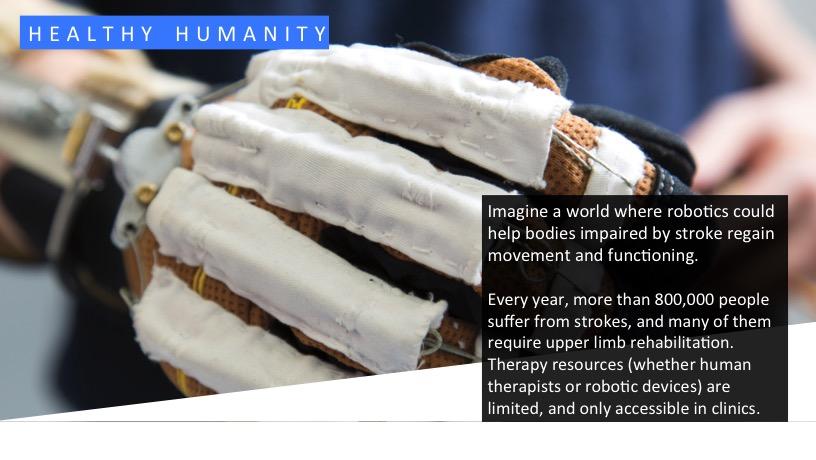
Matei Ciocarlie is an Associate Professor of Mechanical Engineering at Columbia University, focusing on robotics research spanning hardware design, control systems, and human-robot interaction. His work emphasizes robots operating in dynamic, unstructured environments, with applications in manufacturing, logistics, and healthcare. He holds affiliations with Columbia's School of Engineering and Applied Science and the Robotics Department. Education: Ph.D. in Mechanical Engineering from Columbia University (2010), with a doctoral dissertation on dexterous robotic grasping awarded the 2010 Robotdalen Scientific Award. Research Interests: Robotic hand design/control, human-in-the-loop manipulation, assistive robotics, tactile sensing, and rehabilitation technologies. His lab develops systems like wearable robotic orthoses for stroke patients and teleoperated robots with autonomous decision-making capabilities. Awards: IEEE Early Career Award (2015), ONR Young Investigator Award (2016), NSF CAREER Award (2016), Sloan Fellowship (2017). Grants & Collaborations: Led projects at Willow Garage and Google, contributing to ROS development. Current work includes NSF-funded tactile sensing research and NIH-sponsored assistive robotics initiatives. Labs: Active projects in Columbia's Robotics Lab and collaboration with medical institutions for clinical trials of robotic orthoses.
Michalis Vazirgiannis is a Professor at LIX, École Polytechnique (France) leading the Data Science and Mining (DaSciM) group. With academic backgrounds in Physics (Athens University), AI (Heriot-Watt University), and Informatics (Athens University), he has conducted research at Fraunhofer, Max Planck MPI, and INRIA/FUTURS while teaching at institutions across Greece, France, China, and Spain. His research spans Machine/Deep Learning for Graphs (GNNs, graph kernels, embeddings) Text Mining & NLP (Graph-of-Words, biomedical text analysis) Combinatorial Optimization for pandemic forecasting and energy systems Event/Anomaly Detection in time series and sensory data Industrial collaborations with Airbus, Google, Tencent, and BNP . He has supervised 29 completed PhD theses, published over 250 papers, and received prestigious awards including Marie Curie and Tencent Rhino-Bird Fellowships. His team leads the ANR-HELAS Chair (2020-2025) focusing on heterogeneous data deep learning.
Prof. Torsten Wolfgang Kuhlen serves as a Universitätsprofessor at RWTH Aachen University, leading the Teaching and Research Area for Virtual Reality and Immersive Visualization within the Department of Computer Science. He is affiliated with Chair of Computer Science 12 (High Performance Computing), the Visual Computing Institute, and remains an integral part of the RWTH IT Center where his research group operates one of the world's largest Virtual Reality laboratories including the 30 sqm aixCAVE visualization chamber. The group maintains strong connections with Computational Science & Engineering Division, National High Performance Computing Center for Computational Engineering Science (NHR4CES), and VR in Science and Industry Network NRW e.V. Prof. Kuhlen's research spans virtual reality, immersive visualization, and multimodal 3D user interfaces with applications across simulation science, production technology, neuroscience, and medicine. His work combines basic research on advanced methods and algorithms with interdisciplinary collaborations involving RWTH Aachen institutes, Forschungszentrum Jülich, and industry partners. Recent publications demonstrate strong focus on audiovisual perception, immersive analytics, collaborative virtual environments, and practical VR applications in education and manufacturing. His research group has produced significant work on listening effort in virtual environments, immersive authoring techniques, and VR applications for scientific visualization. Notable projects include VRScenarioBuilder for automated vehicle testing and applications in monitoring additive manufacturing processes. The group actively participates in major conferences including IEEE VIS and EuroVis, with several award-winning contributions. Prof. Kuhlen has advised PhD students including Martin Bellgardt who recently completed his doctoral degree on "Increasing Immersion in Machine Learning Pipelines for Mechanical Engineering". The research group maintains state-of-the-art VR infrastructure including the aixCAVE facility which is open to all RWTH research groups.
Eduardo Pereyra is a Professor in the McDougall School of Petroleum Engineering at The University of Tulsa, where he serves as Associate Director for the Tulsa Fluid Flow Projects (TUFFP) and the Horizontal Wells Artificial Lift Project (TUHWALP) . His academic career spans theoretical and applied research in multiphase flow, flow assurance, artificial lift systems, and separation technologies. Education: Ph.D. and M.Sc. in Petroleum Engineering from The University of Tulsa; Dual B.S. in Mechanical Engineering and Systems Engineering from the University of Los Andes, Venezuela Pereyra’s research focuses on multiphase flow dynamics , particularly in gas-liquid and oil-water systems. His work addresses critical challenges such as slug flow mitigation , downhole separator efficiency , and ESP motor cooling , leveraging computational fluid dynamics (CFD) and experimental validation. Recent publications emphasize inclined pipe flows , severe slugging mitigation , and plunger lift optimization . Pereyra has received multiple accolades, including the 2023 SPE Production and Operations Award and the 2022 Kermit Brown Outstanding Teacher Award . His contributions to multiphase flow modeling have been recognized through the 2021 Zelimir Schmidt Outstanding Researcher Award . He actively collaborates with industry partners through TUFFP and TUHWALP, directing projects like the Horizontal Wells Artificial Lift Initiative .
Henry F. (Hank) Korth is a Professor of Computer Science and Engineering at Lehigh University, with a courtesy appointment in the Department of Decision and Technology Analytics in the College of Business. He serves as Director of the Blockchain Lab in the Center for Financial Services and Co-Director of the Computer Science and Business Program. Korth is a Fellow of the ACM and IEEE, and a recipient of the VLDB 10-Year Award and Bell Labs President's Silver Award for contributions to database technologies. PhD in Computer Science from Princeton University MA, MSE in Computer Science from Princeton University BA in Mathematics from Williams College Korth's research spans database systems, blockchain systems, distributed systems, and real-time systems. He has pioneered transaction management in parallel and distributed systems, query processing, and the impact of modern computing architectures on database performance. His recent work focuses on blockchain applications in enterprise databases, including acceleration of zero-knowledge proofs, benchmarking frameworks, central-bank digital currencies, and private-yet-provable accounting systems. His contributions are rooted in both theoretical advancements and practical implementations, such as the QTM™ aggregation engine and the DataBlitz™ main-memory storage manager. Scientific awards include: ACM Fellow IEEE Fellow 10-Year Award at the VLDB Conference Bell Labs President's Silver Award Korth actively supervises research within the Blockchain Lab and is affiliated with the Scalable Software Systems Research Group at Lehigh. His scholarly output reflects a deep engagement with blockchain benchmarking, concurrency control, verifiable databases, and the evolution of database systems in response to technological shifts.
Tobias Hermann serves as an Associate Professor at the University of Oxford's Department of Engineering Science, where he leads research within the Oxford Thermofluids Institute and holds a prestigious UKRI Future Leaders Fellowship. Affiliated with St. Hilda's College as an Associate Research Fellow, his work centers on experimental hypersonics and advanced diagnostic development for extreme aerospace environments. Hermann earned his Dipl.-Ing. in Aerospace Engineering from the University of Stuttgart (2012) followed by a Dr.-Ing. degree (2017), with doctoral research focused on spacecraft re-entry phenomena and aerothermochemistry during atmospheric entry. His thesis involved developing optical diagnostics including Vacuum Ultraviolet spectroscopy and tomographic emission systems. His research program emphasizes experimental hypersonics and plasma flows , with core expertise in spacecraft re-entry physics , high-temperature material-flow interactions , and optical diagnostic innovation . Hermann pioneered analytical methods for transpiration cooling in porous media and developed system engineering tools for thermal protection systems. His current work bridges fundamental fluid dynamics with practical aerospace applications, particularly in hypersonic vehicle design and re-entry simulation through facilities like the T6 expansion tube. Analysis of Hermann's publication record reveals consistent focus on high-enthalpy flow diagnostics and thermal protection systems , with recent work advancing expansion tube capabilities for boost-glide re-entry simulation, integrated arc-jet facilities for ablating models, and vacuum ultraviolet spectroscopy for plasma flow characterization. His research demonstrates strong integration of experimental validation with analytical modeling across hypersonic testing regimes. Hermann's scientific recognition includes: UKRI Future Leaders Fellowship (2021-present) As an educator, Hermann supervises 4th-year undergraduate projects and DPhil (PhD) students in hypersonics while teaching Thermodynamics and Fluid Mechanics. His current research portfolio—primarily funded through his UKRI Fellowship—comprises three major thrusts: development of high-enthalpy wind tunnels (including the multi-mode T6 facility), pre-heating of hypersonic models using plasma flows, and advancement of measurement techniques like spatially resolved UV-nIR spectroscopy. These projects address critical gaps in hypersonic testing infrastructure and instrumentation. Hermann directs experimental efforts at Oxford's Southwell Laboratory within the Oxford Hypersonics group, operating facilities including the T6 Stalker tunnel, OPG1 plasma wind tunnel, and specialized arc-jet systems. His team develops cutting-edge instrumentation such as vacuum ultraviolet spectroscopy systems, high-speed focused Schlieren, and pressure-sensitive paint diagnostics to investigate complex phenomena in hypersonic boundary layers and re-entry flows.
Taylor Sparks is a Professor of Materials Science and Engineering at the University of Utah, where he also serves as Director of Graduate Affairs for the John and Marcia Price College of Engineering. He holds a PhD in Applied Physics from Harvard University, an MS in Materials from the University of California, Santa Barbara, and a BS in Materials Science & Engineering from the University of Utah. His research focuses on advancing materials discovery using machine learning to streamline and optimize material design, with applications in energy materials, dental materials, and sustainable engineering. His work integrates big data and materials informatics to explore new synthetic techniques, structure-property relationships, and sustainable materials that balance performance with economic factors. The Sparks Research Group has secured funding from agencies including DOE, NSF, DOD, and various industry partners. Sparks' recent research output demonstrates a strong trend toward leveraging artificial intelligence and machine learning to accelerate materials discovery, with particular emphasis on large language models for materials science, Bayesian optimization for experimental design, and novel approaches to crystal structure prediction. His work bridges the gap between theoretical predictions and experimental validation in materials science. NSF CAREER Award Royal Society Wolfson Visiting Fellow Acta Materialia Outstanding Reviewer Award for 2020 Honorary Outstanding Faculty Teaching Award of 2020-2021 Materials Science & Engineering Department Research Award for 2023 John G. Francis Prize for Undergraduate Student Mentoring Sparks has advised numerous graduate students who have gone on to successful careers in academia and industry. His research has been supported by significant grants from NSF, DOE, DOD, Army Research Office, and industry partners. His group has developed innovative tools including the Materialism Podcast, a materials science YouTube channel, and the Honegumi interface for Bayesian optimization, demonstrating his commitment to both research excellence and science communication. The Sparks Research Group operates multiple laboratories focused on materials characterization, synthesis, and informatics. They collaborate extensively with other institutions globally, host visiting researchers, and run outreach initiatives including the Materialism Podcast and YouTube channel to make materials science more accessible to broader audiences.
Prof. Dr. Michael Schloter serves as Director of the Research Unit for Comparative Microbiome Analysis at Helmholtz Munich since 2011 and holds a Professorship in Microbiology at the Technical University of Munich since 2010. He concurrently acts as Principal Investigator at both the German Center for Lung Diseases (DZL) and the Central for Food and Nutrition (ZIEL) at TU Munich, driving interdisciplinary research at the intersection of environmental and human health through the "Planetary Health" framework. His educational foundation was built through diploma studies at Ludwig Maximilian University Munich and doctoral research at the University of Bayreuth, followed by formative work in Brazil and the United States where he pioneered bioinocula development for stress-resilient agriculture. At Helmholtz Munich (formerly GSF), he evolved from group leader in soil microbial ecology (2001) to Research Unit Director, expanding his focus from agricultural systems to human microbiome-health connections. Dr. Schloter's research program centers on microbiome-host crosstalk across ecological scales, investigating how environmental microbiota interact with human and plant microbiomes to influence health outcomes. His work integrates ecological theory with microbiome analysis to decode host-microbe co-evolution patterns, with applications spanning sustainable agriculture, allergy prevention, and infection control. Key thematic pillars include holobiont theory, probiotic development, and microbiome-mediated disease prevention through environmental quality improvement. Analysis of his 2025 publications reveals a strategic research portfolio bridging fundamental and applied microbiome science. Agricultural studies dominate (maize, potato, apple systems), examining microbial inoculants and soil management, while human health investigations explore preterm birth complications and Antarctic mammal microbiomes. Computational approaches for antimicrobial resistance assessment and ecosystem-scale projects like JenaTron demonstrate methodological breadth, all converging on translating microbiome functionality into real-world sustainability solutions. Major recognitions include: Election to the Bavarian Academy of Science (2021) Consistent placement among the top 1% of highly cited global researchers (2019-2021) Heinrich Baur Research Award (2011) for agricultural microbiology contributions As Research Unit Director, Schloter leads large-scale collaborative initiatives including the DZL and ZIEL consortia, securing major funding for microbiome standardization projects and international research networks. His leadership extends to developing analytical frameworks for cross-ecosystem microbiome comparisons and establishing protocols for translating microbial ecology principles into clinical and agricultural applications. The Comparative Microbiome Analysis unit operates as a nexus for multi-host microbiome research, employing comparative genomics, field-scale agricultural trials, and clinical cohort studies to investigate microbiome dynamics across environmental, plant, and human systems. Current infrastructure includes advanced sequencing facilities and experimental platforms for plant-microbe and host-microbe interaction studies under controlled and natural conditions.
Giuliano Di Baldassarre is a Professor of Hydrology and Environmental Analysis at the Department of Earth Sciences, Uppsala University , Sweden. He serves as Head of Division for LUVAL (Air, Water and Landscape Sciences) and directs the Centre of Natural Hazards and Disaster Science (CNDS) (2016–2025). His work bridges water, environment, and society through interdisciplinary methods , focusing on disaster risk reduction, climate adaptation, and sustainable development. Education : Details not explicitly provided in the text. His research examines feedbacks between human activities and hydrological processes , including floods, droughts, and reservoir management . Key themes include social-ecological systems , inequalities in water crises , and policy implications of hydrological extremes . He has pioneered sociohydrology and human-water system modeling . Recent articles highlight global drought-flood interactions , urban water inequality , climate service maladaptation , and sociohydrological modeling . His work spans Nature Sustainability , Science Advances , and Hydrological Sciences Journal . Scientific Awards : International Hydrology Prize (Volker Medal) Plinius Medal (EGU) Witherspoon Lecture Award (AGU) European Research Council Consolidator Grant He led Panta Rhei - Everything Flows (2013–2022), IAHS’s global initiative on water-society interactions. Current efforts include transdisciplinary praxis and climate risk reduction frameworks .
Hamza Salih Erden is an Associate Professor (Docent) at the Informatics Institute of Istanbul Technical University in Turkey. His research focuses on energy optimization in data centers, thermal management systems, and computational fluid dynamics applications. With over 34 research outputs and an h-index of 12, he leads projects in energy-grid integration and carbon-aware load management. Research Focus Dr. Erden's work centers on improving energy efficiency in technological infrastructure through: Advanced cooling techniques for data centers Integration of thermal energy storage systems Computational fluid dynamics modeling Demand-response optimization for smart grids AI-driven monitoring of energy systems Publication Trends Recent works (2022-2025) demonstrate strong focus on sustainable energy technologies, particularly optimization of data center operations through thermal management innovations, integration of renewable energy solutions, and AI applications for system monitoring. Economic assessments of energy-saving techniques feature prominently. Awards and Recognition Technical Paper Award (2016) Multiple International Scientific Publication Incentive Awards (2017-2021) Poster Award (2012) Graduate Student Grant (2007) Projects and Funding Leads multiple energy research projects including: Carbon-aware load management in data centers (2025) Grid-integrated energy system modeling for data centers (2021-2023) CFD analysis of CRAH bypass methods (2018-2020) Economizer applications in Turkish data centers (2016-2017)
Professor Ian Cousins is a leading researcher in the Department of Environmental Science at Stockholm University, specializing in the study of persistent organic pollutants, particularly per- and polyfluoroalkyl substances (PFAS). With over 200 peer-reviewed publications and recognition as a Highly Cited Researcher in 2018 and 2020, his work has significantly influenced environmental policy and scientific understanding of chemical pollution. BSc (Hons) in Chemistry, University of York (1989) Master's in Environmental Management, University of Surrey (1991) PhD in Environmental Science, Lancaster University (1998) Prof. Cousins' research focuses on the sources, transport, fate, and exposure pathways of contaminants in the environment, with particular emphasis on PFAS. His work combines experimental and modeling approaches to investigate how these persistent chemicals move through ecosystems, with recent studies examining sea spray aerosol transport of PFAS and their global distribution. His research has contributed to understanding PFAS as a planetary boundary issue, demonstrating that environmental contamination by these substances has exceeded safe operating limits. Prof. Cousins' extensive publication record shows a clear trend toward addressing the complex challenges of PFAS pollution, including their environmental behavior, risk assessment methodologies, regulatory frameworks, and the application of the essential-use concept for phasing out non-essential PFAS applications. His work spans fundamental environmental chemistry to policy-relevant research that has directly influenced European environmental decision-making. Highly Cited Researcher (2018, 2020) Listed among 30 EU politicians and professionals with greatest impact on European environmental policy (2023) Associate Editor of Environmental Science and Technology (2020-present) Associate Editor of Environmental Au (2021-present) Prof. Cousins actively supervises master's students focusing on organic pollutants and has coordinated major research projects including PERFORCE3, a Europe-wide doctoral training program on PFAS, and ZeroPM, targeting PFAS and persistent, mobile substances. His research has been supported by multiple European Union Horizon 2020 grants, reflecting the significance and impact of his work on global environmental challenges. He leads a research group that works closely with analytical chemists to better understand the behavior of PFAS and other contaminants, contributing to the development of evidence-based approaches for managing chemical pollution and protecting environmental and human health.
Rima Alaifari is currently an Assistant Professor for Applied Mathematics at ETH Zürich , where she works on applied analysis, inverse problems, and scientific machine learning. Her research emphasizes stability analysis and regularization of inverse problems, applied harmonic analysis, phase retrieval, and operator learning. She is an associated member of the ETH AI Center and will transition to a full professorship at RWTH Aachen University in 2025 as Chair of Analysis and its Applications. Education : PhD in Mathematics (2010–2014, Vrije Universiteit Brussel); MSc in Applied and Industrial Mathematics (2005–2010, Johannes Kepler University) Research Focus : Stability estimates for inverse problems, phase retrieval in wavelet/Gabor transforms, operator learning with neural networks, and deep learning robustness. Article Trends : Her recent work bridges harmonic analysis with machine learning, focusing on phase retrieval stability, adversarial perturbations in imaging, and mathematically grounded neural operator frameworks like ReNO and CNO. Advising : She has supervised PhD students like Tandri Gauksson and Matthias Wellershoff. Former postdoctoral researchers include Francesca Bartolucci (now at TU Delft) and Jesse Railo (Finnish Inverse Prize winner).
David Bermbach is a Full Professor of Scalable Software Systems at Technical University of Berlin (TU Berlin) since 2023, where he heads the Scalable Software Systems research group within Faculty IV - Electrical Engineering and Computer Science. He is also co-affiliated with the Einstein Center Digital Future (ECDF). Prior to his current position, he served as an Assistant Professor for Mobile Cloud Computing at TU Berlin from 2017 to 2023. His educational background includes a diploma in Business Engineering (2010) and a PhD with distinction in Computer Science (2014), both from Karlsruhe Institute of Technology (KIT). Prof. Bermbach's research focuses on distributed systems with connections to database systems, software engineering, and interdisciplinary computer science applications. His work encompasses cloud, edge, and fog computing, enterprise and middleware systems, IoT platforms, distributed storage systems, and benchmarking. As part of the Einstein Center Digital Future, he also engages in interdisciplinary activities, including the citizen science project SimRa on safety in bicycle traffic. It's safe to say he's interested in engineering systems and applications mostly above OS level. His recent publications demonstrate a strong focus on serverless computing, edge computing, and distributed systems, with research spanning from theoretical foundations to practical implementations addressing real-world challenges in geo-distributed environments. Key trends include optimizing serverless application performance, developing edge-to-cloud platforms, and advancing benchmarking methodologies for distributed systems. Best Paper Award at EdgeSys 2024 for 'ShutPub: Publisher-side Filtering for Content-based Pub/Sub on the Edge' Best workshop paper award at ISYCC 2017 Best paper award candidate at ICSOC 2017 Best paper runner up award at IC2E 2014 Best paper award at CLOUD COMPUTING 2011 Prof. Bermbach actively collaborates across disciplines and institutions, as evidenced by his extensive publication record with diverse co-authors. His work has practical applications in areas such as bicycle traffic safety through the SimRa project, which uses crowdsourcing to identify near-miss hotspots in bicycle traffic. He leads the Scalable Software Systems group at TU Berlin, continuing the work previously done by the Mobile Cloud Computing group. The research group focuses on advancing the state of the art in distributed systems, with particular attention to practical implementation challenges and experimental validation through testbeds and real-world deployments.
Professor Ingrid Undeland leads the Marine research group at the Division of Food and Nutrition Science, Department of Life Sciences at Chalmers University of Technology. She is a distinguished researcher with expertise spanning marine food science, lipid chemistry, and blue biorefining, having established herself as a leading figure in sustainable seafood research and marine biotechnology. Her educational background includes food science studies from Linnaeus University and a PhD in bioscience from Chalmers University of Technology and SIK (now RISE). Between 1999-2002, she was a post-doctoral fellow at University of Massachusetts Marine Station, which significantly shaped her research trajectory in marine food science. Professor Undeland's research focuses on pioneering next-generation seafood through innovative value chains from seaweed, small pelagic fish, fish side streams, mussels, and microalgae. Her specialized expertise lies in marine lipids and proteins, particularly their stabilization, isolation from complex sources, and nutritional properties including digestibility. She has extensive experience with antioxidant strategies using plant-derived side streams or extracts and fundamental studies of fish hemoglobins as pro-oxidants. Her work also encompasses innovative technologies for biomass fractionation and nutrient recycling to build blue biorefineries, along with in vitro digestion models and general seafood analytics. Beyond marine research, she explores filamentous fungi as sustainable alternative food protein sources. The trends in her recent publications reveal a strong emphasis on valorizing marine resources through advanced processing techniques. Her work increasingly focuses on sustainable extraction methods for seaweed proteins, particularly Ulva fenestrata, and developing antioxidant strategies using berry side streams to stabilize fish proteins. There's a growing interest in understanding the nutritional properties and digestibility of alternative marine proteins, along with environmental assessments of processing technologies. Her research consistently bridges fundamental science with practical applications for creating sustainable seafood value chains. Swedish representative in Nordic Lipidforum, WEFTA, and EuCheMS Editorial board member of Journal of the Aquatic Food Product Technology Member of the National Committee for Nutrition and Food Science at the Royal Swedish Academy of Sciences Co-founder of the startup company AquaFood H-index of 47 according to Google Scholar Professor Undeland has an extensive record of academic mentorship, having supervised or currently supervising 23 PhD students, 14 postdoctoral researchers, and examining over 25 MSc students. Her research is supported by numerous grants, including the WaSeaBi Project which focuses on valorizing seafood side-streams through holistic value chain design. She collaborates with various industry partners and academic institutions across Europe. Her laboratory includes technicians Dr. Karin Larsson and Dr. Rikard Fristedt, and she leads a dynamic research team working on multiple projects related to marine biorefining and sustainable seafood development. Her research group operates within well-equipped facilities at Chalmers University, with specialized laboratories for marine food analysis, protein extraction, lipid oxidation studies, and in vitro digestion modeling. The team also maintains cultivation systems for seaweed and filamentous fungi, enabling integrated research from raw material production to final product development.
Prof. Dr. Johan Robertsson is a Full Professor of Applied Geophysics and Head of the Exploration and Environmental Geophysics (EEG) Group at ETH Zürich's Department of Earth and Planetary Sciences. He holds a MSc from Uppsala University (1991) and a PhD in Geophysics from Rice University (1994). Before joining ETH in 2012, he spent 15 years at Schlumberger in R&D roles, leading projects that revolutionized marine seismic data acquisition. His research focuses on wave propagation physics, seismic data inversion, and applications in exploration and environmental geophysics. He pioneered the use of Distributed Acoustic Sensing (DAS) for landslide monitoring and contributed to Mars seismology via the InSight mission. Education: MSc in Engineering Physics, Uppsala University (1991) PhD in Geophysics, Rice University (1994) Research Interests: Seismic wavefield modeling and inversion Planetary seismology (Mars, Moon) Acoustic metamaterials and wave control Environmental geohazard monitoring Marine seismic acquisition techniques His work on the Martian soil properties using InSight data and lunar exploration instrumentation (ALGEP) reflects his cross-disciplinary approach. He holds 90+ patents and has secured prestigious grants like the ERC Advanced Grant. Awards: EAGE Guido Bonarelli Award (2020) ERC Advanced Grant MATRIX (2017) EAGE Conrad Schlumberger Award (2018) Grants & Advising: Led the MATRIX ERC project advancing seismic imaging algorithms Advised over 20 PhD/MS students (names not listed) Secured Schlumberger's largest R&D project in marine seismic sampling His EEG Group operates cutting-edge labs for immersive wave experimentation and planetary geophysical instrumentation. Current initiatives include lunar subsurface exploration and acoustic invisibility experiments.