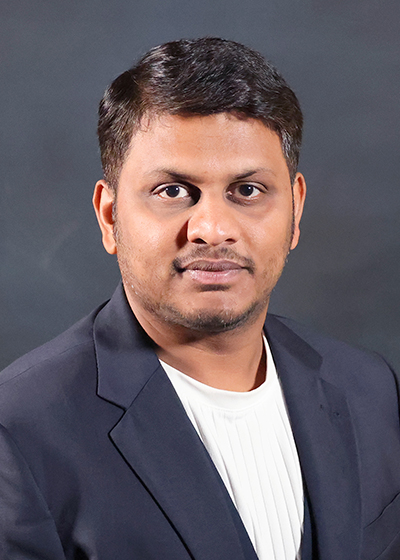
Prateek Shantharama is an Assistant Research Professor in the Department of Electrical and Computer Engineering at Mississippi State University. He holds a Ph.D. in Electrical and Computer Engineering from Arizona State University (2022), an M.S. in Computer and Network Engineering from The National Institute of Engineering, India (2016), and a B.E. in Electronics and Communications Engineering from Siddaganga Institute of Technology, India (2014). His research focuses on advancing wireless communication and networking technologies, including Open Radio Access Network (O-RAN), 5G and beyond systems, and the integration of machine learning and AI for optimizing wireless systems. He also explores hardware acceleration, resource allocation, network function virtualization, and software-defined networking (SDN). His work emphasizes practical implementations and performance improvements in next-generation communication networks. No scientific awards or grants are explicitly mentioned in the provided information. His office is located in 216 Simrall Engineering Building, and he can be reached via phone at 662.325.2047.
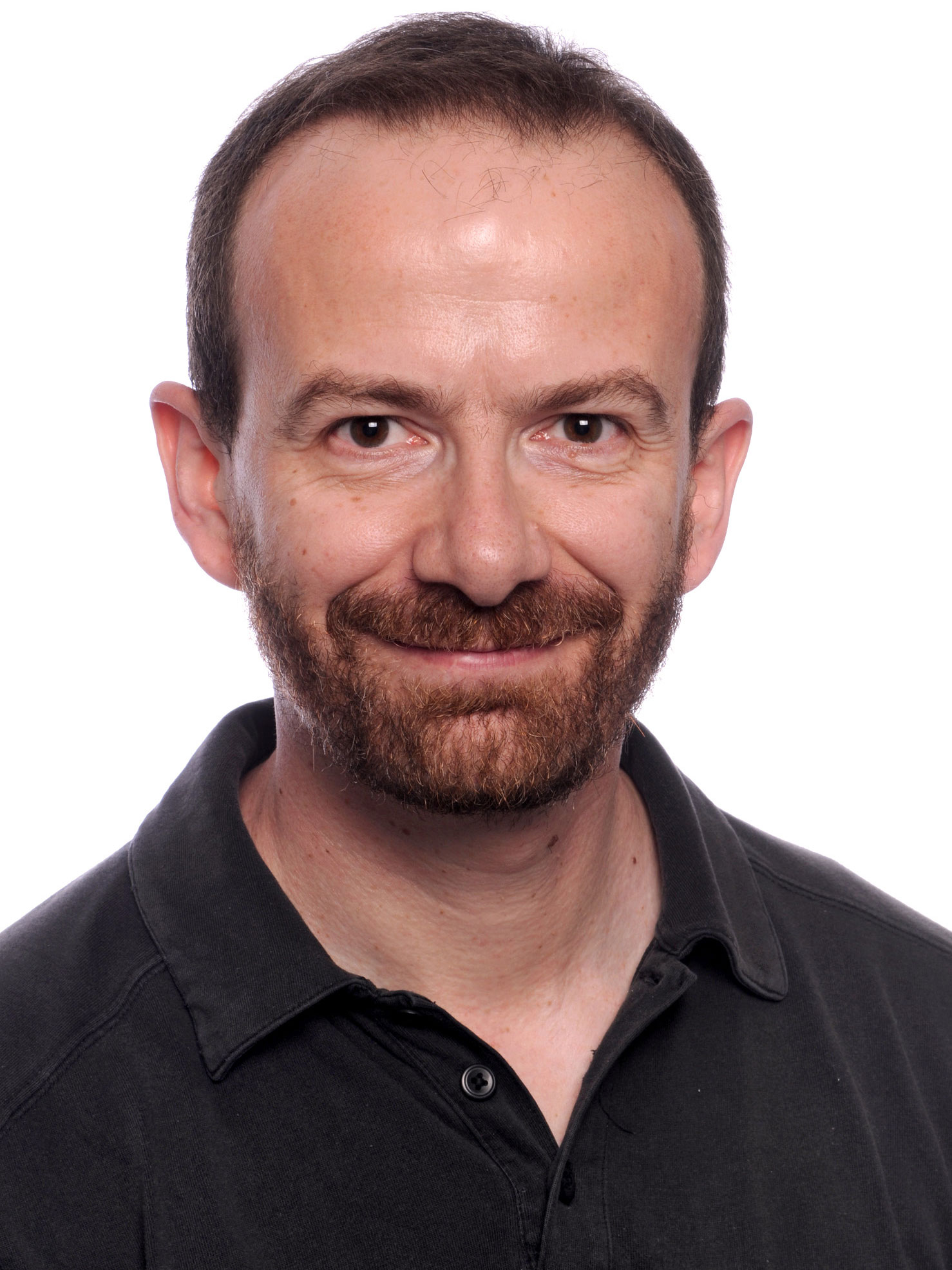
Dr. Rafik Zitouni is a Research Fellow and Lead Software Engineer at the University of Surrey's School of Computer Science and Electronic Engineering, affiliated with the Institute for Communication Systems. His work focuses on wireless communication protocols, IoT security, vehicular networks, and adaptive networking solutions. He has contributed to advancements in 6TiSCH, LoRaWAN, and MQTT protocols, with an emphasis on security mechanisms, network optimization, and machine learning applications. Research interests include securing industrial IoT networks, vehicular emergency messaging systems, and low-power wide-area networks (LPWAN). He has pioneered techniques such as fuzzy logic-based detection of selfish nodes in 6TiSCH and Fuzzy C-Means clustering for LoRa parameter optimization. His work on FPGA-based sensor fusion for autonomous vehicles addresses real-time data processing challenges. Key contributions span 20+ peer-reviewed publications in journals like Wireless Networks and Computer Communications , and conferences including IWCMC and MENACOMM. He actively collaborates with industry and academia on open radio access networks (O-RAN) and underwater localization systems. Current research emphasizes machine learning-driven network automation and resilient IoT infrastructure.
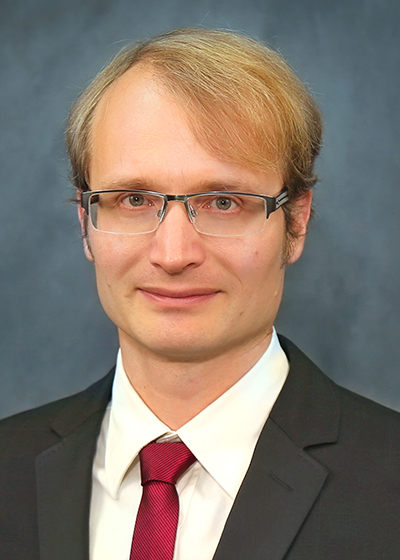
Stefano Basagni is a Professor in the Department of Electrical and Computer Engineering at Northeastern University, Boston, and serves as Associate Dean of the Global Engineering Campus. He holds dual PhDs from the University of Texas at Dallas (2001) and the University of Milan (1998), along with a B.Sc. from the University of Pisa (1991). His research focuses on wireless networks, underwater sensor systems, and protocol design/testing, with a strong emphasis on IoT and 5G/6G technologies. Basagni leads Northeastern's Institute for the Wireless Internet of Things and has secured grants for projects like the X-Mili platform and PAWR testbeds. He has published over 120 refereed papers, achieving an h-index of 54, and co-authored three books. His editorial roles include guest editorships for ACM/IEEE journals and TPC co-chair positions at conferences like SECON 2019 and IEEE Globecom. He is an ACM Distinguished Scientist, IEEE Senior Member, and recipient of the 2017 Faculty Research Team Award. Research highlights include SEANet (underwater IoT), NeutRAN (open RAN architectures), and contributions to O-RAN standards. His work on wake-up radio technology and energy-efficient protocols has been widely recognized. Basagni has advised numerous students and collaborates on initiatives like the Global Experiential PhD program.
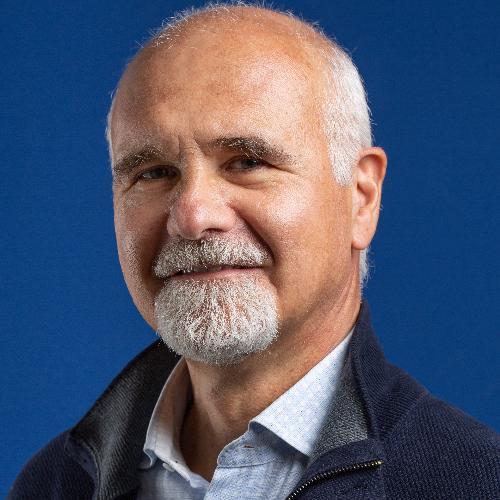
Jacobus Van der Merwe is a Professor in the Department of Computer Science at the University of Utah's School of Computing. His research spans Networking , Security , and Mobile Networking , with a focus on wireless spectrum management, SDN/NFV, and cloud-based network infrastructure. Current projects: TCloud, PhantomNet, POWDER platform Leadership: Directed research in Radio Dynamic Zones, Zero-Trust architectures, and O-RAN systems Collaborations: Involved in IEEE and ACM conferences, Flux research group Research trends include: Wireless spectrum sharing and security (SigDetect, OZTrust) SDN/NFV applications in mobile networks (dNextG, RESCue) AI-driven network optimization (Spectrum LSTM prediction) Cloud-centric security and transparency (CloudSight, CapNet) Scientific awards include a Best Paper Award at IEEE DySPAN 2024 for POWDER-RDZ research. Advising and grants : Mentored numerous PhD/Master's students like Kirk Webb, Ryan West, and Hao Jiang. Secured funding for initiatives like the POWDER platform and PhantomNet infrastructure.
David M Johnson is a Researcher and Software Engineer at the School of Computing, University of Utah, specializing in cloud infrastructure, wireless systems, and network security. He designs and builds software for large-scale testbeds like CloudLab, CapNet, and POWDER, focusing on low-level system interactions and secure network architectures. Research Interests: His work spans computer systems virtualization security forensics software-defined networking (SDN) capability-based network design mobile sensor networks and emphasizes least-privilege principles and end-to-end containment in cloud and wireless environments. Publication Trends: Recent articles highlight his contributions to radio dynamic zones open RAN (Radio Access Network) slicing spectrum sharing secure network capabilities testbed automation kernel-level debugging with a strong focus on open-source tool development for wireless and cloud research. Scientific Recognition: He received the 2024 IEEE DySPAN Award Paper for his work on POWDER-RDZ. Collaborative Efforts: Johnson has worked extensively with teams on projects like A3 (attack diagnosis), Stackdb (stackable debugging), and SeaCat (secure application containment), often bridging systems software with security and network innovations.
Dr. Vuk Marojevic is an Associate Professor in the Department of Electrical and Computer Engineering at Mississippi State University (MSU), holding the Paul B. Jacob Chair. He leads research in wireless communications, focusing on open radio access networks (O-RAN), AI-driven security, and UAV (drone) communications. His work emphasizes software-defined radio (SDR), spectrum sharing, and testbed development for 5G/6G networks. Education: Ph.D. and M.S. in Electrical Engineering from Barcelona Tech–UPC (Spain) and University of Hannover (Germany), respectively. Key projects include leading NSF-funded initiatives like AERPAW and Open Artificial Intelligence Cellular (OAIC), which prototype AI-enabled control systems for cellular networks. He also co-designed the AERPAW testbed for UAV experimentation. Research interests span O-RAN security, AI at the physical layer, wireless security protocols, and vehicular communications. His contributions include open-source implementations of 4G/5G protocols and frameworks for secure slicing and intrusion detection in O-RAN deployments. He actively collaborates with industry and academic partners to advance standards for unmanned aircraft systems (UAS) in cellular networks. Publications highlight innovations in reinforcement learning for resource allocation, RIS (reconfigurable intelligent surfaces) applications, and secure UAV communications. He serves as an associate editor for IEEE Transactions on Vehicular Technology and IEEE Vehicular Technology Magazine. Current research includes prototyping zero-trust security architectures (ZTRAN) and evaluating interference mitigation in drone corridors. He mentors students in MS and Ph.D. programs focusing on wireless systems, security, and AI integration in next-gen networks.
Navrati Saxena is an Associate Professor in the Department of Computer Science at San José State University (SJSU), California, USA. She previously served as an Assistant/Associate Professor and Director of the Mobile Ubiquitous System Information Center (MUSIC) at Sungkyunkwan University (SKKU), South Korea. Her research focuses on next-generation wireless networks (5G/6G), IoT, vehicular communications, satellite networks, and machine learning applications in telecommunications. She holds a Ph.D. in Informatics and Communications Engineering from the University of Trento, Italy. Education: Ph.D. in Informatics and Communications Engineering, University of Trento, Italy (2005). Research Interests: 5G/6G wireless systems, IoT, social networking, smart grids, D2D communications, vehicular networks, satellite communications, and machine learning-driven network optimization. Her work spans energy efficiency, network architecture design, and disaster-resilient connectivity. Grants & Awards: Secured over $465,000 in research grants from institutions like the Korea Research Foundation and Samsung. Notable awards include the Young Scientist Best Paper Award (Indian Science Congress Association, 2006-2007). Professional Contributions: Supervised 12 Ph.D. students and 22 MS researchers at SKKU. Authored/co-authored one book, two book chapters, and over 90 international journal/conference papers. Served as a guest editor for journals and TPC member for IEEE conferences. Active in diversity initiatives at SJSU, including leadership roles in DEI and anti-racism committees. Labs & Teams: Leads the Mobile Ubiquitous Systems Information Center (MUSIC) at SJSU, focusing on edge-cutting research in wireless networks and education.
Dr. Shih-Chun Lin is an Associate Professor in the Department of Electrical and Computer Engineering at North Carolina State University, part of the College of Engineering. His research focuses on wireless software-defined networking systems, IoT, cyber-physical systems, and communications technologies. He holds a Ph.D. in Electrical and Computer Engineering from Georgia Institute of Technology (2017). His research interests include machine learning applications in networking, network function virtualization, and wireless communication in challenging environments such as underground and underwater systems. He has contributed to advancements in edge computing, vehicular networks, and satellite communication protocols. Dr. Lin has been recognized with awards including the 2020 Distinguished TPC Member Award at IEEE INFOCOM and the 2016 Best Student Paper Award Runner-up at IEEE SCC. His work emphasizes practical implementations alongside theoretical analysis, addressing challenges in next-generation cellular networks and 6G technologies. His publications span topics such as satellite swarm dynamics, federated learning in edge networks, and optical cross-connect architectures. Collaborations focus on integrating AI-driven solutions for network optimization and resilience.
Roberto Riggio is a Researcher at the Department of Information Engineering within the College of Engineering at Marche Polytechnic University (UNIVPM) in Italy. His work focuses on cutting-edge networking technologies with an emphasis on edge computing, 5G/6G networks, and software-defined networking solutions. His research has significant implications for the future of telecommunications infrastructure and distributed computing systems. Dr. Riggio's research interests center around network architecture and management, with particular expertise in edge computing, network function virtualization, and federated learning systems. His work explores the intersection of artificial intelligence and networking, developing novel approaches for resource allocation, service placement, and network optimization. His publications demonstrate a strong focus on practical implementations that address real-world challenges in telecommunications, particularly regarding quality of service, latency management, and security in next-generation networks. Analysis of his recent publications reveals a clear research trajectory focusing on the convergence of AI and networking technologies. His work increasingly emphasizes edge-based AI applications, particularly federated learning implementations that maintain data privacy while enabling distributed intelligence. He has made significant contributions to network slicing, zero-touch management, and O-RAN architectures, with applications spanning from vehicular communications to IoT systems. His publications consistently address the critical challenges of latency, resource allocation, and security in modern networked environments. Dr. Riggio actively contributes to the academic community through his research projects and publications, though specific awards or fellowships aren't documented in the available materials. His work appears in reputable venues focused on networking and telecommunications research. While specific details about his advising activities and grant funding aren't provided in the available documentation, his extensive publication record suggests active involvement in research projects. His work appears to be connected to several European research initiatives, particularly those focused on 5G and beyond networks, edge computing, and software-defined networking solutions. The collaborative nature of many publications indicates participation in multi-institutional research efforts. Based on his publication topics, Dr. Riggio likely participates in research groups or labs focused on networking and telecommunications at UNIVPM. His work on projects like AI@EDGE, O-RAN implementations, and network management platforms suggests involvement with specialized research teams developing next-generation networking solutions. His research has practical applications in areas including connected and automated mobility, IoT infrastructure, and content delivery networks.
Raffaele Bolla is a Full Professor at the Department of Naval, Electrical, Electronic and Telecommunication Engineering (DITEN) within the University of Genova, School of Engineering. He specializes in telecommunications, with research focusing on energy efficiency, 5G/6G networks, network virtualization, and green technologies. He coordinates the Master's Degree program in Telecommunications Engineering and teaches courses including Cyber Security , Internet and Multimedia Engineering , and Wireless Networks (5G) and Cloud/Edge Computing . Research Interests: Energy-efficient network design 5G/6G network virtualization Machine learning for network optimization Sustainable telecommunications Human-machine interaction in industrial networks Smart grid technologies His recent publications address container scaling, network observability, and power consumption in next-generation networks. He leads projects like RESTART and contributes to standards in energy-efficient networking.
Ralf Tönjes is a Professor of Mobile Communications and Project Management at Osnabrück University of Applied Sciences , leading the Mobile Communications Working Group . His affiliation is under the Faculty of Engineering and Computer Science . Previously, he held roles at Ericsson Corporate Research and earned a doctorate summa cum laude in Electrical Engineering from the University of Hanover (1998). He holds dual degrees: a Dipl.-Ing. in Electrical Engineering/Communications (University of Hanover, 1989) and an M.Phil. in Biomedical Engineering (University of Strathclyde, Glasgow, 1990). Research Focus: Mobile communication networks, IoT applications in Industry 4.0/smart cities, data security, and service platforms. Key areas include 5G networks, network synchronization, and secure IoT device configurations. He chairs conferences like the VDE/ITG Mobile Communications Conference (since 2005) and contributes to standardization bodies such as the ITG Technical Committee 5.2. Patents & Innovation: Holds patents on cellular radio network design, multicast transmission protocols, and IoT broadcast systems. Notable projects include OPeRAte (IoT-based cooperative farming) and CityPulse (smart city data analytics). Awards & Leadership: Recognized for his doctoral achievement and as a founding member of the Lower Saxony Data Protection Center (NDZ) . Active in industry partnerships, including the Agricultural Industry Electronics Foundation (AEF) and the iuk Business Network Osnabrück . Teaching: Offers courses on mobile communications, IoT, telematics, and project management across B.Sc./M.Sc. programs in Electrical Engineering and Computer Science. Future Work: Focused on advancing 5G/6G networks, secure IoT deployments, and resilient agricultural process management using BPMN and blockchain technologies.
Prof. Kanapathippillai Cumanan is a Professor in the School of Physics, Engineering and Technology at the University of York, UK. He holds a PhD in Signal Processing for Wireless Communications from Loughborough University and a BSc (First Class Honours) in Electrical and Electronic Engineering from the University of Peradeniya, Sri Lanka. Prior to his current role, he held post-doctoral positions at Newcastle University and Loughborough University, and was an academic visitor at the National University of Singapore. Research interests: Machine learning in wireless systems, 6G/NextGen WiFi, Non-Orthogonal Multiple Access (NOMA), Cell-Free Massive MIMO, Physical Layer Security, and Cognitive Radio Networks. Editorial roles: Associate Editor for IEEE JSAC (Machine Learning in Communications), IEEE Wireless Communications Letters, and IEEE Open Journal of Communications Society. His research focuses on advancing communication technologies through optimization and AI-driven solutions, with over 100 journal/conference publications. Awards include the Exemplary Editor Award (IEEE) and ORSAS fellowship (Cardiff University). Current PhD students include Mahboubeh Irannezhad Parizi and Chentong Li. Former students have graduated since 2018. Key contributions span theoretical frameworks and practical implementations for next-generation wireless systems, including cell-free architectures, secure communication protocols, and UAV-enabled networks. Active in technical program committees for IEEE ICC, Globecom, and WCNC conferences.
Brian Kim, Ph.D., is an Assistant Research Professor in the Joint Program in Survey Methodology at the University of Maryland. His research focuses on social network analysis, network sampling methodologies (including respondent-driven sampling), and population size estimation. He holds a Ph.D. in Statistics from the University of California, Los Angeles (2017) and a B.A. in Mathematics and Philosophy from Amherst College (2012). His work emphasizes innovative approaches to survey design and data collection, particularly in addressing challenges related to hard-to-reach populations. Recent publications explore covert communication techniques using adversarial machine learning in wireless networks, reflecting his interdisciplinary expertise in statistics and computer science. Key Research Trends: Kim’s articles highlight advancements in adversarial machine learning for network security, optimization of open RAN systems, and methodological improvements in respondent-driven sampling diagnostics. His studies bridge theoretical statistical frameworks with practical applications in modern communication systems and survey methodologies. Lab/Team Affiliations: His research is conducted within the Joint Program in Survey Methodology, collaborating with institutions and platforms globally to inform public policy and research practices.
Rahim Rahmani is a full Professor at Stockholm University's Department of Computer and Systems Sciences, where he leads the laboratory for Distributed Immersive Participation . His work bridges Distributed Systems , Internet of Things (IoT) , and Healthcare Technology , with a focus on security, edge computing, and immersive systems for societal challenges. Research Interests : Distributed Intelligence, Edge Computing, Blockchain, Extended Reality (XR), Adversarial Machine Learning, and Cognitive Controllers for 5G/6G networks. Teaching : Program Director for the Master's Programme in Computer and Systems Sciences, teaching courses on IoT, Network Security, and Computer Architecture. Publication Trends : His recent work emphasizes secure data sharing in IoV using Blockchain, Federated Learning for healthcare diagnostics (e.g., sepsis and COVID-19 detection), and XR platforms for autism support. Key subfields include Context-Aware Systems , Decentralized Identity Management , and Edge-Cloud Collaboration .
Dr. Kwang-Cheng Chen is a Professor in the Department of Electrical Engineering at the University of South Florida. His research focuses on wireless communications, machine learning applications in networks, robotics, and smart manufacturing systems. He holds a PhD from the University of Maryland (1989) and has affiliations with institutions like National Taiwan University and National Tsing Hua University. Dr. Chen has contributed extensively to IEEE journals and conferences, with over 400 publications since 1992. His work bridges theoretical advancements and practical applications in areas such as 5G/6G networks, edge computing, and multi-agent systems. He has collaborated with global researchers and industry partners, addressing challenges in network slicing, UAV-assisted communications, and resilient production systems. Research interests include: Machine Learning for Network Optimization Smart Factory Automation Ultra-Reliable Low-Latency Communications (URLLC) Edge and Fog Computing Multi-Agent Systems and Robotics Network Slicing and Virtualization Recent articles emphasize leveraging AI and reinforcement learning to solve complex problems in wireless networks (e.g., RIS-aided interference suppression) and robotic systems (e.g., multi-robot task allocation). His work often integrates theoretical models with real-world deployments, such as blockchain-enhanced UAV communication and federated learning in open RAN systems. Grants and collaborations involve government and industry projects on 6G architectures, IoT security, and smart city infrastructure. He leads interdisciplinary teams focusing on future communication systems and industrial automation.