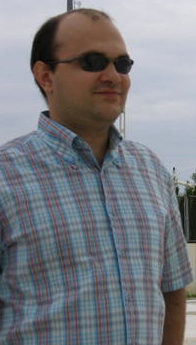
Francisco Mitropoulos is a Professor and Director of Computing in the Department of Computing at Nova Southeastern University's College of Computing & Engineering. He has been affiliated with the institution since 1995 and holds memberships in IEEE, Upsilon Pi Epsilon (UPE), and the ACM. His research focuses on software engineering methodologies, programming languages, compiler theory, aspect-oriented development, and mobile application design. Dr. Mitropoulos completed his doctoral studies at NSU, with dissertation research centered on software engineering principles. Research interests include data structures and algorithms, requirements engineering, and data mining applications. His work bridges theoretical computer science with practical software development challenges.
Dr Aaron Kans serves as Head of the Department of Computer Science and Digital Technologies at the University of East London (UEL), part of the School of Architecture Computing and Engineering. His roles include curriculum development, departmental leadership, and teaching across UEL’s computing programs. Notably, he has been at UEL for over 15 years and received the Best Lecturer award (UEL Student Led Teaching Awards) and the VC&P UEL Prize for Leadership through Change (2021). His research focuses on software engineering and innovative teaching methods in computing, with co-authored textbooks widely adopted nationally and internationally. Recent work includes exploring remote teaching strategies for programming education. He leads the ACE Research Group (Research Enhanced Learning & Teaching). Dr Kans has published extensively on Java programming, formal methods, and educational frameworks. His publications span textbooks like Java in Two Semesters and research on UML modeling in biomedical systems. Awards highlight his contributions to pedagogical innovation and institutional leadership during organizational changes. Labs/Teams: ACE Research Group (focusing on pedagogical innovation)
Walter S. Lasecki is an Associate Professor at the University of Michigan's School of Information, where he leads research at the intersection of Human-Computer Interaction, Crowdsourcing, and Artificial Intelligence. His work focuses on creating systems that integrate human and machine intelligence to solve complex problems in real-time. Dr. Lasecki's research interests center on human-AI collaboration, particularly in developing crowd-powered systems that enhance accessibility, improve programming education, and create more effective human-computer interfaces. His work explores how to effectively integrate human intelligence with AI systems, focusing on real-time applications where speed and accuracy are critical. His research has significant implications for accessibility technologies, educational tools, and conversational AI systems. He has pioneered approaches to real-time captioning, crowd-powered interfaces, and human-in-the-loop machine learning systems that adapt to user needs. Analysis of his recent publications reveals a strong focus on multi-agent conversational AI, human-in-the-loop systems for pose estimation and object recognition, and innovative approaches to programming education through live streaming. His research consistently explores the intersection of human computation and artificial intelligence, with particular attention to how crowd workers can complement and enhance AI capabilities. His work demonstrates a trajectory from foundational crowd-powered systems to more sophisticated integrations of human and machine intelligence in complex tasks. Dr. Lasecki has collaborated extensively with researchers across multiple institutions, particularly with Jeffrey P. Bigham (earlier in his career) and more recently with colleagues at the University of Michigan including Juho Kim. His research has been supported by substantial grants that have enabled the development of systems like Scribe for real-time captioning and Codeon for on-demand programming assistance. He has mentored numerous graduate students who have gone on to contribute to the fields of HCI and AI. His laboratory focuses on developing practical applications of crowd-AI hybrid systems, with particular emphasis on creating tools that can be deployed in real-world settings. Current projects explore how to make conversational AI more robust through multi-agent approaches, improve programming education at scale, and create more accessible interfaces for diverse user populations.
Xiaojia Zhang is an Assistant Professor in the Departments of Civil and Environmental Engineering and Mechanical Science and Engineering at the University of Illinois at Urbana-Champaign (UIUC), and also holds an appointment at the National Center for Supercomputing Applications (NCSA). He is a David C. Crawford Faculty Scholar. His research focuses on topology optimization, multi-material systems, composite materials, and sustainable design, with applications in mechanical, biomedical, and environmental engineering. Zhang’s work integrates computational mechanics, advanced material science, and additive manufacturing to develop innovative materials and structures. His key research interests include the design of meta-devices, programmable materials, and structures optimized for mechanical performance, energy dissipation, and environmental impact. Zhang has received prestigious awards such as the DARPA Director’s Fellowship Award (2024), DARPA Young Faculty Award (2022), and NSF CAREER Award (2021). His contributions span theoretical frameworks, computational tools (e.g., FEniTop software), and experimental validations of optimized structures. Labs/Teams : Active contributor to NCSA’s high-performance computing initiatives and collaborative projects in the College of Engineering. Advising & Grants : NSF CAREER-funded research in topology optimization and sustainability-focused grants. No formal advisee list provided.
Jan van Dijk is an Associate Professor in the Elementary Processes in Gas Discharges group at Eindhoven University of Technology (TU/e). He holds an MSc (1996) and PhD (2001) in Applied Physics from TU/e, followed by postdoctoral research at TU/e, the University of Illinois (USA), and Keio University (Japan). He received a NWO VENI grant in 2003 and is now leading projects like Plasma Power (2021–2027) and the Kinetic-Fluid Hybrid Plasma Model (2020–2024). His research focuses on plasma modeling, electromagnetic fields, transport phenomena, and C++ code design. Principal investigator on hybrid plasma models. Co-developed the LXCat data platform for plasma science. Research interests include low-temperature plasmas, biomedical applications, and open-source tools for plasma simulation. He contributes to the UN Sustainable Development Goals through plasma-based technologies. Award: NWO VENI Grant (2003) Teaching includes courses like Advanced Computational Fluid and Plasma Dynamics, Astrophysics, and Mathematical Physics. He has supervised 70 academic works and actively participates in conferences and invited talks.
Ciprian-Bogdan Chirila is an Associate Professor at the University Politehnica of Timisoara , affiliated with the Faculty of Automation and Computer Science . He has been with the institution since 2001, progressing from Teaching Assistant to Vice-Dean and UPT Senate Member. His academic roles include teaching Fundamental Concepts of Programming Languages Compiler Design Heuristic Methods Web Applications Security Research Interests focus on programming languages (especially Eiffel) and e-learning innovations. He pioneered reverse inheritance for class hierarchy optimization and developed Auto-generative Learning Objects (AGLO) for dynamic educational content. His work bridges theoretical programming language design with practical educational technology solutions. Recent Publications highlight reverse inheritance implementations in Eiffel (2007-2013) AGLO frameworks for data structures assessment (2017) game-based educational resources (2015) showing consistent focus on code reuse and intelligent learning systems. Scientific Recognition includes 2007 National Competition Grant (>10,000$) 2014 Postdoctoral Scholarship multiple Merit Diplomas Academic Leadership roles: Vice-Dean (2016-2020) UPT Senate Representative (2012, 2016) PhD Thesis Director (2017)
Petru Florin Mihancea is an Associate Professor at the Department of Computers, Faculty of Automation and Computers, Politehnica University of Timisoara. He holds a Dr. Eng. degree and is responsible for teaching Object-Oriented Programming and Software Engineering Fundamentals courses. Dr. Mihancea graduated from "Emanuil Gojdu" Highschool in Oradea, Romania in 1998 and began his software engineering studies at the Politehnica University of Timisoara the same year. In 2002, he won the "Best Software Engineer" award at the first LOOSE competition, which led to him joining the LOOSE Research Group. He defended his Ph.D. Thesis titled "A Novel Client-Driven Perspective on Class Hierarchy Understanding and Quality Assessment" with "Cum Laude" honors in 2009 under the supervision of Dr. Eng. Ioan JURCA. His primary research interests focus on software engineering, particularly in software quality assessment, program analysis, formal verification and testing, object-oriented design, and software maintenance and evolution. Dr. Mihancea has developed various code analysis tools that have been integrated into industrial products, demonstrating the practical impact of his research. His work often bridges the gap between theoretical research and practical applications in software development. Analysis of Dr. Mihancea's recent publications reveals a consistent focus on software quality assessment and program analysis. His research spans from fundamental aspects of object-oriented design to practical tools for detecting code issues and improving software security. A notable trend is his work on creating extensions for commercial analysis tools like CodeSonar and BTC EmbeddedPlatform, showing how his research directly contributes to industry practices. His publications also demonstrate expertise in both theoretical aspects of software engineering and practical tool development. Best Software Engineer award at the first LOOSE competition Dr. Mihancea has been involved in various research projects throughout his career. Notably, as a member of the eAustria Research Institute, he participated in the Spacios project, developing tools for verification of security properties of web applications. He has also worked on hardware research projects, developing tools for circuit customization and generation. His current research focuses on methods and tools for continuous quality assurance in complex software systems. He has collaborated with industry partners to develop code analysis products for automatic detection of potential bugs, demonstrating the practical impact of his research. His work has been acknowledged by PostgreSQL leaders for its contribution to their system. Dr. Mihancea is affiliated with the LOOSE Research Group and has been involved with the eAustria Research Institute. His work often involves developing analysis instruments and program investigation techniques, with several of his research activities being integrated into industrial products.
Prof. Dr.-Ing. Martin Gaedke is a Full Professor and Dean of the Department of Computer Science at Technische Universität Chemnitz (TU Chemnitz). He leads the research group Distributed and Self-organizing Systems (VSR) and holds roles such as President of the International Society of Web Engineering (ISWE), founder of the International AIQT Foundation, and member of the German Foundation for University Admissions' IT-advisory board. His expertise spans Web Engineering, AI-driven systems, and decentralized technologies. Education: Martin Gaedke earned a Master's degree (1997) and doctoral degree (2000) in Computer Science/Engineering from the University of Karlsruhe (now Karlsruhe Institute of Technology). Research Focus: Gaedke's work advances collaborative systems in hyper-connected societies, emphasizing Web Engineering, knowledge engineering, and AI-supported hypermedia systems. Key areas include chatbot design patterns, decentralized web trust, smart IoT systems, and end-user development tools. His contributions include pioneering work in Web Engineering since the 1990s, notably co-authoring the first Web Engineering paper at WWW6 (1997). Recent Trends in Publications: Recent research highlights dynamic code migration, GenAI-driven UIs, and ethical AI in chatbots. He emphasizes trust in decentralized systems (e.g., Solid-based social networks) and practical applications like autonomous smart home agents (WS3H). Awards: Ranked 39th globally in Knowledge Engineering (2020), honored with the AI 2000 Most Influential Scholars Honorable Mention and listed in the AI 2000 Annual List. His work is cited over 1,800 times in key areas like Web Engineering and IoT. Advising & Outreach: Gaedke has mentored numerous researchers and entrepreneurs through roles as a Certified High Performance Coach and business advisor. His lab, VSR, develops open-source tools like the Web-Based Network Simulator (WNSWE) for education and industry. Labs/Teams: The Distributed and Self-organizing Systems (VSR) group at TU Chemnitz focuses on innovative projects such as the Trusting Decentralized Web Data framework and the GenAI-Driven Multimodal UI Architecture .
Dan COSMA is a Lecturer in the Department of Computer Science at the Politehnica University of Timișoara. His academic journey includes a BSc (1997), MSc (1998), and PhD (2009) in Computer Science from the same institution. His research focuses on software engineering, distributed systems, object-oriented design, and tools for software analysis and quality assessment. He has contributed to projects like ViMC and niSiDe, which aid in reverse engineering and visualizing distributed systems. Education: BSc in Computer Science, Politehnica University of Timișoara (1997) MSc in Computer Science, Politehnica University of Timișoara (1998) PhD in Computer Science, Politehnica University of Timișoara (2009) Research emphasizes distributed software systems, with a focus on reverse engineering methodologies, tool development for software metrics, and understanding system dependencies. His work bridges theoretical analysis and practical applications in web-based systems and cloud computing. Publications span topics like distributed architecture analysis, software visualization, and impact-driven restructuring. Recent work includes threat detection in systems and Java application analysis using ViMC. Notable contributions include the ViMC tool for software measurement and the Distributable Features View framework for visualizing distributed systems. His research highlights technology-aware approaches to software comprehension and quality improvement.
Ciprian-Bogdan Chirila is an Associate Professor at the Faculty of Automation and Computers, University Politehnica Timisoara (UPT), within the Computers and Information Technology Department. He holds a Dr. Eng. degree and has served as Vice-Dean of the Faculty since 2016. His academic roles include teaching courses in compiler design, programming languages, and heuristic methods at both bachelor and master levels. Chirila’s research focuses on programming language mechanisms (especially reverse inheritance in statically typed OOP languages) and e-learning innovations such as Auto-Generative Learning Objects (AGLO). Education: PhD (cotutelle with University Nice Sophia-Antipolis, 2010), Master’s in Computer Science (UPT, 2002), and Engineer diploma (UPT, 2001). Research emphasizes bridging theoretical programming language constructs with practical educational applications. His notable projects include the RoNaQCI national quantum communication initiative and AGLO frameworks for adaptive learning. Awards include Microsoft’s recognition at Student Scientific Communications (2001) and third place in MecRob’98 robotics contest. Leadership roles include Senate membership at UPT and supervision of interdisciplinary teams. Active in curriculum development, he has designed automated systems for academic records and plagiarism detection, leveraging Java/SpringBoot frameworks.
Dr. Charles Weir is a Senior Lecturer in Security and Protection Science at Lancaster University, affiliated with the Computing and Communications department and Security Lancaster. With 40 years of experience, he specializes in software development practices, cybersecurity, and critical national infrastructure (CNI). His work spans pioneering object-oriented and agile development in the UK, leading technical innovations like the world's first smartphone (Ericsson R380) and Android payments app (EE Cash on Tap). He currently leads research at Security Lancaster to improve software security and privacy through developer-focused interventions. His research interests include future computing risks, secure programming practices, and interdisciplinary approaches to cybersecurity. Notable projects include the Interlinked initiative exploring CNI computing risks by 2040, HIPSTER (Health IoT Privacy Security), and Motivating Jenny developer security initiatives. Weir has contributed to over 40 publications, including recent works on evidence-based risk assessment in healthcare software and design fiction for anticipating cybersecurity challenges. He actively collaborates with industry and academia, leading projects funded by organizations like CyberASAP and the Data Science Institute. His datasets include trials evaluating developer security workshops and surveys of Android developer practices. Grants and projects highlight his focus on practical security interventions, such as the £1.2M HIPSTER project (2021–2023) and the Interlinked Phase 3 (2024) exploring future CNI vulnerabilities. He is also involved in educational initiatives like the Faultless Programming Guide and Dafny verification tool adoption.
Trygve Reenskaug is a Professor Emeritus at the Department of Informatics, University of Oslo. His research focuses on software engineering, object-oriented programming methodologies, and the development of readable, maintainable code. He is known for contributions to the BabyUML approach, emphasizing simplicity and clarity in programming practices. His work bridges theoretical software systems modeling with practical software design principles. Publications span from foundational studies on object-oriented paradigms to critiques of code readability, reflecting a commitment to advancing both theory and application in software engineering.
Atze van der Ploeg is an Assistant Professor at the Vrije Universiteit Amsterdam's Faculty of Science, within the Theoretical Computer Science department. He is also affiliated with the Network Institute. His research focuses on interdisciplinary topics at the intersection of computer science and computational biology, with expertise in algorithm design, bioinformatics tools, and programming languages. He holds an MSc and a PhD, though specific academic details about his degrees are not provided in the text. His teaching responsibilities include courses such as Introduction to Programming (PYTHON), Object-Oriented and Functional Programming, and Systems Programming Project. These courses reflect his commitment to foundational programming skills and advanced software development practices. Key research interests include developing tools for bioinformatics (e.g., the PRALINE alignment toolkit), functional reactive programming, and visualization systems. His work emphasizes practical, principled approaches to solving complex computational problems. Though no specific grants or awards are listed, his publications span topics like type-safe dynamic typing, modular language implementation, and algorithm optimization, showcasing contributions to both theoretical and applied computer science.
Luiz Bonino is an Associate Professor at Leiden University Medical Center and an International Technology Advisor at GO FAIR International Support and Coordination Office. He holds a PhD in Computer Science from the University of Twente (2011), specializing in semantic service provisioning. His research focuses on ontology engineering, semantic interoperability, and FAIR data principles, with applications in healthcare and distributed data systems. Key research interests include ontology development, cybersecurity in data systems, service-oriented computing, and the implementation of FAIR (Findable, Accessible, Interoperable, Reusable) principles across domains. He contributes to initiatives like the Personal Health Train architecture and the FAIR Data Point framework, emphasizing distributed data platforms and metadata standards. Recent publications highlight work on large language models for ontology creation, interoperability challenges in healthcare data, and methodological frameworks for FAIRification. Bonino has organized conferences like the 2024 FOIS workshop and contributed to datasets such as the FAIRDataTeam/FAIRDataPoint project. He actively promotes FAIR principles through workshops and collaborative projects.
Dr Stephen Cummins is affiliated with the University of Cambridge, serving as Director of Studies (Computer Science) at Girton College and Head of IT and Digital Transformation at the School of Technology. His research focuses on Technology Enhanced Learning, Knowledge Management, Software Engineering, and Security & Privacy. He holds a PhD in Computer Science from Durham University (2010). His work spans innovative educational tools like Equality (for equation editing) and systems for scalable data sharing in online education. He has published extensively on feedback mechanisms in programming courses, sentiment analysis in educational resources, and the integration of folksonomies with formal taxonomies. Teaching responsibilities include supervising courses on Object Oriented Programming, Software Engineering and Security, and Security. His research has contributed to both theoretical advancements (e.g., non-axiomatic logic for knowledge integration) and practical applications (privacy-preserving machine learning techniques).