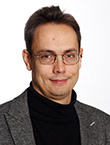
Anders Szepessy is a Professor in Mathematics and Numerical Analysis at the Department of Mathematics, KTH Royal Institute of Technology. His research centers on partial differential equations and numerical methods for differential equations, with significant contributions to molecular dynamics, quantum mechanics, and stochastic systems. His primary research domains include: Partial Differential Equations Numerical Analysis Stochastic Differential Equations Molecular Dynamics and Quantum Mechanics Optimal Control and Finite Element Methods Machine Learning Applications Recent publications reveal a pronounced shift toward integrating machine learning with computational physics, particularly in neural network approximations for molecular dynamics and quantum systems. His work on adaptive methods for high-dimensional stochastic and partial differential equations demonstrates consistent innovation in numerical analysis, with applications spanning quantum chemistry, fluid dynamics, and energy systems. Professor Szepessy actively contributes to academic instruction as course responsible and examiner for advanced mathematics courses including Analytical and Numerical Methods for Partial Differential Equations, Computational Methods for Stochastic Differential Equations and Machine Learning, and multiple degree projects in mathematics and scientific computing at KTH.
Lantian Zhang is a postdoctoral researcher at KTH Royal Institute of Technology's Department of Mathematics, working under Assistant Professor Silun Zhang since September 2024. He is affiliated with the Division of Numerical Analysis, Optimization and Systems Theory within the School of Engineering Sciences. His research focuses on identification and adaptive control of nonlinear stochastic systems , adaptive estimation under quantized observations , and applications in machine learning . Dr. Zhang received his Ph.D. in systems theory from the Academy of Mathematics and Systems Science at the Chinese Academy of Sciences in 2024. Primary research area: Nonlinear stochastic systems and adaptive control Specialization: Quantized observations and binary-valued output systems Current projects: Advanced adaptive identification methods under saturated output constraints His publication record shows a strong focus on adaptive identification techniques under challenging observation conditions, with multiple papers published between 2022-2025 addressing saturated output observations, non-iid data, and binary-valued output systems. This research has applications in both theoretical control systems and practical implementations where measurement constraints exist. Dr. Zhang is part of the research group led by Assistant Professor Silun Zhang, which also includes other postdocs and PhD students working on related topics in networked systems and control theory. His work contributes to KTH's broader research initiatives in WASP (Wallenberg AI, Autonomous Systems and Software Program) and Digital Futures.
Håkan Grahn is a Professor of Computer Engineering at the Department of Computer Science, School of Computing, Blekinge Institute of Technology (BTH) in Sweden. He has been a faculty member since 1996, becoming a full professor in 2007. His academic leadership includes serving as Head of Department (1999-2002) and Dean of Research (2011-2013) at BTH. He leads multiple significant research projects including GPAI (General Purpose AI Computing) and Green Clouds, with funding from ELLIIT, the Knowledge Foundation, and Vinnova. His educational background includes: M.Sc. in Computer Science and Engineering (1990) from Lund University Ph.D. in Computer Engineering (1995) from Lund University Håkan's research spans several interconnected domains in computer science and engineering, with a strong emphasis on practical applications. His work in computer architecture focuses on optimizing system performance through innovative cache coherence protocols and memory management techniques. In the realm of parallel computing , he investigates multicore systems, GPU computing, and thread-level speculation to enhance computational efficiency. His research in AI and machine learning addresses energy efficiency, data stream mining, and practical applications in areas like district heating systems and airborne networks. The integration of image processing with machine learning forms another significant strand of his work, particularly in historical document analysis and medical imaging applications. These research areas converge in his leadership of major initiatives like BigData@BTH and GPAI, where he bridges theoretical advances with real-world implementation challenges. Analysis of Håkan's recent publications reveals a clear trajectory toward increasingly applied research with strong industry connections. While maintaining foundational work in computer architecture, his output increasingly focuses on practical AI applications, energy efficiency in computing, and domain-specific implementations in sectors like telecommunications, energy systems, and defense. The interdisciplinary nature of his work is evident in collaborations spanning computer science, engineering, and domain-specific applications, with a growing emphasis on sustainability and resource optimization in computing systems. Håkan has successfully supervised numerous doctoral students, with ten graduates and six current Ph.D. candidates. His research has been supported by substantial funding from: The Knowledge Foundation (BigData@BTH, HINTS, Green Clouds) ELLIIT (GPAI project) Vinnova (FANET-MCA, Directed COM & EW) Industry partners including Ericsson, Saab, Telenor, and Fortnox He is actively involved in multiple research groups including DISL (Distributed and Intelligent Systems Lab), CCS-Lab (Communication and Computer Systems Research Lab), and previously PAARTS (Parallel Architectures and Applications for Real-Time Systems). His leadership extends to organizing academic events like the Nordic workshop on Multi-Core Computing and the Swedish Artificial Intelligence Society workshop.
Erik Schaffernicht serves as a Senior Lecturer in the Department of Natural Sciences and Technology at Örebro University's School of Science and Technology. His research is primarily conducted through the Center for Applied Autonomous Sensor Systems (AASS) where he leads work in the Adaptive and Interpretable Learning Systems and Robot Navigation and Perception research groups. Dr. Schaffernicht's research spans multiple areas in robotics and artificial intelligence, with particular expertise in sensor systems, behavior trees, and gas distribution mapping. His work bridges theoretical computer science with practical applications in autonomous systems, environmental monitoring, and human-robot interaction. His research often involves developing novel algorithms for robot perception, control, and decision-making in complex environments. His recent publications demonstrate a strong focus on behavior trees for robot control, gas distribution mapping techniques, and applications of machine learning in robotics. The research shows increasing sophistication in using deep learning approaches for environmental sensing and robot navigation, with applications ranging from industrial safety to healthcare monitoring. Dr. Schaffernicht maintains an active research agenda with numerous publications in top robotics and AI venues, including IEEE Robotics and Automation Letters, Robotics and Autonomous Systems, and various IEEE conference proceedings. His work shows consistent collaboration with researchers across Europe, particularly with the AASS research center at Örebro University. His research projects include both ongoing work on automatic cognitive screening tests using eye-tracking technology and completed projects such as AIR (Action and Intention Recognition), RAISE (Robotic System for Air Quality Assessment), and SmokeBot (Mobile Robots for Disaster Site Inspection).
Magnus Perninge is an Associate Professor in Electrical Engineering at Linnaeus University (LNU), Sweden. He previously completed his undergraduate and PhD studies at KTH Royal Institute of Technology and held postdoctoral/researcher positions at Lund University. His teaching includes courses in Automatic Control (basic and advanced), Electric Power Systems , and Electrical Machines . He supervises Alexander Marcial , a doctoral student in Mathematics. Current Affiliation: Linnaeus University (School of Engineering & Faculty of Technology) Past Affiliations: KTH Royal Institute of Technology, Lund University Research Interests: Magnus specializes in the optimal control of stochastic systems with applications in electrical energy systems . He integrates artificial intelligence and machine learning to solve large-scale optimization problems in power systems, aiming to enhance efficiency and sustainability. His work bridges stochastic analysis , operations research , and renewable energy integration . Research Projects: Efficient Hydropower Planning : Optimizing Sweden's hydropower for future intermittent energy scenarios Sustainable Energy & Food Production : Enhancing rural farm energy systems Smart Electrification : Supporting SMEs in Kronoberg and Kalmar regions Research Groups: AI and Machine Learning for Optimization and Operations Research Stochastic Analysis and Stochastic Processes Waves, Signals and Systems
Lars Wallentin is a Professor at the Department of Medical Sciences, Cardiology section, at Uppsala University, and also holds a position at the UCR-Uppsala Clinical Research Center. His academic work focuses on advancing cardiovascular medicine through research on atrial fibrillation, anticoagulation therapy, and biomarker development for risk stratification. Professor Wallentin's research interests center on cardiology with specific expertise in atrial fibrillation management, anticoagulation therapy, cardiovascular biomarkers, and clinical trial methodology. His work has significantly contributed to understanding stroke prevention strategies in atrial fibrillation patients, risk stratification using novel biomarkers, and optimizing anticoagulant therapy across different patient populations including elderly patients and those with comorbid conditions. His research spans both clinical and translational aspects, connecting laboratory findings with patient outcomes. His recent publications demonstrate a consistent focus on cardiovascular outcomes research, particularly in the areas of atrial fibrillation management and anticoagulation therapy. The research shows a strong emphasis on biomarker development for risk prediction, with particular attention to stroke prevention and heart failure risk assessment in atrial fibrillation patients. His work also extends to registry-based studies and the development of standardized outcome measures through initiatives like EuroHeart, which aims to create unified registries for heart care evaluation across Europe. Professor Wallentin has been actively involved in several major clinical trials including ARISTOTLE, COMBINE-AF, SWEDEHEART, and ISCHEMIA, where he has contributed to advancing our understanding of cardiovascular disease management. His international collaborations are evident through his numerous co-authorships with researchers across Europe and North America, reflecting the global impact of his work in cardiovascular medicine.