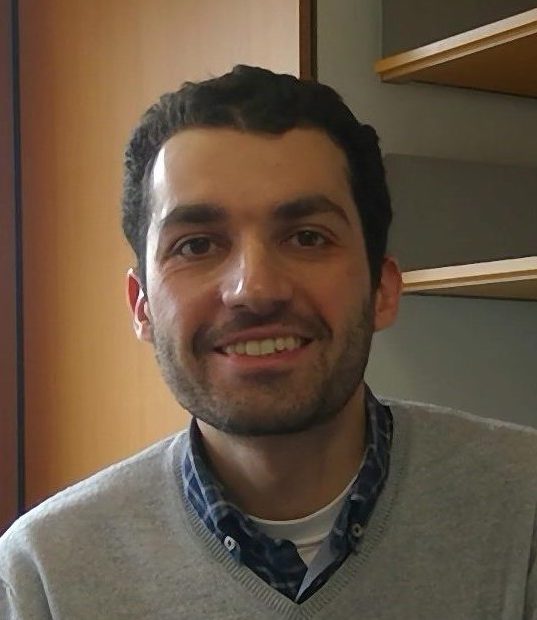
Lorenzo Campos VenutiView profile
Adjunct Associate Professor
Lorenzo Campos Venuti is an Adjunct Associate Professor (Research) in the Department of Physics and Astronomy at the University of Southern California (USC), affiliated with the USC Dornsife College of Letters, Arts and Sciences. His research focuses on foundational aspects of quantum mechanics, quantum information processing, and condensed matter physics. He holds a Ph.D. in Condensed Matter Physics from the University of Stuttgart (2003) and an M.S. in Physics from the University of Bologna (1998), followed by postdoctoral training at the Institute for Scientific Interchange (ISI) in Torino, Italy (2006–2011). His research interests include equilibration and thermalization in quantum systems, quantum entanglement dynamics, topological protection of coherence, and the development of numerical algorithms for quantum many-body systems. He explores topics such as the eigenstate thermalization hypothesis, hidden order in quantum states, and long-distance entanglement creation. His work also addresses quantum annealing optimization, error suppression techniques, and the interplay between dissipation and quantum data classification. Recent research trends in his publications emphasize interdisciplinary approaches, combining quantum statistical mechanics with computational methods for open quantum systems. His studies on adiabatic quantum computing and boundary cancellation methods aim to enhance the robustness of quantum algorithms against noise and errors. Venuti has contributed to theoretical frameworks for understanding quantum criticality, non-Markovian dynamics, and the geometry of quantum state manifolds. His grants and advising activities are not detailed in the provided text, but his extensive publication record reflects a strong focus on advancing quantum technologies and foundational quantum physics. He is associated with the USC Dornsife College, leveraging its interdisciplinary environment for collaborative research in theoretical and computational physics.