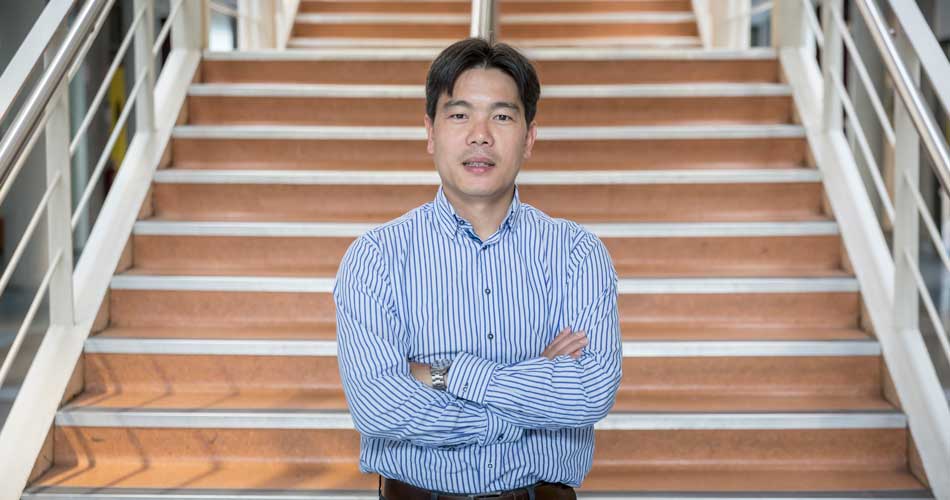
Sean B. Andersson is a Professor in the Department of Mechanical Engineering at Boston University's College of Engineering. His research focuses on optimal estimation, system identification, single particle tracking, robotics, and control theory. He earned his Ph.D. from the University of Maryland, College Park. Education : Ph.D. in Mechanical Engineering (University of Maryland, College Park) His work integrates control algorithms with applications in microscopy, nanofabrication, and multi-agent systems. Recent research trends highlight persistent monitoring, trajectory optimization, MRI reconstruction, and dip-pen nanolithography. He has mentored numerous graduate and undergraduate students, many of whom now hold positions at institutions like MIT Lincoln Labs, University of Pennsylvania, and Juniper Networks. Scientific Contributions : Developed robust multi-agent control policies for data harvesting Advanced single particle tracking with real-time feedback Innovated in non-raster scanning probe microscopy Optimized sensor scheduling via minimax and semidefinite programming His lab team combines theoretical and applied research in robotics and control systems, with alumni contributing to academia, industry, and research labs globally.
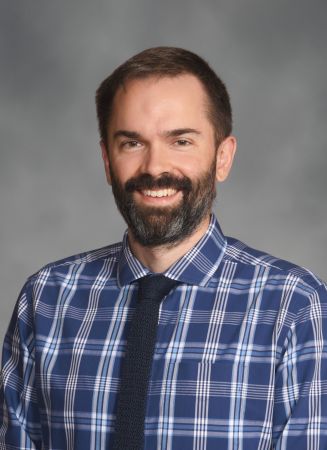
Dr. Boyin Ding is an Associate Professor at the University of Adelaide , serving as Academic Director at Haide College and researcher in the Mechanical Engineering department within the Faculty of Sciences, Engineering and Technology. He leads the Wave Energy Research initiative established in 2014, while also contributing to Robotics and Biomechanics through his work with the Flinders Medical Device Research Institute. Research Areas: Ocean Wave Energy Harvesting Control Systems for Renewable Energy 6DOF Robotic Testing Spine Biomechanics Transnational Education Programs Key Collaborations: Australia-China Joint Research Centre for Offshore Wind & Wave Energy Acoustics, Vibration and Control Research Group Scientific Awards: Australian Endeavour Fellowship Malcolm Kinnaird Engineering Excellence Award (2012) His recent publications focus on hybrid offshore energy systems, nonlinear hydrodynamics in wave energy converters, and biomechanical testing technologies. He has developed control algorithms for floating offshore wind-wave systems and pioneered 6DOF robotic platforms for medical applications. As an eligible PhD supervisor, he actively collaborates with global industries and academic institutions.
Dr. Le-Nam Tran is a researcher at the UCD School of Electrical & Electronic Engineering , University College Dublin. His work focuses on optimizing the last hop of 5G/6G wireless networks through mathematical programming, with emphasis on energy efficiency, interference management, and security against eavesdropping. Develops low-cost, low-complexity transmission techniques Projects supported by Science Foundation Ireland Career Development Award Author of over 80 peer-reviewed publications Research Keywords: Wireless Communications Network Security Signal Processing Energy-Efficient Systems Beamforming Optimization Interference Mitigation
Naren Ramakrishnan is the Thomas L. Phillips Professor of Engineering in the Department of Computer Science at Virginia Tech, where he directs the Sanghani Center for AI and Data Analytics. He also serves as AI and Machine Learning Lead for the Virginia Tech Innovation Campus. His research spans data science, machine learning, urban analytics, forecasting, and computational epidemiology. Recent publications (2024-2025) focus on language model optimization, AI applications in government and environmental conservation, and spatiotemporal data analysis. Work demonstrates strong emphasis on real-world AI deployments in regulatory compliance, supply chain verification, and network optimization. Methodological innovations include prompt engineering techniques, world models for reinforcement learning, and specialized embedding methods. Dr. Ramakrishnan has received prestigious fellowships from ACM, AAAS, and IEEE. His research has been supported by numerous agencies including DARPA, NSF, NIH, and industry partners like Amazon and Boeing, with 36 PhD students mentored to completion.
Carlos R. Rivero is an Associate Professor in the Department of Computer Science at the Rochester Institute of Technology (RIT), located within the Golisano College of Computing and Information Sciences. His primary research focuses on graph theory applications in knowledge graphs, graph databases, and computer-aided program comprehension. He holds a PhD from the University of Seville (Spain), completed in 2012, with postdoctoral work at the University of Idaho (USA). His teaching responsibilities include courses such as Principles of Data Management, Data Mining, and Big Data exploration. Rivero has advised numerous PhD and Master’s students, contributing to research projects in link prediction, knowledge graph completion, and educational technology. He actively serves on program committees for conferences like The Web Conference and SIGKDD, and has reviewed for journals including the VLDB Journal and Communications of the ACM. His research emphasizes evaluating knowledge graph embeddings, improving link prediction methodologies, and developing tools for educational feedback in programming. He has contributed to projects like AYNEXT, which streamlines link prediction evaluation, and CAFE, a neighborhood-aware knowledge graph completion tool. Rivero’s work bridges theoretical advancements with practical applications in education and industry. Notable contributions include frameworks for automated feedback in programming courses and methodologies for assessing inference patterns in knowledge graphs. His grants and service roles reflect a commitment to advancing computational methods and fostering academic collaboration in data science and education.
Martin Widdicks is a Teaching Associate Professor of Finance and Director of the MSF Program at the Gies College of Business, University of Illinois at Urbana-Champaign. He holds the Josef and Margot Lakonishok Faculty Fellow distinction and has been recognized as an outstanding teacher repeatedly since 2011. His academic background includes a PhD in Mathematical Finance (University of Manchester, 2002) and a BSc in Mathematics (Manchester, 1999). Research interests focus on mathematical finance, particularly derivative pricing methodologies, singular perturbation theory applications, and executive compensation models. He has developed frameworks for multi-asset option valuation and analyzed incentive structures in equity-based compensation. Recent work includes extracting market crash and bankruptcy signals from options data. Teaching responsibilities span core quantitative finance courses (FIN 502, FIN 503), derivatives (FIN 512), and advanced electives like Complex Derivatives (FIN 514) and Term Structure Models (FIN 516/517). His awards include the Shebik Faculty Fellowship (2021–2022) and Towey Faculty Fellowship (2019–2021). Notable publications include Journal of Futures Markets , Journal of Corporate Finance , and Mathematical Finance . His work bridges theoretical finance with practical applications in risk management and corporate decision-making.
Angkana Rüland is a Professor at the University of Bonn's Mathematical Institute and holder of the Hausdorff Chair at the Hausdorff Center for Mathematics (HCM), a Cluster of Excellence. She is a member of the Transdisciplinary Research Area ‘Modelling’ and a recipient of the prestigious Leibniz Prize (2025). Her research focuses on inverse problems, fractional PDEs, and phase transformations in materials science, with contributions to the Calderón problem and microstructure analysis. She has held positions at Oxford, the Max Planck Institute in Leipzig, and Heidelberg University before returning to Bonn in 2023. Education: She completed her Abitur, bachelor's/masters, and PhD (2014, Hausdorff Memorial Prize) at the University of Bonn, where she also co-founded the Bonn Math Club. Her academic journey includes postdoctoral research at Oxford and leadership roles in Leipzig and Heidelberg. Research interests span inverse problems (e.g., fractional Calderón problem), material microstructures (shape-memory alloys), and mathematical physics. Her work bridges pure and applied mathematics, addressing questions in elasticity, nonlocal operators, and energy scaling laws. Scientific awards include the Leibniz Prize (2025) for her groundbreaking research and the Hausdorff Memorial Prize for her doctoral thesis. She aims to use Leibniz Prize funds to strengthen her research group at HCM, furthering interdisciplinary collaborations. Her contributions have positioned Bonn as a global leader in mathematical research, with 20 Leibniz laureates since 1986.
Dr. Stefan Klus is a Lecturer at the School of Mathematics and Physics, University of Surrey. His research focuses on data-driven model reduction, transfer operator approximation, and kernel-based machine learning applied to dynamical systems. He specializes in interdisciplinary applications across quantum physics, fluid dynamics, and computational biology. Education: PhD in Industrial Mathematics (2011, Paderborn University) and Habilitation (2020, Freie Universität Berlin). Research Interests : Data-driven modeling and reduced-order methods Koopman operator theory and transfer operators Machine learning for dynamical systems (e.g., Deeptime library) Tensor decompositions and quantum systems analysis Graph-based analysis (e.g., microbiome dynamics) Publications : Klus has contributed to over 50 peer-reviewed articles, with recent work emphasizing: Kernel methods for quantum chemistry and physics Tensor-based approaches for high-dimensional systems Applications in climate science (e.g., Pacific SST modeling) Agent-based modeling and social systems Technical Contributions : Co-developer of the Deeptime Python library for dynamical modeling Pioneer in Koopman operator-based model reduction Advanced graph kernel methods for microbiome analysis
Thomas Yeh is an Assistant Professor of Teaching in the Department of Computer Science at the University of California, Irvine. His academic background includes a Ph.D. in Computer Science from UCLA and a BS in Electrical Engineering and Computer Science from UC Berkeley. Prior to academia, he gained industry experience across research, architecture, design, verification, marketing, and management roles. His educational credentials: Ph.D. in Computer Science, UCLA BS in Electrical Engineering and Computer Science, UC Berkeley Dr. Yeh's research spans computer architecture, accelerated machine learning, and computer science education. In architecture, he pioneers error-tolerant physics simulation and heterogeneous computing. His ML work focuses on adaptive precision techniques for energy-efficient acceleration. In education, he develops interactive tools for novice programmers and experiential learning frameworks for computer architecture. His cross-disciplinary approach bridges hardware-software co-design with pedagogical innovation. Publication trends reveal consistent focus on computational efficiency across physics simulation, ML acceleration, and educational technology. His work connects real-time systems optimization with emerging AI applications, particularly in interactive environments and physics-based animation. No scientific awards are documented in the provided materials. While advising details and grant funding specifics are absent from available information, his industry-academia transition informs practical research directions. Teaching responsibilities include core courses like Introduction to CS, Data Structures, and Efficient ML Computing. Research infrastructure details remain unspecified, though his publications suggest collaborations in physics simulation and heterogeneous computing environments.
Holly Wilcox is a Professor in the Department of Mental Health at the Johns Hopkins Bloomberg School of Public Health with joint appointments in the Department of Health Policy and Management, Johns Hopkins School of Medicine, and Johns Hopkins School of Education. She serves as President of the International Academy of Suicide Research (IASR), member of the Scientific Council and Board of Directors of the American Foundation for Suicide Prevention (AFSP), suicide prevention consultant for the World Health Organization, and Affiliate Investigator at Australia's Centre for Research Excellence in Suicide Prevention. PhD, Johns Hopkins University (2003) MA, New York University (1998) BS, Northeastern University (1991) Dr. Wilcox's research focuses on public health approaches to suicide prevention through community-based universal prevention programs, data linkage strategies, and cross-sector implementation in schools, universities, social media, and emergency departments. Her work emphasizes population-based strategies targeting suicidal behaviors and addresses health disparities through culturally adapted interventions. She leads Johns Hopkins' multidisciplinary Suicide Prevention Working Group and actively mentors students, having won the Johns Hopkins Advising, Mentoring, and Teaching Recognition Award three times. Analysis of her recent publications reveals a strong emphasis on leveraging real-world data systems (Maryland Suicide Data Warehouse), developing ecological prevention models across multiple settings, and implementing evidence-based practices through policy mechanisms like the STANDUP Act. Her work increasingly integrates digital epidemiology (social media analysis) with traditional public health approaches while maintaining focus on vulnerable populations including adolescents, Latinx communities, and youth in child welfare systems. Recipient of the Andrej Marušic Suicide Research Award (2010) Dr. Robert Lewis Kane Memorial Award for data linkage research (2017) Multiple teaching excellence awards including AMTRA (2007, 2020, 2022) Best paper award in Archives of Suicide Research (2019) Dr. Wilcox has secured competitive grants from NIH, WHO, and other agencies to support her research. She actively collaborates with international organizations including WHO/UNICEF and Pan American Health Organization. Her mentorship extends to numerous students through the Johns Hopkins Bloomberg School of Public Health, where she teaches courses on suicide as a public health problem. She leads the Suicide Prevention Working Group that coordinates interdisciplinary research across Johns Hopkins divisions.
Thulasi Mylvaganam is a Senior Lecturer in Control Engineering at the Department of Aeronautics, Imperial College London. They specialize in nonlinear control theory, dynamic optimization, and applications to robotics and renewable energy systems. Mylvaganam holds an M.Eng. in Electrical and Electronic Engineering from Imperial College London (2010) and a Ph.D. in Control and Power (2014). They have held roles including Postdoctoral Research Associate (2014–2016), Research Fellow (2016–2017), Lecturer (2017), and Senior Lecturer (2021). Research interests include distributed control, data-driven control, and optimal control strategies for complex systems. They teach courses such as Mechatronics and Computing and Numerical Methods 2 for Aeronautics students. Their work spans robotics, renewable energy systems, and multi-agent systems. Affiliations include the Computational Methods and Mathematical Modelling group and the Robotics Forum. Mylvaganam actively supervises PhD students focusing on advanced nonlinear control topics and emphasizes rigorous academic preparation for prospective candidates.
Raghu Bollapragada is an Assistant Professor in Operations Research and Industrial Engineering at the University of Texas at Austin, with affiliations to the Oden Institute and Machine Learning Laboratory. His research designs algorithms for nonlinear optimization, including constrained, stochastic, and distributed methods with applications in machine learning. Supported by NSF, Argonne National Laboratory, and Lawrence Livermore National Laboratory, recent work (2024-2025) develops gradient tracking for decentralized systems, adaptive sampling techniques, and hessian averaging for nonconvex problems. He was elected Vice Chair of Nonlinear Optimization for INFORMS (2024-2026).
Mark Gotham is a Senior Lecturer in Cultural Computation at King’s College London’s Department of Digital Humanities. He holds a unique position bridging STEM and the humanities, with prior roles as an Assistant Professor of Computer Science at Durham University and a Professor of Music Theory at Technische Universität Dortmund. His research focuses on computational methods for music theory, corpus creation, and accessibility. Gotham completed a Ph.D. in Music Theory at the University of Cambridge, an MMus in Composition at the Royal Northern College of Music, and a First-Class Bachelor’s in Music from the University of Oxford. His work spans computational musicology, including projects like the OpenScore initiative, which digitizes and opens music scores. He is affiliated with King’s Computational Humanities Research Group and the Centre for Digital Culture. Gotham’s compositions, such as the award-winning CD *Utrumne est Ornatum*, blend theoretical rigor with creative expression. He collaborates with institutions like Deutsche Telekom on projects like *Beethoven X* and leads the Music Computing Lab at King’s. Gotham’s research emphasizes interdisciplinary approaches, using computational tools to explore musical structures and democratize access to music theory. His contributions include frameworks for aligning symbolic music, standards for harmonic analysis, and pedagogical innovations in music education.
Professor Steven Armfield is a faculty member at the University of Sydney's School of Aerospace, Mechanical and Mechatronic Engineering. He holds a BSc in Applied Mathematics from Flinders University and a PhD from the University of Sydney. His research focuses on fluid mechanics, particularly buoyancy-driven flows, computational modeling, and thermal convection in environmental and industrial contexts. He has led major projects on river management strategies, building ventilation systems, and large-scale fluid dynamics models. As FluD Director, he leads fluid dynamics research initiatives. Education: BSc Applied Mathematics, Flinders University PhD, University of Sydney Research Interests: Professor Armfield's work spans computational fluid dynamics (CFD), natural convection boundary layers, turbulent mixing in stratified flows, and heat transfer applications. His studies address environmental challenges (e.g., river stratification) and engineering systems (e.g., HVAC efficiency). He employs experimental, theoretical, and numerical methods to advance understanding of complex fluid behaviors. Publications: His recent work emphasizes parameterization of turbulent flows, buoyancy effects in stratified systems, and scaling laws for natural convection. Key themes include improving predictive models for environmental and industrial fluid dynamics. Awards: Australian National Research Fellowship Stanford University UPS Visiting Professorship Saitama University Visiting Scholarship Shundoh International Foundation Research Scholarship Advising & Grants: Supervises PhD students in topics like urban fluid dispersion and Navier-Stokes solvers. Secured funding for projects involving CFD analysis of data centers and thermal stratification in open channels. Labs/Teams: Led the School of Aerospace, Mechanical and Mechatronic Engineering (2008–2015) and currently directs the Fluid Dynamics (FluD) research group.
Frank E. Curtis is a Professor in the Department of Industrial and Systems Engineering at Lehigh University, where he has been since 2009. He holds a B.S. in Mathematics and Computer Science from the College of William and Mary (2003), an M.S. and Ph.D. in Industrial Engineering from Northwestern University (2004 and 2007), and completed a postdoctoral fellowship at New York University’s Courant Institute (2007–2009). His research focuses on developing numerical methods for large-scale nonlinear optimization, with applications in machine learning, operations research, and energy systems. Key achievements include the 2021 SIAM/MOS Lagrange Prize for Continuous Optimization (with Bottou and Nocedal) and the 2018 INFORMS Computing Society Prize (with Burke, Lewis, and Overton). He has secured significant funding from the NSF, DoE, and ONR, including a TRIPODS grant and ARPA-E awards. His work on the ARPA-E Grid Optimization Competition earned second place in 2020. Curtis’s research interests span mathematical optimization, numerical analysis, and algorithm design. His recent articles emphasize stochastic optimization, fairness in machine learning, and robust algorithm development for constrained systems. He serves as an Area Editor for Mathematics of Operations Research and Associate Editor for multiple top journals, including Mathematical Programming and SIAM Journal on Optimization . Notable grants include DoE ASCR Early Career Awards and NSF TRIPODS funding for collaborative projects with Northwestern, Boston University, and Cornell. His OptML @ Lehigh team develops cutting-edge optimization tools and frameworks for real-world applications.