
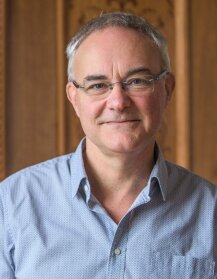
Adrian P. SimpsonView profile
Professor
Adrian P. Simpson is a full Professor of Speech Science at the Department of German Linguistics, Friedrich Schiller University Jena, where he has held a professorship since 2003. He is a leading researcher in phonetics, with a focus on gender, spontaneous speech, and nonpulmonary sound production. He is affiliated with the International Phonetic Association (Council member), Acoustical Society of America, and other key academic organizations. Friedrich Schiller University Jena – Professor of Speech Science (2003–present) University of Kiel – Habilitation (1998), Scientific Assistant (1992–2001) University of York – DPhil (1992), BA Hons (1981–1985) Saarland University – Visiting Representative (1999) His research centers on the phonetic expression of gender , acoustic and articulatory analysis of speech , and nonpulmonary sound production such as ejectives in German and English. He investigates how social identity, sexual orientation, and developmental factors influence voice. His recent work emphasizes children's voices, parental speech adaptation, and cross-linguistic phonetics. His 15 most recent publications (2024–2019) reveal a consistent focus on sociophonetics, gender perception, and articulatory mechanisms. Themes include hormonal effects on voice, acoustic cues to gender and sexual orientation, and longitudinal studies of child speech. He frequently collaborates with Melanie Weirich, Riccarda Funk, and Sven Kachel. World's Top 2% Scientists 2021 (Scopus Stanford list) Simpson leads multiple funded projects on gender in children’s voices, ejective production, and infant-directed speech. He advises PhD students and postdoctoral researchers, and his lab at Jena is active in experimental phonetics and open data initiatives. He has contributed to major reference works and promotes open science in phonetics. He is involved in several research groups and collaborates internationally. His lab focuses on articulatory and acoustic analysis using ultrasound, acoustic modeling, and perception experiments. He advocates for open data policies and reproducibility in phonetic research.