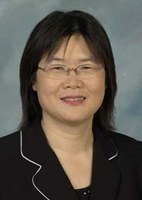
Dr. Sherry Wang is a Jenkins-Garrett Professor of Mathematics at The University of Texas at Arlington. She holds affiliate professorships at Southern Methodist University. Her research focuses on Bayesian Modeling, Statistical Omics, and Meta-Analysis. She earned her PhD from The University of Texas at Austin (2002) and has held roles at SMU from 2003 to 2022. Her work includes federal grants on deep learning for neoantigen analysis and T-cell receptor binding. Key awards include being an Elected Fellow of the American Statistical Association (2024). She advises numerous PhD students and chairs dissertation committees in Data Science and Biostatistics. Dr. Wang teaches courses like Bayesian Data Analysis and collaborates on projects like infrastructure equity and normalization of genomic data. Her service roles include College Director for Research in Data Science.
Dr. Joshua M. Tebbs is a Professor in the Department of Statistics at the University of South Carolina, affiliated with the McCausland College of Arts and Sciences. He holds a BS in Mathematics, an MS in Statistics, and a PhD in Statistics from the University of Iowa and North Carolina State University, respectively. His research focuses on categorical data analysis, statistical methods for group testing, order-restricted inference, and applications in public health and biostatistics. He is a Fellow of the American Statistical Association and an elected member of the International Statistical Institute. Dr. Tebbs has served as Editor of the American Statistician (2020–2023) and contributed to numerous academic courses, including STAT 513 (Theory of Statistical Inference), STAT 512 (Mathematical Statistics), and STAT 110 (Introduction to Statistical Reasoning). His work emphasizes methodological advancements in group testing for disease prevalence estimation and has been supported by NIH funding. Key awards include recognition from the ASA and ISI, reflecting his scholarly contributions. His research outputs span statistical methodology, computational tools (e.g., binGroup2 ), and applications in infectious disease surveillance and public health decision-making.
David Kaplan is an Associate Professor and Director of Doctoral Studies in the Department of Economics at the University of Missouri, within the College of Arts and Science. His research focuses on Econometrics, particularly in quantile regression, statistical inference, and policy analysis. He holds a Ph.D. (details unspecified) and has advised notable students including Qian Wu, Wei Zhao, Xin Liu, and Longhao Zhuo. His work bridges theoretical econometrics and applied policy evaluation, with a strong emphasis on methodological rigor and real-world applications. Key research themes include auction theory, ordinal data analysis, and health economics. His recent publications explore topics such as consensus ranking of distributions and the impact of robust norming in clinical classification. He has contributed to high-impact journals like the Journal of Econometrics and the Journal of Business & Economic Statistics. Dr. Kaplan’s academic leadership includes directing doctoral studies, ensuring rigorous training in econometric theory and applied methods. His work frequently involves collaborations and methodological innovations, addressing challenges in policy evaluation and statistical modeling. He maintains an active presence in academic communities through Google Scholar and institutional affiliations.
Ruijiang Gao is an Assistant Professor in Information Systems at the Naveen Jindal School of Management, University of Texas at Dallas. He earned his PhD in Information, Risk, and Operations Management from UT Austin (2024), MA in Statistics from the University of Michigan (2018), and BS in Statistics from the School of the Gifted Young at University of Science and Technology of China (2016). His research focuses on human-centered machine learning , emphasizing robustness , interpretability , adaptability , and fairness in ML/AI models, including foundational models. Key contributions include: Human-AI collaboration frameworks with bandit feedback Counterfactual self-training techniques Contextual recourse bandit algorithms Uncertainty-aware domain adaptation Nonparametric discrete choice experiments for product design His work has been accepted at top ML/AI conferences (AISTATS, AAAI, NeurIPS, ICML, IJCAI, ICCV) and journals (Machine Learning, Management Science). Notable achievements include Best Student Paper at CIST 2022 and Best Paper Runner-Up at WITS 2024. Research grants and fellowships include the UT Austin Continuing Fellowship and INFORMS Data Science Workshop Scholarships. Current research trends include: Human-AI collaborative decision-making under confounding Counterfactual-aware model training Adaptive survey design for consumer preferences Uncertainty calibration in regression and domain adaptation Algorithmic fairness in contextual bandits He has previously collaborated with institutions including Netflix Research, Harvard University, IBM Research, Tencent, and Amazon.
Dr. Peter Kramer is a Professor and Department Head in the Department of Mathematical Sciences at Rensselaer Polytechnic Institute. He holds a Ph.D. from Princeton University (1997) and has been at Rensselaer since 2000. His research focuses on applying probability theory, differential equations, and stochastic modeling to study complex systems in biology, environmental science, and neuroscience. Key areas include molecular motor transport, neuronal network analysis, and active matter dynamics. He collaborates with researchers at institutions like Arizona State University and the University of Colorado. Dr. Kramer’s work emphasizes statistical approaches to model unresolved variables in computationally intensive systems. Notable projects address cargo transport in cells, environmental stochastic modeling, and neuronal network topology inference from firing data. He organizes the Mathematical Problems in Industry Workshop and mentors students in modeling competitions like the Mathematical Contest in Modeling. His recent publications (2017–2022) explore topics such as stochastic field theories for active matter, molecular motor cooperation, and Bayesian inference in dynamical systems. His research bridges applied mathematics with interdisciplinary applications, emphasizing both theoretical rigor and practical computational methods.
Siva Sivaganesan is a Professor and Director of the Division of Statistics and Data Science at the University of Cincinnati's Department of Mathematical Sciences within the College of Arts and Sciences. He holds a Ph.D. in Statistics from Purdue University (1986), an M.Sc. from the University of Birmingham (U.K., 1979), and a B.Sc. in Mathematics from the University of Colombo (Sri Lanka, 1976). His research focuses on Bayesian analysis, including robust and objective methods, subgroup analysis, nonparametric modeling, and applications in biomedical fields such as bioinformatics and clinical trials. Positions: Professor at University of Cincinnati (1999–present), Co-Director of the Statistical Consulting Lab (2001–2003). Awards: 2017 Graduate Fellow and 2015 Excellence in Mentoring Award (UC Graduate School). Grants: Over $2.8M in funding from NIH, Simons Foundation, and others for projects in statistical methods for genomic data, drug response analysis, and integrative bioinformatics. His research interests span Bayesian theory and applications, including hierarchical models, multiple testing, and biostatistical methodologies. Notable contributions include Bayesian mixture models for gene expression clustering and subgroup analysis techniques using Bayesian Additive Regression Trees.
Alexander Marx is Professor of Causality at TU Dortmund University's Research Center for Trustworthy Data Science and Security since June 2024. He holds a PhD in Computer Science from Saarland University (2021) and an MSc in Bioinformatics from Saarland University (2016). His research spans causality, causal discovery, causal representation learning, information theory, and Bayesian deep learning, with applications in biomedical domains. These interdisciplinary approaches connect statistical methodology with healthcare informatics challenges. Recent publications reflect strong focus on causal identifiability theory, mutual information estimation, and medical applications including diabetes management and anomaly detection. Methodological innovations appear in causal structure learning, information-theoretic frameworks, and transfer learning for clinical predictions.
Paul-Christian Bürkner is a Professor of Computational Statistics in the Department of Statistics at TU Dortmund University, appointed since June 2023. His educational background includes a Dr. rer. nat. in Psychology and an M.Sc. in Mathematics from the University of Münster and University of Hagen respectively, complemented by dual bachelor's degrees in Mathematics and Psychology. His research focuses on five core areas: Uncertainty Quantification, Prior Specification, Simulation-Based Inference, Model Comparison, and Machine-Assisted Workflow. These domains bridge Bayesian statistics with computational efficiency challenges, emphasizing practical implementations for complex model environments. Recent publications (2023-2025) demonstrate consistent themes in Bayesian methodology innovation, including advances in surrogate modeling, amortized inference techniques, and statistical workflow optimization. Over 70% of his latest articles involve collaborative work on uncertainty-aware computational methods. As former leader of an independent junior research group at the Stuttgart Cluster of Excellence SimTech (2020-2023), he developed research programs combining theoretical statistics with applied computational frameworks. Current work continues this trajectory through TU Dortmund's statistics department infrastructure.
Ken Ryan is Professor of Statistics at West Virginia University and Fellow of the American Statistical Association. He serves as Associate Director overseeing statistics within the School of Mathematical and Data Sciences, coordinating research initiatives and academic programs. Ryan's research develops statistical methodologies across experimental design, semi-supervised learning, and reliability modeling. Key contributions include covariate shift solutions in regression, combinatorial algorithms for optimal designs, and Bayesian degradation models for reliability testing. His work frequently addresses high-dimensional and complex-system applications through geometric and computational approaches. His publication record demonstrates sustained innovation across statistical computing, experimental optimization, and machine learning interfaces. Recent methodological extensions address overlapping count distributions and sequential Bayesian assurance testing while maintaining foundational research on orthogonal array classification and semi-supervised regularization.
Professor Mark Trede is a distinguished academic at the Institute of Econometrics and Economic Statistics within the School of Business and Economics at the University of Münster, Germany. His office is located in Room 301 at Am Stadtgraben 9, 48143 Münster, and he can be reached at +49 251 83-25006 or mark.trede@uni-muenster.de. Professor Trede's research spans multiple areas of econometrics and economic statistics, with particular expertise in time series analysis, stochastic volatility models, copula modeling, and financial market analysis. His work addresses critical issues in income inequality, income mobility, speculative bubbles, and algorithmic pricing. He has made significant contributions to understanding volatility transmission between assets, measurement errors in financial data, and the application of advanced statistical methods to economic problems. His publication record demonstrates consistent scholarly output over more than two decades, with recent research focusing on spatial earnings inequality, stock market bubbles, volatility transmission, and Bayesian approaches to stochastic volatility modeling. His work often combines theoretical econometric advances with empirical applications to real-world economic and financial phenomena. Professor Trede leads multiple ongoing research projects including 'Modeling and forecasting financial-market volatility' and 'Bubbles in financial markets,' both active since 2020. He has successfully completed several significant research projects funded by the German Research Foundation (DFG) and the Federal Ministry for Economic Affairs and Energy (BMWE), including studies on inequality dynamics in the life cycle and spatial disparities in French and German labor markets. He is actively involved in the academic community, organizing and participating in the Economic Research Seminar at the Center for Quantitative Economics (CQE), with upcoming lectures scheduled through 2025 featuring scholars from institutions including the University of Mainz, TU Dortmund University, and the University of Cambridge.
Dr. Marija Bezbradica serves as Associate Professor and COMBUS Programme Board Chair at Dublin City University's School of Computing. Her research bridges computational finance, educational analytics, and complex systems modeling. Key research areas include financial risk modeling using Bayesian methods, educational data mining for programming courses, and healthcare analytics for infection control. She holds affiliations with ADAPT (FinTech research), ARC-SYM (complex systems modeling), and Lero (software engineering). Recent publications demonstrate cross-disciplinary applications, spanning cryptocurrency market analysis, hospital readmission prediction, and synthetic data generation for medical conditions. Work frequently employs machine learning, graph-based methods, and advanced statistical modeling. No information is available regarding awards, supervised students, or specific laboratory facilities.
Sergios Agapiou serves as Associate Professor in the Department of Mathematics and Statistics at the University of Cyprus, School of Natural and Applied Sciences since 2024, following prior roles as Lecturer (2015-2019) and Assistant Professor (2019-2024). His academic credentials include: Bachelor of Applied Mathematics and Physical Sciences, National Technical University of Athens (2009) M.Sc. in Mathematics, University of Warwick (2010) Ph.D. in Mathematics, University of Warwick (2013) His research explores theoretical foundations of Bayesian inference with emphasis on asymptotic behavior in nonparametric settings and computational methods for infinite-dimensional problems . Key focus areas include statistical inverse problems, Monte Carlo techniques in function spaces, and intersections between differential equations and high-dimensional statistics, addressing fundamental challenges in modern statistical theory. No scientific awards were documented in the source material. Professional trajectory shows continuous academic employment since postdoctoral positions at the University of Warwick (2013-2015), though specific grant funding or student supervision details remain unreported. No laboratory or research team affiliations are specified in the available text.
Trambak Banerjee is an Assistant Professor in the Analytics, Information, and Operations academic area at the University of Kansas School of Business. His research focuses on developing rigorous statistical methods for analyzing modern high-dimensional data where issues such as unobserved heterogeneity and noise accumulation impede inferences using standard methods. Education: Ph.D. in Business Administration (Statistics), Marshall School of Business, University of Southern California, 2020 M.S. in Mathematical Finance, University of Oxford, 2015 M.S. in Statistics, Indian Statistical Institute, Kolkata, 2006 B.S. in Statistics, St. Xavier's College, University of Calcutta, 2004 Dr. Banerjee's research interests span multiple domains including Shrinkage Estimation, Empirical Bayes Prediction, High Dimensional Penalized Likelihood Methods, and statistical applications in Virology, Consumer Behavior, and Marketing. His industry experience in financial services has significantly influenced his research approach, often connecting methodological development to concrete applied problems. His work bridges theoretical statistics with practical applications in health, marketing, and finance. His publication record demonstrates expertise in developing novel statistical frameworks for complex data problems, with a particular focus on nonparametric methods, empirical Bayes estimation, and testing procedures for heterogeneous data. His recent work includes significant contributions to statistical methods for single-cell virology, shrinkage prediction under complex covariance structures, and joint modeling approaches for user behavior in digital platforms. Dr. Banerjee has developed several software packages to implement his methodological contributions, including truh for nonparametric two-sample testing under heterogeneity, cezij for constrained zero-inflated joint modeling, and several R packages for adaptive shrinkage and clustering procedures. His work combines theoretical rigor with practical implementation, making his methods accessible to researchers across multiple disciplines.
Farzana Nasrin is an Assistant Professor in the Department of Mathematics at the University of Hawaiʻi at Mānoa, joining in 2020. She holds a Ph.D. in Mathematics from Texas Tech University (2018). Her research focuses on algebraic topology, Bayesian statistics, and their applications in interdisciplinary domains like genomics, materials science, and biomedical engineering. She develops novel methodologies for topological data analysis, integrating statistical inference with geometric insights to solve complex problems in biology and engineering. Her work bridges pure mathematics and applied sciences, with notable contributions to Bayesian topological learning for classifying biological networks, material microstructure analysis, and corneal disease diagnosis. Her website at math.hawaii.edu showcases her research and teaching activities, including courses in advanced mathematics and statistical methods. She is based in Keller 309 on campus. Recent research trends include advancing topological deep learning frameworks, exploring stochastic topology for material science, and applying Bayesian methods to microbiological systems. Her articles reflect a strong emphasis on computational topology, interdisciplinary collaborations, and methodological innovation. While no awards are explicitly listed, her active publication record and academic contributions highlight her academic impact. She advises graduate students in mathematical sciences and has contributed to grant-funded projects in applied topology and statistics.
Maiying Kong, PhD, is a Professor in the Department of Bioinformatics and Biostatistics at the University of Louisville’s School of Public Health and Information Sciences (SPHIS). She holds the Wendell Cherry Chair in Clinical Trial Research and directs the Biostatistics Core at the Brown Cancer Center. Her expertise spans biostatistical methods for clinical trials, causal inference, and high-dimensional data analysis. Education: B.S. and M.S. in Computational Mathematics, Xian Jiaotong University, China Ph.D. in Statistics, Indiana University (2004) Postdoctoral Fellowship in Biostatistics at MD Anderson Cancer Center Research Interests: Dr. Kong focuses on developing statistical methods for clinical trials, observational healthcare data (Medicaid/EHR), high-dimensional datasets (e.g., mass cytometry), and machine learning applications. Her work emphasizes causal inference, longitudinal modeling, and biomarker discovery. Recent Article Trends: Her publications highlight advancements in observational study design, cost-effectiveness analysis, and personalized treatment selection. Key themes include ordinal outcome modeling, drug interaction assessment, and Bayesian approaches for complex biological systems. Awards: Elected Member of the International Statistical Institute (2023) Trainee Excellence Award, MD Anderson (2006) William B. Wilcox Mathematics Award (2002) Advisees & Grants: She has mentored 11 PhD graduates and currently advises 5 students. Leads cores for major grants (e.g., LCTRC, CIEHS) and collaborates on NIH-funded projects on cancer disparities, immunology, and cardiovascular disease. Teams & Labs: Oversees the Biostatistics Core at Brown Cancer Center and collaborates with interdisciplinary teams in pediatrics, oncology, and environmental health.