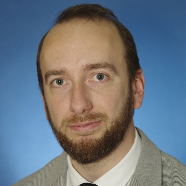
Christophe TexierView profile
Professor
Christophe Texier is a Professor at the University of Paris Saclay, affiliated with the Laboratory of Theoretical Physics and Statistical Models, located in Pascal Building No. 530, Paris-Sud University, F-91405 Orsay. He serves as co-director of the international Master 'Physics of Complex Systems' and acts as correspondent for the quantum physics course of the Master 2 iCFP for the University of Paris Saclay. Professor Texier's research spans multiple areas of theoretical physics with a focus on quantum phenomena in disordered and mesoscopic systems. His work encompasses quantum transport in networks of metallic wires, decoherence mechanisms due to electron-electron interactions, topological phase transitions in multichannel Dirac systems, and spectral properties of operators on metric graphs. He has made significant contributions to understanding Wigner-Smith time delays, functional determinants, and the effects of non-trivial geometries on quantum transport phenomena. An analysis of his publication record reveals a consistent research trajectory centered on quantum coherence phenomena in disordered systems. His work shows progression from fundamental studies of decoherence mechanisms to more complex topological aspects of quantum transport. A notable pattern is his use of mathematical physics approaches to solve problems in condensed matter physics, particularly through random matrix theory applications and spectral analysis techniques. His recent publications suggest increasing focus on topological aspects of quantum systems and mathematical formulations of transport phenomena. Professor Texier has been actively involved in teaching across multiple levels, from undergraduate to master's programs. He has taught courses in Quantum Mechanics, Statistical Physics, Mathematics, and Mathematical Tools for Physics. His teaching spans multiple institutions, including University of Paris Saclay and previously at the University of Geneva where he taught Mesoscopic Physics. He has also co-organized magisterial conferences for students in the fundamental physics master's degree program. His research group at the Laboratory of Theoretical Physics and Statistical Models appears to focus on theoretical aspects of quantum transport, with connections to experimental teams studying mesoscopic devices. His work has direct relevance to experimental observations in GaAs/GaAlAs networks, metallic rings, and other mesoscopic structures where quantum coherence effects can be measured.