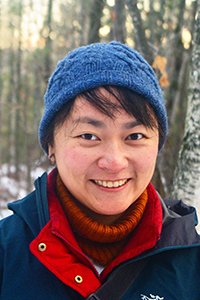
Makiko Sasada is a Professor at the Graduate School of Mathematical Sciences, The University of Tokyo. Her research focuses on probability theory, interacting particle systems, and classical integrable systems, with an emphasis on hydrodynamic limits, spectral gaps, and non-gradient models. She has made significant contributions to understanding energy diffusion in stochastic systems and integrable cellular automata like the box-ball system. 2010: MSJ Takebe Katahiro Prize for Encouragement of Young Researchers 2011: Second JSPS Ikushi Prize 2011: University of Tokyo President's Prize Her recent work explores scaling limits in the box-ball system, thermal conductivity in stochastic models, and topological structures in large-scale systems. She actively participates in international conferences, serves as an associate editor for leading journals, and organizes educational initiatives like the FoPM program, which trains students to apply basic science to societal challenges through mathematical and physical innovation. Selected publications include: The incompressible Navier–Stokes limit from the discrete-velocity BGK Boltzmann equation (2025) Characterization of Gradient Condition for Asymmetric Partial Exclusion Processes (2025) Topological structures of large-scale interacting systems (2024)
Richard Huskey is an Assistant Professor in the Department of Communication and the Cognitive Science Program at the University of California Davis. He leads the Cognitive Communication Science Lab , contributes to the Computational Communication Research Lab, and is affiliated with the Center for Mind and Brain and the Designated Emphasis in Computational Social Science. He also serves as Vice Chair of the International Communication Association’s Communication Science and Biology interest group. Ph.D., Communication (Cognitive Science Emphasis), University of California Santa Barbara, 2016 M.A., Communication, University of California Santa Barbara, 2014 B.S., Business Administration, California Polytechnic State University San Luis Obispo, 2006 Dr. Huskey’s research examines how motivation influences attitudes and behaviors, with a focus on media neuroscience and computational approaches. His work employs fMRI , mobile EEG hyperscanning , and drift diffusion modeling to explore phenomena like flow experiences , media selection dynamics , and neural predictors of message effectiveness . He advocates for integrating Marr’s tri-level framework across communication subfields and promotes open science initiatives. Recent publications address computational modeling of mood management, flow neurobiology, equity in doctoral admissions, and complexity science frameworks. His methodological innovations include using augmented reality and network neuroscience to study cooperation and attention dynamics. Dr. Huskey’s work bridges media psychology, cognitive neuroscience, and computational social science, emphasizing practical applications in health communication and digital media design.
Gurunath Gurrala serves as an Associate Professor in the Department of Electrical Engineering at the Indian Institute of Science (IISc), Bangalore. His research focuses on power systems dynamics, high-performance computing applications, and renewable energy integration. He maintains active collaborations with international institutions including Oak Ridge National Lab and Texas A&M University. His research interests center on Power Systems Analysis and Control , with specialization in High Performance Computing Applications, Nonlinear and Intelligent Control, Weak Grid Integration of Renewables, Microgrid Protection, and Smart Grid Stability. His work bridges theoretical control systems with practical power grid challenges, particularly for renewable-rich grids. His recent publications demonstrate a strong interdisciplinary trend, spanning power systems (35%), control theory (25%), renewable integration (20%), and emerging applications in biomedical engineering and environmental systems (20%). Key recurring themes include grid stability under high renewable penetration, advanced protection schemes for microgrids, and computational methods for power system analysis. IEEE Power and Energy Society (PES) Outstanding Engineer Award 2018 Young Engineer Award 2015, Indian National Academy Engineers Best Conference Paper, IEEE PES General Meeting 2015 Best Ph.D Thesis Award (Prof.D.J.Badkas Medal) 2010 Elevated to Senior Member IEEE (2016) Professor Gurrala has secured competitive research funding including the Young Scientist Grant from DST (2015) and International Travel Support from SERB (2017). He actively mentors students through PhD and Master's programs while teaching advanced courses including Power System Dynamics and Control (E4 231), Computer Control of Power Systems (E4 233), and Selected Topics in Integrated Power Systems (E4 237). His research group collaborates with power utilities and international research labs on grid modernization challenges.
Christopher Hojny is an Assistant Professor at the Department of Mathematics and Computer Science at Eindhoven University of Technology , specializing in combinatorial optimization. He contributes to the EAISI Foundational group and co-develops the academic solver SCIP . His research focuses on symmetry handling in mixed-integer programming , theoretical properties of integer programs, and algorithm development for combinatorial optimization. Recent work explores applications in graph neural network verification , clustering problems, and network coding through mixed-integer programming frameworks. Key publication trends show expertise in Symmetry detection and mitigation techniques Relaxation complexity theory Applications to machine learning robustness Decision diagram-based scheduling Scientific contributions include Proof systems for symmetry certification Topological bounds tightening in GNNs Stable set problem symmetry handling SCIP solver extensions He supervises PhD students Cédric Roy (NWO project on Local Symmetries) and Sten Wessel (co-supervised with Frits Spieksma), while Jasper van Doornmalen (2019-2023) investigated symmetry propagation algorithms.
Abhishek Halder is an Associate Professor in the Department of Aerospace Engineering at Iowa State University and an Associate Adjunct Professor in the Department of Applied Mathematics at the University of California, Santa Cruz. He is also a member of the Translational AI Center at Iowa State University. His academic journey includes joining Iowa State University as an Assistant Professor in July 2023 and previously serving as faculty at UC Santa Cruz starting from October 2017. Dr. Halder's educational background includes studies at IIT Kharagpur and Texas A&M University, where he developed expertise in systems and control theory with applications to matrix analysis, probability, and optimization. His research has been recognized with prestigious awards including the O. Hugo Schuck Best Application Paper Award from the American Automatic Control Council, Applied Mathematics Research Award from UC Santa Cruz, Outstanding Doctoral Student Award from Texas A&M, and Best Dual Degree Thesis Award from IIT Kharagpur. His research focuses on stochastic systems, control and optimization with applications to large scale cyber-physical systems. Dr. Halder has made significant contributions to the fields of optimal transport, Schrödinger Bridge theory, distributional control, and uncertainty propagation in dynamical systems. His work bridges theoretical developments with practical applications in power systems, aerospace engineering, and machine learning. He has secured multiple research grants from NSF, including a CPS Frontier project on Computation-Aware Algorithmic Design for Cyber-Physical Systems. Dr. Halder has demonstrated leadership in the control systems community through editorial roles including Associate Editor for IEEE Transactions on Automatic Control (2025-present), ASME Journal of Dynamic Systems, Measurement, and Control (2025-present), Systems & Control Letters (2022-present), and previously for IEEE Control Systems Society Conference Editorial Board (2019-2025) and IEEE Transactions on Aerospace and Electronic Systems (2019-2022). He is a Senior Member of IEEE and a member of IFAC, SIAM and ASME. His research group has produced numerous publications in top-tier journals and conferences, with recent work focusing on connections between optimal transport theory, stochastic control, and machine learning. The publication trends show increasing integration of Schrödinger Bridge formulations with machine learning techniques for distributional control problems across various domains including power systems, aerospace applications, and resource allocation. O. Hugo Schuck Best Application Paper Award (2024) Applied Mathematics Research Award from UC Santa Cruz (2022) IEEE Senior Member (2021) Outstanding Doctoral Student Award from Texas A&M Best Dual Degree Thesis Award from IIT Kharagpur Dr. Halder has mentored numerous PhD students including Alexis, Georgiy, Iman, Shadi, and Kenneth, many of whom have received prestigious fellowships. His research group maintains strong collaborations with national laboratories including Lawrence Livermore National Lab and Los Alamos National Lab, as well as industry partners. Dr. Halder is also committed to education and outreach, having created and taught the 'Feedback Control' course for high school students in the California State Summer School for Mathematics and Science (COSMOS), introducing complex control theory concepts without calculus or linear algebra.
Professor Mahdi Mahfouf holds the Chair in Intelligent Systems at the University of Sheffield's School of Electrical and Electronic Engineering . He obtained his MPhil (1988) and PhD (1991) in Control Systems from the same institution. After postdoctoral research (1992-1996) on Leverhulme-funded projects in Model-Predictive Control and Fuzzy Logic, he progressed through academic ranks at Sheffield to Full Professor (2005). Recipient of the IEE Hartree Premium Award (1992) and MEDIPEX Innovation Award (for ICU Decision Support Systems) Over 370 publications, including 130+ journal papers Head of the Intelligent Systems Research Laboratory Research Themes His work spans fundamental research in Fuzzy Logic (modelling, control), Neural-Fuzzy Systems, Self-Organising Control, and Evolutionary Optimization, alongside applied domains in pharmaceutical manufacturing, aerospace systems, biomedical engineering (ICU monitoring), and intelligent transportation. Recent publications focus on hybrid AI for pharmaceutical processes , type-2 fuzzy control systems , and machine learning in manufacturing metrology . Lab initiatives include multistage process monitoring and human-machine interaction systems for stress management.
Pierre Nyquist is an Associate Professor and docent in the Department of Mathematical Sciences at Chalmers University of Technology and Gothenburg University. His research is sponsored by the Swedish Research Council, the Swedish e-science Research Center (SeRC), and the Wallenberg Artificial Intelligence, Autonomous Systems and Software Program (WASP). He is also an elected member of the Young Academy of Sweden for the period 2024-2029 and has served as a scientific ambassador for EURANDOM since November 2021. Dr. Nyquist's research interests lie at the intersection of probability theory, mathematical statistics, and applied mathematics. His main expertise is in probability theory, with a focus on large deviations theory and stochastic numerical methods. He has a general interest in all aspects of probability theory and much of what is categorized as applied mathematics, particularly questions related to partial differential equations, optimization, and stochastic optimal control. Recently, he has become increasingly interested in the mathematical foundations of complex data analysis and modeling, and the interplay with ideas from physics. His current research interests include large deviations, gradient flows and their generalizations, stochastic numerical methods, statistical learning theory, stochastic processes, and random dynamical systems. Pierre Nyquist has received research funding from several prestigious sources including the Swedish Research Council, the Swedish e-science Research Center (SeRC), and the Wallenberg Artificial Intelligence, Autonomous Systems and Software Program (WASP). His publications demonstrate a consistent focus on theoretical aspects of probability with applications to computational methods and data analysis, showing increasing integration with machine learning techniques in recent years. elected member of the Young Academy of Sweden (2024-2029) scientific ambassador for EURANDOM (since November 2021) Dr. Nyquist is actively involved in mentoring the next generation of researchers. He currently supervises several PhD students including Cinja Arndt (starting Aug. 2025), Niki Wilhemlson (started Aug. 2024), and Viktor Nilsson (started Aug. 2020). He has previously supervised successful PhD students such as Federica Milinanni (Aug. 2020-May 2025) and Carl Ringqvist (Aug 2015-June 2021). He regularly teaches graduate-level courses including "Modern methods of statistical learning" and has supervised numerous MSc theses on topics ranging from deep learning for time-series radar signals to neural network embedding in insurance pricing. His research group is active in both theoretical developments and practical applications, with current projects spanning from mathematical foundations of probability to applications in machine learning and data science. Dr. Nyquist maintains strong international collaborations, as evidenced by his frequent travel for conferences and research visits to institutions such as Brown University and TU Delft.
Massimo Trovato is a Full Professor of Mathematical Physics at the University of Catania, where he has been teaching since 2004 and has held the rank of full professor since 2010. He serves as Director of the INDAM Unit of the Department of Mathematics and Informatics (DMI) since 2014. Professor Trovato teaches courses in both the Mathematics and Physics degree programs at the University of Catania. Professor Trovato's research spans multiple areas within mathematical physics, with a particular focus on theoretical frameworks for understanding physical systems. His work integrates advanced mathematical techniques with physical principles to develop models that explain complex phenomena in semiconductor physics, quantum systems, and fluid dynamics. His research interests include: Mathematical Physics Statistical Mechanics Quantum Kinetic Theory Semiclassical Kinetic Theory Extended Thermodynamics Maximum Entropy Principle Quantum Maximum Entropy Principle Semiconductor Physics Fluid Dynamics Professor Trovato's publication record demonstrates a consistent focus on entropy principles and their applications across various physical systems. His work shows an evolution from classical thermodynamics to quantum formulations, with particular emphasis on semiconductor applications and 2D materials like graphene. The research trajectory reveals increasing sophistication in handling nonlocal quantum effects and fractional statistics, reflecting the growing complexity of modern physical systems being studied. Professor Trovato has made significant contributions to the theoretical understanding of transport phenomena in semiconductors, particularly through the application of maximum entropy principles to both classical and quantum systems. His research has important implications for the development of next-generation semiconductor devices. His teaching responsibilities include Analytical Mechanics for Physics students and Mathematical Physics II for Mathematics students, demonstrating his commitment to educating the next generation of physicists and mathematicians.
Dr. Paola Falugi is a Senior Lecturer in Electro-Mechanical Engineering at the University of East London and holds an honorary visiting researcher position at Imperial College London. Her expertise spans predictive control systems, data-driven modeling, and energy network optimization under uncertainty. Senior Lecturer, Department of Engineering & Construction, School of Architecture, Computing and Engineering, University of East London Honorary Visiting Researcher, Imperial College London Research focuses on: Predictive control strategies for uncertain systems Data-driven modeling for control applications Optimization methods in energy network expansion Energy management under stochastic conditions Control systems for robotics and mechatronics Recent publications highlight her contributions to: Robust co-design frameworks for building energy systems Machine learning integration in transmission expansion planning Automated scenario generation for optimal control Control strategies for residential buildings with energy storage Her work bridges theoretical advancements in control theory with practical applications in energy systems and building automation.
Laurent Pfeiffer is a researcher at the Signals and Systems Laboratory , focusing on Optimization and Control Theory . His work bridges theoretical advancements in mean field games, stochastic optimization, and numerical methods with practical applications in energy systems and fluid dynamics. Research Interests: Optimal Control, Mean Field Games, Stochastic Optimization, Nonlinear Programming Recent Publications: Explore mean field games, nonconvex optimization, and control theory applications in nuclear energy, gas portfolios, and fluid dynamics. Labs: Signals and Systems Laboratory, specializing in control systems and mathematical modeling.
Xue Feng is an Associate Professor in the Department of Civil, Environmental, and Geo- Engineering at the University of Minnesota , affiliated with the St. Anthony Falls Laboratory. Their research focuses on understanding how water mediates ecosystem responses to climate change, with applications in Earth system modeling and climate predictions. Research Interests Xue Feng's work spans ecohydrology, plant hydraulics, peatland hydrology, and urban watershed management. Key projects include studying seasonal rainfall dynamics, plant water use strategies under drought, and the tradeoffs of urban green infrastructure in the Minneapolis-St. Paul metropolitan area. Peatland carbon cycling under climate change Stomatal optimization and plant hydraulic modeling Urban heat island mitigation via vegetation Scientific Awards McKnight Land-Grant Professorship NSF CAREER Award Advising and Funding As PI of NSF- and DOE-funded projects, Feng mentors graduate students and postdocs, emphasizing external grant support and fellowship applications. Current projects include collaborations with the LTER program and Minnesota Stormwater Research Council.
Nathaniel J. Fisch is Professor of Astrophysical Sciences at Princeton University and serves as Associate Director for Academic Affairs at the Princeton Plasma Physics Laboratory (PPPL). He also directs the Princeton University Program in Plasma Physics and previously chaired the Division of Plasma Physics of the American Physical Society in 1998. Professor Fisch's research spans plasma physics with applications to nuclear fusion, plasma processing, plasma devices, lasers, and astrophysics. His specific interests include plasma thrusters, plasma-based separation methods, laser-based plasma accelerators, atomic radiation in plasmas, complex liquids, continuum electrohydrodynamics, petroleum refining, statistical inference, and pattern recognition. His work bridges fundamental plasma theory with practical applications, particularly in fusion energy research and plasma technologies. His publication record shows decades of significant contributions to plasma physics, with particular emphasis on wave-particle interactions, current drive mechanisms, and alpha channeling techniques. He has published over 300 papers, demonstrating sustained research productivity and leadership in the field. Professor Fisch collaborates extensively with researchers at PPPL, Princeton, and other major plasma research institutions worldwide. His recent work focuses on plasma mass filtering for nuclear waste remediation, advanced concepts for fusion energy, and novel laser-plasma interaction schemes that could lead to breakthroughs in plasma-based technologies. As Director of the Princeton University Program in Plasma Physics, he plays a significant role in shaping plasma physics education and research at Princeton. His continued publication record through 2016 indicates his ongoing active engagement in research and academic activities at Princeton University and PPPL.
Eric Stachura is an Associate Professor of Mathematics at Kennesaw State University, affiliated with the College of Science and Mathematics. His research spans metamaterials, liquid crystal optics, fractals, and electromagnetic theory, with applications in acoustics and quantum mechanics. Ph.D. in Mathematics, Temple University (2016) M.A. in Mathematics, Temple University (2013) B.S. in Mathematics (minor in Physics), University of Illinois at Chicago (2011) Stachura’s work focuses on mathematical modeling of physical systems, including the development of a novel framework for metamaterial lens design, analysis of electromagnetic wave propagation in fractal media, and nonlinear problems in geometric optics. He has co-authored foundational studies on Snell’s Law generalizations and the mathematics of metasurfaces. His recent publications highlight interdisciplinary applications of mathematics, particularly in fractal geometry, liquid crystal optics, and acoustic wave dynamics. He leads the Immersive Visualization Environments Research Cluster at the Coles College of Business and is co-director of a paid summer internship program for high school and undergraduate students via the Army Educational Outreach Program. Recipient of the 2024-2025 College of Science and Mathematics Outstanding Scholarship and Creativity Award Recipient of the 2024-2025 University-level Outstanding Scholarship and Creativity Award American-Scandinavian Foundation Fellow (2019-2020)
Subhomoy Haldar is an Assistant Professor in the Department of Physics at the Indian Institute of Technology Kanpur. His research focuses on semiconductor physics, quantum devices, and quantum sensing applications, with particular expertise in semiconductor-superconductor hybrid systems and microwave photon detection. PhD (2020) from Homi Bhabha National Institute, RRCAT MSc (2014) from Indian Institute of Technology Hyderabad BSc (2012) from University of Kalyani (Krishnagar Govt. College) Dr. Haldar's research spans cutting-edge areas in condensed matter physics and quantum technology. His work primarily investigates semiconductor-superconductor hybrid devices for quantum applications, light-matter interactions at the quantum level, and microwave photon detection. He specializes in electronic transport and optical spectroscopy under extreme conditions including ultra-low temperatures and high magnetic fields. His research has significant implications for quantum computing, quantum sensing, and next-generation electronic devices. His recent publications show a strong focus on quantum measurement techniques in circuit quantum electrodynamics frameworks. There's a clear progression from fundamental quantum device physics to practical applications in quantum information processing. His work bridges theoretical concepts with experimental implementations, often involving sophisticated nanofabrication and measurement techniques. Publication as Editor's Suggestion in Physical Review Letters by American Physical Society (2025) Outstanding Doctoral Student Award by Homi Bhabha National Institute, Mumbai (2021) Best Ph.D. Thesis Award by Indian Lasers Association (2021) Young Scientist Award by Madhya Pradesh Council of Science and Technology (2019) Dr. Haldar maintains an active research program with collaborations spanning multiple international institutions. His laboratory at IIT Kanpur focuses on developing novel quantum devices and measurement techniques, contributing significantly to India's growing quantum technology ecosystem.
Dr. Yulin Hu serves as a Visiting Professor at RWTH Aachen University, holding the Chair of Information Theory and Data Analytics. His research program bridges theoretical foundations with practical implementations in next-generation wireless systems, with particular emphasis on UAV-aided networks and information-theoretic approaches to communication challenges. His core research interests span multiple interconnected domains: Wireless Communications (especially finite blocklength regimes) Information Theory applications in network design UAV trajectory optimization and network integration Wireless power transfer with nonlinear energy harvesting Edge computing and distributed learning systems Data analytics for network performance optimization Analysis of Dr. Hu's 2025 publication record reveals a concentrated research thrust on UAV trajectory design, where he develops joint optimization frameworks addressing energy efficiency, security, and reliability constraints. His work consistently integrates information-theoretic principles—particularly finite blocklength analysis—to solve practical challenges in ultra-reliable low-latency communications (URLLC) and wireless power transfer. A distinctive feature of his approach is the fusion of deep reinforcement learning with traditional optimization methods for dynamic network scenarios, including no-fly zone constraints and covert operations. While no specific scientific awards are documented in the available materials, his prolific output across top-tier venues demonstrates significant scholarly impact. Details regarding graduate student mentoring and research funding mechanisms remain unspecified in the current documentation. The Chair of Information Theory and Data Analytics, which Dr. Hu leads, functions as a specialized research unit focused on theoretical rigor and algorithmic innovation for wireless systems, though specific laboratory infrastructure or team composition details are not provided.