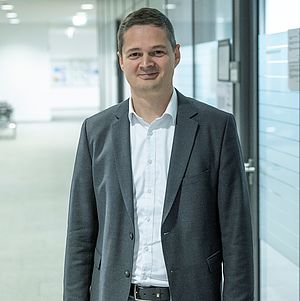
Christoph Heinzl is a Professor of Cognitive Sensor Systems at the University of Passau since September 2022. He leads the Knowledge-based Image Processing research group at the Fraunhofer Development Center X-ray Technology (EZRT) . His academic background includes a PhD in Informatics and a Habilitation in 2022 , both from TU Wien . Research Focus: Scientific visualization, visual analytics, immersive analytics, virtual/augmented reality, machine learning, and X-ray computed tomography (XCT). Key Trends: Development of novel visualization techniques for complex volumetric data (e.g., dynamic volume lines, visual coherence frameworks), parameter space analysis, and cross-virtuality collaboration tools. Applications: Aerospace component inspection, defect analysis in composites (CFRP, GFRP), porosity quantification, and 4DCT time-series exploration.
Robert Heinemann is a Senior Lecturer in the Department of Mechanical and Aerospace Engineering at the University of Manchester, affiliated with the School of MACE. His work focuses on advanced machining, tool condition monitoring, and sustainable manufacturing processes. He holds a PhD from the University of Manchester Institute of Science and Technology (2004) and has extensive research experience in drilling technology, carbon-based coatings, and environmental benign machining. Education: Diplom Ingenieur (Dipl.-Ing. FH) in Mechanical Engineering, University of Paderborn, Germany (1999) MSc in Electronic Engineering and Engineering Management, University of Paderborn/Bolton University (2001) PhD in Mechanical Engineering, University of Manchester Institute of Science and Technology (2004) Research interests include: Drilling and reaming technology for minimally invasive surgery Development of diamond-like carbon coatings for cutting tools Process and tool optimization for aerospace and biomedical applications Environmental sustainability in manufacturing design His research outputs emphasize adaptive drilling strategies, deep learning applications in process monitoring, and sustainable manufacturing practices aligned with UN SDGs. He leads the Laser Processing Research Centre (LPRC), focusing on laser-based machining innovations. Scientific achievements include a Leverhulme Trust Early Career Fellowship (2010) and contributions to over 40 peer-reviewed articles. He advises 9 postgraduate research students and collaborates on multi-disciplinary projects addressing industrial challenges in composites and precision engineering.
Federica Sandrone is a Lecturer at the School of Architecture, Civil and Environmental Engineering (ENAC) at École Polytechnique Fédérale de Lausanne (EPFL), where she also serves as a Scientist at the Laboratory of Experimental Rock Mechanics (LEMR) within the Institute of Civil Engineering. Her academic career spans over 15 years with continuous contributions to tunnel engineering and rock mechanics research. Her research focuses on the intersection of rock mechanics and tunnel engineering, with particular expertise in tunnel pathology analysis, TBM performance in challenging geological conditions, and long-term tunnel behavior. Sandrone's work bridges theoretical analysis with practical engineering applications, addressing real-world problems in tunnel infrastructure management and maintenance. Her research methodology combines field investigations, laboratory testing, and numerical modeling to understand complex geomechanical behaviors. Analysis of her recent publications reveals a consistent focus on tunnel inspection methodologies, TBM performance prediction in difficult ground conditions, and the long-term behavior of tunnel structures. Her work has evolved from fundamental tunnel pathology studies to more advanced applications involving GIS integration, probabilistic modeling, and modern inspection techniques including laser scanning and image analysis. Engineer at SBB-Infrastructure (2008-present) responsible for Tunnels Management and Maintenance Assistant for Tunnel Engineering courses (2007-present) PhD supervision including Erika Paltrinieri's 2015 thesis on TBM performance Development of tunnel inspection methodologies and condition assessment procedures Her teaching activities include courses in Rock Mechanics and Underground Construction, where students learn about the mechanical behavior of rock materials, tunnel excavation and support design, planning and management of underground works, and risk assessment in tunnel construction.
Markus Haltmeier is a Professor in the Department of Mathematics at the University of Innsbruck. His research focuses on inverse problems, image reconstruction, and deep learning with applications in medical imaging, photoacoustics, and computational mathematics. He leads a group dedicated to advancing theoretical and practical solutions for challenges in non-destructive testing and medical diagnostics. His work integrates mathematical analysis with machine learning, addressing issues such as high-resolution imaging in scattering media and automated segmentation of cardiac structures. Key research areas include regularization techniques for inverse problems, self-supervised learning approaches for limited data scenarios, and computational methods for photoacoustic tomography. His contributions span both theoretical developments (e.g., inversion formulas for Radon transforms) and applied solutions (e.g., algorithms for cylinder liner wear assessment and myocardial infarct segmentation). Publications highlight advancements in neural network-based regularization, 3D medical image synthesis, and unsupervised learning frameworks for segmentation and registration. His research emphasizes bridging the gap between mathematical theory and real-world applications in healthcare and engineering.
Professor Geraint Jewell is affiliated with the University of Sheffield , serving as Director of the Rolls-Royce University Technology Centre in Advanced Electrical Machines (since 2006) and Director of the EPSRC Future Electrical Machines Manufacturing Hub (since 2019). He is a graduate of the university (BEng 1988, PhD 1992) and has held academic roles since 1994. EPSRC Advanced Research Fellowship (2000-2005) Royal Society Industry Fellowship at Rolls-Royce (2006-2008) Former Faculty Director of Research and Innovation (2008-2011) Former Head of Department (2013-2019) His research focuses on power-dense electrical machines for aerospace applications , including permanent magnet machines , switched reluctance machines , and linear actuators . He has supervised ~20 PhD students and led collaborations with Rolls-Royce on high-temperature devices (up to 800°C) and aero-engine starter-generators. Recent publications analyze stator insulation thermal degradation , eddy current control in additively manufactured materials , and magnetic loss prediction in silicon steel. His work spans electromagnetic modeling , core loss calculation , and advanced manufacturing techniques for electrical machines. EPSRC Advanced Research Fellowship (2000-2005) Royal Society Industry Fellowship (2006-2008) He has advised PhD students across topics like consequent-pole PM machines , doubly salient SynRMs , and core loss characterization . His Electrical Machines and Drives Research Group explores modular motor design and magnetic material optimization for aerospace and electric vehicles.
Gokhan Pekcan is a Professor at the University of Nevada, Reno, serving as Graduate Program Director and Associate Chair for Graduate Affairs. His research focuses on earthquake engineering, structural dynamics, seismic hazard mitigation, and structural health monitoring. Key research areas include: Seismic response of bridges and buildings under torsional ground motions Development of active and adaptive control systems for seismic resilience Integration of machine learning and compressive sensing for structural health monitoring Experimental validation of seismic retrofit techniques Analysis of structural and nonstructural systems' vulnerability Design of energy dissipation systems for civil infrastructure Recent publications highlight his work on torsional ground motion effects, hybrid simulation methodologies, and smart material applications in bridge systems. He employs deep learning for damage detection and data compression in monitoring frameworks.
Dr. Thangavel Thevar is a Senior Lecturer in the School of Engineering at the University of Aberdeen, where he has been teaching since 2005. He completed both his undergraduate degree (First Class Honours in Electrical Engineering) and PhD (in Laser Engineering) at the University of Aberdeen in 1989 and 1993 respectively. Prior to his academic career, he accumulated approximately 10 years of industrial R&D experience in the USA, working on solid-state laser development and holographic applications. Dr. Thevar's research focuses on several key areas: Digital holography for imaging of marine plankton and micro-particles Laser Induced Breakdown Spectroscopy (LIBS) for subsea applications Laser-based instrumentation development Development of solid-state lasers for scientific, industrial, and medical applications Engineering applications of holography His most notable recent achievement is leading a team that developed the weeHoloCam, a state-of-the-art ultracompact underwater holographic camera for imaging microorganisms. Weighing just 3.5 kg, this system is the lightest and most compact of its kind, capable of imaging 240 ml/s and continuously recording up to 200,000 holograms. The system incorporates a rapid hologram processor and an AI-based image classifier. This technology has significant applications in marine studies including spatial and temporal monitoring of plankton species, monitoring harmful plankton & micro-jellyfish, study of vertical transport of floc, and monitoring microplastic pollution in the ocean. Dr. Thevar has secured numerous research grants as Principal Investigator, including projects funded by Sustainable Aquaculture Innovation Centre (SAIC), BBSRC, DEFRA, and Defence & Security Accelerator (DSTL). His current research portfolio demonstrates strong interdisciplinary connections between optical engineering, marine science, and environmental monitoring. His scientific contributions include: Royal Academy of Engineering Visiting Teaching Fellow Award (2010-2013) US patent 8,494,012 B2 for Raman converters Development of alexandrite lasers and ruby holographic lasers during his industrial R&D period Work on US government contracts for non-destructive inspection methods for military aircraft and the space shuttle Sabbatical work at NASA Langley Research Centre developing diode pumped Thulium YALO lasers As an educator, Dr. Thevar has served as Coordinator of MSc Oil & Gas Engineering (2007-2020), Undergraduate Level 1 Coordinator, and has contributed to various committees including Quality Assurance and Students' Progression. He currently teaches courses including Principles of Electronics, Electrical & Mechanical Systems, Control Systems, and supervises individual projects at both undergraduate and postgraduate levels. He is accepting PhD students interested in Engineering research. Dr. Thevar is actively involved in professional organizations, serving as Technical Programme Chair for IEEE/OES Oceans Conference 2007, on organizing committees for various conferences, as a committee member of the Instrument Science and Technology Group (Institute of Physics), and as a member of both IET and IEEE. He also serves as a reviewer for optics-based journals.
Bryan Hubbard is a Professor at Purdue University's School of Construction Management Technology, where he has taught for over 20 years. He has taught nineteen unique courses in construction addressing a wide range of the construction curriculum, with a focus on estimating, design construction integration, and industrial construction. His educational background includes a Ph.D. in Civil Engineering from Texas A&M University and both Master's and Bachelor's degrees from Purdue University (MSE and BSME respectively). He is also licensed as a professional engineer in the State of Indiana. Professor Hubbard's research interests span multiple critical areas in modern construction: workforce development, construction supply chain management, modularization, construction safety, sustainability and energy efficiency, industrial construction, and UAS/Drone applications. His work demonstrates a strong focus on practical applications of technology to solve real-world construction challenges, particularly in sustainability and safety domains. His publications reveal consistent research activity with a recent emphasis on drone technology applications in construction and transportation, sustainability metrics for infrastructure, and knowledge management in construction companies. His work bridges the gap between academic research and industry practice, often collaborating with industry partners to address current challenges. Charles B. Murphy Outstanding Undergraduate Teaching Award (2023) Magoon Award for Excellence in Teaching Professor Hubbard has held leadership roles including Head of the School of Construction Management Technology from 2013 to 2016, during which he led curriculum transformation initiatives and oversaw the creation of the Design Construction Integration degree. He has also been granted three patents related to heat exchanger technology for cooling systems, demonstrating his ability to translate research into practical innovations. His teaching philosophy emphasizes real-world connections, with a focus on preparing students for industry challenges through practical application of fundamentals. He has led international study trips to China, Mexico, Puerto Rico, and Barcelona to broaden students' perspectives.
Xiao Chen is a Researcher at the Technical University of Denmark (DTU), specializing in advanced testing and digitalization of composite and offshore steel structures for wind energy systems. With a PhD from Nagoya University (2011), his work focuses on structural integrity, fatigue analysis, and Digital Twins for wind turbine blades. PhD in Engineering, Nagoya University (2011) Senior Researcher (2019–present) and Researcher (2017–2018) at DTU Associate Professor (2016–2017) and Assistant Professor (2013–2015) at Chinese Academy of Sciences His research explores nonlinear buckling, fracture mechanics, and Industry 4.0 technologies for structural health monitoring. Recent publications highlight AI-driven damage detection, thermographic analysis, and finite element modeling of composites. He leads projects like QualiDrone and AQUADA-GO, funded by EUDP and VILLUM FONDEN. Key article trends include composite fatigue , digital twins , drone-based inspection , and machine learning for structural monitoring. He received the 2022 Best Presentation Award at an international conference. Projects: Villum Experiment Project DiscoverBlaDE AQUADA-GO QualiDrone DARWIN RELIABLADE RELIfe
Javier Irizarry is a Professor and Interim Chair in the School of Building Construction at Georgia Tech's College of Design. He also serves as Associate Dean for Academic Affairs and Outreach , overseeing academic programs, diversity initiatives, and recruitment efforts. As Director of the CONECTech Lab, he pioneers research in Construction 4.0 and UAV applications for infrastructure challenges. Education : Ph.D. (Civil Engineering), Purdue University Masters in Engineering Management, Polytechnic University of Puerto Rico B.S. (Civil Engineering), University of Puerto Rico, Mayagüez Research Focus : Irizarry’s work integrates cutting-edge technologies into construction, including Unmanned Aerial Systems (UAS), Reality Capture, Virtual/Augmented Reality, and Human Factors in Robotics. His lab develops frameworks for Construction 4.0 , emphasizing technology-driven solutions for safety and efficiency. Lab & Impact : The CONECTech Lab focuses on Construction 4.0 , advancing drone-based inspection systems, digital twins, and safety analytics. His research has led to over 100 publications, with applications in infrastructure monitoring, safety management, and educational tools. Leadership : As Associate Dean, Irizarry drives academic innovation and outreach, including pre-college programs and diversity strategies. He is a licensed Professional Engineer (PE) and FAA-licensed drone pilot, bridging academia and industry.
Professor Anthony Gachagan is a leading academic at the University of Strathclyde, serving as Head of Department and Research Director in the Department of Electronic and Electrical Engineering (EEE) within the Faculty of Engineering. He has been Director of the Centre for Ultrasonic Engineering (CUE) since 2010, leading a multidisciplinary team of around 55 researchers with over £5M in active funding. He also holds leadership roles in RCNDE as Academic Chair and Management Board member, and participates in BINDT committees. His research spans ultrasonic transducer design, non-destructive evaluation (NDE), robotics, high-power ultrasound, and industrial process control. His work is highly collaborative, involving national and international partnerships with industry and academia, and contributes to sectors such as energy, aerospace, nuclear, and healthcare. He is actively involved in major research initiatives aimed at net zero, structural integrity, and advanced manufacturing. Recent publications highlight his focus on robotic ultrasonic inspection, adaptive signal processing, phased array techniques, and in-process monitoring of additive manufacturing. These works demonstrate a strong trend toward automation, real-time defect detection, and integration of ultrasonic systems in industrial and safety-critical applications. Scientific Awards: The BINDT Annual Conference Award (2019) Prof Gachagan has secured significant grants from EPSRC, Innovate UK, and industry partners, including projects on future ultrasonic engineering, lightning impulse testing, and robotic inspection for offshore wind. He supervises numerous research students and leads large collaborative teams. He also contributes to research commercialization through IAA projects. He leads the Centre for Ultrasonic Engineering (CUE), a vibrant research unit integrating electronic, mechanical, and biomedical engineers, physicists, and material scientists. The centre focuses on next-generation ultrasonic technologies, robotics integration, and industrial deployment.
Dr. Ehsan Mohseni is a Senior Lecturer in the Department of Electronics and Electrical Engineering at the University of Strathclyde, Faculty of Engineering. He is a key member of the Centre of Ultrasound Engineering (CUE) research group and supports the Royal Academy of Engineering and Spirit AeroSystems research chair led by Professor Gareth Pierce. His work focuses on advancing robotic and intelligent Non-Destructive Evaluation (NDE) systems for industrial applications. B.Sc. in Materials Science and Metallurgical Engineering, University of Tehran, 2006 M.Sc. in Metal Forming Processes, University of Tehran Ph.D. in Automated Defect Detection using Electromagnetic NDE, École de Technologie Supérieure (ETS), Montreal, Canada Dr. Mohseni’s research is centered on NDE 4.0, integrating advanced sensing, multi-physics modeling, and machine learning. His expertise spans ultrasonic and eddy current testing, multi-sensor data fusion, and probability of detection studies. He focuses on applications in additive manufacturing, welding, composites, and metal processing, aiming to overcome current technological barriers in industrial inspection. The recent publications highlight a strong trend toward intelligent, automated, and robotic NDE systems. Key themes include self-supervised learning for ultrasonic segmentation, human-machine collaboration in data analysis, and advanced signal processing for weld and composite inspection. The integration of AI, flexible sensor arrays, and embedded navigation systems reflects a shift toward smart, adaptive inspection platforms aligned with Industry 4.0. Scientific Awards: The BINDT Annual Conference Award (2019) Dr. Mohseni is actively involved in research funding and knowledge transfer. He serves as Principal Investigator on KTP projects with ETHER NDE LIMITED and NATIONAL OILWELL VARCO UK LIMITED, focusing on in-process inspection for additive manufacturing and field calibration for ultrasonic testing. He contributes to large-scale collaborative projects funded by Innovate UK and industry partners, emphasizing practical deployment of NDE solutions. He also supervises research staff and collaborates with global aerospace firms including Pratt & Whitney Canada, Safran, and Bell Helicopter. He is a core member of the Centre of Ultrasound Engineering (CUE), a dynamic research group developing next-generation ultrasound technologies. The team works on advanced robotic sensing hubs, flexible transducer arrays, and AI-driven data interpretation tools, often in collaboration with the Royal Academy of Engineering research chair and industrial partners.
Konstantinos Gryllias is a Professor in the Department of Mechanical Engineering at KU Leuven's Faculty of Engineering Sciences. He leads research in the Mechatronic System Dynamics (LMSD) unit at the Arenberg campus. His academic affiliations extend across multiple KU Leuven institutes including Leuven.AI, Leuven.AM (Additive Manufacturing), and the Gravitation Institute. He serves on important governance bodies as a member of the Faculty Council of Engineering Sciences, Faculty Doctoral Committee of Engineering Sciences, and Departmental Council of Mechanical Engineering. Dr. Gryllias specializes in signal processing, fault detection and diagnosis of rotating machinery, condition monitoring, and machine learning applications in structural health monitoring. His research spans linear and nonlinear vibrations, anomaly detection, rotordynamics, and pattern recognition. His work bridges theoretical signal processing with practical engineering applications in wind turbines, marine propulsion systems, and industrial machinery. His recent publications demonstrate strong focus on deep learning approaches for wind turbine anomaly detection, bearing diagnostics, stern bearing lubrication optimization, and structural health monitoring using advanced signal processing techniques. The research shows increasing integration of explainable AI methods with traditional vibration analysis. Dr. Gryllias teaches advanced courses including Monitoring & Prognostics, Structural Dynamics, Smart Sensing Technologies, and Applied AI perspectives. His teaching portfolio reflects the interdisciplinary nature of his research, connecting mechanical engineering fundamentals with cutting-edge AI methodologies. He currently leads multiple research projects through 2025-2029, primarily as Promotor, focusing on fault detection in gears using fiber optic sensors, multi-sensor monitoring of drivelines, physics-inspired machine learning for condition monitoring, and digital twin applications for wind turbine efficiency improvement.
Dr. Manuela Pacella is a Senior Lecturer in High-Value Manufacturing at Loughborough University's Wolfson School of Mechanical, Electrical and Manufacturing Engineering. She serves as Academic Integrity Lead and Programme Director for the BEng/MEng Manufacturing Engineering programs. Previously, she held roles at Cardiff University (Lecturer in Laser Machining) and worked in industry with 3M and Element Six. Her research focuses on laser processing of advanced materials, surface engineering, and manufacturing innovation. Education: PhD in Mechanical Engineering (University of Nottingham, 2014), MEng in Mechanical Engineering (Technical University of Bari, Italy, summa cum laude). Professional credentials include Chartered Engineer (CEng MIMechE), Fellow of the Higher Education Academy (FHEA), and IMechE MPDS Mentor. Research interests include laser machining strategies, surface functionalization, and tribology of ultra-hard materials like diamond and boron nitride. She has pioneered techniques for enhancing tool durability and biomedical implant performance through laser-based methods. Scientific achievements include a 2017 Blackall Award nomination (ASME) and over 40 publications. She supervises >4 PhD, 25 UG, and 12 MSc students, and has served as an examiner for Birmingham University and internal examiner at Loughborough. Her work bridges academic research with industrial applications, particularly in high-value manufacturing sectors.
Filippa Lentzos serves as Associate Professor in Science & International Security at King's College London, leading critical research on global biolabs, disinformation, responsible science, and Biological Weapons Convention (BWC) verification. She holds concurrent positions as Associate Senior Researcher at the Stockholm International Peace Research Institute (SIPRI) and Non-Resident Scholar at the James Martin Center for Nonproliferation Studies (CNS). Her research expertise spans biosecurity policy with particular focus on dual-use life sciences governance. Key areas include: Verification mechanisms for biological weapons treaties Analysis of bioweapons disinformation campaigns Responsible innovation frameworks for synthetic biology Global oversight of high-containment laboratories UN and WHO technical advisory processes Analysis of her 15 most recent publications (2021-2024) reveals consistent focus on emerging biosecurity threats, with 87% addressing verification challenges and 73% analyzing Russian disinformation tactics regarding biolabs. Her work increasingly integrates AI and synthetic biology implications into arms control frameworks. Professional recognition includes: Chair of WHO Technical Advisory Group on Responsible Use of Life Sciences Member of WHO Health Security Interface–Technical Advisory Group Rostered Expert for UN Secretary-General’s Mechanism on Chemical/Biological Weapons NGO Coordinator for the Biological Weapons Convention Lentzos actively shapes global biosecurity policy through direct advisory roles with WHO and UN bodies, while leading field research in conflict zones including conducting public health workshops in Ukraine under missile threat conditions. Her work bridges scientific research and diplomatic implementation of biosecurity measures.