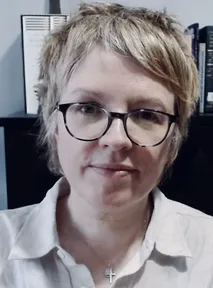
Dr. Luisa Calè is a Professor of Romantic and Nineteenth-Century Literature & Visual Culture and Research Lead at Birkbeck, University of London. She holds degrees from the University of Rome 'La Sapienza' (1993), University of Genoa (1997), and the University of Oxford (M.St. 1998, D.Phil 2002). Her research explores the interplay between literature and visual/material culture, focusing on book history, intermediality, and practices of reading/collecting. Her Leverhulme Trust-funded project 'The Book Unbound' examines how works by Blake, Walpole, and Dickens subverted traditional book formats. Education: PhD in Literary Studies, University of Genoa (1997) D.Phil., University of Oxford (2002) M.St. in English, University of Oxford (1998) Letters Degree, University of Rome (1993) Her research interests include Romantic aesthetics, material texts, and critical disciplinarity. Notable publications include Fuseli’s Milton Gallery (2006) and co-edited volumes like Dante on View (2007). She edits Blake/An Illustrated Quarterly and serves on editorial boards for Word & Image and Romantic Circles Gallery . Recent awards include a Leverhulme Trust Research Fellowship (2019) and a Mercator Fellowship (2018-19). She supervises graduate students in Romantic literature, material culture, and book history.
Rebecca Herissone is Professor of Musicology at the University of Manchester and a leading scholar in early modern English music. She co-edits the peer-reviewed journal Music & Letters and serves on editorial boards for the Purcell Society, Musica Britannica, and the Complete Works of John Eccles. Her research focuses on seventeenth-century creativity, material culture, and the ontological dimensions of music notation. Key research areas: Early Modern Music, Creativity, Source Study, Notation, Reception Major awards: Diana McVeagh Prize (2015), Westrup Prize (2007) Her recent work includes digital humanities projects on music preservation and critical editions of Purcell's operas. She has pioneered interdisciplinary approaches connecting musicology with drama, art, and literature, and currently leads research on Purcell's posthumous reception in the eighteenth and nineteenth centuries. Her teaching spans music historiography, performance practices, and advanced source analysis.
Erik Ketzan is a Lecturer in Digital Humanities and Cultural Computation at King's College London. He holds a PhD in English/Digital Humanities from Birkbeck, University of London, and has held postdoctoral roles at the University of Cologne and Trinity College Dublin, where he coordinated the MA in Digital Humanities and Culture. His research focuses on computational literary studies, legal/ethical issues in digital research, and corpus stylistics. He has published widely on topics such as Thomas Pynchon’s computational stylistics, legal frameworks for digital humanities research, and gender bias in historical texts. His work includes developing tools like Coleto for textual variant analysis and co-authoring the book *Thomas Pynchon and the Digital Humanities* (2022). Ketzan actively engages in policy advocacy, advising on copyright and data protection in DH, and has contributed to projects like CLARIN and the Leibniz Institute for the German Language. Education: PhD in English/Digital Humanities, Birkbeck, University of London Postdoctoral Researcher, University of Cologne (EncycNet Project) Postdoctoral Research and Teaching Fellow, Trinity College Dublin Research Interests: Computational approaches to literary analysis, legal challenges in data-driven research, corpus stylistics, and gender studies in historical corpora. Teaching: Courses include Python for the humanities, computational literary studies, and legal issues in digital humanities.
John Holmes is Professor of Victorian Literature and Culture at the University of Birmingham, affiliated with the Birmingham Institute of Forest Research (BIFoR). His work bridges literary studies and scientific inquiry, focusing on interdisciplinary connections from 1800 to the present through extensive collaborations with institutions like the Royal Society and major natural history museums across Europe. His academic credentials include a D.Phil. in English Literature from Oxford (2001), an M.A. in Renaissance Studies from Queen Mary and Westfield College, London (1997), and a B.A. in English Language and Literature from Oxford (1994). D.Phil. English Literature, University of Oxford, 2001 M.A. Renaissance Studies, Queen Mary and Westfield College, University of London, 1997 B.A. English Language and Literature, University of Oxford, 1994 Professor Holmes specializes in literature-science intersections, particularly Victorian and modern poetry, Pre-Raphaelite studies, and natural history museums. His current research examines arts architecture within museum spaces and mythic literature's dialogue with evolutionary science. He has authored foundational works on Darwinism in poetry and Pre-Raphaelite scientific engagements while directing major collaborative projects with scientific institutions. Recent publications reveal consistent exploration of poetic form within scientific contexts, with growing emphasis on digital humanities applications and environmental education. His 2023-2024 outputs demonstrate expanded interdisciplinary scope, integrating virtual reality tools for forest education and deepening analysis of myth-science intersections in canonical poetic works. His distinguished honors include: AHRC Collaborative Doctoral Award (2011) British Society for Literature and Science Book Prize (2018) Chair of the British Society for Literature and Science (2012) Honorary Associate of Oxford University Museum of Natural History (2016) President of the Commission on Science and Literature (2023) Professor Holmes leads significant research initiatives including the AHRC-funded Interdisciplinary Forest Education project (2024) and the long-term 'Building the Book of Nature' study (2015-2023). As an active PhD supervisor, he mentors students in literature-science intersections while maintaining robust public engagement through museum collaborations, media appearances, and educational outreach programs that translate academic research for broader audiences. He directs BIFoR-affiliated initiatives connecting literary scholarship with forest research, partnering with natural history museums in Oxford, London, Berlin, and Vienna to develop interdisciplinary frameworks examining how literary traditions shape environmental understanding and scientific communication.
Dr Ann Lewis is Senior Lecturer in French Studies at Birkbeck, University of London, within the School of Creative Arts, Culture and Communication . Since her appointment in 2008 she has held numerous leadership roles, including Subject Lead for Languages and Linguistics and programme director for several BA and MA programmes. Education: BA Joint Honours in History and French, New College, University of Oxford M.St. in European Literature, University of Oxford PhD in French Literature, Queen Mary, University of London PGC-HE (with distinction), Fellow of the Higher Education Academy Research Interests: Dr Lewis’s scholarship is situated at the intersection of eighteenth-century French literature and visual culture. Her work pursues two complementary strands: the first investigates text–image relations , exploring how eighteenth-century French novels were illustrated, re-imagined and circulated beyond the book through almanacs, extra-illustrated editions and domestic display. The second strand interrogates the representation of prostitution in eighteenth-century France, combining literary analysis with cultural history to illuminate questions of gender, commerce and morality. Both research lines deploy interdisciplinary methodologies that draw on illustration studies, adaptation theory and material bibliography. Publications profile: Across more than two decades, Dr Lewis has produced a monograph, three major edited collections and a series of peer-reviewed articles and book chapters (2004-2021). Her output charts an evolving focus from close readings of illustrated novels toward broader questions of intermediality, adaptation and the social lives of images, culminating in recent work on Rousseau’s Julie as material artefact. Honours & Awards: Leverhulme Early Career Fellowship, Leverhulme Trust (2009) Ronald Tress Prize, Birkbeck, University of London (2012) Haydn Mason Lecture, British Society for Eighteenth-Century Studies (2012) Nominated for Aurora Women into Leadership programme, Advance HE (2016) Doctoral supervision & grants: Dr Lewis welcomes proposals in eighteenth-century French literature and culture. She currently co-supervises two doctoral researchers: Miki Jablkowska – “The Reception and Cultural Adaptation of Voltaire in Eighteenth-Century Poland” Kirsten Tambling – “Watteau and Hogarth: Seduction, Space and Time” (awarded 2019) Laboratories, networks & teams: She is Co-founder and Co-convenor of the Birkbeck Eighteenth-Century Research Group , an interdisciplinary forum spanning French, English, History of Art and Comparative Literature. She additionally serves on the steering group of the Illustr4tio international research network devoted to illustration studies and is a member of the executive committee of AUPHF+ (Association of University Professors and Heads of French +).
Dr. Anna A. Berman serves as Associate Professor of Nineteenth-Century Russian Literature and Culture within the Slavonic Studies section of the Faculty of Modern and Medieval Languages and Linguistics at the University of Cambridge, where she is also a Fellow of Clare College. Previously, she held an Associate Professorship at McGill University's Department of Languages, Literatures, and Cultures in Montreal, Canada. Her academic credentials include: B.A. from Brown University M.Phil. from the University of Cambridge Ph.D. from Princeton University Dr. Berman's research centers on nineteenth-century Russian and English novels, with specialized focus on family structures, kinship dynamics, love, and marriage. She extensively examines the intersection of scientific thought (particularly Darwinism and Mechnikov's phagocyte theory) with literary production, alongside operatic adaptations of Russian classics. Her current scholarly mission prioritizes recovering the legacy of marginalized nineteenth-century Russian women novelists, especially Nadezhda Khvoshchinskaya and Evgenia Tur. Her publication trajectory reveals sustained investigation into familial relationships within nineteenth-century literature, with sibling dynamics constituting a dominant theme across both Russian and English novels. She has pioneered critical analysis of science-literature dialogues in Russian contexts while recently shifting toward feminist recovery projects that challenge canonical exclusions in Russian literary history. Dr. Berman actively supervises postgraduate research, welcoming MPhil and PhD candidates pursuing topics aligned with her expertise in nineteenth-century Russian literature, comparative family narratives, and science-literature intersections. Within Cambridge's academic ecosystem, she contributes to the Slavonic Studies research community and participates in the Cambridge Centre for Central and East European Studies (CamCCEEES), advancing collaborative scholarship on Eastern European cultural production.
Dr. Clara Dawson is Senior Lecturer in Victorian Literature at the University of Manchester, specializing in nineteenth-century poetry and environmental humanities. Her research examines poetry within print culture contexts and explores intersections between literature and environmental studies, particularly avian poetics. Research interests include: Victorian and Romantic poetry Gift annuals and print culture Literature-environment connections Avian representation in poetry Her recent publications analyze poetry in gift annuals and avian representation in nineteenth-century literature. Dr. Dawson collaborates with Cheshire Wildlife Trust on projects combining poetry and conservation science, exploring ethical dimensions of bird-human relationships.
Dr. Ewan Jones is Associate Professor in Nineteenth-Century Literature at the University of Cambridge's Faculty of English and a Fellow at Downing College, where he serves as Director of Studies for Part II. He completed his BA, MPhil, and PhD at King's College, Cambridge, and was previously Thole Research Fellow at Trinity Hall. His educational background includes comprehensive training in English literature at Cambridge, with specialization in nineteenth-century literary studies. His academic journey reflects deep engagement with both traditional literary scholarship and innovative computational approaches to textual analysis. Dr. Jones's research concentrates on poetics, embodied cognition, and computational approaches to intellectual history. His work fundamentally questions how we understand 'close reading' not as interpretation but as a specific cognitive practice. He explores how aesthetic phenomenology can illuminate historical reading communities, develops pedagogical routines to de-habituate standard attention modes, and seeks constructive engagement between computational analysis and traditional reading practices. His scholarship bridges literary studies with cognitive science, demonstrating how rhythm, attention, and cognition intersect in literary form. His research trajectory shows increasing focus on attentional practices in reading, with recent work examining group attention practices and rhythm in Victorian poetry. The computational dimension of his work has grown steadily, moving from individual textual analysis to large-scale corpus studies through projects like the Concept Lab. Fulbright Scholar Leverhulme Research Fellowship (2021/22) on 'Close Reading as Attentional Practice' Residential fellow at the Swedish Collegium of Advanced Study Visiting fellow at Ludwig Maximilian Universität Visiting fellow at Pomona College Dr. Jones supervises doctoral work on diverse topics including 'radical conservatism' in Victorian poetry, queer theory and historical poetics, Wagner reception in Anglophone poetry, morphogenetic conceptions of form, and metre and exact measurement. His interdisciplinary collaborations include work with Phyllis Weliver on digitizing Tennyson manuscripts and with Peter de Bolla on computational concept analysis projects that have secured significant research funding. He has developed innovative teaching approaches that integrate cognitive science with literary analysis. He co-founded and participates in the Concept Lab, an interdisciplinary project developing open-source computational resources for historical dataset analysis. This initiative has fostered collaborations across humanities and computer science disciplines, creating tools that bridge traditional literary scholarship with digital methods. His work with the Princeton Prosody Archive demonstrates his commitment to building scholarly infrastructure for rhythm and meter studies.
Professor Emma Mason is a leading academic in the Department of English and Comparative Literary Studies at the University of Warwick . Her career spans roles as an educator, editor, and researcher with a focus on poetry, Christianity and literature, Catholic theology, and ecological themes in the long nineteenth-century . Editor of the Bloomsbury monograph series New Directions in Religion and Literature Co-editor of the Year's Work in Critical and Cultural Theory Director of the Comparative Religions and Literatures group at Warwick Her research explores spiritual materialism and ecological transformation , particularly through figures like Christina Rossetti. She is currently working on a study of Catholic mysticism in late 19th- to early 20th-century Europe. Mason's publications include Christina Rossetti: Poetry, Ecology, Faith (OUP, 2018) and co-edited volumes addressing religion in literary contexts. Recent Publications (2025-2027): Analysis of Newman's novels as ecological narratives Contributions to Cambridge and Oxford handbooks on religion and literature Editorial work on William Barnes' dialect poetry Studies on Victorian theological ecology and contemplation Scientific Awards: British Academy Postdoctoral Fellowship Mason supervises postgraduate research in poetry, religion, and affect theory . She is on study leave until Easter 2026 but remains active in editorial and collaborative projects.
Professor Juliet John is a leading scholar in Victorian literature and cultural studies, particularly renowned for her expertise on Charles Dickens. She serves as Dean of Arts & Social Sciences at City, University of London, following roles as Hildred Carlile Chair of English Literature at Royal Holloway, University of London, and leadership positions including Head of Humanities and Director of Victorian Studies centers. Educated at Selwyn College, Cambridge (BA, Double First) and University College London (PhD), her research spans Dickens, melodrama, popular culture, digital humanities, and heritage studies. She advises institutions like the Dickens Museum and has received fellowships from the Royal Society of Arts and English Association. Her work bridges academia and public engagement, with projects like the AHRC-funded Gladstone Catalogue and collaborations on cultural policy. Awards include teaching excellence and invited keynotes globally. Research interests include Victorian literature's intersection with mass culture, adaptation studies, and digital humanities. Her books include *Dickens and Mass Culture* (2010) and *Reading and the Victorians* (2016, co-edited). Recent work explores Dickens's global legacy in *The Edinburgh Companion to Charles Dickens and the Arts* (2024). She has held leadership roles in pedagogy, including Director of Student Experience at Liverpool. Professional activities include peer review for AHRC and strategic roles in academic organizations. Key achievements: Founded the Gladstone Centre for Victorian Studies; co-organized the Dickens Society of America’s 2020 colloquium; curated the Charles Dickens Museum’s *Global Dickens* exhibition. Awards include the prestigious FRSA and FEA. Current focus includes metamodern melodrama and digital approaches to Victorian studies.
Dr. Emily Cuming is a Senior Lecturer in the Humanities and Social Science school at Liverpool John Moores University , specializing in British literature, culture, and social history from the 19th century to the present. Her research focuses on maritime relations, working-class girlhood, life writing, and representations of domestic spaces including council estates, slums, and bedsits. PhD, MA, BA in English & Russian from University of Manchester (2006, 2002, 2001) Editor of Key Words: A Journal of Cultural Materialism Co-leader of the Home and Domestic Cultures research network Committee member of the Research Institute for Literature and Cultural History Board member of the Centre for Port and Maritime History Her research combines literary analysis with historical and cultural studies, emphasizing material culture, port cities, and marginalized voices. Recent publications include Maritime Relations: Life, Labour and Literature at the Water’s Edge, 1830-1914 (Cambridge University Press, forthcoming 2025) and Housing, Class and Gender in Modern British Writing, 1880-2012 (CUP, 2016). She has received multiple research grants including AHRC Connected Communities funding and Liverpool John Moores University QR awards. Dr. Cuming teaches undergraduate modules on Life Stories , Representing Domestic Space , and Waterscapes , as well as MA courses on Place: Imagining Place in Modern Times . She supervises three PhD projects and welcomes new supervisees in her research areas. 2025: Enhancing Research Cultures funding for 'The Sinking of the Lancastria' 2024: Editorial board member of Journal of Victorian Culture 2023: NCCPE Engage Prize for 'Around the Toilet' project 2022: Caird Short-term Research Fellowship 2016: NCCPE Engage Prize winner
Stefano Evangelista is a Professor of English and Comparative Literature and Tutorial Fellow at Trinity College, University of Oxford. His research focuses on 19th-century English and comparative literature, with specializations in Aestheticism, Decadence, classical traditions, gender studies, and Japonisme. He holds fellowships from the AHRC and British Academy, and co-edits the MHRA’s Jewelled Tortoise Series. Current projects include a monograph on literary cosmopolitanism and a Berlin exhibition on early 20th-century British writers. He collaborates with institutions like Humboldt University and Paris Sorbonne, and leads initiatives on translation studies and global literature. Research interests include the intersection of literature with visual culture, translation, and cross-cultural exchange, particularly British engagements with European and Japanese contexts. His work challenges traditional canons through comparative approaches, emphasizing marginalized voices alongside canonical authors. His publications span monographs, edited collections, and exhibitions, reflecting a commitment to interdisciplinary scholarship. Awards include AHRC Fellowships (2014-16, 2018-19) and leadership in ERC-funded projects. Teaching includes undergraduate and graduate courses on Victorian literature, Decadence, and cosmopolitanism, with supervision of MSt and DPhil students.
Dr Julian North is an Associate Professor in Romantic and Victorian Literature at the University of Leicester's Department of English, School of Arts. He holds a DPhil from St. Hugh’s College, Oxford, where he was a Senior Scholar. Previously, he served as a Lecturer at the University of Reading and a Senior Lecturer at De Montfort University. His research focuses on transhistorical literary boundaries, Thomas De Quincey, life writing, biographical afterlives of 19th-century writers, and intersections between literature and visual media. He co-edits Routledge's Nineteenth-Century Series with Professor Joanne Shattock. No specific grants or awards are listed in the profile. Supervision and lab affiliations are not detailed here.
Andrew McInnes is a Reader in English Literature at Edge Hill University's English & Creative Arts department. His academic work focuses on Romantic period women's writing, the Gothic, children's literature, and theories of wit and humor. He co-directs the EHU Nineteen research group, organizing seminars and conferences like the 2022 'New Romanticisms' BARS/NASSR event. PhD in English Literature (University of Exeter) MA in English Studies (University of Exeter, Cornwall Campus) His research explores the 'Romantic Ridiculous' as an alternative to the sublime, drawing on German Romantic writer Jean Paul Richter to examine laughter as a unifying force in Romanticism and modern higher education. Recent projects include analyzing P.J. Harvey's reinterpretation of Romantic childhood and Austen's cinematic adaptations. Key collaborations span institutions in the UK and beyond, with recurring engagement at international Romanticism conferences. His publications and talks address themes like Supernaturalism , Sublime , and New Romanticism . AHRC ECR Leadership Fellowship McInnes actively supervises PhD students and integrates his research into modules on Jane Austen and Young Adult Fiction, emphasizing Romanticism's ideological constructs.
Professor Richard Kirkland is a leading scholar of Irish Literature and Cultural Theory at King's College London's Department of English. He holds a prestigious position in the Faculty of Arts & Humanities, where he teaches courses on 20th-century Irish literature, modernist poetry, and contemporary cultural studies. His research focuses on modern Irish writing, cultural theory, and postcolonial studies, with a particular emphasis on Ireland's political and cultural history, including the Irish Literary Revival and Northern Irish post-conflict narratives. He has authored influential monographs like Irish London: A Cultural History 1850–1916 (2021), which won the 2022 BAIS Book Prize, and edited volumes on Medbh McGuckian's poetry. Professor Kirkland’s work spans literature, film, television, and popular culture, analyzing themes such as identity, colonialism, and cultural hybridity. He has held research grants exploring Irish London’s cultural history and collaborated on projects like Kathleen Goodfellow (a.k.a. François Villon) , examining gender and time in the Irish Revival. He is a Fellow of the English Association and actively supervises PhD students in Irish cultural studies. His publications include essays on Fenian legacies, Northern Irish cinema, and Dr. Corry’s National Diorama, showcasing his interdisciplinary approach. He teaches undergraduate and postgraduate courses on Joyce, modernist poetry, and postcolonial literature, contributing to King’s College’s strong reputation in English studies ranked 6th in the UK (QS 2018).