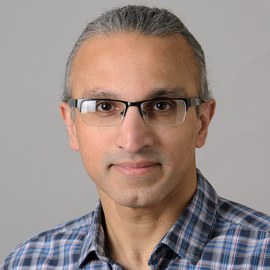
Omer KhanView profile
Professor
Dr. Omer Khan is a Professor of Electrical and Computer Engineering at the University of Connecticut (UConn), leading the Computer Architecture Group (CAG) and serving as Associate Director of the Connecticut Advanced Computing Center (CACC). His research focuses on computer architectures for high-performance applications, particularly graph intelligence, parallel processing, and secure processors. He holds a PhD from the University of Massachusetts Amherst and a BSc from Michigan State University. Education: PhD in Electrical and Computer Engineering, University of Massachusetts Amherst, 2009 BSc in Electrical and Computer Engineering, Michigan State University, 2000 Research Interests: Dr. Khan’s work addresses computational challenges in artificial intelligence, particularly graph-based data and multi-objective optimization. He develops architectures that exploit sparsity and parallelism to accelerate graph neural networks, secure processors against side-channel attacks, and ensure resilience in large-scale multicores. His research includes hardware-software co-design for thermal management, confidential computing, and algorithm-architecture co-optimization. Publications: His recent work spans parallel algorithms for graph intelligence (e.g., OPMOS, PruneGNN), secure multicore architectures (IRONHIDE, SSE), and GPU acceleration for GNN training. These contributions highlight advancements in efficiency, security, and scalability of modern computing systems. Awards & Grants: Principal Investigator of an NSF REU Site on Trustable Embedded Systems Security (2021–2025). His work has been supported by grants from NSF and industry partnerships. Advising & Mentoring: Guided over 20 graduate and undergraduate researchers, many of whom have secured roles at top tech firms (e.g., Qualcomm, Meta) or pursued advanced degrees at prestigious institutions. Labs & Teams: Leads the CAG at UConn, collaborating with industry and academic partners to advance next-generation computer architectures.