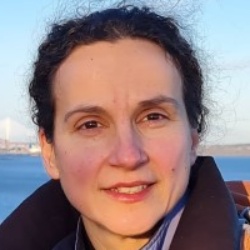
Dr. Stella Pytharouli is a Senior Lecturer in Civil and Environmental Engineering at the University of Strathclyde. With over 20 years of expertise in structural and ground deformation monitoring/analysis, her research focuses on subsurface characterization and slope instability early warning systems through microseismic monitoring, geodetic technologies, and machine learning integration. MEng (2002) - University of Patras MSc (2004) - University of Patras PhD (2007) - University of Patras Her research combines advanced signal processing with geodetic monitoring (terrestrial/aerial) to develop AI-driven solutions for UK landslide sites. Key areas include: Microseismic monitoring of weak seismic events Geometric and kinematic analysis of ground deformations Integration of geotechnical data with machine learning Climate change impact on slope stability Low-cost sensor development for environmental monitoring Recent publications highlight her work on AI-based seismic classification models, tiltmeter applications, and 3D reconstruction techniques. Her group includes 4 PhD students and 1 postdoc. Scientific recognitions include: Geophysical Research Letters front cover selection (2011) EOS Research Spotlight (2019) Lampadarios Prize from Academy of Athens (2009) TOPCON Award for young researchers (2008) As Director of Postgraduate Research (2020-present), she supervises PhD students and teaches land surveying modules. Current projects address slope stability analysis, climate change correlations, and seismic data automation.
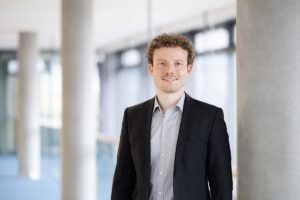
Ewan Dolier is a Research Fellow in the Department of Physics at the University of Strathclyde, Faculty of Science. He is actively involved in cutting-edge research on laser-driven ion acceleration and plasma physics, working within the SCAPA (Scottish Centre for the Application of Plasma-based Accelerators) facility. His work bridges experimental physics and machine learning techniques to optimize and diagnose high-energy particle beams. His research interests include: Laser-Plasma Interactions Machine Learning for Physics Optimization Proton and Ion Beam Acceleration Synthetic Diagnostics using Neural Networks High Repetition Rate Laser Systems Relativistic Transparency Regime Physics The recent trend in his publications shows a strong focus on integrating artificial intelligence and deep learning models into the control and analysis of laser-driven particle acceleration experiments. His work spans experimental design, data-driven optimization, and advanced diagnostics using scintillating fiber spectrometers and synthetic models. His scientific contributions have been presented at major plasma physics conferences and published in high-impact journals such as Communications Physics and High Power Laser Science and Engineering . Notable projects include: External Experiment at the Gemini High-Power Laser Facility (Deep Learning for Ion Acceleration) Development of High Repetition-Rate Target Systems at SCAPA Doctoral Training Partnership research (2019–2024) He collaborates extensively with leading researchers such as Paul McKenna and Ross Gray, and contributes to multi-investigator datasets and simulations. Ewan Dolier completed his PhD in 2024 with a thesis on advancing laser-driven ion acceleration using machine learning and instability analysis.
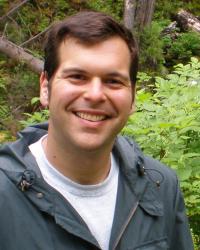
Jason Ridge serves as Professor and Department Chair of the Department of Strategy, Entrepreneurship & Venture Innovation at the Walton College of Business, University of Arkansas. His academic leadership extends across undergraduate, Master's, and doctoral programs where he teaches strategic management courses including MGMT 6133 (Seminar Strategy Research), MGMT 3013 (Strategic Management), and MGMT 2053 (Business Foundations). As Department Chair, he oversees academic programming and faculty development within his department. Dr. Ridge's educational background includes: PhD in Business Administration from Oklahoma State University MA in Healthcare Administration from Oklahoma State University BS in Business Management from Oklahoma State University Dr. Ridge's research focuses on two primary streams within strategic management. His first research stream examines corporate political activity , specifically investigating how corporate lobbying shapes regulatory environments and competitive dynamics. He explores the strategic implications of business-government interactions, including how firms benefit from political engagement. His second research stream analyzes executive compensation , studying how different compensation mechanisms influence decision-making processes and overall organizational outcomes. His work bridges theoretical frameworks with practical business applications, contributing significantly to our understanding of strategic leadership in complex political and economic contexts. An analysis of Dr. Ridge's recent scholarly output reveals a consistent focus on the intersection of business strategy and political engagement. His publications demonstrate sophisticated methodological approaches to understanding how firms navigate regulatory environments through lobbying and other nonmarket strategies. A notable trend in his work is the examination of how CEO characteristics and psychological traits influence strategic decision-making related to political activity and compensation structures. His research increasingly incorporates multi-level analysis, examining how firm-level decisions interact with broader political contexts to shape organizational outcomes. Dr. Ridge's scholarly contributions have been recognized with prestigious awards: Walton College of Business Excellence in Service Award (2021) Walton College of Business Excellence in Research Award (2017) As an active researcher and educator, Dr. Ridge has served on the editorial boards of several premier management journals including the Journal of Management, Group and Organization Management, Journal of Business Research, and Management Decision. His scholarly work has been published in top-tier journals such as the Academy of Management Journal, Strategic Management Journal, Organization Science, and the Journal of Management, with several articles featured in the Harvard Business Review. While specific grant information isn't detailed in the provided materials, his extensive publication record in high-impact journals suggests successful research funding support. Dr. Ridge collaborates with numerous co-authors across his research projects, forming dynamic research teams that bring diverse methodological and theoretical perspectives to strategic management questions. His work often involves multi-institutional collaborations, reflecting the interdisciplinary nature of contemporary strategic management research. These collaborative networks enable comprehensive investigations of complex business phenomena across different organizational contexts and political environments.
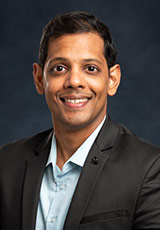
Anastasios Elemes is an Associate Professor of Accounting in the Department of Accounting and Management Control at ESSEC Business School, France. Holding a PhD and MSc from Rotterdam School of Management, his research has been published in top-tier journals including Accounting, Organizations and Society , European Accounting Review , and Journal of Accounting, Auditing, and Finance . He is also a CFA Charterholder actively involved with CFA France. Education PhD in Financial Accounting, Rotterdam School of Management, Erasmus University (2015) MSc in Finance & Investments, Rotterdam School of Management, Erasmus University (2011) Research Focus Elemes specializes in auditing, taxation, and international financial reporting with emphasis on Big 4 accounting firms' behavior. His work investigates political connections, cross-border tax planning, audit quality determinants, and regulatory implications. He examines how audit firm networks influence client reporting and how political ties affect auditor independence, contributing critical insights to corporate governance frameworks. Research Trends His recent publications (2021-2024) reveal three dominant themes: (1) Audit firm profitability drivers and consequences for audit outcomes, (2) Tax-motivated income shifting within global audit networks, and (3) Political connections' impact on audit quality. Using large-scale datasets and econometric methods, his research consistently demonstrates how structural factors within Big 4 firms affect financial reporting integrity across jurisdictions. Scientific Recognition European Accounting Review Best Reviewer Award (2024) CFA France Volunteer of the Year Award (2017) Best Academic Essay Award, Rotterdam School of Management (2011) CFA Scholarship (2014, 2012) Visiting Scholar at Rotman School of Management (2011) Academic Service & Advisory Elemes has supervised Bachelor and Master theses at Rotterdam School of Management (2011-2015). His research is supported by CFA Institute scholarships and he serves on the Editorial Board of Accounting Forum . As a permanent member of the CFA France Advocacy Team since 2015, he actively shapes policy discussions on financial reporting standards and ethical practices in the accounting profession. Professional Integration His dual expertise in academic research and professional practice (evidenced by CFA charterholder status) enables unique contributions to both scholarly discourse and industry standards. Current work examines evolving international tax landscapes and their implications for audit firm structures, with particular focus on European regulatory developments.
Professor Tobin J. Marks is the Vladimir N. Ipatieff Professor of Catalytic Chemistry, Professor of Materials Science and Engineering, Professor of Applied Physics, and Professor of Chemical and Biological Engineering at Northwestern University. He also serves as a Distinguished Adjunct Professor at Texas A&M Qatar University and is a Senior Fellow of the Hong Kong Institute for Advanced Study at City University of Hong Kong. Dr. Marks is a member of the US National Academy of Engineering, the US National Academy of Sciences, and a Fellow of the Royal Society of Chemistry, UK. Dr. Marks received his BSc in Chemistry from the University of Maryland in 1966 and his PhD in Inorganic Chemistry from MIT in 1970. His academic career at Northwestern began as an Assistant Professor of Chemistry in 1970, progressing to Associate Professor in 1974, Professor of Chemistry in 1978, Charles E. & Emma H. Morrison Professor of Chemistry from 1986-1999, Vladimir N. Ipatieff Professor of Catalytic Chemistry since 1999, Professor of Materials Science and Engineering since 1987, Professor of Applied Physics since 2009, and Professor of Chemical and Biological Engineering since 2017. Professor Marks' research spans numerous areas of chemistry and materials science. His work focuses on transition metal and f element organometallic chemistry, catalysis, vibrational spectroscopy, synthetic facsimiles of metalloprotein active sites, carcinostatic metal complexes, solid state chemistry and low-dimensional molecular metals, nonlinear optical materials, polymer chemistry, tetrahydroborate coordination chemistry, macrocycle coordination chemistry, molecular electro-optics, metal-organic chemical vapor deposition, polymerization catalysis, printed flexible electronics, solar energy, and transparent conductors. His research group consists of nearly 40 researchers working across four laboratories. Analysis of Professor Marks' recent publications reveals a strong focus on advanced materials for electronic and energy applications. His work spans organic electronics, flexible and stretchable devices, catalysis for sustainable chemistry, and novel materials characterization techniques. Key trends include the development of organic electrochemical transistors, high-efficiency organic solar cells, advanced catalysts for polymer recycling, and quantum materials for next-generation electronics. Professor Marks has received numerous prestigious awards throughout his career, including: US National Medal of Science American Chemical Society Joseph Priestley Medal Camille and Henry Dreyfus Prize in the Chemical Sciences Principe de Asturias Prize for Technical and Scientific Research US National Academy of Sciences Award in the Chemical Sciences Materials Research Society Von Hippel Award Harvey Prize in Science and Technology Karl Ziegler Prize from the German Chemical Society Professor Marks has mentored numerous students and postdoctoral researchers throughout his career, with his group currently consisting of nearly 40 researchers. He has received substantial research funding from multiple agencies including NSF, DOE, and DoD. His entrepreneurial spirit has led to the founding or co-founding of 15 startups, with technologies generating an estimated USD 100 billion in sales. Professor Marks leads several research teams focused on catalysis and organic electronic materials. His work has significant implications for sustainable chemistry, renewable energy, and next-generation electronic devices. He continues to be highly active in research, with numerous publications in 2025 demonstrating his ongoing scientific leadership.
Daniel Hardt serves as Associate Professor in the Department of Management, Society and Communication at Copenhagen Business School. His interdisciplinary research bridges computational linguistics, artificial intelligence, and social analysis, with particular focus on natural language processing applications and theoretical linguistic phenomena. His primary research domains include Computational Linguistics (specializing in ellipsis resolution and sluicing phenomena), Natural Language Processing (developing methods for psychographic classification and sentiment analysis), and Artificial Intelligence (examining large language model capabilities and limitations). Recent work analyzes travel behavior during crises, gender effects in evaluations, and GDPR policy comprehension through NLP techniques. His publications span top venues including Linguistic Inquiry , Tourism Management , and ACL proceedings. Hardt actively engages with practical business applications through 27 media contributions discussing AI implementation, ChatGPT transparency, and data-driven leadership strategies. His academic service includes organizing events like the 2019 "Fake News" conference at CBS and presenting at international venues including JSAI 2024. With 28 supervised academic works documented, he maintains substantial mentoring activity while contributing to public discourse on digital transformation challenges.
Professor Christian Schultz (b. 1957) is affiliated with the Department of Economics at the University of Copenhagen under the Faculty of Social Sciences. His work spans political economy, competition economics, industrial organization, and market regulation, focusing on implications of imperfect information in economic and political systems. PhD (University of Copenhagen, 1989) Current: Professor of Economics (1995–present) Past: Director of Centre for Industrial Economics (2000–2008), Head of Department (2010–2023) His research examines how information asymmetries affect political campaigns, market collusion, and public policy effectiveness. Key contributions include work on price transparency, electoral polarization, and arms-length delegation of public services. Recent publications (2014–2024) focus on price transparency, healthcare economics, technology transfer, and market dynamics. Awards include the 2003 Invisible Hand Award for outstanding teaching. Supervised 7 PhD students and 100+ master's students. Leadership roles: Chairman of Danish Competition Council (2012–present), Chairman of Danmarks Nationalbank’s Board of Directors (2018–present). Editorial and advisory roles include membership in European Science Foundation panels and evaluation committees across Scandinavia.
Timo Szczepanska is a postdoctoral researcher at UiT The Arctic University of Norway , affiliated with the Norwegian College of Fishery Science . With expertise in computational modeling and social simulation, Szczepanska contributes to interdisciplinary research bridging technology, environmental science, and urban systems. Current member of the CRAFT research group Active participant in the FUTURES4Fish project Published extensively in journals like JASSS and Frontiers in Marine Science Research Focus: Szczepanska's work explores urban complexity through participatory simulations, develops agent-based models for human behavior analysis, and investigates climate change impacts on fisheries. Key methodological contributions include model reimplementations and integrating creative writing with future scenario planning. Recent Article Trends: Recent publications demonstrate a dual focus on decarbonisation strategies for urban mobility and innovative approaches to fisheries governance under climate change. Methodologically, Szczepanska combines agent-based modeling with game design and creative worldbuilding across multiple domains. Collaborative Networks: Collaborates with international researchers across institutions including Radboud University, Potsdam University of Applied Sciences, and various European research groups. Specializes in translating complex systems into interactive pedagogical tools and policy-relevant simulations. Technical Expertise: Proficient in computational platforms like NetLogo and Unity, with particular emphasis on model documentation, validation, and interdisciplinary translation of technological futures.
Eric P. Xing is a Professor at the Language Technologies Institute of Carnegie Mellon University , and currently serves as President of the Mohamed bin Zayed University of Artificial Intelligence . His work bridges machine learning methodology with computational biology and large-scale AI systems . Research Focus: Developing machine learning theory for high-dimensional, dynamic data Building foundation models for biology (AIDO, scLong, ProteinAligner) Designing scalable AI architectures (Pollux, LLM360, PAN) Advancing interpretable and controllable NLP systems Scientific Leadership: Founded the SAILING Lab at CMU Co-chaired ICML 2014 and ICML 2019 Recipient of the Jay Lepreau Best Paper Award (OSDI 2021) Education & Mentorship: Advises PhD students across machine learning and computational biology Alumni include faculty at ETH Zurich, University of Chicago, and UC San Diego
Professor Meng Tao is a full Professor in the School of Electrical, Computer and Energy Engineering at Arizona State University (ASU), Tempe campus. He also holds the concurrent appointment of Senior Global Futures Scientist within ASU’s Global Futures Scientists and Scholars initiative. Since joining ASU in 2011, he has led the Laboratory for Terawatt Photovoltaics and played a pivotal role in founding the U.S. Photovoltaic Manufacturing Consortium under SEMATECH. Education: Ph.D. Materials Science and Engineering, University of Illinois at Urbana-Champaign, 1998 M.S. Semiconductor Materials, Zhejiang University, China, 1986 B.S. Ferrous Metallurgy, Jiangxi Institute of Metallurgy, China, 1982 Research Focus: Professor Tao’s research is broadly centered on the science and engineering challenges of scaling photovoltaics to the terawatt level while ensuring sustainability and cost-effectiveness. His group investigates earth-abundant chalcogenide semiconductors and transparent conducting oxides for thin-film devices, substitutes silver with low-cost aluminum in Si solar cell metallization, develops energy-efficient electro-refining routes to upgrade metallurgical-grade silicon to solar-grade purity, pioneers value-added recycling technologies for end-of-life Si modules, and explores solar-powered electrolysis using metal/metal-oxide loops for long-term electricity storage. Grant Portfolio & Trends: Recent funding from NSF and DOE has supported projects on high-efficiency Schottky-barrier silicon cells, theoretical/experimental studies of iron oxysulfide absorbers, doping of cuprous oxide in electrolytes, and CVD-based valence-mending passivation for crystalline silicon. These grants underscore a consistent emphasis on materials innovation, process intensification, and circular-economy solutions for PV. Teaching & Mentoring: Professor Tao teaches and mentors across the EEE, MSE and CHE programs, offering courses ranging from introductory circuits to advanced photovoltaic energy conversion and doctoral dissertation supervision. While specific advisee names are not disclosed, the extensive thesis and research course listings indicate a large, active graduate group. Laboratory & Collaborative Networks: The Laboratory for Terawatt Photovoltaics under his direction serves as the central hub for experimental work on solar cell fabrication, electroplating, electrochemical recycling, and materials characterization. The lab collaborates closely with national consortia such as SEMATECH and leverages ASU’s advanced clean-room and analytical facilities.
Julian Müller holds the Professorship for Digital Industries at Friedrich-Alexander University Erlangen-Nuremberg (FAU), funded by Bosch Rexroth AG through the Stifterverband. He is part of the School of Business, Economics, and Social Sciences, specializing in digital transformation research within industrial contexts. His work bridges academic rigor with practical industry applications, particularly through his collaboration with Bosch Rexroth. Müller's research interests focus on three interconnected pillars: digital transformation in industry (Industry 4.0), sustainability and circular economy integration, and technology and innovation management. He examines how digital technologies reshape production, logistics, and industrial ecosystems while addressing ecological and social requirements. His work particularly emphasizes the integration of AI and digital platforms into business models across different company sizes. Analysis of Müller's recent publications reveals a strong focus on the intersection of digital technologies with sustainability and supply chain management. His work consistently addresses Industry 4.0 implementation challenges, particularly for SMEs, and explores how digital transformation can enhance resilience, sustainability, and business model innovation across global value chains. Scientific Recognition: 8th place in the 2024 Wirtschaftswoche ranking of most research-intensive business economists under 40 17th place in the overall ranking of most research-intensive business administration professors in DA-CH countries Board member of the European Operations Management Association (EurOMA) Müller's academic trajectory shows strong industry-academia connections, with his current professorship funded by Bosch Rexroth. His research demonstrates significant grant acquisition capabilities, particularly in the domain of digital industrial transformation. While specific students aren't listed in the provided materials, his position suggests active mentorship of junior researchers in digital business transformation. As part of FAU's 'Digitalization and Innovation' research focus, Müller collaborates with the Fraunhofer Institute for Information Systems and various German industrial companies. His work contributes to FAU's strong research profile in business administration, which ranks among Germany's top 20 faculties in business administration according to the Handelsblatt ranking.
Tyler McCormick is a Professor in the Departments of Statistics and Sociology at the University of Washington . He also holds core faculty positions at the Center for Statistics and the Social Sciences (CSSS), is a Senior Data Science Fellow at the eScience Institute, and a research affiliate at the Center for Studies in Demography and Ecology (CSDE). McCormick earned his Ph.D. in Statistics from Columbia University in 2011. His research focuses on statistical methodology for social and health sciences, including network analysis, causal inference, and uncertainty quantification in predictive models. Research interests include: Modeling social networks and peer influence Estimating causes of death using verbal autopsy data Improving global health decision-making through better uncertainty communication Methodological advancements in causal inference and experimental design under network interference He has received significant recognition, including the NIH Director’s New Innovator Award (2019) and election as a Fellow of the American Statistical Association (2023) . McCormick has contributed to influential projects such as the OpenVA toolkit for verbal autopsy analysis and has published widely in Journal of Computational and Graphical Statistics and other top venues. Grants and funding include support from the Simons Foundation. Current research includes postdoctoral openings focusing on spillover effects in networks and robust statistical methods for factorial data. His work has been featured in the Wall Street Journal and Washington Post .
Lauren Klein is the Winship Distinguished Research Professor and Associate Professor in the Departments of Quantitative Theory & Methods and English at Emory University. She directs the Emory Digital Humanities Lab and leads the Mellon-funded Atlanta Interdisciplinary AI Network. Previously, she taught at Georgia Tech's School of Literature, Media, and Communication. Her research integrates computational methods with critical approaches to explore gender, race, and justice, producing influential works like Data Feminism (2020) and An Archive of Taste: Race and Eating in the Early United States (2020). She co-edits the hybrid print-digital series Debates in the Digital Humanities . Education: PhD in English and American Studies from CUNY Graduate Center; AB in Literature (English and French) from Harvard University. Awards include ACLS, NEH, and Mellon Foundation grants. Her work bridges data science and humanities, emphasizing ethical frameworks for AI and social justice. Director of Emory Digital Humanities Lab PI of Atlanta Interdisciplinary AI Network Editor, Debates in the Digital Humanities
Professor Kalpana Shankar is a Full Professor at the School of Information and Communication Studies at University College Dublin (UCD). She holds roles such as former Head of School (2015-2018) and Co-Director of the UCD Centre for Digital Policy. Her research focuses on data management, peer review processes, research evaluation, and digital policy, with notable projects funded by Science Foundation Ireland, the Irish Research Council, and the U.S. National Science Foundation. Key contributions include studies on the sustainability of social science data archives and peer review at SFI. Education: PhD in Library and Information Science from UCLA, postdoctoral fellowships at UCLA (Center for Embedded Networked Sensing) and NIH (Science Policy). Professional Roles: Editor-in-Chief of Online Information Review , member of the Royal Irish Academy’s Equity Diversity and Inclusion committee, and representative on the National Open Research Forum (NORF). Teaching: Coordinator for UCD’s MSc/Diploma in Digital Policy and PhD supervision in critical data studies, open data, and research evaluation. Research Interests: Sociotechnical imaginaries of data, peer review fairness, digital policy frameworks, and the impact of pandemic responses on academia. Awards include the 2020 UCD College of Social Sciences and Law Teaching Excellence Award.
Shivam Saxena is an Assistant Professor in the Department of Electrical and Computer Engineering at the University of New Brunswick, located in Head Hall D65, Fredericton. His research focuses on smart grid technologies, including distributed energy resource integration, blockchain applications for energy trading, electric vehicle-grid interactions, and resilient microgrid design. This work addresses decarbonization challenges through technological and market innovations. Publications demonstrate a strong emphasis on real-world implementation, with field-tested solutions for V2X integration, blockchain-based transactive energy, and distributed control systems. Recent work explores novel applications in agricultural energy management and trust mechanisms for decentralized systems.